Three weeks before the hearing, Renate met Dr.
Chapter 3
Three weeks before the hearing, Renate met Dr.
Moore, an independent psychiatrist recommended by Mr. Weber.
For two hours, Dr. Moore tested her memory, reasoning, judgment, mathematical ability, and understanding of her finances. Renate answered every question carefully.
At the end, the doctor closed her folder.
“Mrs. Richter, your cognitive performance is above average for your age. You are fully capable of managing your life and your money.”
The words brought relief, but not comfort. A medical report could prove she was competent. It could not explain how the boy she had raised had become a man willing to destroy her dignity for access to her bank account.
Eleanor and several women from the garden club offered to testify. Mr. Green, the pharmacist, admitted Lena had tricked him into signing a vague statement. The hardware-store owner agreed to explain why cameras and new locks were reasonable after an unauthorized entry.
On the morning of the trial, Renate wore
a black suit her late husband had always loved and entered the courthouse beside Mr. Weber.
Max waited in a new navy suit. Lena stood beside him dressed in black, her face cold. Neither spoke.
Inside, their attorney portrayed Renate as a vulnerable widow manipulated by strangers. He claimed she had abandoned her loving family, installed cameras because of paranoia, refused medical help, and made irrational financial changes.
Then Lena took the stand.
Her tears appeared instantly.
“Renate was like a second mother to me,” she said. “Watching her decline has been devastating.”
Mr. Weber approached.
“When was the last time you called Mrs. Richter without asking for money?”
Lena hesitated. “We discussed many things.”
“Name one date.”
“I don’t remember.”
“Did you invite her to your wedding?”
“It was intimate.”
“Were your parents and siblings there?”
“Yes.”
“And did you tell Mrs. Richter that only special people had been
invited?”
Lena’s cheeks reddened. “It was taken out of context.”
“What context makes telling your mother-in-law she is not special an act of love?”
Lena had no answer.
Max testified next. He said Renate had become erratic and that strangers were separating her from her family.
Mr. Weber displayed a financial summary.
“Did your mother give you approximately $33,400 over three years?”
“I never calculated it.”
“Did she pay your rent, buy your groceries, and furnish your home?”
“Yes.”
“Did you enter her house after she canceled the transfers?”
“We had keys.”
“Did you inspect her private documents and bring a lawyer with a power of attorney?”
“We wanted to help.”
“Do you believe a competent seventy-one-year-old woman is obligated to support her thirty-five-year-old married son?”
Max stared at the floor.
The silence answered for him.
Their remaining witnesses weakened under questioning. Mr. Davis admitted he had never asked Renate
why she installed cameras. Dr. Lehman admitted he had never completed a formal examination. Mr. Green explained that Renate bought only vitamins and aspirin and that Lena had misrepresented his words.
Then Dr. Moore testified.
“Mrs. Richter shows no sign of dementia, psychosis, impaired judgment, or diminished financial capacity. Her decisions are informed and rational.”
Eleanor described the frightened woman she first met and the confident woman Renate became after setting boundaries.
“She is not isolated,” Eleanor said. “She has friends now. What she lost was not family support. It was financial exploitation.”
Finally, Renate was called.
She walked to the witness stand with her back straight and her hands steady.
Mr. Weber asked why she had stopped supporting Max and Lena.
“For three years, I believed giving them money was how I protected my relationship with my son,” Renate said. “Then they married without telling me. His wife said they invited only special people.”
She looked toward Max.
“I realized my money was special to them. I was not.”
The courtroom became still.
“When I stopped paying, they entered my home, searched my papers, brought me a power of attorney, reported me to social services, and asked this court to take away my freedom. None of this began because I could not manage my life. It began because I said no.”
Max’s attorney tried to confuse her with dates, figures, and investment questions. Renate answered each one precisely.
“How much rent did you pay over thirty-six months?”
“Eighteen thousand dollars.”
“Why did you install surveillance cameras?”
“Because people seeking control of my finances repeatedly approached my property.”
“Why did you refuse Dr. Lehman’s evaluation?”
“Because he was chosen by the people seeking my assets. I wanted independent counsel.”
The attorney returned to his seat.
In closing, Max’s lawyer insisted the family was motivated by love.
Mr. Weber stood.
“Love does not arrive with a power of attorney. Love does not fabricate evidence. The petitioners are not asking this court to protect Mrs. Richter from bad decisions. They are asking the court to protect themselves from the consequences of her good one.”
Judge Miller left to deliberate.
Two hours later, Renate gripped Eleanor’s hand as he returned.
“The evidence establishes that Mrs. Renate Richter is in full possession of her mental faculties,” the judge said. “Her financial decisions are rational, lawful, and hers alone to make. The petition for guardianship is denied.”
Renate exhaled.
The judge continued. “This court also finds substantial reason to believe the action was driven by financial interest rather than genuine concern.”
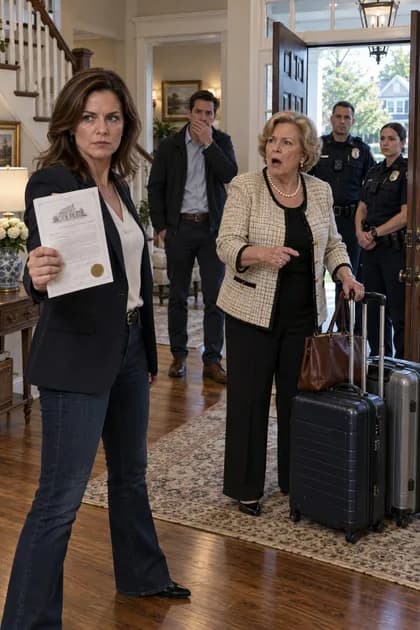
Outside, Lena glared at her. Max stood several feet away.
“Mom,” he said.
Renate waited, but no apology came.
She turned and walked away.
Three months later, Renate sold the house and moved into a bright apartment near the city center. She revised her will and donated part of her estate to organizations protecting older adults from financial abuse.
She traveled, returned to painting, and built friendships that did not come with invoices.
Max and Lena never contacted her again. She later heard they had moved into a smaller apartment and found additional work.
Some evenings, Renate stood on her balcony and thought about the woman she had been—the mother who believed love had to be purchased and renewed through sacrifice.
That woman was gone.
At seventy-one, Renate finally understood that saying no had not destroyed her family.
It had revealed what was already broken.
And by protecting her money, her home, and her freedom, she had saved the one person she had neglected for far too long.
Herself.
THE END
Chapter complete
You have reached the end of this chapter.
Continue reading
A few more worlds to get lost in after this chapter.