The Son He Refused to See
The day Warren Pierce left us, the apartment was too quiet.
Chapter 1
The Son He Refused to See
The day Warren Pierce left us, the apartment was too quiet.
That was the part Claire Rowe remembered most clearly.
Not shouting.
Not broken glass.
Not a dramatic fight that neighbors would whisper about later.
Just the low hum of the refrigerator, the pale autumn light across the kitchen floor, and her three-month-old son sleeping against her chest while the man who had promised to love them both stood by the counter with his car keys already in his hand.
Claire had just returned from the hospital.
Her arms still ached from holding the baby through hours of tests. Her head was full of words she had never wanted to learn.
Motor delay.
Therapy.
Adaptive support.
Long-term care.
Unknown prognosis.
The neurologist had spoken gently, but gentleness did not make the truth smaller. Adrian’s body might never move the way other children’s bodies moved. He would need help. He would need patience. He would need a family willing to fight for
him before he was even old enough to understand what had happened.
Claire had driven home with one hand on the steering wheel and the other trembling against the baby seat at every red light.
She had imagined Warren waiting for them.
Maybe he would be frightened. Maybe he would be silent. Maybe he would need time.
But she had still believed, with the fragile hope of a young wife, that he would step toward their son.
That he would touch the baby’s soft hair.
That he would say, “We’ll figure it out.”
Instead, Warren did not move.
He looked at Claire.
Then at the diaper bag on the kitchen chair.
Then at the sleeping baby.
And something in his face closed.
“I’m not doing this,” he said.
Claire blinked.
“What?”
Warren tightened his grip around his keys. “I’m not giving up my life for this.”
The baby stirred against
her chest.
Claire lowered her voice. “He is your son.”
Warren’s jaw shifted.
“I didn’t choose this.”
The words did not explode.
They landed quietly.
That made them worse.
Claire stood there with her son pressed against her heart, waiting for shame to appear on Warren’s face. Waiting for panic. Waiting for any sign that he had spoken from fear and would take it back.
He did not.
Within ten days, Warren had moved into an apartment downtown.
Within a month, he was posting photos of himself at rooftop bars, business dinners, weekend trips, and charity events where he smiled beside people who had no idea what kind of man they were standing next to.
He called it a new beginning.
Claire called it what it was.
Abandonment.
The divorce moved quickly because Warren wanted it that way. He hired an expensive lawyer who spoke with calm cruelty and made
every document look cleaner than the damage behind it.
Claire sat across from him in court hallways with a diaper bag at her feet, therapy papers in her hands, and a sleeping child beside her.
Warren signed everything with a silver pen.
He did not look into the stroller.
He did not ask if the baby was sleeping.
He did not ask about the appointments.
When the final papers were done, he capped his pen and said, “This is better for everyone.”
Claire looked at him then and understood something that would guide the rest of her life.
Some people did not leave because they were confused.
They left because staying would reveal who they truly were.
She named her son Adrian Rowe.
Rowe was her name.
The name of the family that stayed.
Life after Warren did not become beautiful. It became organized.
Claire learned to survive by schedule.
Therapy at seven.
Work calls at nine.
Insurance disputes at lunch.
Medical forms after midnight.
She worked from home, then part-time, then full-time, then any extra hours she could find. Some mornings she drank coffee so bitter it made her eyes burn. Some nights she fell asleep with forms open beside her and woke up with ink on her wrist.
Adrian grew slowly.
Not weakly.
Slowly.
His body fought him, but his mind never did.
By the time he was six, he understood when adults were speaking around him instead of to him.
By eight, he hated the word “inspiring.”
By ten, he had learned that people often smiled at disabled children with the same expression they used for sad stories.
By twelve, he could detect pity before the sentence was finished.
And by fourteen, he carried a sleek black cane.
He did not hide it.
He did not apologize for it.
He used it like punctuation.
A clean tap against tile.
A warning.
A rhythm.
When he entered a room, some people saw the cane first.
They always regretted stopping there.
Because Adrian Rowe was brilliant.
Not the soft kind of brilliant people praised to be polite.
Sharp brilliant.
Dangerous brilliant.
He asked questions that made teachers pause. He found contradictions in rules adults had never examined. He read legal cases the way other kids read adventure novels, tracing every argument, every loophole, every failure of power.
One night, when Adrian was sixteen, Claire found him at the kitchen table surrounded by library books, legal pads, and sticky notes.
The house was dark except for the lamp over his shoulder.
“You should sleep,” she said.
Adrian did not look up. “I will.”
“You don’t have to prove anything to anyone.”
He turned one page.
“I’m not proving anything.”
Claire leaned against the doorway. “Then what are you doing?”
Only then did Adrian lift his eyes.
“I’m getting ready.”
She did not ask for what.
Some answers needed time to arrive.
Years passed.
Adrian earned scholarships.
Then awards.
Then internships.
Then admission to law school.
Professors described him as precise, disciplined, and unnervingly calm. Opponents in debate tournaments learned that his silence was not hesitation. It was measurement.
Claire watched him become a man with pride she kept mostly to herself.
He was tall now. Broad-shouldered. Controlled. His features had hardened into something handsome and serious, though sometimes, when he turned his head in certain light, Claire saw the baby who had once slept against her sweater while the world tried to label him before he could speak.
When Adrian was seventeen, Claire finally told him the full truth about Warren.
Not the softened version.
Not the one mothers tell when they are still trying to protect a child from a wound already inside him.
She told him about the diagnosis.
About the kitchen.
About the words Warren used.
About the divorce.
About the years of silence.
About the checks Warren paid only because the law forced him to.
Adrian listened with both hands resting on his cane.
He did not interrupt.
When Claire finished, the room stayed quiet for a long time.
Then Adrian asked, “Did he ever try to see me?”
Claire swallowed.
“No.”
“Did he ever ask about me?”
“No.”
Adrian nodded once.
Claire reached for his hand. “Whatever you feel, don’t let him become the center of your life.”
A faint smile touched Adrian’s mouth.
“He isn’t,” he said. “He is evidence.”
Claire did not understand what he meant.
Not then.
The invitation arrived four years later, two weeks before Adrian’s twenty-first birthday.
It came in a cream envelope with raised gold lettering.
The Pierce Foundation Annual Gala for Merit and Leadership.
Claire stared at the name until it blurred.
Pierce.
Of course Warren had become successful. Men like Warren knew how to polish themselves for public admiration. Over the years, his name had appeared in business magazines, charity panels, and foundation announcements. He had become a man people applauded for giving away money in rooms where nobody asked what he had refused to give at home.
Claire wanted to throw the invitation away.
Adrian stopped her.
“My firm nominated me,” he said.
Claire looked at him sharply. “You knew this foundation was his?”
“I knew the name.”
“And now?”
Adrian held the invitation between two fingers.
“Now I know he will be there.”
Claire shook her head. “You do not owe that room your presence.”
“No,” Adrian said. “I don’t.”
But he did not throw the card away.
He only looked at it with that same quiet expression he had worn at sixteen, surrounded by law books beneath the kitchen lamp.
Then he said, “Come with me.”
The gala was held in a grand hotel in Seattle, the kind of place where money tried to disguise itself as tradition.
Marble columns.
Gold light.
Tall windows.
White flowers arranged in heavy crystal vases.
The ballroom shimmered with chandeliers and polished silver. Waiters moved between tables with trays of champagne. Donors laughed softly. Cameras flashed near the stage.
Claire wore a charcoal gown Adrian had chosen for her.
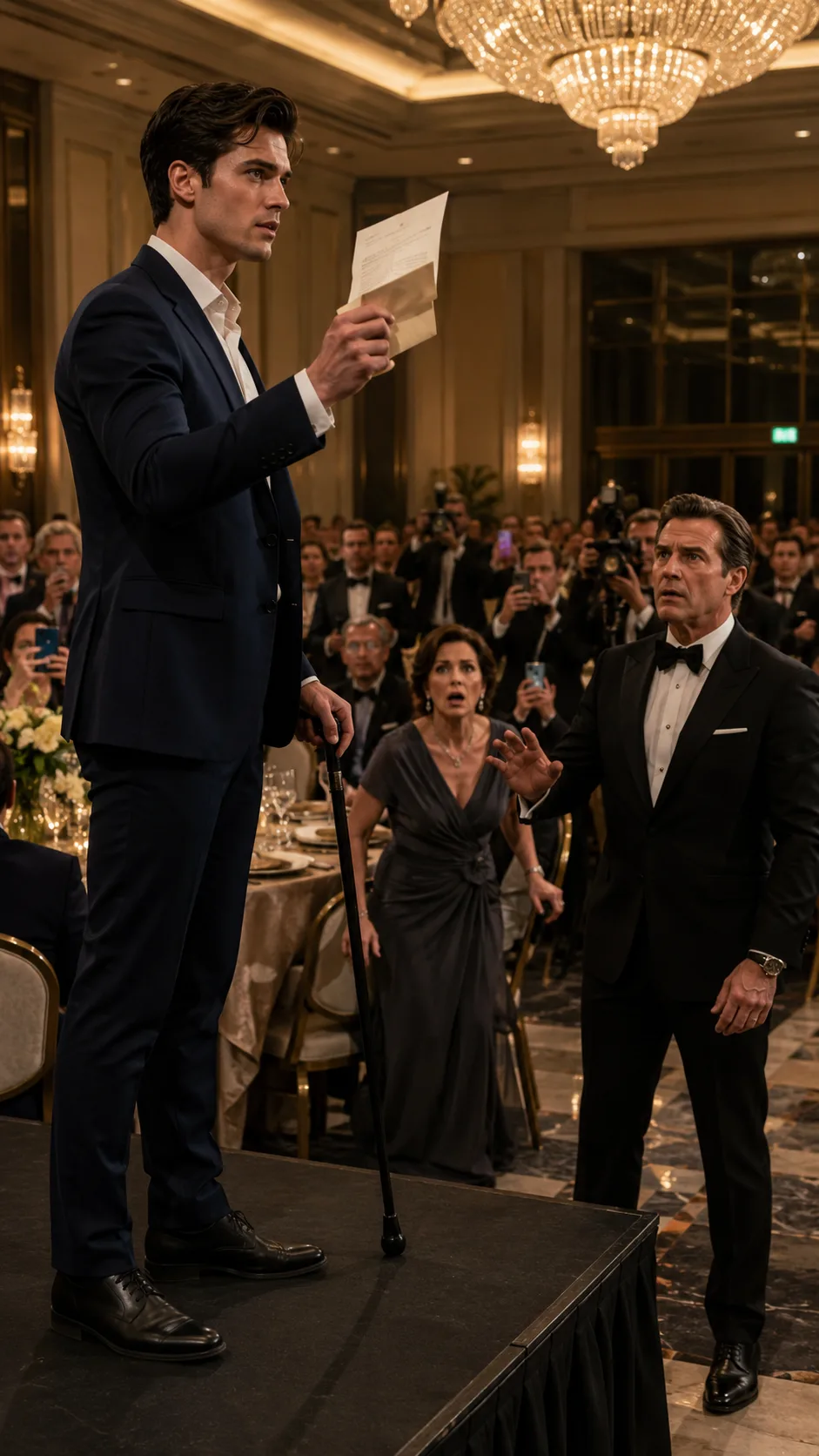
Adrian wore a dark navy suit, a white shirt, and no tie.
His cane rested in his left hand.
He looked composed enough to frighten people who paid attention.
Heads turned as they entered.
Claire saw the sequence on their faces.
First, the cane.
Then Adrian’s posture.
Then his eyes.
Warren Pierce stood near the center of the ballroom, surrounded by board members and city officials. He had aged into the kind of man newspapers liked to photograph: silver at the temples, tailored tuxedo, expensive watch, practiced smile.
He lifted a champagne glass while someone beside him laughed.
Claire’s hand tightened around her clutch.
Adrian saw him.
He did not slow down.
They took seats near the back.
The program began with speeches about service, opportunity, leadership, and legacy. Warren stood when introduced as founder and chairman of the Pierce Foundation. The room applauded him warmly.
Claire did not clap.
Adrian sat still beside her, one hand resting on the handle of his cane.
Then the host announced the Young Leadership Recognition Award.
Adrian Rowe.
The applause began politely.
Adrian rose.
He walked toward the stage with steady, measured steps. The sound of his cane disappeared beneath the clapping, but Claire heard it anyway.
Tap.
Step.
Tap.
Step.
Halfway down the aisle, Warren turned.
At first, he looked with casual curiosity.
Then he looked again.
Something shifted in his face.
Adrian had Warren’s height. Warren’s mouth. A trace of Warren’s brow. But his eyes were Claire’s, and his stillness belonged entirely to himself.
Warren’s applause slowed.
Adrian climbed the stage without assistance.
The room settled.
He stood behind the podium, adjusted the microphone, and let the silence widen.
“Good evening,” Adrian said. “It’s an honor to stand here tonight.”
People smiled.
Warren relaxed slightly.
Adrian continued.
“I was asked to speak about leadership. Most people think leadership means influence, vision, or legacy. But I learned leadership from a woman who had none of those things in the way this room usually measures them.”
A few heads turned toward Claire.
She stopped moving.
“She was twenty-seven when a doctor told her that her infant son would need years of therapy, support, patience, and sacrifice. The child’s father heard the same news and chose the life he imagined over the child he had created.”
The ballroom changed.
No one shouted.
No one stood.
But the air sharpened.
Warren’s face lost its warmth.
Adrian did not look away from the audience.
“He left quietly,” Adrian said. “No scene. No courage. Just calculation.”
A glass touched a table too hard.
Someone whispered.
“That woman raised her son alone. She worked. She fought systems. She ignored lowered expectations. She taught him that dignity is not something the world gives you. It is something you refuse to surrender.”
Claire pressed her fingers together beneath the table.
Adrian turned his head.
Not fully.
Just enough.
His eyes landed on Warren.
“Tonight,” Adrian said, “I was introduced as a young lawyer, an advocate, and someone whose future reflects the values of this foundation.”
He paused.
“But before I accept anything from the Pierce Foundation, this room deserves to know what that name once meant.”
Warren went still.
Adrian stepped away from the podium.
The microphone caught the faint tap of his cane as he moved to the front of the stage and stood beneath the chandelier light.
Then he said, “Eighteen years ago, Warren Pierce abandoned his disabled infant son.”
The room broke into whispers.
Heads turned toward Warren.
Phones lifted.
A woman near the front covered her mouth.
Warren took one step forward. “Adrian.”
Claire froze.
It was the first time she had ever heard Warren say their son’s name.
Adrian looked down at him.
“You don’t get to say my name now.”
The room went silent again.
Warren’s expression cracked, not with grief, but with exposure. The kind of fear that comes when a man realizes the story he built around himself is no longer under his control.
Board members leaned toward one another. The host stood near the curtain, useless and pale. A journalist at the side of the room was already typing.
Then Adrian reached into his jacket.
He pulled out a sealed envelope.
“This night is not about confronting the man who left us,” Adrian said. “It is about the truth he buried.”
Warren’s head lifted sharply.
Adrian held the envelope where the room could see it.
“This arrived at my office six days ago from the law firm that handled my parents’ divorce. It was found during an audit of archived files.”
Claire’s pulse beat against her throat.
Adrian opened the envelope.
“There was never a custody dispute,” he said. “Because Warren Pierce had already written a private statement explaining why he refused involvement.”
Warren’s face drained.
“Don’t,” he said.
Adrian unfolded the paper.
His voice stayed steady.
“The statement says Warren knew before the divorce that the child was not biologically his.”
A sound moved through the ballroom.
Claire gripped the edge of the table.
Adrian looked at her then, and for the first time that night, his voice changed.
“Mom,” he said. “He knew.”
The world narrowed.
Claire saw Warren.
Then Adrian.
Then the paper in Adrian’s hand.
Adrian read from the statement. Warren had discovered during Claire’s pregnancy that he was sterile because of a medical condition from years earlier. He had never told Claire. He had chosen silence to avoid humiliation. When Adrian’s diagnosis came, Warren had allowed the disability to become his excuse.
Claire could not breathe.
Pieces of the past began to return.
A clinic call she missed during one of Adrian’s hospital stays.
A letter she never opened because Warren told her it was probably billing.
A strange calm in Warren’s face after the diagnosis.
Not an affair.
Not betrayal in the way people would assume.
Something colder.
A fertility clinic mistake.
A truth Warren had hidden because telling it would have cost him his pride.
Claire stood before she realized she had moved.
“No,” she said.
Warren turned toward her. “Claire—”
“No.”
This time, the word carried.
Adrian held up another document.
“The clinic records were attached,” he said. “There was a sperm mix-up. My mother never knew. But Warren did.”
The ballroom held its breath.
Adrian looked back at Warren.
“You did not leave because a child was disabled,” he said. “You left because his diagnosis gave you a clean excuse to hide your own shame.”
Warren opened his mouth.
Nothing came out.
Adrian folded the document with careful hands.
“You spent eighteen years letting the world believe you were a man touched by private tragedy,” he said. “But you were never a victim. You were a coward who found a convenient door.”
No one clapped.
No one moved.
Adrian placed the envelope on the podium.
“Tonight, I decline this award.”
Then he turned away from the microphone.
Step.
Tap.
Step.
Tap.
He came down from the stage while the Pierce Foundation collapsed behind him in whispers.
Claire rose from her chair.
When Adrian reached her, he held out his hand.
She took it.
His hand was warm.
Steady.
Real.
Behind them, Warren called her name one last time.
“Claire.”
She did not turn around.
Neither did Adrian.
Together, mother and son walked out beneath the chandeliers, past the donors, past the cameras, past the man who had spent eighteen years pretending absence could be rewritten as dignity.
Outside, the night air was cold.
Adrian stopped at the curb.
For a moment, neither of them spoke.
Then Claire looked at her son—the boy she had carried through therapy rooms, hospital halls, school meetings, court documents, and every silent year Warren never came back.
“You should have told me about the envelope,” she said.
Adrian looked down at the cane in his hand.
“I wanted you to hear the truth where he could not bury it again.”
Claire nodded.
A black car pulled up beside them, but she did not move toward it yet.
She looked back once at the glowing hotel doors.
Somewhere inside, Warren Pierce was learning that applause could disappear faster than love.
Adrian followed her gaze.
“He lost everything tonight,” Claire said.
Adrian shook his head.
“No,” he said. “He lost us eighteen years ago.”
Claire looked at him.
Adrian opened the car door for her.
Then, with the calm of a man who had spent his whole life becoming more than the wound someone left behind, he added,
“Tonight, everyone else found out.”
THE END.
Chapter complete
You have reached the end of this chapter.
Continue reading
A few more worlds to get lost in after this chapter.