Don Roberto kept the same cup of coffee beside him every morning until it went cold.
Chapter 1
Don Roberto kept the same cup of coffee beside him every morning until it went cold.
No one in the mansion touched it.
The housekeeper had learned that rule after her first week. The driver knew not to remind him. The gardeners trimmed the hedges outside the glass doors without looking into the breakfast room, because every morning at seven, the old millionaire sat at the long table with one cup in front of him and one empty chair across from him.
The empty chair had belonged to Elena.
His daughter had hated coffee. She drank hot chocolate even at twenty-one, with too much cinnamon and one spoonful of sugar she pretended not to add. She used to sit barefoot in that chair when her mother was still alive, ignoring the servants who placed slippers near her feet.
Now the chair stayed polished.
Untouched.
Seven years had passed since Elena disappeared.
The city had moved on. The newspapers stopped using her photograph. The police closed the
file twice. Private investigators took Don Roberto’s money, opened dusty folders, followed rumors, and returned with the same sentence dressed in different words.
No confirmed location.
No reliable witness.
No trace.
Don Roberto signed checks anyway.
He paid for hope the way other men paid for medicine.
Outside his grief, he remained powerful. He owned construction companies, shipping warehouses, apartment towers, and half the commercial land near the port. His name opened doors before his hand reached them. Men who laughed loudly in restaurants lowered their voices when he entered.
But inside his own home, his footsteps had become quiet.
Every room held Elena in pieces.
Her piano sat closed beneath a white cloth. Her riding boots remained in the back of a closet. Her portrait hung in the main hall above the marble fireplace, painted when she was twenty, with dark hair over one shoulder and a small smile
that looked like she had been keeping a secret.
Don Roberto could pass a hundred contracts without reading twice.
He could not pass that portrait without stopping.
That Thursday, the mansion hired a new cleaning employee.
Her name was Maria Alvarez. Thirty-five. Thin hands. Gray uniform. Shoes repaired at the heel. She arrived ten minutes early and stood near the service entrance with her purse held against her stomach as if someone might take it.
The head housekeeper gave her a list.
“Main hall last,” she said. “Do not move anything near the fireplace unless I tell you.”
Maria nodded.
She did not ask questions.
She worked well. Quietly. Carefully. She wiped the long windows, folded towels in the guest rooms, and kept her eyes lowered when Don Roberto walked past the corridor with his phone pressed to his ear.
At three in the afternoon, she entered the main hall.
The cloth slipped from her hand.
Don Roberto was standing in the study doorway when he heard the small sound.
He looked up.
Maria stood beneath Elena’s portrait, staring at it with her mouth half open. Her face had gone pale enough that the freckles on her cheeks looked darker.
“Señora Alvarez?”
She did not turn.
Her fingers gripped the cleaning cloth so tightly it twisted.
Don Roberto stepped into the hall.
“You look ill.”
Maria swallowed. Her eyes stayed on the painted face.
“Sir…”
One word.
Nothing else.
The old millionaire followed her gaze, and the familiar ache opened in his chest. He had trained himself not to react when strangers saw the portrait. Some asked politely. Some pretended not to know. Some recognized the story from old news articles and offered the kind of sympathy that ended quickly because grief made them uncomfortable.
But Maria did not look curious.
She looked afraid.
Don Roberto’s voice changed.
“Do you know her?”
Maria turned then.
Her lips moved twice before sound came out.
“Where did you get that painting?”
“That is my daughter.”
The cloth fell from Maria’s hand.
For three seconds, no one moved.
Then she backed away from the fireplace like the portrait itself had stepped toward her.
“No,” she said.
Don Roberto’s fingers tightened around the head of his cane.
“What do you mean, no?”
Maria pressed one hand to her chest. Her breathing came too fast, but she forced the words out.
“I know this woman.”
The hall became too large.
Don Roberto took one step toward her.
“Where?”
Maria looked from him to the painting and back again.
“We slept in the same room at a women’s shelter two years ago. Near San Marcos Street. She used another name, but it was her. I remember the scar near her wrist. I remember because she covered it when she washed dishes.”
Don Roberto’s cane hit the marble once.
Hard.
“My daughter has a scar there.”
Maria closed her eyes.
“She told me her name was Elena once. Only once. Then she said never to repeat it.”
The old man’s face did not change, but the hand holding the cane shook.
“Where is she now?”
Maria hesitated.
That hesitation cut deeper than the words before it.
Don Roberto saw it. The way her shoulders pulled inward. The way her eyes went to the side, searching for the safest version of the truth.
“Tell me.”
“She worked at a laundry near the bus depot when I last saw her. But someone told me she moved into the old district. A room above a closed bakery.”
“Who told you?”
“A woman from the shelter.”
“Is she alive?”
Maria flinched at the question.
“I think so.”
The old man stared at her.
Not at the portrait.
At Maria.
“Think?”
Maria’s fingers curled into her sleeves.
“Sir, that place is not safe. People disappear there without anyone asking.”
Don Roberto turned.
No driver.
No assistant.
No security team.
He took his coat from the chair near the study and grabbed the keys from the silver tray by the door.
Maria followed two steps behind him.
“Sir, maybe we should call someone first.”
He did not slow down.
“I have called people for seven years.”
The front doors opened.
Cold city air entered the mansion.
“Today I go myself.”
---
Maria sat in the passenger seat without touching the leather around her.
Don Roberto drove.
The truck was too expensive for the roads they entered after twenty minutes. Shiny black paint. Heavy engine. Windows so clean they reflected the broken signs and leaning apartment blocks around them like another world passing over this one.
Maria guided him with short instructions.
“Left here.”
“Past the pharmacy.”
“Slow down.”
The city changed block by block.
Banks became pawnshops. Boutiques became repair stalls. Cafés became metal doors covered in faded posters. The sidewalks narrowed until people walked in the road, stepping around puddles, plastic bags, sleeping dogs, and children kicking a flat ball near a wall.
Don Roberto had funded charity kitchens in neighborhoods like this.
He had signed donation certificates.
He had shaken hands with priests, mayors, school directors.
But he had never looked through these streets searching for his own blood.
Maria kept twisting the strap of her purse.
“What was she like?” Don Roberto asked.
Maria looked at him.
“At the shelter?”
He nodded.
Maria’s eyes went forward again.
“She did not talk much. She helped clean after dinner. If someone cried at night, she pretended to be asleep, then left bread near their bed in the morning.”
Don Roberto’s jaw moved once.
Maria continued.
“She never kept money. When she had some, someone else needed it more.”
“That sounds like her mother.”
Maria said nothing.
A bus groaned past them, close enough to shake the window.
“She had nightmares,” Maria added.
Don Roberto’s hand tightened on the steering wheel.
“About what?”
“She never said.”
A red light stopped them near a corner where three boys sold phone chargers from a cardboard box. One of them stared at the truck with open interest. Another pointed toward the rims.
Maria lowered her voice.
“Sir, when we get there, please do not show money.”
Don Roberto looked at her.
She held his gaze for one second, then looked away.
“People smell it there.”
The light turned green.
He drove on.
They reached the old district just before dusk. The street was narrow, with tangled wires hanging between buildings like black vines. Laundry dripped from balconies. Someone had painted blue over graffiti, but the old letters still showed through.
Maria pointed to a three-story building with a closed bakery below it.
The sign had lost two letters.
The upper windows were barred.
“There.”
Don Roberto parked in front.
A man sitting near the doorway looked at the truck, then looked at Don Roberto’s coat, then stood and walked away without hurry.
Maria noticed.
“We should be quick.”
Don Roberto stepped out.
The smell hit him first.
Damp concrete. Frying oil. Dust. Old drains.
He closed the truck door.
Maria led him through a narrow entrance and up a stairwell where the bulb flickered between floors. Someone had left a child’s red sandal on the second step. Don Roberto almost stepped on it, then moved around it carefully.
From the second floor came voices.
Male.
Sharp.
Maria stopped.
Don Roberto heard it too.
A chair scraped against a floor.
Then a woman spoke.
“I told you already. That debt is not mine.”
The voice was lower than he remembered.
Older.
Roughened by years he had not been allowed to see.
But it struck him in the ribs.
Maria touched his sleeve.
“Sir.”
He lifted one hand.
Silence.
Another man spoke from behind the door.
“You rented the room. You answer for what was found inside.”
“That paper is fake.”
Paper slapped wood.
“You want fake? We can call the police and ask them. A woman with no family, no documents anyone cares about, no lawyer. You think they listen to you?”
A third voice laughed.
“Sign. Then maybe we let you leave with your bag.”
Don Roberto moved toward the door.
Maria whispered, “Wait.”
He did not.
His hand closed around the old brass knob.
Inside, the woman said, “I won’t sign.”
Don Roberto pushed the door open.
---
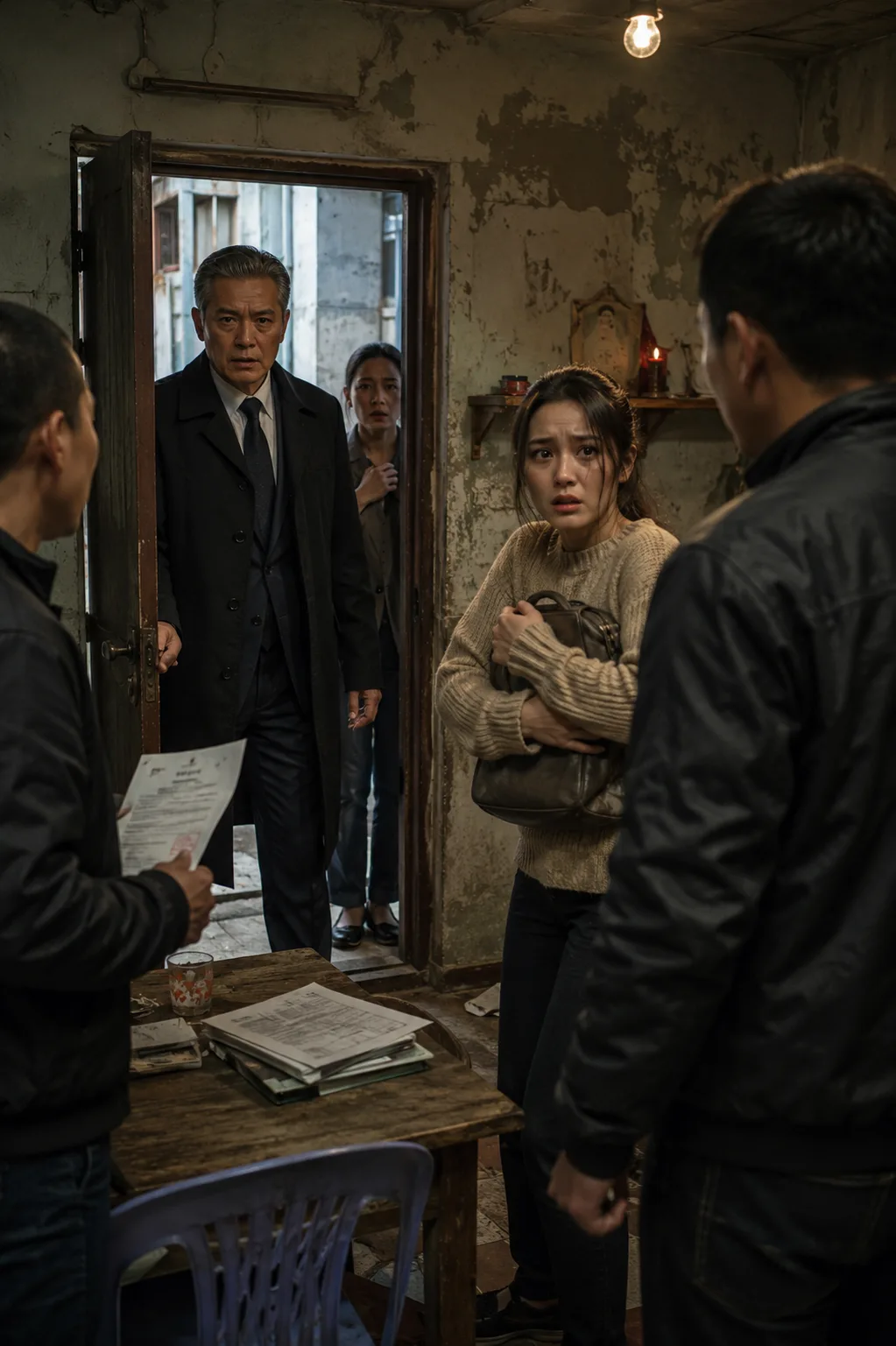
The room was smaller than the pantry in his mansion.
A single bulb hung from a cracked ceiling. Peeling walls. One wooden table. One plastic chair with a broken back. A mattress pushed against the corner under a window with rusted bars.
Elena stood beside the table.
Not the Elena from the portrait.
Not the girl in the pale dress who used to leave books open on the terrace.
This woman wore a faded beige sweater and black pants worn thin at the knees. Her hair was tied back with a rubber band. Her face was leaner. Her hands clutched an old brown handbag against her chest like it contained the last proof that she existed.
Three men surrounded her.
One held a paper.
One blocked the window.
One stood near the door, too close to Maria when she stepped in behind Don Roberto.
Elena turned.
Her eyes found his.
The room lost all sound.
Don Roberto had imagined this moment so many times that imagination had become punishment.
He had pictured her running to him.
He had pictured himself finding her in a hospital bed, in a police station, in a house by the sea with children he did not know. He had pictured anger. Tears. Questions. Accusations.
He had never pictured this.
His daughter cornered under a flickering bulb, being forced to sign a debt made by men who looked at her as if she were already erased.
“Elena.”
Her name came out broken.
The man holding the paper lowered it.
Elena stared at Don Roberto.
Her lips parted.
Then she shook her head once.
“No.”
The word barely crossed the room.
Don Roberto stepped inside.
The closest man moved in front of him.
“This is private, old man.”
Don Roberto did not look away from Elena.
The man smiled.
“You deaf?”
Maria stood frozen behind him.
Elena’s eyes moved to Maria, then back to Don Roberto. Recognition flickered there, but she crushed it before it could become anything else.
“You shouldn’t be here,” she said.
Don Roberto took another step.
The man put one hand against his chest.
Don Roberto looked down at that hand.
Slowly.
The man removed it.
No one had told him to.
The one with the paper cleared his throat.
“She owes money. We are collecting. You family?”
Don Roberto’s eyes stayed on Elena.
“Yes.”
Elena flinched.
The man laughed.
“Convenient. Then you can pay.”
Elena snapped toward him.
“I don’t owe you anything.”
He waved the paper.
“Room contract. Storage fee. Damage fee. Interest. Police complaint if unpaid.”
“You invented all of it.”
“Prove it.”
Elena’s grip tightened on the handbag.
Don Roberto finally turned toward the man.
“Show me.”
The man hesitated.
“Show you what?”
“The document.”
The man looked at the others. A small, ugly confidence returned to his face.
He stepped to the table and slapped the paper down.
“Read it yourself.”
Don Roberto picked it up.
The paper was cheap. The stamp on it badly copied. The signature line blank. Several charges listed without dates. No legal letterhead. No case number. No creditor address.
A child could have made a better fraud.
Don Roberto set it down.
“This is nothing.”
The man’s smile flattened.
“To people like her, it is enough.”
Elena went still.
That sentence changed the room.
Not loudly.
Not all at once.
But Maria saw Don Roberto’s face settle into something colder than anger.
The old millionaire reached inside his coat.
The men watched his hand.
He removed a gold-edged business card and placed it beside the fake debt paper.
Then he removed his truck keys and set them beside the card.
The metal touched wood with a small sound.
Everyone heard it.
The man with the paper glanced down.
His eyes moved across the embossed name.
Roberto Salazar.
Chairman, Salazar Holdings.
His mouth opened.
No words came.
The man near the window leaned closer to see.
The third man looked from the card to the truck keys, then toward the open doorway and the expensive vehicle parked below.
Don Roberto stepped between Elena and all three men.
“Now,” he said, “we will speak clearly.”
Elena stood behind him.
Close enough that he could hear her breathing.
Not touching him.
Not yet.
The man holding the paper tried to recover.
“Sir, there has been a misunderstanding.”
Don Roberto looked at the fake document.
“Yes.”
He picked it up between two fingers.
“A serious one.”
The man raised both hands.
“We were only doing business.”
Don Roberto’s eyes moved to Elena’s old handbag.
“To a woman alone.”
No one answered.
“To a woman you thought had no name worth protecting.”
The man’s jaw worked, but nothing useful came out.
Don Roberto folded the fake paper once. Carefully. He placed it inside his coat pocket.
“That is evidence now.”
The man near the door shifted.
Maria stepped back.
Don Roberto did not turn.
“You will not block that door.”
The man stopped.
A phone rang in the hallway. Somewhere below, a child laughed. The ordinary sounds of the building kept moving around the room, unaware that three men had just lost control of the air inside it.
Elena spoke behind him.
“Don’t.”
The word struck him harder than the men had.
He turned slightly.
She looked at the floor.
“Please. If you fight them, it gets worse later.”
Don Roberto’s face changed.
For the first time, the men saw something other than power.
They saw a father hearing how long his daughter had been living with fear as a daily rule.
He lowered his voice.
“There will be no later with them.”
The man holding the card swallowed.
“Mr. Salazar, we can settle this.”
“You will.”
He took out his phone.
The men stiffened.
Don Roberto dialed one number.
“Carlos,” he said when the call connected. “Send legal, security, and two police contacts to the old bakery building on Calle Norte. Second floor. Bring cameras.”
The man near the window cursed under his breath.
Don Roberto looked at him.
“Louder.”
No one moved.
He ended the call.
Elena stared at him now, not like he was a ghost.
Like he was dangerous.
That hurt more than the years.
The man with the paper forced a smile.
“Sir, we did not know she was your daughter.”
Don Roberto’s answer came without heat.
“That is not your defense.”
Silence.
Maria stood near the doorway with both hands locked together.
Elena slowly lowered the handbag from her chest. Her fingers remained around the strap.
Don Roberto wanted to turn and hold her.
He did not.
A father had no right to demand comfort from a daughter he had failed to find.
So he stood between her and the men until footsteps thundered up the stairs.
---
The first person through the door was Carlos Mendoza, Don Roberto’s lawyer.
He wore a dark suit and had the kind of calm face that made guilty men start talking too much.
Two security men followed. Then a uniformed officer Don Roberto knew from city charity boards, and another younger officer carrying a small camera.
The room shrank even more.
Carlos took one look at Elena, one look at the men, and opened his leather folder.
“Names.”
No one answered.
He looked at the closest man.
“Now.”
The man gave a name.
Then another.
Then the third.
The younger officer photographed the table, the card, the room, the fake stamp on another paper left under a cup. Carlos asked short questions. The men gave shorter answers. Each lie lasted less than a minute before it found a wall.
Elena stood near the shelf with the candle.
Maria moved beside her.
“You remember me?” Maria asked.
Elena looked at her.
A small nod.
“From the shelter.”
“Yes.”
Maria’s mouth pressed into a thin line.
“I saw your picture.”
Elena’s eyes closed.
Just once.
“I should have left the city.”
Don Roberto heard it.
He turned.
“Why didn’t you come home?”
The room quieted.
Even Carlos stopped writing.
Elena looked at Don Roberto for a long time.
Then she smiled.
Not happily.
Not kindly.
A tired little curve that did not reach her eyes.
“Home?”
The word landed between them.
Don Roberto had faced hostile boards, political threats, bankruptcy scares, lawsuits built to ruin him.
Nothing had prepared him for that one word from his daughter.
“Elena.”
“You don’t know what happened.”
“Then tell me.”
She glanced at the men.
“Not here.”
Don Roberto nodded at Carlos.
Carlos understood.
Within ten minutes, the debt collectors were escorted downstairs. Not dragged. Not beaten. No spectacle. Just names taken, phones checked, statements recorded, and faces stripped of arrogance.
The room remained.
The broken table. The candle. The peeling wall.
Elena sat on the edge of the plastic chair.
Don Roberto stayed standing because he did not know where a father should stand after seven years.
Maria quietly picked up scattered papers from the floor and stacked them, though no one had asked her to.
Carlos waited by the door.
“Sir,” he said, “we can move her now.”
Elena’s head lifted.
“No.”
Don Roberto looked at her.
“You are not staying here.”
“I said no.”
The old command in his voice almost returned.
Almost.
Then he saw her hand on the handbag again.
He softened his tone.
“Where do you want to go?”
Elena looked toward the barred window.
“Somewhere they don’t know.”
Carlos said, “We can arrange a hotel under another name.”
Don Roberto nodded.
Elena stood.
She took one step, then stopped near the shelf.
The small candle burned in front of a chipped saint picture. Beside it lay a cheap hairpin with a missing pearl.
She picked it up.
Don Roberto recognized it.
His wife had bought Elena a set of hairpins when she turned nineteen. Real pearls. Gold stems. Elena had complained they looked too formal, then wore them for three days because her mother smiled every time she saw them.
This one was fake.
Plastic pearl.
Bent metal.
But Elena held it as if it mattered.
Don Roberto did not ask.
Not then.
They walked downstairs together without touching.
People watched from doorways.
The men who had threatened Elena stood near a police car, no longer laughing. One avoided Don Roberto’s eyes. Another stared at the pavement.
At the truck, Elena paused.
She looked at the polished black door.
“I’ll dirty the seat.”
Don Roberto opened it for her.
“It has been waiting.”
She looked at him.
The sentence had escaped him before he could make it safe.
For a moment, neither moved.
Then Elena climbed in.
Maria sat in the back.
Don Roberto drove.
No one spoke for several blocks.
At a traffic light, Elena looked out at the city and said, “I didn’t disappear.”
Don Roberto kept both hands on the wheel.
“I know.”
“You don’t.”
He accepted that.
She continued.
“I left because someone told me you knew.”
The light turned green.
Don Roberto did not move until a horn sounded behind him.
He drove forward.
“Who?”
Elena’s reflection in the window looked thinner than her face.
“Your brother.”
The words entered the truck like smoke.
Don Roberto’s younger brother, Esteban, had managed part of the family trust for years. He had comforted him after Elena vanished. He had sat beside him during press conferences. He had cried at the anniversary mass.
Elena spoke again.
“He told me you found out I was not your real daughter. That you wanted me gone before the will changed.”
Don Roberto’s breath left him.
Maria covered her mouth in the back seat.
Elena kept looking outside.
“I was twenty-one. Mother was gone. You were always working. Esteban showed me papers. He said if I stayed, you would destroy me quietly. He gave me money and a bus ticket.”
“Elena.”
“I believed him.”
Don Roberto pulled the truck to the side of the road.
Cars passed around them.
He turned toward her.
“You are my daughter.”
She did not look at him.
“I know that now.”
His voice roughened.
“No. Listen to me. You were my daughter the day your mother placed you in my arms. You were my daughter when you broke my office window with a tennis ball. You were my daughter when you screamed at me for missing your school concert. You were my daughter when you left.”
Elena’s fingers tightened around the hairpin.
“And when you thought I was dead?”
Don Roberto’s face folded in on itself.
“I was not alive enough to think properly.”
That was the closest he came to crying.
Elena looked at him then.
The city moved outside their windows. A man pushed a cart of oranges past the truck. A bus hissed at the curb. Somewhere nearby, music played from a shop radio.
Ordinary life.
Cruel in its ordinary rhythm.
Don Roberto said, “I never signed anything against you. I never wanted you gone. I spent seven years looking.”
Elena’s mouth trembled once.
She turned away before it became anything.
“I need proof.”
He nodded.
“You will have it.”
---
The hotel Carlos arranged did not use Don Roberto’s name.
Elena refused the presidential suite.
She chose a plain room on the sixth floor with one bed, one desk, and curtains that closed properly.
Maria stayed with her until midnight.
Don Roberto waited in the hallway.
He sat on a chair too small for him, coat over his knees, phone silent in his hand. Carlos came and went. Documents were requested. Old trust records pulled. Esteban’s access reviewed. Names from Elena’s false debt case connected to shell companies Don Roberto had never heard of.
At 1:20 a.m., Carlos returned.
His tie was loosened.
“We found transfers.”
Don Roberto stood.
Carlos handed him a folder.
“Your brother moved money through a small lending network. Same names from tonight. He may have used them to keep track of her.”
Don Roberto stared at the papers.
Esteban’s signature appeared twice.
Not directly enough for a careless man.
Directly enough for Carlos.
Don Roberto closed the folder.
“Where is he?”
“At his house.”
“Wake him.”
Carlos nodded.
Then the hotel room door opened.
Elena stood there in a borrowed white robe, hair wet from a shower, face scrubbed clean. Without the dirt and old sweater, she looked younger.
Not twenty-one.
Not the portrait.
Something in between.
“What did you find?” she asked.
Don Roberto held the folder.
“Enough.”
She looked at it.
Then at him.
“Don’t hide it from me to protect me.”
“I won’t.”
He gave her the folder.
Carlos looked surprised.
Don Roberto did not.
Elena sat on the hallway chair and read every page.
No one spoke.
At the end, she closed the folder and placed it on her lap.
“He knew where I was.”
Don Roberto’s voice was quiet.
“Yes.”
“He let you keep searching.”
“Yes.”
“He sent those men.”
Carlos answered this time.
“We cannot prove that yet.”
Elena looked up.
“But he did.”
Carlos did not answer.
He did not need to.
The next morning, Esteban Salazar arrived at Don Roberto’s corporate office wearing a gray suit and a face full of concern.
He expected a private meeting.
He found Elena seated at the conference table.
Maria stood near the window.
Carlos stood beside a projector screen.
Don Roberto sat at the head of the table.
Esteban stopped in the doorway.
His hand remained on the handle.
For half a second, the mask broke.
Elena saw it.
So did Don Roberto.
Then Esteban smiled.
“My God,” he said. “Elena.”
She did not stand.
“Uncle.”
He came forward with his arms half open.
She raised one hand.
He stopped.
The old conference room, with its polished table and city view, suddenly felt smaller than the apartment from the night before.
Don Roberto placed the fake debt paper on the table.
Then the transfer records.
Then the old trust documents.
One by one.
Esteban looked at them and gave a short laugh.
“Roberto, what is this?”
“A question.”
Esteban adjusted his cuff.
“Then ask.”
Don Roberto leaned back.
“Why did my daughter spend seven years believing I wanted her erased?”
Esteban’s eyes moved to Elena.
“There must be confusion.”
Elena pulled the cheap hairpin from her pocket and placed it on the table.
“You gave me that the day you put me on the bus.”
Esteban stared at it.
His face stayed composed.
His fingers betrayed him.
They tapped once against his thigh.
Elena continued.
“You said my father had ordered you to handle it quietly. You said if I loved my mother’s memory, I would not make a scene.”
Don Roberto’s jaw tightened.
Esteban sighed, as if saddened by the burden of lying.
“She was unstable then. Grief does strange things to young people.”
Maria took one step forward.
“She was not unstable when your men cornered her yesterday.”
Esteban looked at Maria as if noticing furniture had spoken.
“And you are?”
“The woman who recognized her.”
That answer struck harder than her tone.
Carlos clicked the remote.
Bank transfers appeared on the screen.
Dates.
Companies.
Names.
Payments.
The room went still.
Esteban’s expression thinned.
Don Roberto stood.
“You will leave the company today.”
Esteban laughed once.
“You cannot be serious.”
“You will leave the board. The trust. The estate. Every account you touched will be audited.”
“Roberto.”
“And then you will answer questions from people who do not sit at family tables.”
Esteban’s face darkened.
“You are making a mistake for a girl who abandoned you.”
The sentence had barely finished when Don Roberto’s hand came down on the table.
Not loud enough to shatter anything.
Loud enough to end the performance.
“She did not abandon me.”
Esteban looked at Elena.
For the first time, he stopped pretending.
“You should have stayed gone.”
Elena did not move.
Don Roberto did.
He stepped around the table, but Carlos placed a hand near his arm without touching.
No violence.
No loss of control.
That would have been too easy for Esteban.
Instead, Don Roberto looked at his brother with the full weight of seven years.
“You were right about one thing,” he said.
Esteban’s eyes narrowed.
“The Salazar name can erase a man.”
Carlos opened the conference door.
Two officers waited outside.
Esteban looked from them to Don Roberto.
Then to Elena.
His mouth opened, searching for family, excuse, blood, history.
None of it came.
The officers entered.
Esteban did not fight.
He only straightened his jacket before they led him out, because men like him wanted even ruin to look tailored.
Elena watched until the door closed.
Then she picked up the cheap hairpin.
Her hand shook.
Just a little.
Don Roberto saw it and looked away, giving her the dignity of not being watched.
---
Elena did not move back into the mansion that week.
Or the next.
Don Roberto offered. She refused.
He bought nothing for her without asking. No clothes sent in boxes. No phone delivered in velvet packaging. No driver waiting downstairs unless she requested one.
Trust returned in inches.
A lawyer helped restore her documents. A doctor checked her health. Carlos filed cases that moved slowly, then quickly once newspapers began asking why a billionaire’s brother had been tied to illegal debt networks.
Maria received a position at the mansion.
Not as a cleaner.
Don Roberto gave her a choice. She chose to manage the household staff because, as she told him, “Rich houses waste too much soap.”
For the first time in years, laughter entered the kitchen.
Small laughter.
Careful laughter.
But real.
Elena visited the mansion on a Sunday afternoon.
She came without warning.
Don Roberto was in the breakfast room, sitting before his cold coffee.
The empty chair across from him had remained empty.
Elena stood at the doorway.
He rose too quickly.
She looked at the chair.
“Still there?”
He did not answer.
She walked in and sat down.
The room changed shape around her.
A servant appeared, then froze.
Elena looked at the cup in front of Don Roberto.
“Still drinking terrible coffee?”
His hand covered his mouth for one second.
Then he lowered it.
“You still hate it?”
“Yes.”
He turned toward the servant.
“Hot chocolate.”
Elena added, “Cinnamon.”
The servant nodded and left.
Father and daughter sat across from each other in the room that had waited seven years.
Neither rushed to fill the silence.
Outside, the gardeners trimmed the hedges. A fountain clicked softly near the terrace. Somewhere in the house, Maria scolded someone for folding napkins wrong.
Elena took the cheap hairpin from her pocket.
She placed it on the table.
“I kept it because I thought it proved I was stupid.”
Don Roberto looked at it.
“No.”
She pushed it toward him.
“Then you keep it for a while.”
He accepted it with both hands.
The servant returned with hot chocolate.
Elena wrapped her fingers around the cup.
She took one sip, then made a face.
“Too much cinnamon.”
Don Roberto looked at her.
For the first time in seven years, the empty chair was not empty.
He smiled.
Not much.
Enough.
Chapter complete
You have reached the end of this chapter.
Continue reading
A few more worlds to get lost in after this chapter.