The Girl at the Piano Was Never Supposed to Be Seen
The dare was meant to humiliate a child.
Chapter 1
The Girl at the Piano Was Never Supposed to Be Seen
The dare was meant to humiliate a child.
That was how it began.
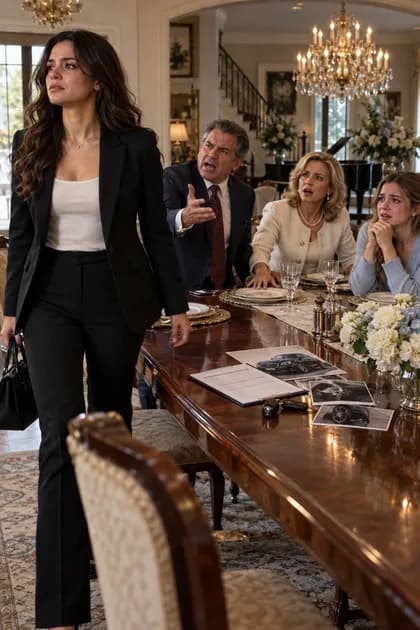
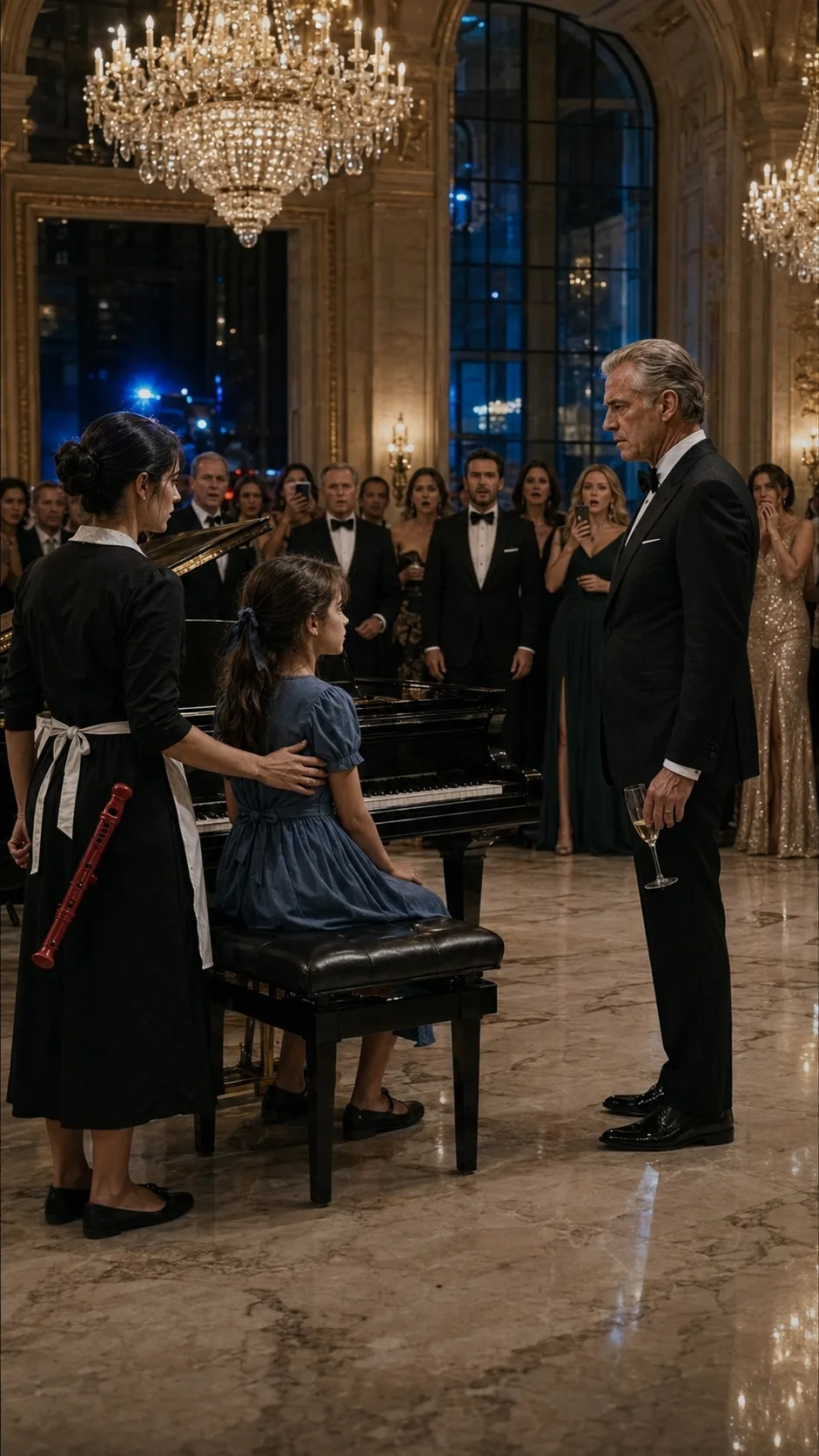
Under the blinding crystal lights of the Caldwell estate, surrounded by champagne glasses, silk gowns, polished marble, and the richest people in Manhattan, Richard Caldwell looked at a nine-year-old girl and smiled as if she were nothing more than entertainment.
“One hundred million dollars,” he said, his voice loud enough for every guest to hear. “If you can play this.”
Laughter moved through the grand hall.
It was not joyful laughter.
It was the kind of laughter people used when they had too much money, too much power, and no fear of consequences.
The little girl stood beside the black Steinway piano, wearing a simple blue dress that had been washed too many times. Her shoes were cheap. Her hair was tied back with a ribbon her mother had fixed in the service hallway less than an hour earlier.
Her name was Lily Bennett.
She
was not supposed to be there.
And by midnight, the music she played would tear Richard Caldwell’s empire apart.
---
Olivia Bennett had spent years learning how to disappear.
In Manhattan, invisibility was not weakness. It was survival.
She entered wealthy homes through side doors. She kept her eyes lowered. She moved through rooms without disturbing the air. She polished mirrors that reflected women wearing diamonds worth more than her yearly income. She carried trays past men who never looked at her face unless something had gone wrong.
At the Caldwell estate, Olivia was only “the maid.”
Not Mrs. Bennett.
Not Olivia.
Just the woman who cleaned the glass, changed the flowers, removed fingerprints from silver, and vanished before the guests arrived.
But every morning, before she stepped into that world, she reminded herself why she endured it.
Lily.
Her daughter was the one bright thing left from a life
that had been heavy with unpaid bills, hospital rooms, and grief that never fully slept.
At nine years old, Lily was quiet in a way that made adults uncomfortable. She watched too much. Listened too carefully. Sometimes, while other children talked or played, Lily’s fingers moved in the air as if pressing keys no one else could see.
Olivia never understood where it came from.
They did not own a piano.
They barely owned enough groceries by the end of each month.
Music lessons were impossible.
The closest Lily came to learning music was standing near the back wall of a church on Wednesday evenings, listening to the choir practice through old wooden doors.
But whenever Lily passed the music room inside the Caldwell estate, she changed.
Her steps slowed.
Her eyes lifted.
Her hands rose slightly, hovering in the air like they were remembering something her mind had never
been taught.
Olivia noticed.
She noticed everything about her daughter.
But noticing did not mean understanding.
---
That evening had gone wrong before it even began.
The babysitter canceled.
The landlord called twice.
The hospital sent another warning about Lily’s old medical bills.
Olivia stared at her phone in the tiny apartment kitchen, then looked at Lily sitting quietly at the table with a half-finished drawing in front of her.
There was no choice.
There was never a choice.
So Olivia brought Lily with her to the Caldwell estate and prayed that Richard Caldwell would not find out.
For several hours, the prayer held.
Lily sat near the service corridor with a small book and a sandwich wrapped in paper. She did not wander. She did not touch anything. She waited with the patience of a child who had already learned that being a burden was dangerous.
Olivia worked faster than usual.
She polished silver trays.
She adjusted white lilies in crystal vases.
She wiped down the staircase railing until the wood shone under the gold light.
Then Richard Caldwell walked in.
He was the kind of man newspapers called a visionary.
Tall. Silver-haired. Perfectly dressed.
His wealth had built hospitals, restored concert halls, funded galleries, and bought silence more efficiently than most people bought dinner.
He stopped when he saw Lily.
Olivia’s body tightened.
“I’m sorry, sir,” she said quickly. “My sitter canceled. She’ll stay out of the way.”
Richard looked at Lily the way some people looked at a stain on fabric.
“A child,” he said.
Not a question.
A judgment.
Lily did not lower her eyes.
That was the first mistake.
Richard Caldwell was used to people shrinking under his attention. Employees apologized before he spoke. Guests laughed before he finished his jokes. Musicians thanked him for opportunities he used to own them.
But Lily only looked back.
Calm.
Still.
Unreadable.
Something small and sharp passed through Richard’s expression.
Then the first guests arrived, and his attention moved away.
Olivia exhaled only after he left.
She touched Lily’s shoulder.
“Stay right here,” she whispered.
Lily nodded.
“I mean it.”
“I know, Mom.”
Olivia forced herself to return to work.
But all night, the mansion felt wrong.
---
By eight o’clock, the Caldwell estate was no longer a home.
It was a stage.
The chandeliers burned like captured stars above the grand hall. Wealthy guests moved through the room with champagne in their hands and boredom behind their smiles. A string quartet played near the staircase. Reporters lingered near the entrance, invited only because Richard liked public generosity when it could be photographed.
At the center of the hall stood the piano.
A black Steinway.
Polished.
Massive.
Almost holy beneath the light.
Olivia knew that piano well. She had dusted it for years. She had cleaned around it, never touching the keys unless instructed. She had watched famous pianists sit before it while guests whispered names and histories she could not afford to recognize.
Beside that piano, Richard Caldwell often became most alive.
Not because he played.
He did not.
But because he owned.
He owned the room. The estate. The collection. The foundation. The musicians who needed his funding. The critics who needed his dinners. The stories people told about art in New York.
That night, Olivia had almost succeeded in getting Lily out through the rear hall.
Then a guest stopped her for champagne.
Only for a moment.
Only long enough for Olivia to turn her head.
When she looked back, Lily was gone.
Her breath stopped.
She moved through the service corridor first, then the east hall, then the entrance to the grand ballroom.
And there she saw her daughter.
Standing beside the Steinway.
The quartet had stopped playing.
The guests had begun forming a circle.
Richard Caldwell stood across from Lily with a glass in one hand and amusement at the edge of his mouth.
“My mom is tired,” Lily said.
Her voice was small.
But somehow, the entire room heard it.
Olivia froze.
Lily looked at the piano.
“But I can play.”
A wave of laughter passed through the guests.
Someone raised a phone.
Then another.
Richard set down his glass with careful elegance.
“You can play?” he asked.
Lily nodded.
Olivia stepped forward.
“Lily, no.”
But Richard was already reaching toward a locked music cabinet beside the piano.
He opened it, removed a red leather folder, and pulled out a sheet of music protected inside a clear sleeve.
The reaction from several musicians in the room changed immediately.
Olivia saw it.
The sudden stillness.
The slight widening of eyes.
This was not ordinary music.
Richard placed the sheet on the stand and turned back to Lily.
“Go ahead,” he said. “Play this, and I’ll give you one hundred million dollars.”
The room laughed louder.
The joke had become public now.
A rich man challenging a maid’s daughter.
A child placed under crystal lights to fail for entertainment.
Olivia’s face burned.
She started forward again, but Lily had already climbed onto the piano bench.
The laughter faded into expectant silence.
Lily placed her hands over the keys.
Olivia could barely breathe.
Then the first note rang out.
Clear.
Perfect.
Certain.
The room changed.
The second note followed.
Then the third.
Then a line of music so precise and haunting that every smile disappeared.
Phones lowered.
Glasses stopped halfway to lips.
The child at the piano did not hesitate. She did not stumble. Her fingers moved across the keys as if they had known the path long before her body did.
The music was not pretty.
It was more dangerous than pretty.
It began like a whisper trapped under a door, then widened into something darker. Notes struck like questions no one wanted answered. The left hand carried a low, restless pulse. The right hand rose above it, delicate and aching, then suddenly sharp enough to cut.
Olivia stood with both hands over her mouth.
She had never heard Lily play.
Not like this.
Not anything close to this.
There had been no lessons.
No teacher.
No piano.
Yet her daughter played as if every locked room in the world had opened inside her.
Richard’s face changed first.
The amusement vanished.
Then the confidence.
Then the color.
At the center passage, a famous conductor near the staircase took one step forward.
“My God,” he whispered.
The piece became more difficult.
Impossible, someone murmured.
Lily did not stop.
Her small shoulders stayed steady. Her eyes remained on the music. Her fingers crossed and fell with impossible control, striking intervals that made trained pianists in the room stare as if witnessing something that should not exist.
The final movement rose like thunder.
A waiter dropped a glass.
No one turned.
Then Lily struck the last note.
It held in the air.
Long.
Trembling.
Unforgiving.
Silence followed.
Not polite silence.
Not stunned admiration.
Something larger.
Something afraid.
Lily slowly turned on the bench and looked at Richard Caldwell.
Then she asked the question that ended him.
“Why do you have my father’s music?”
---
At first, no one moved.
Then Olivia whispered, “What did you say?”
Lily turned toward her mother.
“The song in the red box,” she said. “The one Daddy recorded. It’s the same one.”
Olivia’s body went cold.
Noah.
She had spent years avoiding her husband’s name in rooms that echoed.
Noah Bennett had died when Lily was two years old.
Officially, it had been a subway accident.
A tragic fall.
No witnesses.
No investigation that mattered.
A closed casket.
A short funeral.
A debt Olivia had never fully escaped.
Noah had loved music. That much was true. He hummed while cooking pasta. He tapped rhythms on Lily’s crib when she cried. He sometimes played old keyboards in pawnshop windows when the owner let him.
But this composition?
This impossible work?
Olivia could not make the pieces fit.
Richard recovered faster than anyone else.
“This is absurd,” he said.
His voice was not as strong as before.
“You coached her.”
Olivia stared at him.
“I don’t even know what this is.”
Richard’s eyes hardened.
“What game are you playing in my house?”
Lily’s small hands rested in her lap.
“It isn’t a game.”
Richard stepped toward the piano.
“That’s enough.”
Lily flinched, but she did not climb down.
Then she added, “Daddy said if I ever played it for you, I should ask why you let him die.”
The room erupted.
Gasps.
Whispers.
Phones rose again, this time with purpose.
Olivia grabbed the edge of a nearby chair to steady herself.
“Lily,” she said, barely able to form the word. “When did your father tell you that?”
Lily looked confused.
“In the hospital,” she said. “The night with the red lights.”
Olivia’s mind flashed backward.
A fever.
A hospital corridor.
Lily half-conscious years earlier.
A child’s voice whispering through sleep:
Daddy says don’t let the man with silver hair hear the music.
Olivia had thought it was fever.
Nonsense.
A dream.
She had forced herself to forget.
Richard backed away from the piano.
One of the guests moved forward.
He was older, thin, elegant, with the careful posture of someone who had spent his life listening to truth inside sound.
Olivia recognized him from magazine covers.
Julian Moreau.
A conductor.
A legend.
“Mr. Caldwell,” he said, “where did you acquire this piece?”
Richard said nothing.
Julian looked at the sheet music on the stand.
“This is not Voss.”
A murmur spread through the crowd.
Richard’s jaw tightened.
“It was authenticated.”
“No,” Julian said. “It was paid for.”
The words landed hard.
Julian lifted the page slightly, studying the notation.
“I met Aleksander Voss twelve years ago in Prague. He told me there was one unfinished work he could never complete because a young American copyist had surpassed him in a single movement. He said the copyist had written something terrifyingly original.” Julian looked at Richard. “This is that hand. Not Voss’s.”
The room turned toward Richard.
Olivia felt the world tilt.
Noah had once mentioned extra work before Lily was born.
Copying scores.
Restoring old compositions.
Private clients.
Easy money, he had called it.
Enough to keep the electricity on.
She had never asked more.
Poor people often survived by not asking questions that might cost them the answer.
Richard lifted his chin.
“You are making dangerous accusations.”
Julian did not look away.
“Then correct me.”
Richard said nothing.
---
Olivia suddenly remembered the red box.
Months earlier, while packing their apartment for another move, Lily had found an old toy box with a false bottom. Inside was a scratched red recorder and a folded piece of paper in Noah’s handwriting.
Olivia had nearly thrown it away.
Lily had begged to keep it.
“Daddy’s voice lives inside,” she had said.
Olivia had never listened.
She had not been ready.
Now she turned to Lily.
“The red box,” Olivia said. “Where is it?”
Lily pointed toward Olivia’s canvas work bag near the service doorway.
“I brought it.”
Every eye followed Olivia as she crossed the marble floor.
Her hands shook as she opened the bag, pulled out the small red recorder, and stared at it.
For three years, she had carried grief like a locked door.
Now the key was in her hand.
She pressed play.
Static filled the hall.
Then Noah Bennett’s voice came through.
Warm.
Tired.
Alive.
“If you’re hearing this,” he said, “then something has already gone wrong.”
Olivia’s knees almost gave way.
Lily pressed against her side.
Richard closed his eyes.
Noah’s voice continued.
“Men with money think music can be owned. They think people like me can be erased. Richard Caldwell hired me to restore and copy private scores. Then he heard what I was writing.”
The room had gone utterly still.
“He offered to buy it. I said no. He told me genius without power was just poverty with a soundtrack.”
Someone cursed under their breath.
The recording clicked.
Another file began.
This time Noah sounded frightened.
“He changed the contract. My name was removed from every page. He said no one would believe a copyist over him. He said if I made noise, I would lose more than work.”
A breath.
Then the final line.
“If I don’t come home tonight, it wasn’t an accident.”
The recorder clicked off.
For several seconds, no one spoke.
Olivia looked at Richard Caldwell.
The man who had smiled at her daughter.
The man who had offered money as a weapon.
The man whose walls were filled with stolen beauty.
“You killed him,” she said.
Richard opened his mouth.
Closed it.
Opened it again.
“I didn’t—”
But the lie had no room left to stand.
A woman in emerald silk stepped out from the crowd.
She was older, elegant, and sharp-eyed. The guests parted for her before Olivia even understood why.
Margaret Vale.
Widow of Aleksander Voss.
Chair of the Caldwell Philharmonic board.
Her gaze stayed fixed on Richard.
“I knew,” she said.
Richard turned toward her.
“Margaret—”
“No.” Her voice cut cleanly through the room. “I knew there was another composer. Aleksander told me before he died. He said a young copyist had written something greater than anything being performed in that circle. Richard asked for an introduction.” She stepped closer. “Three weeks later, the young man disappeared.”
Richard’s expression cracked.
Margaret looked at the recorder in Olivia’s hand.
“I stayed silent because I had no proof.”
She turned back to Richard.
“Now I do.”
Outside the mansion, sirens began to wail.
At first, they seemed distant.
Then closer.
Blue and red light flashed against the tall windows.
Someone had called the police.
Someone else had called the press.
And because this room was filled with people who knew how power worked, someone had likely called every person Richard Caldwell had ever paid to stay quiet.
Richard looked toward the exits.
There were people in every doorway now.
Guests.
Staff.
Security guards who no longer seemed certain whose orders mattered.
Then Lily stepped away from her mother.
Olivia reached for her, but Lily moved only a few steps.
Back to the piano.
She placed one small hand on the polished black surface.
“But Daddy said one more thing,” she said.
Richard stared at her as if she were no longer a child, but the verdict itself.
Lily looked at him.
“He said you didn’t steal the music because you loved it.”
Her voice stayed steady.
“He said you stole it because you were afraid.”
No one breathed.
Because everyone could see it now.
The grand estate.
The foundation.
The orchestra seats.
The donor plaques.
The interviews about preserving genius.
Richard Caldwell had not built an empire from greatness.
He had built an empire by standing close enough to greatness that people mistook him for its source.
The police entered moments later.
No guest defended him.
No musician spoke for him.
No employee stepped forward.
As officers approached, Richard finally seemed to understand that money had reached the edge of its power.
His face collapsed in a way that was not dramatic.
It was smaller than that.
Ugly.
Human.
He looked at Olivia.
“I can pay,” he whispered.
Olivia stared at him with tears on her face and steel in her spine.
“You already did,” she said. “With my husband.”
They led him away through the room he had once owned completely.
No one followed.
No one applauded.
The music had done what truth often failed to do.
It had made silence impossible.
---
By morning, the recordings were everywhere.
The video of Lily playing spread across every news channel, every social feed, every private group that had once praised Richard Caldwell as a guardian of culture.
The scandal did not unfold slowly.
It detonated.
The Caldwell Foundation froze its assets within days.
Former employees came forward.
Contracts surfaced.
Missing signatures became evidence.
Settlements once buried under legal language were dragged into daylight.
Musicians spoke.
Assistants spoke.
A retired security guard admitted he had been paid to forget the night Noah Bennett died.
Within a month, prosecutors reopened the case.
Within a year, Richard Caldwell’s name was no longer spoken with admiration in concert halls.
It became a warning.
A case study.
A stain.
But the world spoke most about Lily.
They called her a prodigy.
A miracle.
A child genius.
Olivia hated those words at first.
They made it sound simple.
As if Lily had merely been gifted.
As if she had sat down at a piano and impressed rich people.
That was not what happened.
Lily had carried a song no one had taught her.
She had played her father’s truth in the only room powerful enough to hear it.
She had placed a dead man’s voice beneath a chandelier and forced the living to listen.
Margaret Vale established the Noah Bennett Fellowship for young composers with no money and no connections.
The Caldwell estate was sold.
Part of the settlement paid Olivia’s debts.
For the first time in years, her phone stopped ringing with threats from collectors.
For the first time in years, she opened the refrigerator and did not count meals by days.
And one afternoon, a piano arrived at their new apartment.
Not a Steinway.
Nothing grand enough for a mansion.
Just a beautiful upright piano, warm brown wood, delivered by two men from the Philharmonic.
Lily stood in front of it for a long time without touching the keys.
Olivia stood behind her.
“You don’t have to play today,” she said.
Lily nodded.
Then she sat down anyway.
Her fingers hovered over the keys.
For a moment, Olivia saw Noah in the curve of her shoulders.
Not as a ghost.
Not as a wound.
As something gentler.
A promise.
Lily began to play.
The music filled the small apartment slowly, reaching the windows, the kitchen, the worn rug beneath Olivia’s feet.
Halfway through, Lily stopped.
“Mom?”
“Yes?”
“Daddy says I missed a note.”
Olivia went still.
Lily turned around.
“Not with words,” she said. “Just here.”
She placed one hand over the center of her chest.
“Sometimes music talks when nobody else is in the room.”
Olivia crossed the apartment and knelt beside her daughter.
She held Lily close.
For years, grief had felt like an ending.
Now, sitting beside the piano, Olivia understood something different.
Maybe love did not disappear when a person was gone.
Maybe it waited inside old recordings, unfinished songs, and children brave enough to play what adults were too afraid to hear.
Lily turned back to the piano.
Her hands found the keys again.
This time, when the melody rose, Olivia did not hear only loss.
She heard Noah.
She heard Lily.
She heard every stolen thing returning to its rightful name.
And in that sunlit room, where there had once been fear, debt, and silence, the music rose clear and unbroken.
At last, it belonged to them.
THE END.
Chapter complete
You have reached the end of this chapter.
Continue reading
A few more worlds to get lost in after this chapter.