The Fake Princess Took Her Microphone On Live TV, Until The Prince Asked One Question She Could Not Answer
The palace press hall had never felt colder.
Chapter 1
The Fake Princess Took Her Microphone On Live TV, Until The Prince Asked One Question She Could Not Answer
The palace press hall had never felt colder.
Not because of the marble floors, though they shone like ice beneath the chandeliers. Not because of the tall windows standing open to a pale morning sky over the capital. It was cold because every person in that room knew something was wrong and had decided not to say it.
Princess Amelia stood behind the second row of royal chairs with a leather folder pressed against her ribs.
Her name was not printed on the front table card.
It should have been.
Three months earlier, when the alliance summit between Valoria and Northmere had first been announced, Amelia had written every clause of the treaty herself. She had spent nights in the west archive with maps spread across the desk, border reports stacked beside her tea, and old trade documents marked in red pencil. She knew which ports had been closed after the winter riots. She knew which mines were
failing. She knew which noble families were secretly funding separatists along the northern pass.
She knew because she had been raised to know.
Her late father, King Edmund, had taught her that a crown was not jewelry. It was debt.
But that morning, the cameras did not turn toward Amelia.
They turned toward Isabella.
Isabella sat in the center chair beneath the royal crest, wearing a white satin dress and a diamond collar that glittered every time she moved her throat. She was twenty-five, beautiful in the clean, polished way of a magazine cover, with golden hair pinned perfectly and a smile that never reached her eyes. On the nameplate in front of her, written in gold, were the words Princess Isabella of Valoria.
Amelia looked at it once and felt her stomach drop.
Princess.
Not Lady Isabella.
Not royal ward.
Princess.
Her stepmother, Queen Helena, sat beside Isabella with
both hands folded on her lap. Helena wore deep emerald silk, a strand of pearls, and the soft expression of a woman who had never raised her voice in public because she had servants to do that for her in private.
When Helena noticed Amelia staring at the nameplate, she gave the smallest smile.
A warning.
Amelia lowered her eyes.
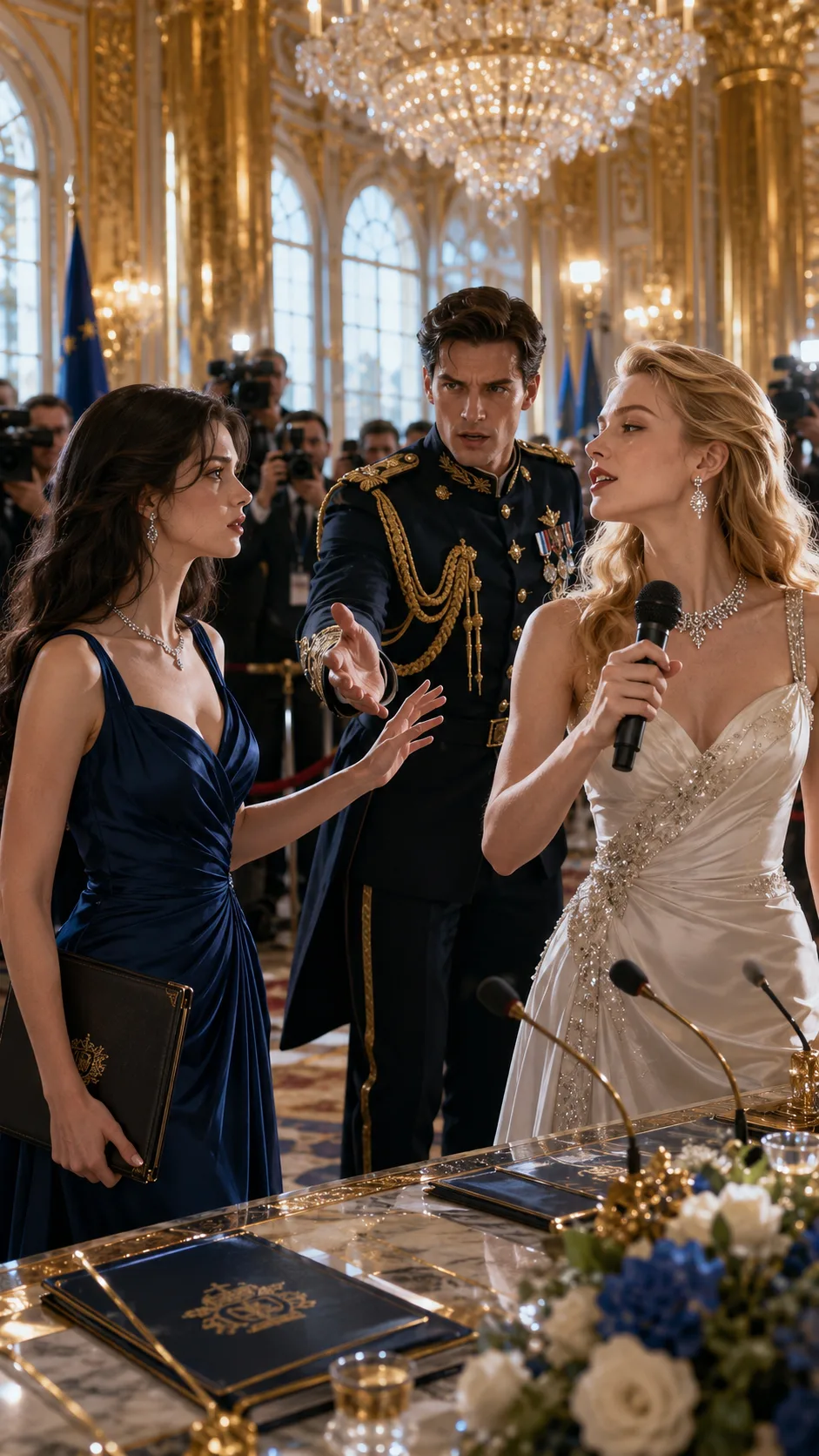
Beside the stage, Prince Alexander of Northmere stood with his council. He was tall, broad-shouldered, dressed in a navy royal military uniform with gold embroidery at the cuffs. Every camera loved him. Every newspaper called him disciplined, cold, impossible to manipulate.
Amelia had met him only four times.
The first time, he had been polite.
The second time, curious.
The third time, he had asked why the trade corridor numbers in the public draft were different from the sealed draft.
The fourth time, he had looked straight at her across
the treaty table and said, quietly, “You wrote this, didn’t you?”
Amelia had not answered.
Because Helena had been standing behind her.
Now Alexander’s eyes moved across the press hall, past Isabella, past the cameras, and stopped on Amelia.
For one breath, the noise faded.
Then Helena’s private secretary touched Amelia’s elbow.
“Behind the advisors,” he murmured.
Amelia stepped back.
It was always like this.
She was close enough to save them.
Never close enough to be seen.
The palace had trained her into silence after her father died. At first, Helena had called it protection. Valoria was grieving. The court was unstable. The old nobles did not trust a young princess who looked too much like her dead mother and asked too many questions. Amelia should stay out of the public eye, Helena said, just for a season.
A season became a year.
A year became a role.
Strategic assistant.
Policy advisor.
The woman behind the door.
The one who drafted speeches no one credited.
The one who corrected errors before ambassadors noticed.
The one who stood behind Isabella while Isabella waved.
Amelia had tried to fight it once.
She had walked into the council chamber with her father’s signet ring on a chain beneath her blouse and told Helena she wanted her title restored before the Northmere negotiations began.
Helena had not shouted.
That was the terrifying part.
She had simply opened a folder and slid across a report listing every staff member who had remained loyal to Amelia’s mother. Their names. Their debts. Their children’s schools.
“Crowns are heavy, my dear,” Helena had said. “So are consequences.”
After that, Amelia learned to work quietly.
She told herself the kingdom mattered more than pride.
She told herself a public title was less important than preventing war.
She told herself she could survive being erased as long as Valoria survived.
But when Isabella lifted her hand to the cameras that morning and smiled like she had already won, something in Amelia’s chest twisted.
The press chief stepped to the podium.
“Ladies and gentlemen, thank you for attending this historic broadcast. Today, Valoria and Northmere present the final framework of the Eastern Alliance Treaty, a partnership that will secure trade, defense, and diplomatic stability for the next generation.”
Flashbulbs cracked.
Reporters leaned forward.
The room hummed with the appetite of people waiting for a mistake.
The press chief continued, “Her Majesty Queen Helena will make opening remarks, followed by Princess Isabella and His Royal Highness Prince Alexander.”
Amelia’s fingers tightened around her folder.
Her own briefing notes sat inside it. Her maps. Her contingency charts. Her handwritten explanation of the disputed border language that could either calm three provinces or ignite them.
Helena rose.
She spoke beautifully. She always did when the words were someone else’s.
“Our nations are bound not only by duty,” Helena said, “but by shared values, mutual respect, and a vision of peace.”
Amelia heard her own sentence come out of Helena’s mouth.
No credit.
No pause.
No shame.
The cameras turned next to Isabella.
Isabella stood slowly, letting the light find the diamonds at her throat.
“Today is deeply personal for me,” she said.
Amelia almost closed her eyes.
The treaty was about grain routes, defense commitments, mineral access, naval corridors, and prisoner exchange protocols. It was not personal. It was political architecture built over months of sleepless nights.
But Isabella knew how to speak to cameras.
She placed one manicured hand over her heart.
“As a princess, I have always believed that leadership is about grace. About unity. About showing our people that we are stronger together.”
The press loved it.
Pens moved. Cameras blinked red.
Alexander did not smile.
When his turn came, he walked to the podium with the measured calm of a man stepping onto thin ice.
“Northmere welcomes cooperation,” he said. “But cooperation requires clarity. We will support any alliance that protects both nations honestly and equally.”
Honestly.
The word landed harder than it should have.
Helena’s smile did not move, but Amelia saw the tension appear at the corner of her jaw.
Then came the questions.
A reporter from the Capital Ledger stood first.
“Princess Isabella, the treaty mentions a shared military response if unrest spreads through the northern provinces. Critics say this may pull Northmere into Valoria’s internal conflicts. How do you answer that concern?”
Isabella’s smile froze for half a second.
Only half.
Most people would not have noticed.
Amelia did.
Isabella turned slightly toward Helena.
Helena’s eyes flicked to Amelia.
The press chief cleared his throat. “Strategic Advisor Amelia Gray will clarify the technical language.”
Gray.
Not Valorian.
Not princess.
Gray.
Her mother’s name, stripped of rank and used like a curtain.
The room shifted. Cameras adjusted. Some reporters looked disappointed, as if a policy answer was less entertaining than royal vanity.
Amelia stepped forward.
Every movement felt louder than it was.
Her navy satin dress was modest compared to Isabella’s diamonds, but it fit her with quiet elegance. Her hair was pinned low. Pearl earrings brushed her neck. She looked like exactly what Helena wanted the public to believe she was: useful, educated, replaceable.
An assistant handed her the microphone.
Amelia looked out at the room.
For one strange second, she imagined her father standing at the back wall, hands clasped behind him, waiting to see whether she would shrink.
She inhaled.
“The clause does not require Northmere to intervene in domestic unrest,” she said. “It limits joint action to verified cross-border threats, and only after review by both defense councils. The distinction matters because—”
A hand shot across her body.
Isabella snatched the microphone.
The sound cracked through the speakers.
The room went silent.
Then Isabella laughed.
Not loudly.
Just enough for the cameras to catch it.
“Let the princess answer,” Isabella said, smiling directly into the lens. “The assistant can explain paperwork later.”
For half a heartbeat, nobody moved.
Then several reporters laughed.
Not all of them.
Enough.
The kind of laughter people use when power tells them something is funny.
Amelia stood with her hand still half-raised where the microphone had been.
Heat climbed her throat.
Her face stayed calm because years in Helena’s palace had taught her that humiliation grows when you feed it.
But inside, something cracked.
She heard one journalist whisper, “Brutal.”
Another murmured, “That clip will go everywhere.”
Isabella lifted the microphone again, pleased with herself.
“Now,” she said, “as I was going to explain, this alliance simply means we will support each other as friends and family. There is no need to complicate what is clearly a beautiful agreement.”
Amelia looked down at the table.
Clause Seven was not beautiful.
Clause Seven was dangerous if misunderstood.
If Isabella’s answer became the public interpretation, the hardline ministers in Northmere could reject the entire treaty by sunset. The northern governors would accuse the crown of hiding military obligations. The markets would panic. Border commanders would move troops to prove strength. One careless sentence could undo everything.
Amelia’s hand tightened on the folder until the edge cut into her palm.
Helena smiled.
As if it was only a joke.
As if Amelia had not just been publicly reduced to a servant in front of two kingdoms.
Alexander moved.
It was a small movement at first. A shift of his shoulders. A step away from his council. But the room noticed. Cameras followed him the way iron follows a magnet.
He walked toward Isabella.
Isabella’s smile brightened. She thought he was coming to rescue the moment. To stand beside her. To make the clip look romantic instead of cruel.
He stopped in front of her and held out his hand.
“The microphone,” he said.
Isabella blinked.
“I was answering.”
“No,” Alexander said. “You were performing.”
The press hall tightened.
Helena stood halfway from her chair. “Your Highness, perhaps we should proceed with the prepared statement.”
Alexander did not look at her.
His eyes stayed on Isabella.
“The question was about Clause Seven,” he said. “What is the verification threshold for cross-border threat classification?”
Isabella’s lips parted.
The cameras zoomed in.
Someone stopped laughing.
“I believe,” Isabella said slowly, “that is handled by our ministers.”
“It is handled by the treaty,” Alexander replied. “What is the threshold?”
Her fingers tightened around the microphone.
“The spirit of the alliance is more important than technical language.”
Alexander’s expression did not change.
“That technical language decides whether soldiers cross a border.”
The silence became sharp.
Amelia felt every eye in the room shifting now. First to Isabella. Then to Helena. Then back to Alexander.
Helena stepped forward, her voice smooth as polished glass.
“Prince Alexander, Princess Isabella has worked closely with my advisors. There is no need to test her like a schoolgirl.”
Alexander finally turned to Helena.
“I am not testing a schoolgirl,” he said. “I am testing the woman your court has presented as the architect of this alliance.”
Isabella’s face changed.
There it was.
Fear.
Small, fast, but real.
Amelia saw it, and she knew Alexander saw it too.
The prince reached for the microphone. Isabella hesitated one second too long. Then he took it from her hand.
He turned toward Amelia.
The whole room turned with him.
Amelia’s pulse hammered in her ears.
Alexander crossed the space between them and held out the microphone, not like a favor, not like charity, but like returning something stolen.
“Then let us hear from the only woman in this room who knows what she is talking about,” he said.
The words hit the hall like a glass breaking.
A reporter gasped.
Isabella went white.
Helena’s smile disappeared.
Amelia stared at the microphone.
For years, she had survived by staying useful and invisible. She had told herself silence was strategy. She had let other people wear her work like borrowed jewels because the kingdom needed stability.
But now the cameras were on her.
Not because Helena allowed it.
Because the lie had become too loud to ignore.
Amelia took the microphone.
Her fingers did not shake.
At first, that surprised her.
Then it steadied her.
She turned to the reporters.
“The verification threshold is threefold,” she said. “A confirmed armed movement across the mapped border, independent intelligence from both councils, and written authorization from the joint defense committee. Without all three, no military response can be triggered under Clause Seven.”
No one laughed now.
Amelia opened her folder.
“The reason the clause is worded this way is because both kingdoms have suffered from false border alarms before. In 1998, one forged dispatch nearly caused a cavalry deployment. In 2011, a private mining dispute was misreported as a militia crossing. This treaty prevents those mistakes from becoming war.”
Pens moved again.
This time, not because of gossip.
Because she was giving them facts.
A Northmere minister leaned toward another and whispered, “She knows the archive cases.”
Amelia heard him.
So did Alexander.
A second reporter stood.
“Advisor Gray, does that mean Princess Isabella’s answer was incorrect?”
Amelia looked at Isabella.
Isabella’s eyes begged and threatened at the same time.
Helena’s stare was colder.
Amelia could still step back. She could soften the damage. She could say Isabella was speaking symbolically. She could protect the palace from embarrassment one more time.
Her father’s voice rose in memory.
A crown is debt.
Amelia turned back to the microphone.
“It means public language matters,” she said. “When leaders describe a defense treaty as a family promise, people may believe soldiers can be moved by emotion. They cannot. They must be moved by law.”
The room went completely silent.
Alexander’s eyes stayed on her.
Helena’s fingers curled around the edge of her chair.
The press chief tried to step in. “Perhaps we should move to the signing—”
“No,” Alexander said.
One word.
The press chief stopped.
Alexander faced the room. “I have a question before any signing proceeds.”
Helena’s chin lifted. “This is highly irregular.”
“So is presenting an unprepared woman as the political mind behind a military treaty.”
Isabella flinched as if the sentence had touched her skin.
Alexander reached inside his jacket and removed a sealed blue folder marked with Northmere’s crest. He placed it on the podium.
Amelia had seen that folder once before.
Three nights ago.
In the west archive.
She had been returning a treaty draft after midnight when she found Alexander standing alone by the old succession cabinet. He had not seemed surprised to see her.
“Your father’s records are incomplete,” he had said.
Amelia had frozen.
He had shown her a copy of the original alliance memorandum, signed six years before King Edmund died. It named Amelia as the primary royal negotiator upon reaching majority. It referred to her as Princess Amelia Rose Valorian.
Her full name.
The name Helena had spent years burying.
Amelia had stepped back from the document like it could burn her.
“How did you get this?” she had whispered.
“My father kept a duplicate,” Alexander said. “He trusted yours.”
“Then you know.”
“I know enough to ask why the woman who wrote the treaty is standing behind advisors while another woman wears her title.”
Amelia had told him not to interfere.
He had asked if the treaty was still safe.
She had said yes.
She had lied.
Now, in the press hall, Alexander opened the folder.
Helena’s face changed so quickly most of the room missed it.
Amelia did not.
Fear made Helena look older.
Alexander removed a single page.
“Before Northmere signs,” he said, “we require confirmation of authorship and authority.”
Helena laughed once. It was too soft and too sharp.
“Authorship? Are we publishing poetry now?”
“No,” Alexander said. “We are deciding whether the person authorized under the original memorandum was deliberately concealed from the negotiation.”
The reporters erupted.
Questions flew from every side.
“Your Highness, are you saying—”
“Is Princess Isabella not authorized?”
“Who is Amelia Gray?”
“Was the treaty misrepresented?”
Helena lifted a hand. “Enough. This broadcast is not a courtroom.”
“No,” Amelia said.
Her own voice surprised her.
Everyone turned.
Amelia looked at Helena, really looked at her, and felt years of swallowed words rise behind her ribs.
“No,” she repeated. “It is not a courtroom. That is why you thought you could control it.”
The cameras swung toward her.
Helena’s eyes narrowed.
“Careful, Amelia.”
Amelia smiled faintly.
Not because she was amused.
Because she was done being afraid.
“You have said that to me in private for six years,” she said. “Say the rest in public.”
The room stopped breathing.
Helena stepped down from the stage, emerald silk whispering around her feet.
“You are emotional,” she said, her voice low enough to sound maternal and loud enough for every microphone to catch. “You always have been. This is why your father trusted me to manage the kingdom after his death.”
“My father trusted you to protect the crown until I was ready.”
“You were never ready.”
There it was.
Not hidden. Not dressed as kindness.
The truth of Helena’s contempt stood naked under the lights.
Isabella gripped the back of her chair. “Mother, stop.”
Mother.
The word cut through the hall.
Reporters exchanged glances. Isabella was Helena’s daughter from her first marriage, adopted into court after Helena married King Edmund. Everyone knew that. Everyone also knew adoption into court did not make her heir by blood or treaty.
Alexander looked at Amelia.
“Do you have proof of your authority?” he asked.
Amelia opened the folder she had carried all morning.
Helena’s eyes dropped to it.
For the first time, her mask broke.
“You were told to bring only the briefing copy.”
“I did,” Amelia said.
She pulled out the top document.
Then the second.
Then the third.
Beneath them lay a cream-colored envelope sealed with faded red wax.
The royal archive seal.
Helena whispered, “No.”
Amelia heard it.
So did the microphones.
“My father left this in the succession cabinet,” Amelia said. “You moved the cabinet to the west archive after his funeral. You forgot he taught me every hidden lock in this palace before I turned twelve.”
Alexander’s mouth tightened, almost a smile, but not quite.
Amelia broke the seal.
The paper inside trembled only slightly as she unfolded it.
“My daughter Amelia Rose Valorian,” she read, “is to retain full royal status and treaty authority upon reaching twenty-one years of age. Any regent, spouse, minister, or guardian attempting to suppress her legal identity acts against the crown and the constitution of Valoria.”
Chaos broke loose.
Reporters shouted over one another.
Cameras pushed closer.
The press chief looked like he might faint.
Isabella sank slowly into her chair.
Helena did not move.
She stood in front of Amelia with a face carved from stone.
“That document is not verified,” she said.
Alexander lifted the Northmere folder. “My copy is.”
Helena turned on him. “You had no right.”
“I had every right to know who Northmere was binding itself to.”
“And now what?” Helena demanded. “You will humiliate a queen on foreign television because an assistant wanted attention?”
Amelia stepped closer.
The word assistant no longer landed where Helena wanted it to.
“No,” Amelia said. “You humiliated yourself when you let your daughter steal a microphone because you thought the room would laugh with you forever.”
Isabella’s eyes filled with tears, but Amelia knew better than to trust them.
“Amelia,” Isabella whispered. “I didn’t know it was this serious.”
Amelia looked at her.
“You knew enough to call me assistant.”
Isabella flinched.
That was the moment everything changed.
Not the document.
Not Alexander’s folder.
Not the reporters shouting.
It was Isabella flinching because, for the first time, Amelia’s words had power in public.
Alexander returned to the podium.
“Northmere will suspend the signing until Valoria confirms its lawful representative,” he said.
Helena’s head snapped toward him. “Suspend?”
“Not cancel,” he replied. “Suspend. Because the treaty is sound.”
His eyes moved to Amelia.
“The person who wrote it made sure of that.”
The room shifted again, but this time the movement felt different. Less like scandal. More like recognition.
A reporter from Northmere stood. “Lady Amelia—sorry, Princess Amelia—do you intend to claim your title?”
Princess Amelia.
The words moved through her like sunlight entering a locked room.
Amelia did not answer immediately.
She looked at the press hall, at the chandeliers, at the flags of two kingdoms hanging side by side. She looked at the councilors who had ignored her for years and were now staring as if she had appeared from nowhere. She looked at Helena, whose silence had become its own confession.
Then Amelia looked at the camera.
“My title was never something I needed to claim,” she said. “It was something others needed to stop stealing.”
For once, no one laughed.
The broadcast ended twelve minutes later, but the damage had already escaped the palace.
By noon, the clip had crossed every border.
Isabella snatching the microphone.
Her laugh.
The line about paperwork.
Alexander asking one question.
Her failure to answer.
Then Amelia standing under the lights, calm as a blade, explaining the treaty Isabella could not even summarize.
The people of Valoria watched it in cafés, offices, university halls, and train stations. Some watched because they loved scandal. Some watched because they hated Helena. Some watched because they had believed for years that Princess Amelia had disappeared from public life by choice.
By evening, they understood she had been hidden.
Outside the palace gates, the crowd began with twenty people.
Then fifty.
Then hundreds.
They carried no weapons. Only candles, old photographs of King Edmund, and signs bearing Amelia’s true name.
Inside the palace, Helena demanded the broadcast records be sealed.
The legal council refused.
She demanded the royal guard remove Amelia from the east wing.
The captain of the guard, a man who had served King Edmund for thirty years, looked at Amelia and bowed.
“Your Highness,” he said.
Helena slapped him.
The sound echoed down the corridor.
No one moved to support her.
That was when Helena finally understood the palace had not loved her.
It had feared her.
Fear looks like loyalty until the first door opens.
The next morning, the constitutional court convened an emergency review. Alexander remained in Valoria as Northmere’s official witness. He did not sit beside Amelia during the hearing. He sat across from her, with his council, because he understood something most princes did not.
If Amelia was to stand, she had to be seen standing on her own.
Helena’s lawyers argued that Amelia had withdrawn voluntarily from public duty.
Amelia’s lawyers produced six years of restricted memos signed by Helena forbidding Amelia from attending state ceremonies.
Helena’s lawyers argued that Isabella had been introduced only as a ceremonial princess.
The court played the press conference clip.
Princess Isabella of Valoria.
The hall fell quiet.
Helena’s lawyers stopped arguing that point.
Then came the private threats.
Amelia had kept records.
Not everything. Not enough to look vindictive. Just enough to show a pattern. Staff dismissed after defending her. Letters intercepted. Invitations declined in her name. Her father’s ring removed from the royal registry. Her mother’s portrait moved to storage.
When the chief justice asked why she had not come forward sooner, Amelia answered honestly.
“Because I thought protecting the kingdom meant absorbing the damage myself.”
“And now?”
“Now I understand that a kingdom built on silence is already damaged.”
The ruling came at sunset.
Amelia Rose Valorian was recognized as the lawful princess of Valoria and the authorized representative under the original alliance memorandum. Helena was removed from treaty authority pending investigation. Isabella retained no political title beyond court courtesy.
No one clapped in the courtroom.
It was not that kind of victory.
It felt heavier.
Cleaner.
Like a door opening onto a room full of dust.
That night, Amelia returned to the press hall alone.
The chairs had been cleared. The nameplates removed. The chandeliers were dimmed, and the cameras were gone.
She walked to the spot where Isabella had taken the microphone from her hand.
For a moment, she stood there and let herself feel it.
The shame.
The anger.
The years.
Then footsteps sounded behind her.
She did not turn.
“I thought I would find you here,” Alexander said.
Amelia looked at the empty podium. “You embarrassed a queen on live television.”
“She had practice embarrassing others.”
Despite herself, Amelia almost smiled.
Almost.
“You could have warned me.”
“I thought you might refuse.”
“I would have.”
“I know.”
She turned then.
Alexander stood a respectful distance away, hands behind his back, uniform jacket gone, white shirt sleeves rolled once at the wrist. Without the cameras, he looked less like a symbol and more like a man who had chosen the harder path and was waiting to see whether it had cost too much.
“Why did you do it?” Amelia asked.
“For the treaty.”
“That is not the whole answer.”
“No.”
He was quiet for a second.
Then he said, “Because when Isabella took that microphone, everyone laughed except you. You looked like you had been trained not to react. I know what courts do to people they plan to use. I also know what it means when the only competent person in the room is treated like furniture.”
Amelia swallowed.
The room blurred slightly, not with tears exactly, but with exhaustion.
“I did not need rescuing.”
“I know.”
“Then what was that?”
Alexander stepped closer, but not too close.
“A door.”
Amelia looked away.
Outside, the crowd beyond the gates was still chanting her name. Softly now. Like a tide.
“Doors can close again,” she said.
“Not if you walk through them.”
The next week, the alliance summit resumed.
This time, the seating chart was different.
Princess Amelia Rose Valorian sat at the center of the Valorian delegation, not behind advisors, not beside a wall, not holding someone else’s papers. Her nameplate stood in front of her in gold.
Across the table sat Prince Alexander of Northmere.
Beside the press ropes stood Isabella in a pale gray dress with no diamonds at her throat. Helena was absent. Officially, she was unwell. Unofficially, she was answering questions from investigators about forged correspondence, restricted access orders, and misuse of royal authority.
The press chief looked nervous as he began.
“Your Highness, would you like to make a statement before the signing?”
Amelia looked at the microphone.
No one grabbed it.
She placed one hand on the treaty folder.
“Yes,” she said.
The room waited.
Amelia looked toward the cameras, then toward the ministers, then finally toward her own people watching from beyond the hall.
“For years, many people believed peace required silence,” she said. “Today, Valoria signs a treaty built on the opposite belief. Peace requires truth. It requires law. It requires leaders who understand the documents they sign and the people they affect.”
Alexander’s expression softened for the first time that morning.
Amelia continued, “This alliance will not be a family promise. It will be a lawful partnership between two sovereign nations. It will not be protected by performance. It will be protected by accountability.”
She signed first.
Her name moved across the page in black ink.
Amelia Rose Valorian.
Not Gray.
Not assistant.
Not hidden.
Alexander signed after her.
When he finished, he closed the folder and looked up.
This time, the applause began slowly.
One person.
Then another.
Then the whole hall.
Amelia did not smile for the cameras.
Not at first.
She looked to the back row, where the old captain of the guard stood straight despite the bruise Helena had left on his cheek. He bowed.
Then Amelia smiled.
Small.
Real.
Hers.
Weeks later, Isabella requested a private meeting.
Amelia almost refused.
Then she remembered all the years she had mistaken silence for strength and decided she would not build her reign from the same stone Helena had used.
They met in the winter garden, beneath glass panes silvered with rain.
Isabella arrived without pearls, without cameras, without Helena.
For once, she looked young.
“I hated you,” Isabella said.
Amelia waited.
“Not because you were cruel,” Isabella continued. “Because you made me feel temporary. Even when no one said your name, the palace belonged to you. The portraits looked like you. The old guards softened when you passed. The ministers trusted your notes more than my speeches. Mother told me if I did not take the place, I would have no place at all.”
Amelia looked at the rain sliding down the glass.
“That may explain it,” she said. “It does not excuse it.”
“I know.”
Isabella’s voice broke on the second word.
Amelia did not reach for her.
Some wounds did not need a comforting hand. They needed space to remain true.
“I cannot give you back what I helped take,” Isabella said. “But I can testify.”
Amelia turned.
“In court?”
“Against my mother.”
The garden became very quiet.
Outside, rain tapped the glass like fingers.
Amelia studied her stepsister’s face and found, beneath the vanity and fear, something she had not expected.
Shame.
Real shame.
Not useful. Not polished. Not performed.
“Why?” Amelia asked.
Isabella looked down. “Because when Alexander asked me that question, I realized I had spent years pretending to be a woman I had never tried to become.”
Amelia did not forgive her that day.
But she accepted the testimony.
Helena’s trial lasted six months.
The kingdom watched every careful revelation: the forged refusals, the sealed records, the staff punishments, the quiet rewriting of Amelia’s life. Helena never confessed. Even at the end, when the court stripped her of royal authority and sentenced her to exile at the northern estate, she stood straight and cold.
As guards escorted her from the chamber, she passed Amelia.
“You think they love you now,” Helena said under her breath. “Wait until they need someone to blame.”
Amelia looked at the woman who had stolen years and mistaken control for power.
“They may blame me,” she said. “But they will know my name when they do.”
Helena had no answer.
A year after the live broadcast, Valoria and Northmere opened the Eastern Trade Corridor together.
No diamonds. No stolen microphone. No fake laughter.
Just a bridge, a crowd, and two flags moving in the wind.
Amelia stood beside Alexander as the ribbon was cut. Their alliance had become stronger than either court expected, not because it was romantic, not because it looked good on camera, but because both of them had learned to distrust performance and respect competence.
The reporters still asked about that first broadcast.
They asked whether Amelia hated watching the clip.
She told them the truth.
“No,” she said. “I keep a copy.”
The journalist looked surprised. “Why?”
Amelia glanced across the bridge, where young girls in school uniforms waved small Valorian flags and shouted her name without fear.
“Because it reminds me that sometimes the moment meant to silence you becomes the first time everyone hears you clearly.”
Behind her, Alexander laughed softly.
Not at her.
Never at her.
With her.
Amelia looked toward the cameras and did not step back.
This time, the microphone was already in her hand.
THE END.
Chapter complete
You have reached the end of this chapter.
Continue reading
A few more worlds to get lost in after this chapter.