The first thing I noticed was that my chair had been moved.
Chapter 1
The first thing I noticed was that my chair had been moved.
Not far. Just a few inches away from Daniel’s place setting, enough for the gap to look accidental to anyone who did not know Margaret Whitmore. The silverware still lined up perfectly. The linen napkin still sat folded into a sharp little triangle on the plate. The crystal water glass still caught the chandelier light.
But my chair was not beside my husband’s anymore.
It was beside Lily’s.
My daughter climbed into the chair next to mine, her pale blue cardigan buttoned wrong at the bottom because she had insisted on dressing herself after ballet class. She had a purple sticker stuck to the cuff of one sleeve. A tiny dinosaur, of all things. She kept rubbing it with her thumb while she looked around the dining room.
“Grandma has the big plates tonight,” she said.
“She does,” I answered.
Margaret heard us from the far end of the table.
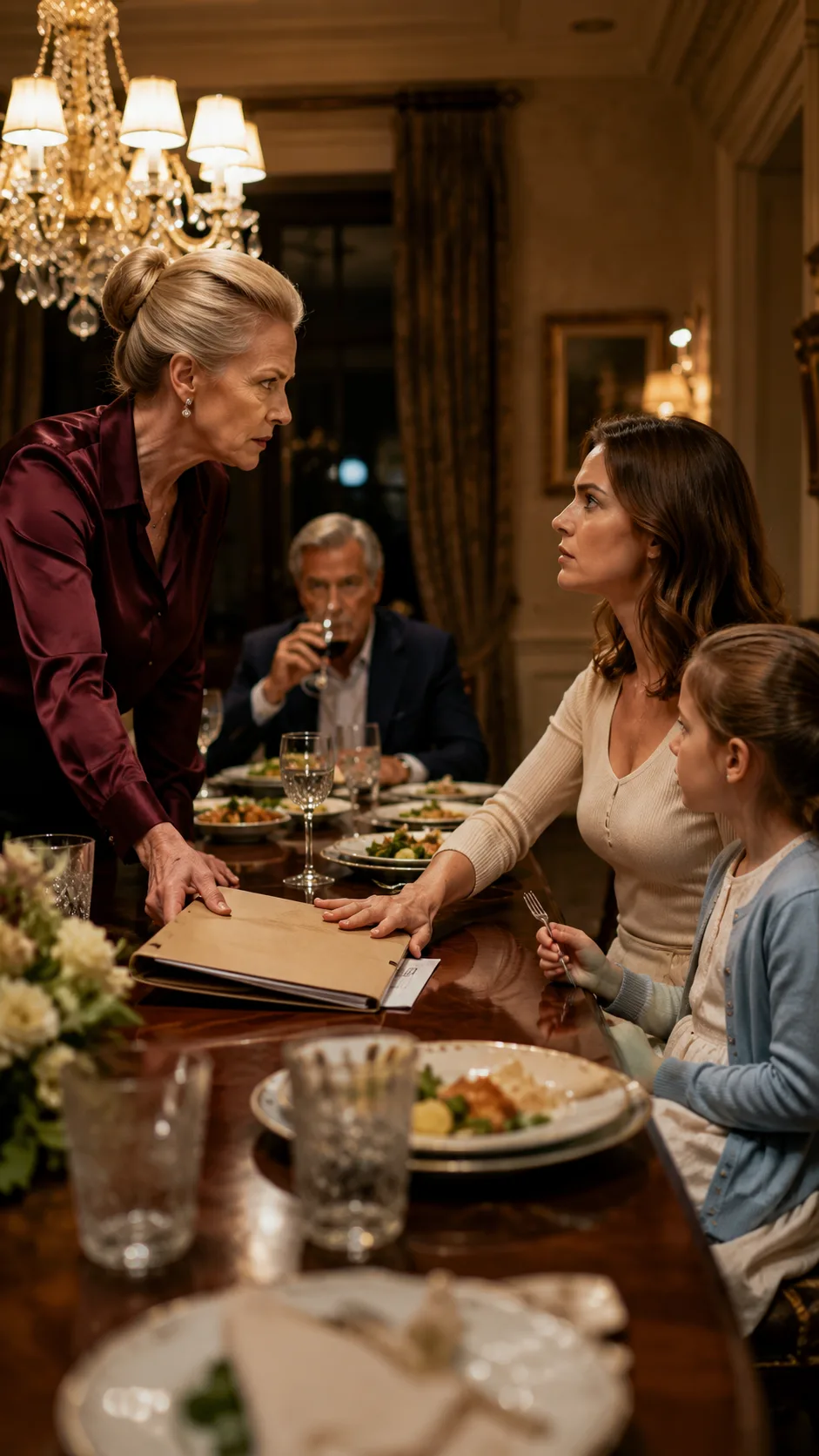
She stood near the sideboard in a burgundy satin blouse, silver-blonde hair pinned into the tight bun she wore whenever she wanted to look untouchable. Pearls at her ears. Pearls at her throat. One hand resting lightly on the back of Robert’s chair.
Robert Whitmore, my father-in-law, sat at the head of the table with his wine glass untouched.
Daniel sat two chairs away from me.
That was the second thing.
He did not look at me when I entered. He did not stand. He did not ask whether traffic had been bad or whether Lily had remembered her ballet shoes or whether I had eaten since lunch. He adjusted his cuff link and kept his eyes on the plate in front of him, as if the empty porcelain had become the most demanding thing in the room.
I had known the Whitmores for nine years. Married into them for
eight. By then, I understood their language.
A shifted chair meant I had been reassigned.
A quiet husband meant he had already agreed to something.
A formal dinner on a Thursday meant Margaret had witnesses.
The old clock near the French doors ticked three times before anyone spoke.
Margaret smiled at Lily.
“Sweetheart, why don’t you eat your carrots before they get cold?”
Lily looked down at the little orange half-moons arranged beside her chicken. She always pushed them into circles when she felt watched. One circle. Then another. Her fork tapped the plate.
Tap.
Tap.
I placed my hand on her knee under the table.
Daniel finally looked up, but not at me. At his mother.
That was the third thing.
Margaret sat after everyone else did. She let the silence stretch until it belonged to her. The dining room was too warm, the candles too tall, the flowers
too white. Someone had placed lilies in a glass bowl at the center of the table. I hated lilies at dinner. They smelled clean in the wrong way, like a hospital hallway after visiting hours.
Robert cleared his throat.
“Margaret.”
She did not look at him.
“Dinner first,” she said.
No one believed her.
A small bowl of soup was placed in front of each of us by a housekeeper I did not recognize. Margaret had hired new staff again. She liked strangers in the room when she needed family to behave. The soup was pale and glossy, with a swirl of cream on top. Lily leaned over it and frowned.
“Is this onion?”
“Leek,” I said.
She looked at me like that did not improve the situation.
I almost smiled.
Almost.
Across the table, Daniel’s phone buzzed once. He turned it face down so quickly that his knuckle struck the wood.
Margaret’s eyes moved to him.
Not fast. Not obvious. Just enough.
I saw it.
He saw that I saw it.
His hand stayed on the phone.
“Daniel,” Robert said, “put it away.”
Daniel slipped it into his jacket pocket without a word.
Margaret lifted her spoon. “We are not here to discuss phones.”
“No,” Robert said. “Apparently not.”
A small crack opened in the room then. Not enough for anyone to step through. Enough for me to feel the draft.
Margaret ate two spoonfuls. Daniel ate none. Robert touched the stem of his wine glass and then released it. The other two relatives Margaret had invited, Daniel’s aunt and cousin, kept their eyes lowered. They had learned the same language I had.
Do not interrupt Margaret.
Do not ask direct questions.
Do not save anyone unless you are ready to be next.
Lily tried one spoonful and made a face she thought was private. I reached for her water glass, but Margaret spoke before I could pass it.
“Emma, I heard you went by Daniel’s office again yesterday.”
My hand stopped around the glass.
“I dropped off Lily’s school forms. Daniel forgot them.”
Daniel looked at the tablecloth.
Margaret’s smile did not change. “His assistant could have handled that.”
“His assistant didn’t marry me.”
Robert’s mouth tightened.
Aunt Caroline set her spoon down.
Margaret dabbed the corner of her mouth with her napkin, although there was nothing there. “That is exactly the problem, isn’t it?”
The housekeeper entered again to remove the soup bowls. The spoon in Lily’s bowl slid to one side with a soft ceramic scrape. Lily watched it like it was more interesting than the adults.
I kept my voice even. “What problem?”
Margaret folded her napkin on the table.
Dinner was over.
The main course had not even been served.
She reached to the empty chair beside her and lifted a thick tan folder from the seat. It had been there the whole time, hidden by the fall of the tablecloth and the floral arrangement. The folder was legal-sized, expensive, tied with a narrow black band.
Daniel closed his eyes.
Just once.
The tiny motion told me more than any confession.
Margaret placed the folder on the table in front of her. “There is no need to prolong this.”
Robert’s hand closed around his wine glass.
“Margaret,” he said again.
She ignored him again.
I looked at Daniel. “What is this?”
He opened his mouth. Nothing came out.
Not one word.
Lily looked up from her carrots.
Margaret untied the black band with two fingers, slow and neat, the way she opened gifts at charity luncheons when photographers were present. Then she turned the folder toward me and pushed it across the polished mahogany.
The folder slid past the lilies.
Past Robert’s untouched wine.
Past Daniel’s empty hands.
It stopped near my plate because I put my palm down.
Lily’s fork hovered in the air.
Margaret leaned forward.
“Sign it. My son is done with you.”
The words did not land loudly.
They landed clean.
Aunt Caroline looked at her lap. Daniel’s cousin reached for his water and missed the glass by an inch. Robert lowered his wine glass before he had taken a sip.
Lily blinked.
“What does sign mean?”
I did not look away from Margaret. “It means Grandma brought grown-up papers to dinner.”
Margaret’s eyes cut to me. “Do not make this childish.”
I turned the folder slightly, enough to see the top page. A marriage settlement dissolution agreement. Daniel’s name already printed. Mine waiting below it. A yellow tab marked where my signature belonged.
My thumb covered the line.
Daniel spoke then, barely.
“Emma, it’s better if—”
“No,” I said.
One word.
He stopped.
Margaret’s chin lifted. She had expected tears. She had expected questions. She had expected me to beg Daniel to explain. Margaret preferred women who begged. It gave her something to refuse.
I pushed the folder three inches away from Lily’s plate.
“Not in front of my daughter.”
Margaret gave Lily a long, assessing look, as if my child were a witness she had not approved.
“She should learn what failure looks like.”
The room went smaller.
Lily’s fork lowered to her plate.
Robert set his glass down at the exact center of his coaster.
Daniel stared at me then. Not with apology. Not with shame. With fear that I would say something he could not take back.
And I almost did.
I almost told Margaret that failure looked like a man who let his mother end his marriage for him. I almost told Daniel that I had smelled someone else’s perfume on his scarf two weeks earlier. I almost told Robert that his son had been coming home from “late board calls” with a parking receipt from a street nowhere near his office.
But Lily was beside me.
Her purple dinosaur sticker was peeling at the corner.
So I kept my hand on the folder and said nothing.
Margaret mistook silence for surrender.
She always had.
She tapped the signature tab twice.
Tap.
Tap.
“Emma,” she said, “you can leave with dignity tonight.”
I looked at Daniel. “Did you write that line for her?”
His face changed.
Just enough.
Margaret’s smile thinned. “Daniel is tired.”
“Daniel is sitting right there.”
“He has asked me to handle this.”
Robert turned his head toward his son. “Is that true?”
Daniel’s mouth tightened. He looked at his mother first.
Wrong answer.
Robert saw that too.
The air-conditioning hummed above the old plaster ceiling. One candle near the lilies had burned lower than the others and spilled a thin trail of wax down the brass holder. It looked messy. Margaret hated messy.
Lily reached for her water and knocked her fork slightly. It slid toward the edge of her plate, then stopped against a carrot.
That tiny sound pulled my eyes down.
A corner of paper was sticking out from beneath the tan folder.
Not one of the divorce pages.
This paper was smaller. Folded once. Cream-colored, with a faint blue stamp near the top edge. It must have caught under Margaret’s folder when she shoved it across the table. Maybe it had been tucked inside by mistake. Maybe someone had pulled the folder from a larger stack too quickly.
Maybe Daniel had been careless.
He had become careless lately.
Lily saw it too.
Her eyes followed mine.
Then her small fingers moved toward the corner.
Margaret’s hand shifted.
Fast.
Only an inch, but fast enough.
I placed my palm flat over the folder before Margaret could pull it back.
The room noticed that.
Lily touched the paper.
“Mommy,” she said.
Margaret’s voice sharpened. “Lily, leave that alone.”
Children understand commands. They also understand when a command is not meant to protect them.
Lily pulled the paper halfway out.
Daniel stood so quickly his chair legs dragged against the floor.
Robert’s voice cut across the table. “Sit down.”
Daniel stayed half-raised, one hand gripping the chair back.
Emma, he mouthed.
Not “please.”
Not “I’m sorry.”
Just my name, as if I were a door he needed closed.
I looked at Lily. “It’s okay.”
Margaret said, “That document is private.”
I kept my hand on the folder. “So was my marriage.”
Nobody moved.
Lily unfolded the paper with careful fingers. She had learned to unfold school notices that way, smoothing the crease before reading the top line. The paper trembled slightly in her hands, not because she knew what it was, but because every adult in the room had stopped pretending.
She tilted it toward herself.
The text was dense. Legal language. Property transfer. Lease option. Private residential unit.
A Manhattan address I recognized at once.
East 74th Street.
The parking receipt in Daniel’s jacket had been from East 74th.
The perfume on his scarf had arrived on a night he said he had slept at the office.
And near the bottom of the page, below Daniel’s printed name, below another signature I did not know, was a witness line.
Margaret E. Whitmore.
My daughter sounded it out.
“M-a-r…”
Margaret reached across the table.
I slid the paper away from her hand and placed it in the center, between the lilies and the divorce folder.
The motion was small.
It changed the room.
Robert leaned forward.
Daniel sat back down.
Aunt Caroline’s napkin slipped from her lap to the floor, and she did not pick it up.
Lily looked from the signature to her grandmother. Her forehead folded in the way it did when she tried to understand adult handwriting.
“Grandma,” she said, “why did you sign Daddy’s apartment paper?”
No one breathed right.
Margaret’s hand remained suspended over the table.
Daniel looked at the document as if he could make the ink disappear by staring hard enough.
Robert reached for the paper, then stopped and looked at me. He did not ask permission out loud. That mattered.
I nodded once.
He picked it up.
The paper made a soft sound as it lifted from the table. Loud enough for everyone to hear.
Margaret found her voice. “Robert, that is not what it looks like.”
Robert read.
His eyes moved once across the page, then again, slower.
Daniel said, “Dad—”
Robert raised one hand.
Daniel stopped.
Lily leaned against my side. I put my arm around the back of her chair but did not pull her away. Not yet. Not before the adults finished what they had dragged her into.
Robert lowered the paper.
“Daniel,” he said, “whose apartment is this?”
Daniel’s throat moved. “It was temporary.”
Margaret shut her eyes for half a second.
There it was.
Not denial.
Timing.
She had known.
Robert turned to her. “And why is your signature on it?”
Margaret’s expression rearranged itself into something almost calm. Almost. “Because Daniel needed discretion.”
Aunt Caroline made a sound under her breath.
Robert’s hand tightened on the paper. “Discretion.”
Margaret lifted her chin. “For the family.”
I laughed once.
It came out wrong. Too quiet. Too dry.
Margaret looked at me as if the sound had offended her more than the document.
“For the family,” I repeated.
Daniel leaned toward me. “Emma, this doesn’t have to get worse.”
“It already did.”
He looked at Lily and then away.
That was the last time I waited for him to become the man I had married.
Robert placed the apartment document flat on the table. Then he placed the divorce folder beside it. Two stacks of paper. Two versions of truth. Margaret’s stack and the one she had not meant anyone to see.
The lilies between them looked ridiculous now.
Too white.
Too staged.
Robert turned the apartment document so that everyone at the table could see the signature line.
Margaret’s name sat there in blue ink.
Not printed.
Signed.
A witness.
An accomplice.
A mother protecting her son’s apartment while handing his wife divorce papers at dinner.
Lily pointed at the line again. “That says Grandma, right?”
I covered her hand gently. “Yes.”
Margaret’s mouth opened.
For the first time all night, no sentence came ready.
Robert looked at her. “Tell this table whose apartment that is.”
Margaret did not answer.
Daniel did.
“Robert, please.”
He used his father’s first name when he was cornered. I had never noticed before.
Robert’s eyes stayed on Margaret. “I asked your mother.”
The room had belonged to her when I walked in.
It did not anymore.
Margaret’s fingers lowered to the table edge. She touched the wood once, as if steadying herself. The candle wax had hardened in a crooked line beside the lilies. The housekeeper stood frozen near the doorway with a tray she should have carried away minutes ago.
Margaret said, “It was handled.”
Robert’s face did not change. “Handled for whom?”
Daniel pushed back from the table. “I made a mistake.”
“No,” I said.
My voice surprised everyone, including me.
Daniel looked at me.
I stood slowly, keeping one hand on Lily’s chair.
“A mistake is forgetting school forms,” I said. “A mistake is missing dinner. A signed apartment paper is a plan.”
Margaret’s eyes narrowed. “You will not speak to him like that in my house.”
Robert picked up the divorce folder and closed it.
The sound was soft.
Final.
“This is my house,” he said.
Margaret turned toward him.
He did not raise his voice. He did not need to. The Whitmore dining room, with its polished table and old portraits and crystal glasses, seemed to lean toward him for the first time all evening.
He looked at me. “Emma, take Lily upstairs to the sitting room. Mrs. Bell will stay with you.”
The housekeeper near the door stepped forward. So she was not new after all. Mrs. Bell had worked for Robert’s sister years ago. Margaret had not hired her.
Robert had.
Another small thing I had missed.
I looked at Lily. “Come on, sweetheart.”
Lily held the edge of the table. “Did I do something bad?”
The question hit harder than anything Margaret had said.
I knelt beside her chair. Not all the way, because my legs did not feel steady enough, but enough to be at her height.
“No,” I said. “You read carefully. That is never bad.”
She looked at the paper in Robert’s hand. “Is Daddy in trouble?”
Daniel made a small sound.
I did not look at him.
“Daddy has grown-up things to answer,” I said.
Lily accepted that because children accept what they can carry and leave the rest on the floor for adults to trip over.
She climbed down from the chair. Her fork fell from the edge of the plate and struck the wood before landing on the carpet. No one picked it up.
Mrs. Bell opened the door.
As I led Lily out, Margaret spoke behind me.
“Emma.”
I stopped, but I did not turn.
“If you leave this room now,” she said, “do not expect to come back the same way.”
I looked over my shoulder.
She stood beside the divorce papers she had brought like a weapon. Robert held the apartment document. Daniel sat between them, smaller than I had ever seen him.
“I wasn’t planning to,” I said.
The sitting room upstairs smelled like lemon polish and old books. Lily sat on a velvet chair that was too big for her and asked for paper. Mrs. Bell found a notepad in the desk drawer and a pencil sharpened to a perfect point.
Lily drew circles.
Carrots at first.
Then tables.
Then four people with long arms.
I stood by the window and watched the dark garden beyond the glass. Downstairs, voices rose once, then dropped. A door closed. Another opened. The old house carried sound strangely, giving you pieces without meaning.
Lily held up the drawing.
“Grandma looks mad,” she said.
The woman in the drawing had triangle hair and very long fingers.
“She probably is.”
“Are you?”
I looked at the drawing. Then at my daughter. The purple dinosaur sticker had come off her cuff and was stuck to the side of the chair.
“I am thinking.”
Lily nodded like that made sense. “I think Daddy should say sorry.”
“So do I.”
“Will he?”
I did not answer quickly enough.
She went back to drawing.
Downstairs, the argument ended with silence. Not peace. Just no more sound.
Robert came up twenty minutes later. He knocked before entering, which he had never done in his own house. He held the apartment document in one hand and the closed divorce folder in the other.
Daniel was not with him.
Neither was Margaret.
Robert looked at Lily first. “May I speak to your mother for a minute?”
Lily nodded solemnly. “I’m drawing Grandma’s angry hands.”
Robert glanced at the paper. “Very accurate.”
For the first time that night, something almost human moved across his face.
Mrs. Bell took Lily to the small library next door under the promise of finding colored pencils. When the door closed, Robert placed both folders on the desk.
“I knew Daniel was unhappy,” he said. “I did not know this.”
I kept my arms folded because if I dropped them, my hands might shake.
“Margaret did.”
“Yes.”
He did not defend her.
That mattered too.
Robert looked older than he had at dinner. Not weak. Just less polished. His navy dinner jacket sat slightly crooked at one shoulder.
“I have already called Richard Hale,” he said. “He handles the family legal work independent of Margaret. He will contact your attorney tomorrow morning.”
“I don’t have an attorney.”
“You will. Not mine. Yours.”
I looked at the divorce folder. “Did Daniel sign?”
Robert nodded once.
I let the information settle on the desk between us.
It did not break me.
That surprised me.
“I want Lily protected,” I said.
“She will be.”
“Not by promises.”
Robert accepted that with a small tilt of his head. “By documents.”
The word should have sounded cold. That night, it sounded honest.
He slid the apartment paper toward me. “This copy is yours. Margaret will not touch it.”
I did not pick it up right away.
“Where is Daniel?”
“In my study.”
“And Margaret?”
Robert’s mouth tightened. “In the dining room.”
Still with her flowers. Still with her perfect table. Still where she had chosen to make a spectacle and then become one.
I picked up the apartment document.
The signature was clearer under the desk lamp. Margaret E. Whitmore. Blue ink. Confident slant. No hesitation.
There are people who betray you with trembling hands.
Margaret had signed like she was approving a seating chart.
The next morning, Lily refused carrots at breakfast.
I did not blame her.
We stayed at a hotel for three nights, then moved into a townhouse Robert arranged through a rental agency without Margaret’s name anywhere on the paperwork. He did not call it help. He called it logistics. That was easier for both of us.
Daniel called eleven times the first day.
I answered once.
He said, “I never wanted it to happen like that.”
I looked at Lily’s ballet shoes lined up by the door. One ribbon was frayed at the end.
“How did you want it to happen?”
He had no answer.
After that, I let my attorney take his calls.
The apartment turned out to be leased under a small holding company connected to Margaret’s private accounts. Daniel had used it for four months. The woman whose signature appeared above Margaret’s was not a stranger, not exactly. She worked with a consulting firm Margaret had recommended to Daniel the previous winter.
Every thread led back to the same careful hand.
Margaret sent one message through Robert.
She wanted to see Lily.
I said no.
Not forever.
Just not while Lily was still asking whether reading a paper had made everyone upset.
Margaret did not like conditions. She liked access. She liked rooms arranged before anyone else entered them.
For the first time since I had known her, access was not hers to take.
The legal process was not dramatic in the way people imagine. There were no speeches. No public collapses. No cinematic confrontation in a courtroom. There were emails, statements, bank records, revised custody proposals, and Daniel’s signature appearing in more places than his courage ever had.
Robert kept his distance but not his silence. He provided the apartment document, the payment trail, and one brief written statement that said Margaret had knowingly concealed material information during a family legal discussion.
Material information.
That was the phrase lawyers used for a grandmother’s signature on a secret apartment paper.
Margaret moved out of the mansion before Thanksgiving. Robert did not announce it. One afternoon, Mrs. Bell told me the burgundy napkins had been removed from the dining room drawers, and I understood.
Daniel saw Lily twice a week at a supervised family center at first. Later, when she stopped flinching at folders and adult papers, the visits changed. He learned to bring coloring books instead of excuses. He learned to answer small questions plainly.
Some fathers grow when they are exposed.
Some only shrink more neatly.
Daniel did both for a while.
One Saturday, he brought Lily a new sheet of dinosaur stickers. Purple ones. She accepted them, then handed one to me when she came home.
“For your laptop,” she said.
I stuck it on the corner.
The townhouse dining table was smaller than the Whitmore table. No polished mahogany. No crystal glasses. No lilies. One leg had a tiny wobble unless you folded a napkin under it. Lily loved that. She said the table had a secret foot.
On the first night we ate there, I made roasted chicken and carrots cut into small half-moons.
Lily arranged them into a circle.
Then she broke the circle with her fork and ate one.
I watched her chew.
She looked at me. “What?”
“Nothing.”
“You’re doing the thinking face.”
I smiled then. A real one. Small, but mine.
The divorce became final in March. I signed in a plain office with beige walls and a printer that jammed twice before producing the last page. My attorney apologized for the delay. I told her not to.
I had learned to appreciate papers that took their time.
Robert came by the townhouse one week later with a box of Lily’s books from the mansion. He placed it by the door and did not come in until I invited him.
He looked at the little dining table, the mismatched chairs, the purple sticker on my laptop.
Then he looked at me.
“Are you all right here?”
I thought about the shifted chair at Margaret’s table. The folder under her hand. The way Lily’s voice had cut through a room full of adults who thought silence was safer than truth.
I looked at our small table with its secret foot.
“Yes,” I said.
Lily ran in from the hall holding a drawing. This time, it was three people at a round table. One with brown hair. One with a blue cardigan. One gray-haired man standing near the door with a box.
Robert looked at it for a long time.
“Where is Grandma?” he asked.
Lily pointed to the edge of the paper. A tiny figure stood outside the house, drawn smaller than everyone else.
“She’s not invited yet,” Lily said.
Robert folded his hands in front of him.
“That seems fair.”
Months later, Margaret wrote a letter. Not an email. Not a message through Robert. A real letter on thick cream paper, her handwriting as controlled as ever.
She did not apologize well.
People like Margaret rarely do.
But she wrote Lily’s name without ownership. She wrote mine without insult. She wrote that she had mistaken control for protection, which was the closest she could come to the truth without touching it directly.
I placed the letter in a drawer.
Not hidden.
Not displayed.
Just kept.
Lily asked about it once.
“Is that Grandma’s paper?”
“Yes.”
“Do I have to read it?”
“No.”
She nodded and went back to her homework.
That was the difference now.
Papers no longer entered our home as weapons. They waited until we were ready.
On Lily’s eighth birthday, she asked for dinner at home instead of a party. She wanted chicken, carrots, and chocolate cake with too many candles. Robert came. Daniel came for dessert and brought a gift wrapped badly enough that Lily laughed before opening it.
Margaret did not come.
But she sent a card.
Lily read it at the table, slowly and carefully, the way she had read that apartment document months before. Her finger moved under each line. Her lips formed the harder words.
Then she set it down beside her plate.
“What does it say?” Daniel asked.
Lily looked at me first.
I nodded.
She looked back at him. “It says Grandma hopes I have a beautiful birthday.”
Daniel waited. “Anything else?”
Lily picked up her fork.
“She signed her own name this time.”
No one rushed to fill the silence.
No one needed to.
The carrots sat in a bright little circle on her plate, and this time, nobody moved my chair.
Chapter complete
You have reached the end of this chapter.
Continue reading
A few more worlds to get lost in after this chapter.