She Lost the Crown Princess Vote Until the Royal Lawyer Exposed the Queen Who Bought Every Ballot
The first time Isabella told me votes chose queens, she was standing in front of my mirror, wearing my mother’s pearls.
Chapter 1
She Lost the Crown Princess Vote Until the Royal Lawyer Exposed the Queen Who Bought Every Ballot
The first time Isabella told me votes chose queens, she was standing in front of my mirror, wearing my mother’s pearls.
Not copies.
Not ceremonial pieces from the palace vault.
My mother’s pearls.
The same small, luminous pearls King Edmund had given Queen Rose on the night their daughter was born. The same necklace that had disappeared from the eastern archive three days after my father died. The same necklace Helena later claimed had been “misplaced during inventory.”
Now it sat around Isabella’s throat like history had chosen her.
I stood behind her with a silver tray of documents in my hands, dressed not like a princess, not like a daughter of the crown, but like what Helena had trained the palace to call me.
An assistant.
A strategic aide.
The quiet girl who drafted treaties, corrected speeches, and disappeared before photographers turned their cameras.
Isabella tilted her chin and smiled at her reflection.
“Do you think they’ll photograph me from the left?” she asked.
“They always do,” I said.
My
voice sounded calm.
That was the part people misunderstood about calm women. They thought silence meant weakness. Sometimes it meant calculation. Sometimes it meant you were counting every lie in the room because one day you would need the exact number.
Isabella adjusted one pearl with the tip of her finger.
“You should look happier, Amelia.”
I placed the tray on the dressing table. “The Royal Council is voting today. Happiness is not usually part of constitutional procedure.”
She laughed softly. “There it is again. That little voice you use when you want people to remember you’re clever.”
I met her eyes in the mirror.
She was twenty-four, golden-haired, polished, perfectly taught. Helena’s daughter from a marriage the court pretended had never been scandalous. Isabella had been raised in sunlight. Every dress fitted to her body. Every tutor instructed to praise her. Every mistake covered by someone else’s signature.
Usually
mine.
She turned away from the mirror and faced me.
“My mother says you still believe being useful matters.”
“It does.”
“To servants.”
The room went very still.
A maid standing near the wardrobe lowered her eyes. The stylist froze with a hairpin between two fingers. Even the palace clock seemed quieter.
I looked at Isabella’s necklace, then at her face.
“I’m not a servant.”
Her smile widened.
“Of course not. You’re paperwork with a pulse.”
The stylist swallowed.
Isabella stepped closer, lowering her voice so only I could hear.
“After today, I will be named interim crown princess and royal successor. Not because I wrote the best policies. Not because I memorized every clause in the Regency Act. Because the nobles will raise their hands for me.”
She tapped a manicured nail against the stack of council folders.
“Dignity is lovely, Amelia. But votes choose queens.”
My stomach dropped.
Not because I believed her.
Because I knew she believed she had already won.
For ten years, Helena had built a court out of favors. She did not win people with love. She bought them with access. Tax exemptions. Mining contracts. Shipping rights. Appointment letters. Invitations to private hunts. Quiet pardons for louder sins.
And today, those favors would be collected in public.
I picked up the tray again.
“Then you should hope every vote is legal.”
Isabella blinked once.
Then she laughed as if I had made a joke she planned to repeat.
“Oh, Amelia.” She touched my cheek with two cold fingers. “You really do sound like a woman who has never been chosen.”
I did not move until she left.
Only after the door closed behind her did the maid whisper, “Your High—”
I looked at her.
She stopped.
Not because she had forgotten who I was.
Because she remembered what happened to people who said it out loud.
My name was Amelia Rose Waverly.
Firstborn daughter of King Edmund Waverly and Queen Rose Valen.
By blood, by treaty, by every sealed document in the western archive, I was the crown princess of Astoria.
But after my mother died and my father married Helena, my name slowly disappeared from rooms where crowns were discussed.
At first, Helena called it protection.
“The court is cruel to grieving children,” she told me when I was twelve. “Let Isabella stand before them. You can study in peace.”
When I was fourteen, she replaced my portrait in the north hall with a landscape.
When I was sixteen, she moved my apartments from the royal wing to the advisor’s corridor.
When I was eighteen, she announced that Isabella would represent the kingdom during state ceremonies because I was “intellectually gifted but socially fragile.”
When I was twenty-two, she began introducing me to foreign ministers as Miss Amelia Hart, policy assistant to the royal household.
Every time, someone objected.
Then someone lost a title.
A duke who questioned my removal was audited into silence. A councilwoman who asked why my seal was missing from the succession register suddenly resigned for “health reasons.” My father’s oldest friend left court with shaking hands and no pension.
Helena never shouted.
That was her gift.
She smiled, signed, and erased.
But she had one problem.
She had never understood the machinery she was stealing.
I did.
Because while Isabella learned how to wave from balconies, I learned how the kingdom actually survived.
Budgets.
Treaties.
Drought relief.
Border security.
Port taxes.
Military pensions.
I knew which noble houses held debt. I knew which hospitals were waiting for funding. I knew which valleys would flood if the eastern dam repairs were delayed one more season.
And I knew the Royal Council’s voting law better than anyone Helena had bribed.
Including Helena.
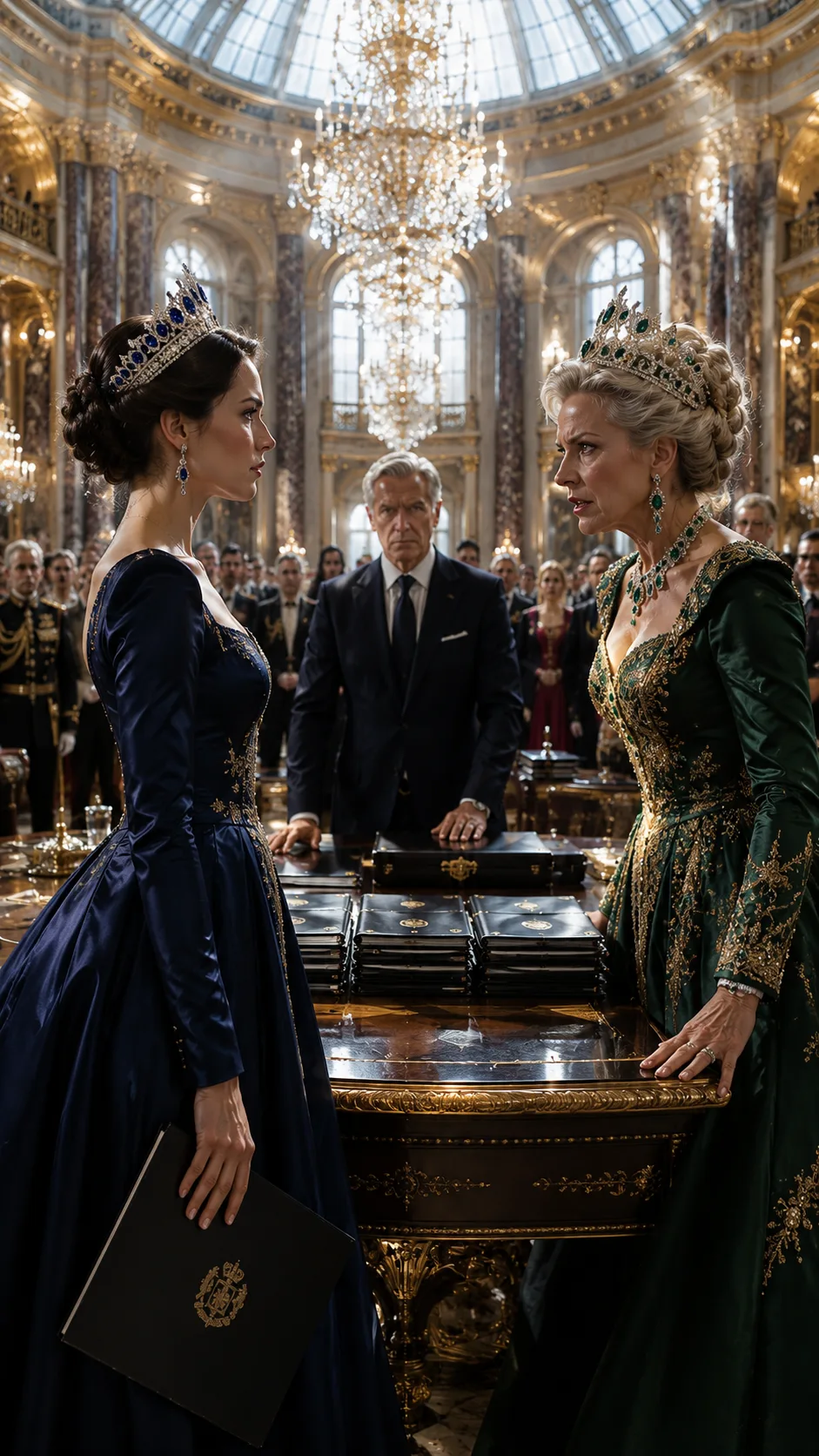
The council chamber sat beneath the glass dome of Saint Aurelia Hall, a room designed to make power look holy.
Sunlight fell through the high windows in pale sheets. Gold-veined marble shone under hundreds of polished shoes. Reporters waited behind velvet ropes. Noble families filled the upper gallery, their whispers moving like dry leaves.
At the center stood the crescent table of the Royal Council.
Twenty-seven seats.
Twenty-seven votes.
One temporary successor to be chosen until the final bloodline verification hearing was completed.
That hearing had been delayed three times by Helena’s lawyers.
Of course it had.
Delay was her favorite weapon. Delay made lies look administrative.
I entered through the side door carrying three binders and a tablet. No one announced my name. No herald struck the floor. No guard opened the central aisle for me.
That entrance was reserved for Isabella.
She arrived five minutes later on Helena’s arm.
Cameras flashed.
Isabella wore ivory satin and my mother’s pearls. Helena wore emerald green, the color queens wore when they wanted history to remember them as merciful.
She was fifty-two, beautiful in a cold way, with silver-blonde hair pinned perfectly beneath a small diamond comb. Her face never looked angry. It looked arranged.
The nobles rose for her.
Some out of respect.
Most out of fear.
Prince Alexander of Valmont stood near the diplomatic section, dressed in a navy royal uniform with gold braid at the shoulders. He had come as an observer because Astoria’s succession affected the marriage treaty between our kingdoms.
He looked at Isabella.
Then at me.
His expression did not change, but his eyes did.
Alexander had never been easy to fool.
We had met three years earlier during the grain crisis, when Isabella had fainted during a policy meeting after realizing the maps on the table were not decorative. I had finished the negotiation in her place from the back of the room.
Afterward, Alexander found me in the archive and said, “You speak like someone carrying a kingdom no one can see.”
I told him, “Then stop looking.”
He didn’t.
That had made him dangerous.
Helena took her seat at the queen regent’s platform. Isabella sat below her, directly opposite the council table, smiling like the room already belonged to her.
I stood behind the legal clerks.
Not seated.
Not named.
Exactly where Helena wanted me.
Lord Benedict Vale, the Council Speaker, struck his silver gavel once.
“The Royal Council of Astoria is now in session.”
The whispers died.
“Today, under Article Nine of the Regency Continuity Act, this council shall vote to appoint a temporary royal representative and successor until the Crown Registry completes its final review.”
Helena folded her hands.
Isabella looked at me across the chamber and smiled.
He smiled like he had already won.
No.
She did.
Lord Vale continued. “The eligible candidates placed before the council are Lady Isabella Waverly, recognized representative of the royal household, and Princess Amelia Rose Waverly, firstborn daughter of King Edmund Waverly.”
The room shifted.
Some heads turned toward me.
A few reporters lifted their cameras.
Helena’s smile tightened so slightly only someone raised beneath it would notice.
She had fought to keep my title out of the official reading.
But the old law was clear. In a succession vote, legal names had to be spoken.
Even buried names.
Even stolen ones.
Isabella’s eyes flickered.
Then she recovered.
A woman trained to lie in public never panicked at the first cut.
Lord Vale looked down at the sealed voting tablets before each councilor.
“Councilors may now cast their votes.”
The first tablet lit blue.
Then the second.
Then the third.
I watched hands move across screens.
One by one.
Lord Ashcombe, who had received an emergency extension on his family’s port lease last month.
Lady Celia Montfort, whose brother’s corruption inquiry disappeared after a private dinner with Helena.
Duke Rovan, who had somehow gained a royal mining contract despite owning no mines before winter.
Countess Elian, who owed the palace bank nine million crowns.
I knew them all.
I knew what they had been given.
I knew what they were paying back.
The vote closed in less than two minutes.
Lord Vale’s clerk handed him the result.
The chamber held its breath.
“Preliminary count,” Lord Vale said. “Lady Isabella Waverly: seventeen votes. Princess Amelia Rose Waverly: ten votes.”
The gallery exploded.
Applause rose from the noble section, too fast, too eager, like people cheering before the judge finished speaking because they had already been told the verdict.
Isabella placed a hand over her heart.
Helena lowered her gaze in a performance of humble gratitude.
My fingers tightened around the binder in my arms.
Alexander took one step forward.
Then stopped.
He looked at me.
I shook my head once.
Not yet.
Isabella rose from her chair.
She did not wait for the formal declaration. She stepped into the center aisle, turning toward the cameras with tears shining in her eyes.
They were not real tears.
I knew because real tears do not wait for lighting.
“I am honored,” she said, voice trembling beautifully. “To serve this kingdom, to protect my father’s legacy, and to continue the work my mother has guided with such wisdom.”
Helena touched her necklace.
My mother’s pearls moved under Isabella’s throat.
The camera lights flashed again.
Then Isabella turned toward me.
Not toward the council.
Toward me.
“I also want to thank Amelia,” she said sweetly. “For all her hard work behind the scenes. Every queen needs loyal staff.”
A ripple of laughter moved through the chamber.
Not loud.
Worse.
Polite laughter.
The kind that lets cruelty wear gloves.
My face stayed still.
Inside, something old and tired stood up.
Isabella extended one hand toward me.
“Come,” she said. “Bring me the succession folder.”
The room went silent again.
The folder she wanted was on the clerk’s desk.
Not in my hands.
She knew that.
She wanted me to walk across the marble while the cameras watched. She wanted the world to see me deliver my own erasure.
Helena did not speak.
She only watched.
That was her true signature.
Other people performed the cut. She enjoyed the bloodless part.
I stepped forward.
The sound of my heels against marble echoed through Saint Aurelia Hall.
One step.
Then another.
Then another.
Cameras turned.
Reporters leaned in.
Isabella’s smile sharpened.
“Careful,” she whispered when I reached her. “This is what losing looks like.”
I looked down at the folder.
Then at her.
“No,” I said quietly. “This is what an illegal count looks like before correction.”
Her smile faded.
“What?”
Before she could recover, the side door opened.
Royal Lawyer Marcus Ellery entered with two legal clerks behind him.
He was fifty-five, silver-haired, calm as winter water, carrying a black leather portfolio marked with the crown seal. He had served my father for thirty years. Helena had tried to retire him twice.
He had ignored both notices.
Lord Vale stood. “Sir Marcus?”
Marcus bowed once. “My apologies for the interruption, Speaker. But the council cannot declare a result based on contaminated ballots.”
The word hit the chamber like a dropped glass.
Contaminated.
Helena’s hand stopped moving.
Isabella turned pale beneath the makeup.
Lord Vale frowned. “Explain yourself.”
Marcus opened the portfolio and removed twelve slim files.
Twelve.
I saw Helena count them.
So did Alexander.
Marcus placed the files before the Speaker.
“Under Article Twelve, Section Four of the Regency Continuity Act, any councilor with undisclosed direct financial benefit from a candidate’s household within ninety days of a succession vote must recuse themselves. Failure to do so voids the ballot.”
Murmurs surged through the chamber.
Helena rose slowly.
“Sir Marcus,” she said, voice smooth, “this is a serious accusation to make during a national proceeding.”
“Yes, Your Majesty.” Marcus did not look afraid. “That is why I brought bank records, contract approvals, debt cancellations, and signed property transfers.”
The room went silent.
Then the screen behind the Speaker lit up.
Not with portraits.
With documents.
The first file appeared: Lord Ashcombe’s port lease renewal, authorized by Helena’s private office forty-six days earlier.
The second: Lady Montfort’s family inquiry closure, approved after a confidential royal payment.
The third: Duke Rovan’s mining contract.
The fourth: Countess Elian’s debt restructuring.
Then another.
And another.
Twelve names.
Twelve favors.
Twelve votes.
A reporter gasped so loudly the microphone caught it.
Isabella looked at Helena.
For the first time all day, she looked like a daughter instead of a weapon.
“Mother?” she whispered.
Helena’s face did not move, but something in her eyes went hard.
“Those records are incomplete,” Helena said.
Marcus nodded. “They are complete enough for disqualification.”
Lord Vale read the first page. Then the second. His jaw tightened.
“Clerk,” he said. “Recalculate the vote excluding the twelve invalid ballots.”
The clerk’s hands shook as she returned to the voting console.
No one laughed now.
No one whispered.
The nobles who had clapped for Isabella looked at the floor as if marble might become a door and let them escape through it.
Isabella stood in the center aisle, hand still extended toward me, but now it looked absurd. A queen asking for a folder she had not earned.
Helena stepped down from the platform.
“Lord Vale,” she said, “I demand a private review before any revised result is announced.”
“You may file a review after the session,” Marcus said.
Helena turned to him.
“This is not your decision.”
“No,” he said. “It is the law’s.”
That was the moment everything changed.
Not because the documents appeared.
Because for the first time in years, someone in that chamber said no to Helena and did not apologize afterward.
The clerk handed Lord Vale the corrected count.
He stared at it.
Then he looked up.
“Corrected result,” he said, voice carrying through the hall. “Lady Isabella Waverly: five valid votes. Princess Amelia Rose Waverly: ten valid votes.”
My breath caught.
Not because I was surprised.
Because hearing the truth spoken aloud still felt dangerous.
Lord Vale raised his voice.
“By legal majority of valid ballots, the Royal Council appoints Princess Amelia Rose Waverly as temporary royal representative and successor of Astoria, effective immediately pending final registry review.”
For one heartbeat, nobody moved.
Then Alexander stepped forward and bowed.
Not a shallow diplomatic bow.
A prince’s bow.
The kind offered to an equal.
The room followed him in pieces.
First the foreign ministers.
Then the legal clerks.
Then two councilors who had voted for me.
Then the gallery, slowly, awkwardly, like a kingdom relearning the shape of its spine.
Isabella stood frozen.
Her mouth opened, but no sound came out.
The pearls at her throat suddenly looked less like inheritance and more like evidence.
Helena turned to me.
There it was.
Not shock.
Not shame.
Fury.
Clean and sharp beneath all that royal polish.
“You arranged this,” she said.
I walked past Isabella and stopped in front of Helena.
Cameras clicked behind me.
A thousand people watched.
For ten years, she had made sure every confrontation happened behind doors. In bedrooms. In corridors. In offices where witnesses were paid to forget.
Not today.
Today, the doors were open.
Today, the microphones were on.
Today, the law had a voice louder than hers.
I looked at the woman who had taken my name, my rooms, my mother’s memory, and nearly my country.
Then I said the only sentence that had been waiting inside me all morning.
“You bought loyalty. You forgot legality.”
The words landed harder than shouting could have.
Helena’s expression cracked.
Only for a second.
But the cameras caught it.
Isabella backed away as if the floor beneath her had turned unstable.
“Amelia,” she whispered. “You can’t do this.”
I turned to her.
“I didn’t. The law did.”
Her hand rose to my mother’s pearls.
I held out my palm.
“Take them off.”
The chamber inhaled.
Isabella stared at me. “What?”
“My mother’s pearls,” I said. “Take them off.”
Helena snapped, “They belong to the royal household.”
Marcus lifted one page from his portfolio. “Actually, they were listed in Queen Rose’s private estate and transferred in trust to Princess Amelia Rose Waverly on her eighteenth birthday.”
A small sound left Isabella’s throat.
No one moved.
Slowly, with shaking fingers, she reached behind her neck and unclasped the pearls.
For the first time that day, she looked her age.
Not royal.
Not cruel.
Just young and terrified of the truth her mother had built around her.
She placed the necklace in my hand.
It was warm from her skin.
I closed my fingers around it and felt something inside me settle.
Not victory.
Something older.
Return.
Helena looked at the necklace, then at me.
“You think this makes you queen?”
“No,” I said. “It makes me visible.”
Alexander stepped to my side, not in front of me.
That mattered.
A lesser man would have tried to rescue me in a room where I had just rescued myself.
He only stood near enough for everyone to understand Valmont recognized the result.
“Your Highness,” he said, voice steady, “Valmont accepts the council’s legal declaration.”
Helena’s eyes flashed toward him.
“You have no authority here.”
“No,” Alexander said. “But I have a treaty waiting for the lawful representative of Astoria. And I prefer signing with someone who knows what a conflict of interest is.”
A few people in the chamber swallowed laughter.
This time, it was not cruel.
This time, Helena was the one standing alone.
Lord Vale struck the gavel again.
“By order of the council, the palace security office is instructed to preserve all financial records related to the invalidated votes. Sir Marcus Ellery will supervise the legal review.”
Helena’s head turned slowly toward him.
“You would investigate your queen?”
Lord Vale met her gaze.
“I would investigate a crime.”
The difference between those sentences cut through the room.
Two palace guards moved toward the queen regent’s platform. They did not touch Helena. They did not need to. Power is sometimes measured by who no longer steps aside when you walk.
Isabella’s shoulders trembled.
I looked at her and felt something complicated move through me.
Not forgiveness.
Not pity exactly.
Recognition.
She had been cruel because cruelty had been rewarded in her house. She had stolen because everything she loved had been handed to her already labeled as hers. She had humiliated me because Helena taught her that my silence was permission.
But she had still chosen her words.
She had still worn the pearls.
And choices have consequences, even when mothers teach you to call them destiny.
“Isabella,” I said.
She looked up.
“You will keep your title as Lady Isabella until the registry review. You will have counsel. You will not be publicly harmed.”
Helena gave a short, bitter laugh. “Merciful. How theatrical.”
I did not look away from Isabella.
“But you will no longer speak for this kingdom.”
Her face collapsed.
That was the part Helena had never prepared her for.
Losing applause.
Lord Vale stepped toward me with the temporary representative’s seal: a small gold emblem on a velvet cushion, engraved with the lion of Astoria.
I had seen that seal in my father’s study when I was a child. He once let me press it into warm wax on a birthday card for my mother.
He had laughed when I pressed too hard and cracked the wax.
“Gently, Amelia,” he had said. “Power is not stronger because you crush what it touches.”
I thought of him as Lord Vale presented the seal.
“Princess Amelia Rose Waverly,” he said, “do you accept the duties of temporary royal representative and successor under the laws of Astoria?”
Every camera pointed at me.
Every noble waited.
Every servant watching from the side corridors held their breath.
Ten years of locked doors stood behind me.
A kingdom stood in front of me.
I took the seal.
“I accept.”
The chamber erupted.
Not in the perfect applause Isabella had bought.
This was uneven.
Human.
Real.
Some people clapped because they believed in me. Some because they feared being seen not clapping. Some because history had shifted and they were trying to stand on the right side of it before the floor finished moving.
It did not matter.
The sound was not the victory.
The seal in my hand was.
After the session, I expected Helena to retreat.
She did not.
She waited in the marble corridor outside the chamber, away from microphones but not away from witnesses. Isabella stood behind her, pale and silent, no pearls around her neck.
Palace guards lined the walls.
Alexander remained three steps behind me with Marcus.
Helena looked at me like she was studying a mistake she intended to correct.
“You were always clever,” she said.
I said nothing.
“But clever girls confuse exposure with control.”
“Do they?”
She stepped closer.
“You think documents are power. You think laws are shields. You have no idea how much of this kingdom still answers my calls.”
A year ago, that sentence might have frightened me.
A month ago, it might have made my hands cold.
Today, I looked at the woman who had ruled through whispers and understood something simple.
Her power had survived because everyone thought they were alone when she threatened them.
They weren’t anymore.
I opened the binder in my arms and removed a signed order.
Helena’s eyes dropped to it.
“What is that?”
“My first act as temporary representative.”
The corridor went quiet.
Marcus did not smile, but I saw approval in the corner of his eyes.
I handed the paper to Captain Renard, head of palace security.
“Effective immediately, all royal household financial communications from the last ninety days are to be preserved. No deletion, no transfer, no sealed removal from palace servers. Any staff member pressured to destroy evidence is to report directly to Sir Marcus Ellery.”
Helena’s face hardened.
“You planned that before the vote.”
“Yes.”
“You arrogant little—”
I stepped closer.
Not much.
Just enough.
“I learned from you.”
For the first time in my life, Helena was the one who fell silent first.
Isabella looked between us.
Then she whispered, “Mother, is it true?”
Helena did not turn around.
Isabella’s voice cracked. “Did you pay them?”
Still nothing.
That silence answered more clearly than confession.
Isabella’s eyes filled.
“You told me they believed in me.”
Helena’s mouth tightened.
“They believed in what I secured.”
Isabella flinched as if the words had struck her.
I watched her learn, in one sentence, the price of being raised as a crown instead of a person.
It did not erase what she had done.
But it ended one lie.
By sunset, the story had reached every screen in Astoria.
The palace tried to issue a controlled statement. It failed. The footage was already everywhere: Isabella calling me staff, Marcus displaying the records, Helena’s expression cracking, me holding my mother’s pearls in one hand and the temporary seal in the other.
The headline on the largest news channel was simple.
THE VOTE WAS RIGGED.
But the people in the lower districts did not care about court scandal the way nobles did. They cared about winter heating subsidies, hospital contracts, school repairs, flood walls, food prices.
So my first televised address was not about Helena.
It was not about Isabella.
It was not even about my stolen title.
I stood in the same council chamber at dusk, wearing a navy satin dress and my mother’s pearls.
Not as decoration.
As a return.
The cameras counted down.
Three.
Two.
One.
The red light turned on.
“My name is Amelia Rose Waverly,” I said. “For years, many of you were told I served this palace quietly because I had no claim to lead it. That was false.”
My hands did not shake.
“The Royal Council has corrected today’s vote. A legal investigation has begun. But tonight, I want to speak not about the corruption that was exposed, but about the work that must continue.”
I looked directly into the lens.
The room behind me was silent.
“The eastern dam repairs will be funded. The hospital supply freeze will end. The veterans’ pension review will be signed tomorrow morning. The crown exists to serve the kingdom, not the families wealthy enough to purchase its silence.”
I paused.
“And to every person who has ever been pushed behind the room while someone else took credit for your work: I saw you before I saw myself.”
The speech lasted four minutes.
Not long.
Long enough.
When it ended, Alexander was waiting outside the broadcast room.
“You looked like your father,” he said.
I touched the pearls.
“I hope I sounded like my mother.”
“You sounded like yourself.”
I looked toward the dark windows. The city below the palace was full of lights, each one small, stubborn, alive.
“Do you think they’ll fight the result?” I asked.
“Helena will.”
“I know.”
“Are you afraid?”
I thought about Isabella’s smile in the mirror. Helena’s quiet threats. The laughter in the council chamber. The years when my own name felt like a secret I had to carry carefully or it would be taken from me again.
Then I thought about the vote.
Five to ten.
Not overwhelming.
Not perfect.
Enough.
“No,” I said. “I’m done mistaking fear for prophecy.”
Alexander’s mouth softened.
For a moment, he looked less like a prince and more like the man who had found me in the archive and refused to stop seeing me.
“Then Valmont is ready to sign with Astoria’s lawful representative,” he said.
“Good.”
He glanced down at the seal in my hand.
“And Amelia?”
“Yes?”
“Votes matter.”
I smiled for the first time that day.
“Legal ones do.”
The next morning, twelve noble houses received formal notices of investigation.
Three councilors resigned before breakfast.
Two attempted to leave the capital and were stopped at the western gate.
Helena remained in the palace, stripped of financial authority pending review. She walked the halls as if she still owned them, but servants no longer lowered their eyes fast enough. Guards no longer opened doors before she reached them. The court still bowed, but now the bows looked measured, not automatic.
Power had not vanished.
It had changed direction.
Isabella requested a private meeting three days later.
I almost refused.
Then I remembered my father’s words about power and crushing.
She entered my office without pearls, without cameras, without Helena.
Her ivory gowns had been replaced by a simple gray dress. She looked smaller, though she was not.
For a while, she said nothing.
Then she placed a folder on my desk.
“What is this?” I asked.
“Copies of letters my mother sent to councilors.”
I did not touch it immediately.
“Why give me this?”
Her eyes were red.
“Because she told me they loved me.”
I waited.
“And because I believed her.”
There was no apology in that sentence yet.
Only wreckage.
But sometimes wreckage is where truth begins.
I opened the folder.
The letters were real.
Not enough to end Helena’s influence alone, but enough to begin cutting the wires she had hidden behind portraits, dinners, and favors.
Isabella stood rigidly in front of my desk.
“I was cruel to you,” she said.
“Yes.”
“I knew some of it was wrong.”
“Yes.”
Her mouth trembled.
“I don’t know who I am without what she promised me.”
I looked at her for a long moment.
Then I said, “Then find out before you ask anyone to trust you again.”
She nodded once.
It was not forgiveness.
It was a door left unlocked.
Weeks later, the Crown Registry completed its final review.
There were no surprises.
Birth records.
Medical seals.
My father’s signed acknowledgments.
My mother’s estate documents.
Everything Helena had hidden still existed because someone, somewhere, had followed procedure even when power wanted them not to.
That was the thing about legality.
It was slow.
It was boring.
It was full of clauses, dates, signatures, and filing cabinets.
But sometimes, when everyone glamorous had finished lying, the boring thing stood up and saved your life.
The official ceremony took place in Saint Aurelia Hall, beneath the same glass dome where Isabella had tried to make me carry my own defeat.
This time, I entered through the central doors.
The herald struck the floor.
“Princess Amelia Rose Waverly, lawful heir and crown representative of Astoria.”
The words echoed across the marble.
I did not look at Helena.
I did not need to.
I walked to the crescent table, signed the treaty with Valmont, and placed my mother’s pearls beneath my collarbone where they belonged.
When the ink dried, Alexander signed beside me.
The cameras flashed.
The council rose.
And somewhere in the gallery, a young palace clerk I had once trained wiped her eyes.
I thought of every version of myself who had stood behind rooms, holding folders, waiting for someone to remember I had a name.
Then I looked out at the kingdom waiting beyond the glass.
For years, Helena had taught me that power belonged to the loudest liar in the room.
She was wrong.
Power belonged to the truth that survived long enough to be read aloud.
And when mine finally was, the room went silent.
Then it rose.
THE END.
Chapter complete
You have reached the end of this chapter.
Continue reading
A few more worlds to get lost in after this chapter.