She Called Him Up to Be Humiliated.
Chapter 1
She Called Him Up to Be Humiliated.
The Note He Sang Changed Everything
The first wound of the night did not come from thunder.
It came from Harper Weston’s voice.
“You there. The janitor. Come up here. Now.”
The command sliced through the Ryman Auditorium like a blade.
Five hundred guests turned at once.
Men in tailored suits paused with champagne halfway to their lips. Women in glittering gowns leaned over their tables. Cameras shifted. Phones rose. On the giant livestream screen behind the stage, the viewer count climbed past two million.
At the very back of the hall, beside a service door, Cole Brennan froze.
He was holding a mop.
His gray janitor’s uniform was damp at the sleeves. Yellow rubber gloves covered his hands. A bucket stood beside his boots, filled with cloudy water and the dull reflection of chandelier light.
He had spent the evening doing exactly what he was paid to do.
Disappear.
Clean the stage.
Avoid the artists.
Avoid the guests.
Avoid becoming part of the night.
But Harper Weston had seen him.
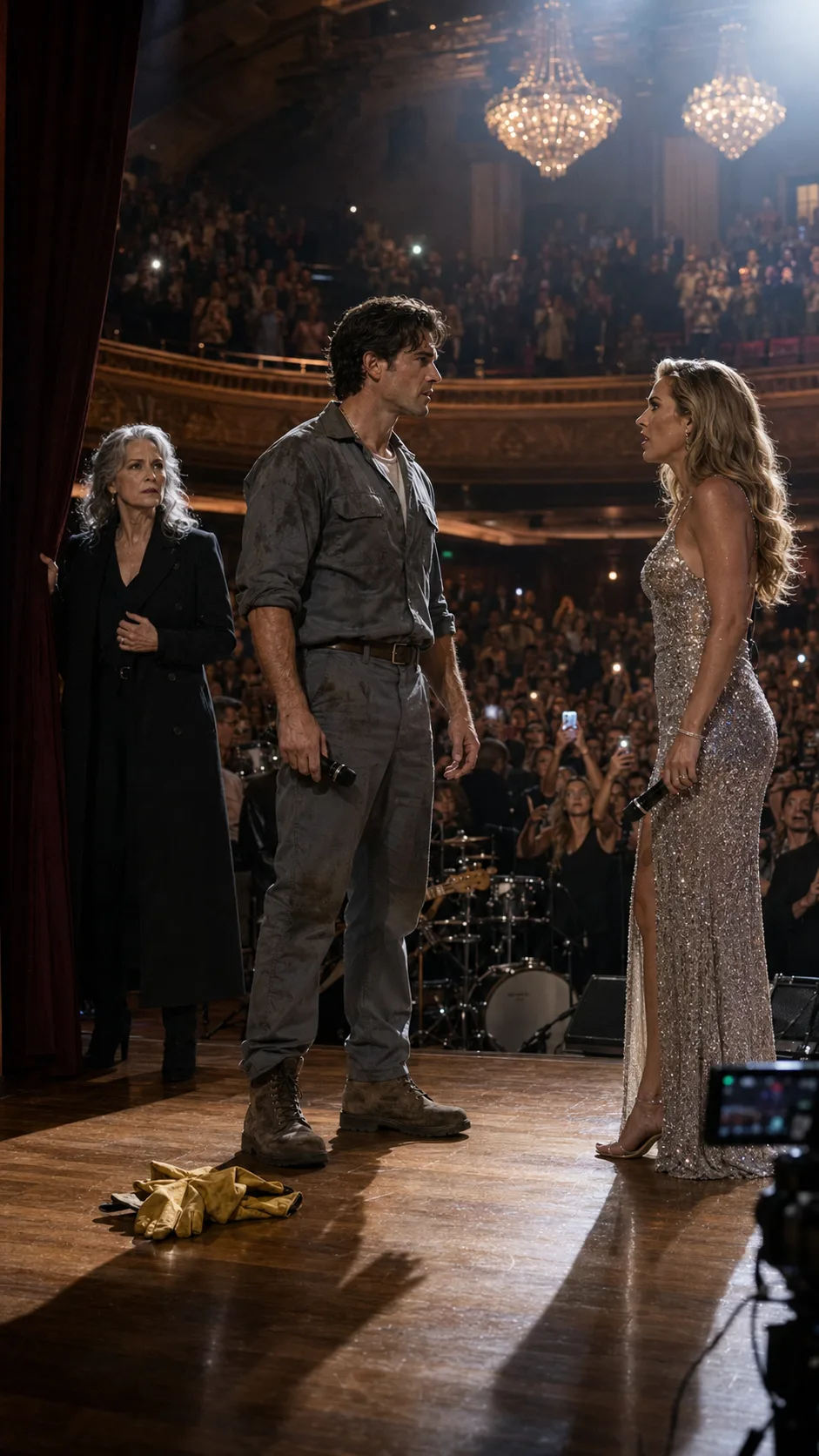
The most famous singer in America stood beneath the stage lights in a silver dress that sparkled like broken ice. Her smile was bright enough for cameras and sharp enough to cut through bone.
“Me?” Cole asked.
His voice barely reached the first row.
Harper tilted her head.
“Yes, you. Unless there’s another janitor back there humming my song like he belongs on my stage.”
A ripple moved through the audience.
Some people laughed.
Some looked uncomfortable.
Most did both.
Cole lowered his eyes. “I’m sorry, ma’am. I didn’t mean to disturb anyone. I was just working.”
“Don’t apologize from back there,” Harper said. “Come apologize properly.”
The audience laughed louder now.
Cole felt heat rise up his neck.
He had heard laughter like that before. Not exactly the
same, but close enough. The kind that didn’t come from joy. The kind that came from people being relieved they were not the one standing under the knife.
Harper stepped down from the stage and walked toward him.
Every camera followed her.
She reached Cole, placed one glittering hand on his shoulder, and guided him toward the light as though presenting him to the world.
“Come on,” she said. “Since you enjoy singing during my rehearsal, let’s give everyone a real performance.”
Cole stopped. “Please. I don’t want trouble.”
Harper leaned closer.
The microphone caught her words.
“Then don’t be boring.”
More laughter.
Cole looked toward the exit.
Two security guards stood there.
Not blocking him exactly.
Just watching.
That was enough.
He let Harper lead him forward.
His boots dragged against the polished floor. The stage lights grew hotter with every step. By the time he reached the center
of the stage, the brightness had swallowed the audience into a dark wall of shapes, jewels, and phone screens.
Harper turned to the band.
“Play *Higher Ground*.”
The guitarist hesitated.
The drummer glanced at the music director.
No one moved.
Harper’s smile vanished for half a second.
“Did I stutter?”
The first chord rang out.
The audience immediately understood the joke.
*Higher Ground* was Harper’s signature song. It was dramatic, difficult, and famous for one particular note near the chorus — a note so high and clean that even Harper avoided it in live performances. She usually let the backing singers cover it or turned the microphone toward the crowd.
Everyone knew that.
That was why she chose it.
She wasn’t asking Cole to sing.
She was preparing him to fail.
Harper lifted the microphone toward him.
“Let’s see what our hardworking janitor can do.”
Cole did not take the mic at first.
He stared at the stage floor.
His reflection looked wrong beneath him. The lights made him look pale, thin, smaller than he was. His hands trembled inside the yellow gloves.
Then, from somewhere deep inside him, an old memory opened.
A small kitchen in Knoxville.
Rain tapping against a cracked window.
A cheap piano with one broken key.
His mother standing at the stove, stirring soup with one hand and tapping rhythm against the counter with the other.
“Again, baby,” Marlena Brennan used to say. “Don’t sing from your throat. Sing from the place that still hurts.”
Cole swallowed.
That place had been quiet for years.
Quiet after the hospital bills.
Quiet after the rejection letters.
Quiet after his mother stopped singing.
Quiet after the world took her songs and gave her nothing back but silence.
“Go on,” Harper said. “We’re waiting.”
Cole slowly peeled off one glove.
Then the other.
They fell to the stage with two soft sounds.
For some reason, the auditorium became quieter.
Cole took the microphone.
Harper stepped back, folding her arms.
The band began again.
Cole closed his eyes.
The first note left him gently.
Not loud.
Not polished.
Not desperate.
It was low and dark, carrying something the room was not ready for.
The murmurs stopped.
Cole sang the next line.
Then another.
His voice rose with a kind of pain that did not beg for attention. It simply existed. Raw. Steady. Honest. Every note seemed pulled from a place deeper than performance, deeper than pride, deeper than the humiliation Harper had planned for him.
The guitarist looked up.
The drummer missed a beat.
Harper’s smile flickered.
Cole opened his eyes.
He was no longer looking at the floor.
He looked straight ahead.
The shame began to fall away from him, piece by piece, until only the song remained.
When he reached the chorus, the room shifted.
People stopped recording him to laugh.
They recorded because they knew no one would believe them without proof.
A woman in the front row lowered her champagne glass.
A producer near the soundboard whispered, “Who is he?”
Then the high note came.
Everyone knew it.
The band knew it.
The audience knew it.
Harper knew it most of all.
Cole inhaled.
And hit it.
Clean.
Clear.
Impossible.
The note rose through the auditorium like light breaking through a sealed door. It held there, strong and unshaken, until the entire room seemed to hold its breath beneath it.
Harper stepped backward.
Just one step.
But millions of people saw it.
Cole finished the chorus and let the last note fall.
Silence.
No glasses.
No whispers.
No coughs.
Then the auditorium exploded.
The applause struck like thunder.
People rose from their seats. Chairs scraped. Voices shouted. The band stared at Cole as if a stranger had walked onto the stage and opened the sky.
Cole blinked.
For a second, he looked frightened by what he had done.
Harper recovered first.
She laughed into her microphone as though she had planned every second.
“Well,” she said, breathless, “I think we just discovered ourselves a hidden star.”
The crowd cheered again.
But Cole stepped away when she reached for him.
It was a small movement.
Not dramatic.
Not loud.
But it changed the temperature of the room.
Harper’s smile tightened.
“Tell us,” she said, “where have you been hiding that voice?”
Cole looked at the crowd.
Then at the livestream camera.
Then back at Harper.
“I wasn’t hiding,” he said.
The microphone carried his quiet voice through the entire hall.
“I was trying to work.”
A few people laughed.
This time, they laughed with him.
Harper’s jaw tightened.
“Well,” she said, “you may not be mopping floors much longer after tonight.”
The crowd cheered.
Cole did not smile.
His eyes stayed on her.
Something in his stillness made the music director lower his hands.
Harper noticed.
“What?” she asked.
Cole held the microphone closer.
“I know you.”
A few people laughed again, assuming he meant it like a fan.
Harper gave a practiced smile.
“I would hope so.”
Cole shook his head.
“No. I know you.”
The laughter died.
Harper’s expression remained perfect.
Too perfect.
“You’re overwhelmed,” she said. “Why don’t we give him a hand and—”
“My mother used to sing that song.”
The words landed softly.
But the room heard them.
Harper stopped.
Cole continued.
“She sang it before you did.”
No one moved.
The giant screen behind them showed Harper’s face in frightening detail. The glitter near her eyes. The stillness of her mouth. The tiny pause before she remembered to smile again.
“I don’t know what you’re talking about,” she said.
Cole bent down and picked up one of his yellow gloves. He turned it in his hands.
“My mother’s name is Marlena Brennan.”
Harper did not breathe.
Not visibly.
But Cole saw it.
So did the camera.
So did everyone close enough to understand that a name had just wounded her.
“She worked nights,” Cole said. “Diners. Hotel bars. Church basements. County fairs. She wrote songs in notebooks and kept them under our sink because the roof leaked, and that was the driest place in the apartment.”
The audience listened now with complete attention.
“When I was fourteen, a producer came through Knoxville. He heard her sing. He told her she had something rare. He said he could introduce her to the right people.”
Cole looked directly at Harper.
“You were there.”
Harper lifted her microphone. “This is absurd.”
“You weren’t famous yet,” Cole said. “Just hungry.”
The words were not shouted.
That made them worse.
“My mother trusted you. She thought you were her friend. She let you hear her songs. Her arrangements. Her voice memos. Her unfinished demos. Her dream.”
Phones lit up across the hall.
People began searching.
Old interviews.
Old credits.
Old release dates.
Harper’s first EP.
Cole’s voice remained steady.
“Three months later, your first record came out.”
Harper’s smile disappeared.
“Security.”
No one moved.
Cole gave a small, broken laugh.
“My mother tried to fight it. She sent letters. She called offices. She begged people to listen. But we didn’t have money. You had lawyers. Management. A publicist. A story.”
Harper stepped closer and lowered her voice.
The microphone still caught it.
“Stop.”
Cole looked at her.
“She stopped singing after that.”
The room became painfully still.
“She told me once that losing songs hurts differently than losing money. Money leaves your hands. Songs leave your bones.”
Someone in the audience covered their mouth.
Harper looked toward the wings.
Toward the producers.
Toward anyone who might save her.
No one did.
Cole continued.
“The last song she ever wrote was the one she couldn’t finish. The one that hurt too much.”
He turned slightly toward the band.
“You renamed it.”
Harper whispered, “That’s a lie.”
Cole’s eyes did not move.
“Then why did you just make me sing the bridge exactly the way she wrote it in her demo?”
The question struck the room like a dropped blade.
Harper’s face emptied.
Only someone who had heard the original demo would know that the version played tonight was not the released version. Years earlier, Harper had changed the bridge just enough to blur the trail.
But tonight, in her arrogance, she had ordered the band to play from the old rehearsal chart.
The stolen one.
The guitarist stared at the sheet music in front of him.
“I played what was given to us,” he said.
His voice shook.
Cole nodded.
“Because that is the version she still keeps.”
A man in the audience shouted, “Who?”
Cole turned toward the livestream camera.
“My mother isn’t dead,” he said. “She’s here.”
A wave of gasps crashed through the auditorium.
Harper spun toward the curtain.
Every camera followed.
For one long second, nothing happened.
Then a woman stepped out from the shadows.
Marlena Brennan was thinner than the photographs on old flyers. Her hair was threaded with silver. One hand gripped the edge of the stage curtain as if she needed the wood to keep herself upright.
But her eyes were alive.
Terrified.
Burning.
Cole almost dropped the microphone.
“Mom.”
Marlena took one trembling step forward.
Then another.
The audience rose into a roar of stunned voices.
Harper looked at her as if the past had walked out of a locked room.
Marlena stopped beneath the edge of the spotlight.
She looked at her son.
Then she looked at Harper.
For twenty years, the world had called Harper Weston a legend.
For twenty years, Marlena Brennan had heard her own pain sung back to her by a woman who had stolen it.
Now the room belonged to the truth.
Marlena lifted her chin.
“Sing the second verse, baby.”
Cole stared at her.
The band looked at Harper.
Harper’s face hardened.
“Do not play another note,” she said.
No one obeyed.
The guitarist slowly placed his fingers on the strings.
The pianist turned toward Cole.
The drummer raised his sticks.
Cole lifted the microphone.
And sang.
This time, the words were different.
Not Harper’s version.
Not the polished version millions knew.
The original.
Marlena’s second verse.
The verse Harper had removed because it was too specific. Too personal. Too impossible to explain if anyone ever asked where it came from.
Cole sang about a woman washing diner cups at midnight.
About a child asleep under a coat in booth seven.
About a notebook hidden beneath a leaking sink.
About a dream sold by someone wearing a friend’s face.
The audience went silent again, but not from confusion.
From recognition.
Marlena stood at the edge of the stage with one hand pressed against her mouth. Her body shook, but she did not look away.
Harper did.
For the first time all night, Harper Weston looked away from the camera.
That was the moment the internet turned.
Comments flooded the livestream faster than anyone could read.
*That verse isn’t in the song.*
*Where did he get those lyrics?*
*Search Marlena Brennan Knoxville.*
*Old demo exists.*
*Someone found it.*
At the soundboard, a producer removed his headset.
Backstage, Harper’s manager shouted into a phone.
Onstage, Cole kept singing.
When he reached the bridge, Marlena stepped forward.
The band softened instinctively.
Cole saw her coming and lowered the microphone.
Marlena shook her head.
“No,” she said. “Keep going.”
Then she sang with him.
Her voice was older.
Rougher.
Marked by years of silence.
But when it joined Cole’s, the room changed again.
It was no longer a performance.
It was testimony.
Mother and son stood under the lights, singing the song that had been taken from them, while the woman who had built an empire from it stood only feet away with nowhere left to hide.
Harper lifted her microphone.
“This is a setup,” she said.
Her voice cracked.
The crowd heard it.
Marlena stopped singing.
She turned toward Harper.
“No,” Marlena said. “A setup is when someone invites a poor woman into a studio, records everything she sings, and tells her the files were lost.”
Harper went pale.
Marlena continued.
“A setup is when that same woman hears her song on the radio three months later and gets told by every lawyer in Nashville that she can’t prove what everyone already knows.”
Harper’s manager appeared at the side of the stage.
“Harper,” he said, “leave the stage.”
She did not move.
Marlena reached into the pocket of her worn black coat.
The entire auditorium leaned forward.
She pulled out a small cassette tape inside a cracked plastic case.
Harper’s eyes locked onto it.
Cole turned to his mother.
Marlena held it up.
“I kept the original.”
The words moved through the hall like a storm.
Harper shook her head.
“No one uses tapes anymore.”
Marlena looked at her.
“That’s why you forgot to destroy it.”
The audience erupted.
Not applause this time.
Shock.
Noise.
People shouting.
Cameras pushing closer.
Harper’s manager stepped back as though he had touched fire.
Marlena handed the tape to Cole.
His fingers closed around it carefully.
For a moment, he was fourteen again, standing in a kitchen while his mother sang over a pot of soup, believing the world might still be fair.
Cole walked to the front of the stage.
A livestream camera followed every step.
He held the tape up.
“This is not about fame,” he said. “It never was.”
He looked at Harper.
“You took her songs. But worse than that, you made her believe her voice didn’t matter.”
Harper’s lips parted, but no sound came out.
Cole turned back to the audience.
“My mother is not asking for pity. She’s asking to be heard.”
A woman in the front row stood first.
Then another.
Then an older man near the aisle.
Then the entire auditorium.
The applause rose slowly at first, then stronger, then overwhelming.
Marlena covered her face.
Cole wrapped one arm around her shoulders.
For once, cameras caught Harper Weston outside the frame of worship.
She stood alone in her silver gown while the applause passed her by.
Her own band would not look at her.
Her own manager would not step onto the stage.
Her own audience had chosen someone else.
The next morning, every news headline carried the same image.
A janitor in a gray uniform.
A silver-haired woman beside him.
A cassette tape held beneath the lights.
Harper’s team released a statement before sunrise.
It denied everything.
By noon, three former studio assistants had come forward.
By evening, an old recording engineer confirmed the date on the demo session.
Two days later, Harper Weston’s record label suspended all promotion connected to the song.
One week later, Marlena Brennan’s name appeared on streaming platforms for the first time.
Not hidden.
Not misspelled.
Not buried in fine print.
Written clearly.
Marlena Brennan.
Songwriter.
The first time Marlena saw it, she sat at Cole’s kitchen table and touched the screen with one finger.
She did not cry loudly.
She simply sat there for a long while.
Cole made coffee.
Neither of them spoke.
Some things were too heavy for words when they finally arrived.
Three months later, the Ryman Auditorium sold out again.
This time, Cole Brennan was not standing near a service door.
He was not wearing gloves.
He was not holding a mop.
He stood at center stage in a simple black suit, with his mother seated at a piano beside him.
The audience was quiet before he even lifted the microphone.
Cole looked down at Marlena.
She nodded once.
The first chord began.
And this time, when they sang the song, no one laughed.
No one looked away.
No one called him up to be humiliated.
They came to hear the truth.
And when Cole reached the high note, he did not sing it to prove Harper wrong.
He sang it for the woman who had taught him where music really came from.
Not the throat.
Not the spotlight.
Not the applause.
From the place that still hurts.
And somehow, survives.
THE END.
Chapter complete
You have reached the end of this chapter.
Continue reading
A few more worlds to get lost in after this chapter.