My Sister Tried to Extort Me With Lawyers—Until My Husband Exposed Her Theft
My sister asked me to a “family dinner” after I refused to pay for her $50K wedding.
Chapter 1
My Sister Tried to Extort Me With Lawyers—Until My Husband Exposed Her Theft
My sister asked me to a “family dinner” after I refused to pay for her $50K wedding.
Instead of dinner, I found three lawyers waiting with documents. She leaned in and said, “Sign this or I’ll destroy you.” I answered, “Meet my lawyer.” What he laid on the table changed the whole room...
I thought the ugliest part of my sister’s wedding would be the bill. I was wrong.
My name is Commander Julia Bennett, U.S. Navy Supply Corps. I manage contracts, fuel schedules, procurement failures, and the kind of paperwork that can sink careers. My younger sister, Briana Collins, lives in a different world—vineyards, curated table settings, designer flowers, and the belief that aesthetics can justify any invoice if you say “once-in-a-lifetime” enough times.
She asked me for fifty thousand dollars over coffee like she was borrowing gas money.
“We’re short,” she said, smiling across the table. “You’re doing well. It wouldn’t even hurt you.”
That line hit me harder than the number. It wouldn’t hurt
you. As if my years of discipline, deployments, and careful investing had turned me into the family emergency fund. I had bailed Briana out before—a car payment here, a maxed-out credit card there, rent once when she swore she was changing. But I was not about to bankroll imported peonies, a live band, and a wedding my father was already raiding his retirement to support.
So I told her no.
Not maybe. Not later. No.
Two weeks after that, she texted me: Family dinner. Let’s clear the air. I almost didn’t go, but some stupid part of me still believed blood carried limits. I changed out of uniform, drove to her apartment, and walked in expecting wine, tension, maybe a guilt speech.
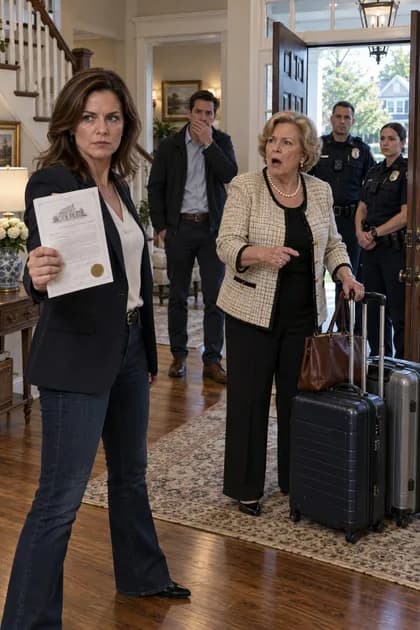
Instead, three lawyers were sitting in her living room with briefcases open.
No food. No family. Just paper.
One of them stood and said, “Commander Bennett, thank you
for coming.”
The title was deliberate. So was the packet they slid across the table.

My name was on the first page above a document labeled Binding Pledge of Financial Contribution. At the center of it was an email I had sent my mother months earlier: I’ll help where I can. Someone had wrapped that sentence in legal language, attached a notary page, and turned it into a weapon. Briana sat on the couch with her arms folded like a client, not a sister.
“You said you’d help,” she said.
“I did not promise you fifty thousand dollars.”
The taller attorney tried the soft voice first. Reliance. Intent. Private resolution. Then they moved to the real leverage. If I refused to sign, “questions” could be raised about my finances, my disclosures, my assets. Briana leaned forward and said it plainly.
“Sign it, Julia. Or I’ll report you.”
She knew exactly
where to aim. I had a promotion board coming. One false allegation about undisclosed money could drag my name through security review, command scrutiny, and rumor. Even when you’re clean, accusation leaves residue.
I looked at my sister, at the men she had hired, at the forged respectability of stamps and folders. Then I took out my phone and called my husband.
“Michael,” I said when he answered, “come now. Three lawyers. Fake contract. Threats.”
Briana laughed and told me I was overreacting.
Then Michael walked in, picked up the papers, and with one cold scan of the document said the words that changed the room:
“This isn’t a contract. It’s attempted extortion.”
The room didn't just go silent; the temperature seemed to drop ten degrees. Michael didn’t sit down. He stood behind me, his hand on my shoulder, and opened a black leather portfolio. He pulled out a single sheet of paper—not a contract, but a sworn affidavit—and slid it across the glass table toward the lead attorney.
“That,” Michael said, his voice like grinding stones, “is a statement from the notary whose stamp appears on page four of your 'Binding Pledge.' He’s prepared to testify that he never saw my wife, he never witnessed a signature, and that his seal was used without his knowledge.”
The lead lawyer’s eyes darted to the document. He looked at Briana. She didn't look back; she was staring at the floor, her face turning a sickly shade of grey.
“But that’s not all,” I added, leaning into the silence.
Michael laid a second set of documents down. These weren't legal filings. They were bank statements—specifically, our father’s retirement account records from the last six months.
“Briana,” I said quietly, “I manage procurement for the Navy. I track missing fuel in the middle of the ocean. Did you really think I wouldn't notice $12,000 missing from Dad’s Vanguard account? Or the ‘administrative fees’ you’ve been charging him to ‘manage’ his estate?”
The Collapse
The three lawyers suddenly looked very uncomfortable. The one on the left actually closed his briefcase. They weren't there to fight a war; they had been told this was a simple mediation for a "reluctant benefactor." They realized in real-time they were being used to facilitate grand larceny and elder abuse.
“This is a misunderstanding,” Briana stammered, her voice thin and high. “I was going to put it back! Once the wedding gifts came in, I was going to—”
“There isn’t going to be a wedding, Briana,” Michael interrupted. “At least, not one paid for by this family. Because if you don't call these gentlemen off and sign a full confession regarding the unauthorized withdrawals from your father's accounts, my next call isn't to a notary. It’s to the District Attorney.”
The lead lawyer stood up, signaling his colleagues. “Ms. Collins, our firm cannot represent you in this matter any further. We were under the impression this was a good-faith dispute. We will be sending our final invoice for this evening's... consultation.”
They left in thirty seconds. The door click echoed like a gunshot.
The Aftermath
Briana collapsed onto her designer velvet sofa, the one I now realized was likely bought with our father's medication money. She didn't look like a bride. She looked like a thief who had finally run out of shadows.
“I just wanted to be happy,” she sobbed. “Just once.”
“You wanted to be admired,” I corrected her. “There’s a difference. You were willing to sink my career and rob our father for a party. That’s not a ‘family emergency,’ Briana. That’s a pathology.”
I didn't stay for the rest of the tears. Michael and I walked out, taking the forged pledge and the bank records with us.
The Resolution: I spent the next week moving our father into an assisted living community he actually liked and stripping Briana of her Power of Attorney.
The Fall: The wedding was canceled. The vineyard sued her for the deposit. The "friends" she was trying to impress vanished the moment the open bar disappeared.
The Promotion: Three months later, I stood in my dress whites and received my promotion to Captain. My father was there, clear-eyed and safe. My husband was there. Briana was not.
As I took the oath, I realized that loyalty isn't about saying "yes" to family; it’s about having the strength to say "no" when they try to burn the house down.
Chapter complete
You have reached the end of this chapter.
Continue reading
A few more worlds to get lost in after this chapter.