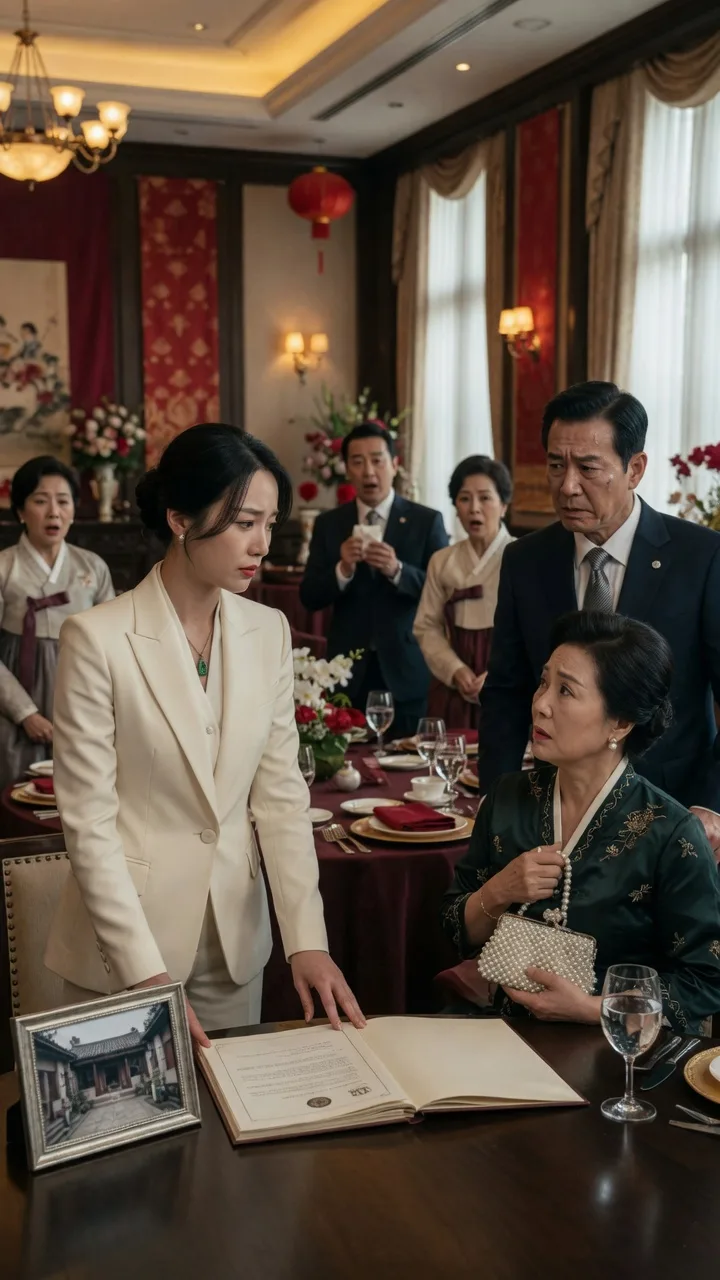
The next morning, the sky over Willow Lane was pale and bright, washed clean by a night of rain.
Chapter 3
The next morning, the sky over Willow Lane was pale and bright, washed clean by a night of rain.
News traveled faster than shame in our community. By the time I arrived at the old house, half the neighborhood already knew something had happened at the banquet.
Aunties stood behind curtains. Old men paused with newspapers in their hands. Children slowed their bicycles near the green gate, curious about the polished black car parked outside.
My parents were already there.
So was Jiho.
They stood in front of the house like people waiting outside a courtroom.
My mother wore sunglasses, though the morning was cloudy. My father looked older than he had the night before. Jiho kept checking his phone, probably watching messages arrive from relatives who had suddenly become very interested in the truth.
Ms. Tran stood beside me with the final transfer documents.
A restoration architect, Kenji Mori, waited near the gate with a clipboard. He was a quiet Japanese Korean man in his thirties, someone my
company had hired for delicate heritage projects. He knew buildings the way doctors knew bones.
He nodded respectfully when I approached.
“The structure is strong,” he said. “Neglected, but strong.”
I looked at the house.
The paint was peeling near the porch. The stone path was cracked. The persimmon tree leaned slightly toward the second-floor window, as if listening.
Neglected, but strong.
I almost smiled.
My father stepped forward. “Hana, we should speak privately.”
I glanced at the neighbors watching from a distance.
“Private conversations are how we got here.”
His face tightened.
My mother removed her sunglasses. Her eyes were swollen, but her voice was still proud.
“You have made your point,” she said. “You embarrassed us. You exposed the paperwork. Fine. But don’t turn this house into a public monument to your resentment.”
I studied her face.
Even now, she thought my pain was an inconvenience.
“This isn’t
resentment,” I said. “It’s restoration.”
Jiho scoffed. “You always talk like you’re better than us.”
I turned to him.
“No, Jiho. I just stopped shrinking so you could feel taller.”
The words landed hard.
His face flushed, but he looked away.
Ms. Tran stepped forward with the documents. “The holding company now has full legal control of the property. The forged consent issue will be handled separately. Ms. Park has the right to enter, inspect, restore, and determine future use.”
My father looked at the house behind him.
For the first time, I saw what he had lost—not the property, not the money, but the authority. The ability to decide who belonged.
“Hana,” he said, and his voice softened in a way that would have broken me years ago. “We raised you.”
I felt the old ache rise, familiar and dangerous.
Then I remembered every birthday dinner where Jiho’s achievements
were toasted and mine were corrected. Every time my mother told relatives I was too ambitious to be a good daughter. Every winter night I studied under library lights because home had become a place where love came with conditions.
“You housed me,” I said. “Grandmother raised me.”
My mother looked away.
The neighbors were no longer pretending not to listen.
Auntie Sora arrived quietly, wrapped in a blue cardigan. She held a small cloth bag in both hands.
“I brought something,” she said.
From the bag, she removed an old framed photograph.
It showed my grandmother standing on the porch, younger and laughing, one hand resting on my shoulder when I was ten. I had missing front teeth, crooked bangs, and both hands wrapped around a bowl of persimmons.
On the back, written in my grandmother’s careful handwriting, were the words:
For Hana, who must always have a door that opens.
My throat tightened.
My mother saw the writing and pressed her lips together.
“She wrote many sentimental things,” my father muttered.
Auntie Sora looked at him sharply.
“She wrote legal things too,” she said.
That silenced him.
Kenji unlocked the temporary chain around the gate, but I stopped him.
“Wait.”
Everyone looked at me.
I took out the brass key.
For thirteen years, I had carried it through rented rooms, small apartments, lonely cities, and office desks where I pretended not to miss anything. The red thread had faded. The metal was scratched. But the weight of it in my palm felt exactly the same.
My mother whispered, “That lock was removed.”
Kenji gestured to the polished wooden box on the stone post.
“We reinstalled it this morning,” he said. “Original hardware. Still functional.”
My father stared at him. “Who told you to do that?”
Kenji looked at me.
“The owner.”
That word moved through the morning like a bell.
The owner.
Not the difficult daughter.
Not the selfish one.
Not the girl who left.
The owner.
I stepped toward the gate.
My hand trembled once, but not from fear. From memory.
Behind me, my mother said quietly, “Hana.”
I paused.
For a moment, I wanted her to say it. The thing I had waited half my life to hear.
I was wrong.
I’m sorry.
You were always my daughter.
But she only looked at the key and said, “If you open that gate, there is no going back.”
I turned to her.
“There was no going back the day you sold it.”
Then I slid the key into the lock.
It fit.
The click was small, but everyone heard it.
A sound like a sentence ending.
The gate opened inward.
Soft morning light spilled across the stone path. The persimmon tree moved gently in the wind. Somewhere inside, dust waited on old floors, and sunlight waited behind closed curtains.
I walked through first.
Not quickly. Not dramatically.
Calmly.
Behind me, Ms. Tran followed. Then Auntie Sora. Then Kenji.
My parents remained outside the gate.
For once, they were the ones who did not know whether they were allowed in.
At the porch, I turned back.
My father’s face had gone gray. Jiho stood with his hands in his pockets, staring at the ground. My mother held her sunglasses so tightly one arm had bent.
I could have shut the gate.
Part of me wanted to.
Instead, I said, “The foundation opening will be next spring. Grandmother’s name will be on the front plaque. You may attend as guests, if you can come with respect.”
My mother’s eyes filled, but she did not speak.
That was fine.
I no longer needed her words to unlock anything.
I opened the front door.
The smell of old wood, dust, and rain-washed air met me like a memory waking up.
In the entryway, the pencil marks were still there.
Hana, age seven.
Hana, age ten.
Jiho, age six.
My grandmother’s handwriting beside mine.
I touched the mark from the year I turned sixteen, the year she put part of the house in my name without telling anyone.
Maybe she had known I would need proof one day.
Maybe love, real love, always leaves evidence.
Outside, the neighborhood remained silent.
Inside, sunlight crossed the floor.
For years, my family told everyone I had no place there.
But the house had waited.
The key had waited.
And when I finally returned, I did not come back begging for a room.
I came back as the woman my grandmother believed I would become.
The new owner.
The rightful daughter.
The one who opened the door herself.
Chapter complete
You have reached the end of this chapter.
Continue reading
A few more worlds to get lost in after this chapter.