Leonard Hayes had built companies that changed the way people lived, worked, and spoke to each other.
Chapter 1
Leonard Hayes had built companies that changed the way people lived, worked, and spoke to each other.
His name appeared on magazine covers. His interviews were clipped into motivational videos. His net worth was discussed by strangers who would never know what his mornings really looked like.
Because every morning, before the drivers, assistants, board calls, investors, and headlines, Leonard Hayes stood barefoot in his kitchen making lunch for a six-year-old girl.
Her name was Lily.
She liked her sandwiches cut into triangles, not squares. She liked her rice packed on the left side of the lunchbox, never the right. She liked one small orange juice, one napkin folded into a flower if her father had time, and one tiny note hidden under the lid.
That morning, the note said:
*Eat well, little star. Daddy loves you.*
Leonard smiled when he tucked it beneath the container.
Lily had been quieter lately. Not sad exactly. Just smaller. She no longer raced out of school talking about finger painting
or playground games. She answered questions with nods. She picked at dinner. Twice, Leonard had noticed food returning untouched in her lunchbox.
When he asked if everything was okay, she gave him the answer children gave when they had already learned adults might not believe them.
“It’s fine, Daddy.”
He wanted to push. He almost did. But then she leaned into him, wrapped her small arms around his neck, and whispered that she was tired.
So he waited.
Leonard had never liked waiting when it came to his daughter.
That afternoon, a business meeting ended almost two hours early. His assistant began listing the calls that could be moved forward, but Leonard looked at the clock and suddenly pictured Lily sitting in the school cafeteria.
Lunch period.
He grabbed the small container of homemade macaroni and cheese he had prepared as a surprise, slipped out without the usual security announcement,
and drove himself to Westbridge Preparatory Academy.
The school was proud of its reputation.
High gates. Cream-colored stone walls. Perfect hedges trimmed like someone measured them every morning. Parents paid more than most families spent on rent, and the school brochure promised confidence, kindness, and academic excellence in gold lettering.
Leonard had donated millions to the district foundation the year before.
Not because he wanted his name on a building.
Because Lily had asked him once why some children did not have enough art supplies.
That was the kind of girl she was.
The receptionist almost dropped her pen when Leonard walked in wearing a gray hoodie and jeans.
“Mr. Hayes,” she said quickly, standing. “We weren’t expecting—”
“I’m just here to surprise my daughter,” he said.
Her smile tightened.
For half a second, her eyes flicked toward the hallway leading to the cafeteria.
Leonard noticed.
He had spent his
life reading rooms where people smiled while hiding knives. A nervous receptionist was easier to read than a venture capitalist.
“Is lunch still happening?” he asked.
“Yes, of course.” She reached for the phone. “I can call Principal Sterling and have him escort—”
“No need.”
Leonard walked past before she could stop him.
The closer he came to the cafeteria, the stranger the silence became.
Schools were never silent at lunch.
There should have been noise—forks clattering, juice boxes popping, children arguing over seats, laughter bouncing off walls.
Instead, the air felt pressed flat.
Then he heard a small sound.
A sob.
Leonard stopped.
He knew that sound before his mind could name it.
Lily.
He moved faster.
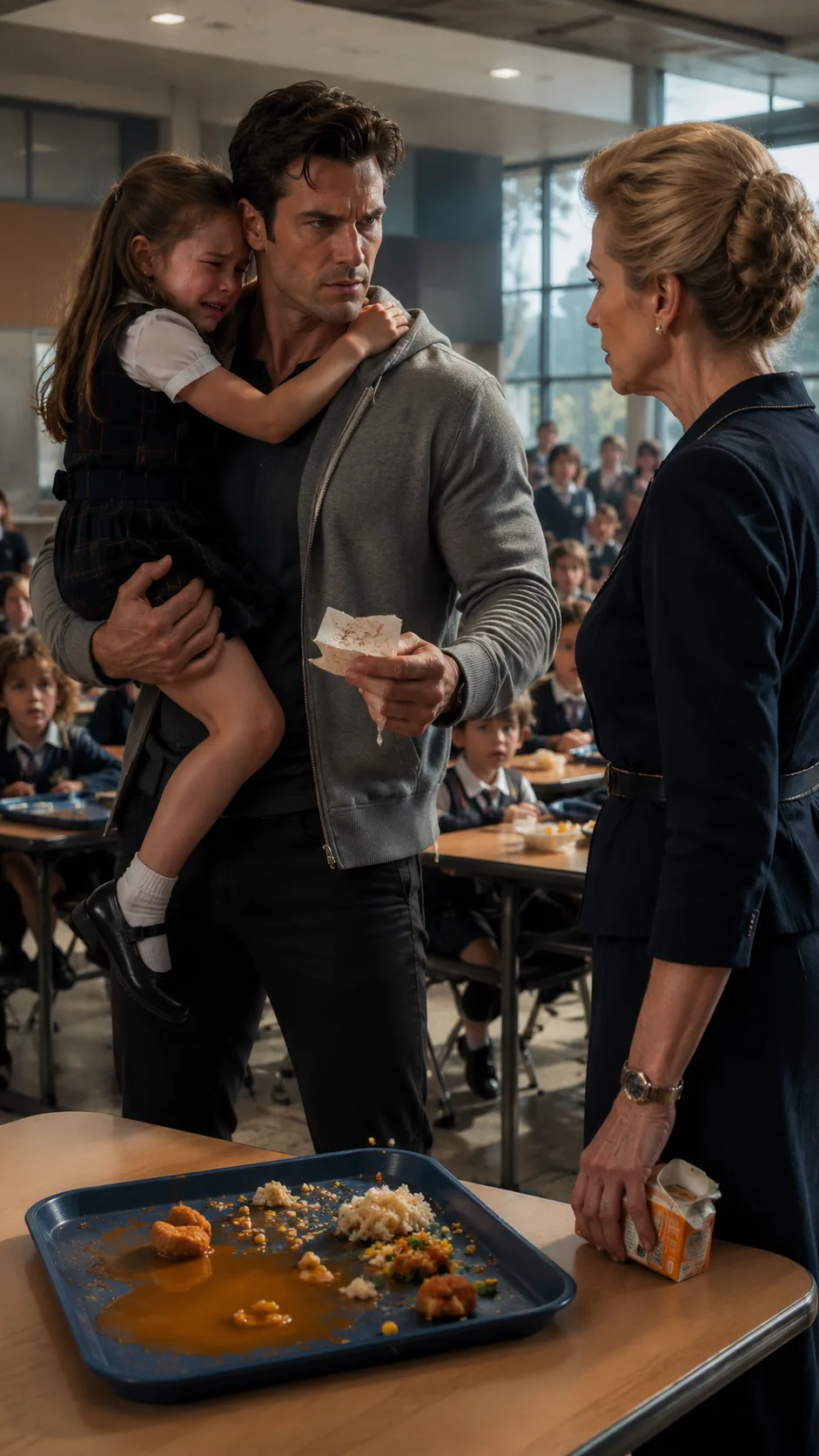
When he stepped into the cafeteria, every child seemed frozen in place. Dozens of little faces turned toward the same table near the center of the room.
Lily sat there with her shoulders hunched, both hands curled beside her tray. Her cheeks were wet. Her lips trembled as she tried not to make any noise.
Standing above her was Mrs. Aldridge.
Leonard knew the name. Senior teacher. Strict but respected, according to the school. One of those educators other adults described as “old-fashioned” when they really meant frightening.
In Mrs. Aldridge’s hand was Lily’s orange juice.
The one Leonard packed every morning.
“Please,” Lily whispered. “That’s my lunch.”
Mrs. Aldridge leaned over her.
“This is what happens when children refuse to listen.”
Then she turned the juice box upside down.
Orange liquid spilled across Lily’s tray, soaking the rice, the chicken bites, the vegetables, the napkin, and the little note Leonard had hidden beneath the lid.
Children gasped.
One girl covered her mouth.
Lily made a broken sound and reached for the tray, but Mrs. Aldridge slapped the table hard enough to make the spoon jump.
“Hands down.”
Leonard’s body went still.
Then his voice tore through the cafeteria.
“What are you doing to my daughter?”
The room snapped toward him.
Mrs. Aldridge froze with the empty juice box still in her hand.
Lily looked up.
For one second, she did not move.
Then she pushed back from the table and ran straight into Leonard’s arms.
“Daddy!”
He dropped the container of macaroni and cheese onto the nearest table and caught her.
Her uniform smelled like juice. Her hands clung to his hoodie. Her whole body shook.
Leonard held her against his chest and looked over her head at the teacher.
No boardroom had ever seen his face like that.
Mrs. Aldridge recovered first.
“This is a school cafeteria, not a playground for emotional outbursts,” she said. “Your daughter refused to finish the food provided to her. I was correcting disobedience.”
Leonard stared at the ruined tray.
“You poured juice over her food.”
“She was being wasteful.”
“You ruined the food I packed for her.”
Mrs. Aldridge’s eyes flicked over his hoodie, his jeans, his plain sneakers.
She did not recognize him.
That made her bolder.
“Parents like you are exactly the problem,” she said. “You drop children here expecting us to fix what you refuse to teach at home. Rules matter. Consequences matter. Your daughter needs structure.”
Lily buried her face deeper into Leonard’s shoulder.
“She does not need humiliation,” Leonard said.
Mrs. Aldridge stepped closer. “I will not be lectured by a father who clearly thinks money excuses bad manners.”
The cafeteria went even quieter.
A lunch monitor whispered, “Mrs. Aldridge…”
The teacher ignored her.
Leonard shifted Lily onto one arm and picked up the soaked note from the tray with his other hand.
The ink had bled.
Only three words remained visible.
*Daddy loves you.*
He folded it once.
Slowly.
Then he placed it in his pocket.
“What is your principal’s name?” he asked.
Mrs. Aldridge gave a thin smile.
“Principal Sterling supports his staff.”
“Good,” Leonard said. “Then he can support you in person.”
The walk to the principal’s office felt longer than it was.
Lily would not let go of his hand. The receptionist stood when she saw them, her face losing color as she noticed Lily’s stained uniform.
“Mr. Hayes, I’m so sorry, Principal Sterling is—”
“In his office,” Leonard said.
He opened the door without knocking.
Principal Harold Sterling looked up from his desk, irritated at first. Then he saw who had entered.
His expression changed so fast it almost looked painful.
“Mr. Hayes.”
Mrs. Aldridge, who had followed behind with stiff dignity, stopped mid-step.
The name hit her late.
Leonard Hayes.
The donor.
The billionaire.
The man whose foundation had funded the school’s wellness wing, library renovations, and new counseling program.
Sterling stood so quickly his chair rolled backward.
“I had no idea you were visiting today. We would have arranged a proper welcome.”
Leonard set Lily gently on the leather chair beside him.
“A welcome is not necessary,” he said. “An explanation is.”
Sterling glanced at Mrs. Aldridge.
She lifted her chin, but her hand trembled slightly.
Leonard placed Lily’s ruined lunch note on the principal’s desk.
“This was in my daughter’s lunchbox. Mrs. Aldridge poured juice over her meal in front of the cafeteria because she said Lily needed to learn her place.”
Sterling swallowed.
Mrs. Aldridge cut in. “That is not an accurate summary.”
“Then summarize it,” Leonard said.
Her mouth opened.
Nothing came out.
Sterling cleared his throat. “Mrs. Aldridge has served this institution for thirty-two years. Her methods can appear strict to outsiders, but she has always maintained discipline.”
Leonard looked at him.
“Strict?”
Sterling’s face tightened. “We cannot allow children to become entitled.”
Leonard almost laughed.
Not because anything was funny.
Because he suddenly understood.
This had not happened in secret. Not really. It had happened in a room full of children, monitored by staff, protected by a principal who had trained everyone to look away.
Leonard turned to Lily.
“Has this happened before?”
Lily stared at her shoes.
Sterling spoke quickly. “Mr. Hayes, children sometimes exaggerate when corrected.”
Leonard did not look away from his daughter.
“Lily.”
Her fingers twisted in her skirt.
“She takes lunches sometimes,” Lily whispered.
Mrs. Aldridge stiffened.
Leonard crouched in front of his daughter.
“Whose lunches?”
“Kids who don’t finish fast enough. Or kids who talk. Or kids who bring food she says smells weird.” Lily swallowed. “She throws it away.”
The room went silent.
“And why didn’t you tell me?”
Lily’s eyes stayed on the floor.
“She said if parents complain, we get moved to the bad table.”
Leonard turned his head toward the two adults.
His voice dropped.
“The bad table?”
Sterling sat down slowly.
Mrs. Aldridge’s face had gone pale beneath her makeup.
Leonard stood.
“I want every cafeteria camera recording from the last ninety days. I want all complaint records involving Mrs. Aldridge. I want the names of every staff member who witnessed food punishment, public shaming, or intimidation and failed to report it. And I want the school board on a call within one hour.”
Sterling raised both hands. “Mr. Hayes, surely we can handle this internally.”
“No,” Leonard said. “You handled it internally. That is why my daughter was crying over a lunch tray.”
Mrs. Aldridge snapped.
“This is absurd. Children today are fragile because parents like you make them fragile. I prepared generations of students for the real world.”
Leonard looked at her.
“The real world has consequences for adults too.”
For the first time, Mrs. Aldridge had no answer.
By sunset, Leonard’s legal team had arrived.
By morning, the story no longer belonged to one cafeteria.
Parents began calling the school. Some furious. Some shaking. Some crying because their own children had been coming home quiet for months and they had not known why.
A mother named Priya said her son stopped eating anything she packed from home because Mrs. Aldridge mocked the smell of his food.
A father named Marcus said his daughter begged to stay home every Wednesday because that was “inspection day.”
A grandmother said her grandson had hidden crackers under his pillow because he was afraid lunch would be taken again.
Complaint after complaint surfaced.
Some were written.
Some had been buried.
Some had never been filed because parents had been told their children were “sensitive,” “dramatic,” or “attention-seeking.”
Leonard listened to every one.
He did not speak much.
He took notes.
The school board tried to move carefully at first. They used phrases like “review process” and “personnel matter.” They hoped time would soften the outrage.
Leonard did not give them time.
He released a public statement through his foundation.
No names of children. No dramatic exaggeration. Just facts.
A child had been publicly humiliated by an educator. Other families had raised similar concerns. The school had failed to act. His foundation would suspend all future donations until an independent investigation was completed and student safety reforms were implemented.
That statement changed everything.
Mrs. Aldridge was placed on leave.
Principal Sterling resigned three days later.
But Leonard was not satisfied with removal.
Removal was what powerful people did when they wanted a problem to disappear.
Leonard wanted the place rebuilt.
A month later, he returned to Westbridge Preparatory.
This time, Lily walked beside him.
She wore a yellow cardigan and held his hand, but she did not hide behind him.
The cafeteria doors were open.
The room no longer looked like a place where children waited to be judged. The gray walls had been painted with murals designed by the students. Long tables had been replaced with smaller round ones. A nutrition board stood near the entrance, not with rules, but with choices.
A new principal greeted children by name at the door.
There were no “bad tables.”
There were no punishment trays.
There were adults called Meal Mentors who sat among the children, helped open containers, encouraged tasting new foods without forcing anyone, and made sure lunch was not treated like a test children could fail.
Leonard had funded it, but he had not designed it alone.
Parents had helped.
Child psychologists had helped.
The cafeteria workers had helped.
Most importantly, the children had helped.
On the first day of the new program, every student received a small card.
It said:
*Food is care. Lunch is not a punishment.*
Lily kept hers in her backpack.
That afternoon, Leonard sat at a round table with Lily and three of her classmates. She opened her lunchbox slowly. Inside was rice, chicken bites, carrots, and a fresh orange juice.
For a moment, her hand paused over the juice.
Leonard saw it.
So did the little girl beside her.
Without making a big deal of it, the girl picked up her own juice box and tapped it gently against Lily’s.
“Cheers,” she said.
Lily smiled.
A real smile.
Then she drank.
Across the room, a small boy approached Leonard with careful steps. He was one of the children who had always sat at the old corner table.
“Are you Lily’s dad?” he asked.
“I am.”
“Are you the reason lunch is different now?”
Leonard looked around the cafeteria.
At children talking freely.
At teachers kneeling to listen instead of standing over them.
At Lily laughing with her mouth full because she had forgotten to be afraid.
“I helped,” Leonard said.
The boy nodded as if that answer mattered.
Then he held out a folded napkin.
“My mom wanted me to give you this.”
Leonard opened it.
Written in blue pen were five words:
*Thank you for staying.*
Leonard read it twice.
He had almost done what people expected him to do. Pull his daughter out. Hire private tutors. Send her somewhere safer. Make one phone call and protect only what belonged to him.
But Lily had not been the only child at that table.
She had only been the one whose father walked in at the right moment.
Leonard folded the napkin and placed it carefully in his pocket beside the ruined note from that day.
One soaked with orange juice.
One written by a grateful mother.
Both reminders.
That evening, when Leonard tucked Lily into bed, she looked up at him with sleepy eyes.
“Daddy?”
“Yes, little star?”
“Mrs. Aldridge won’t come back?”
“No.”
“And the other kids can eat now?”
Leonard brushed a strand of hair away from her forehead.
“Yes,” he said. “The other kids can eat now.”
Lily thought about that.
Then she reached for the small lunch note he had written her that morning and placed it under her pillow.
“Can you write me another one tomorrow?”
Leonard smiled.
“I’ll write you one every day.”
She closed her eyes.
For a long time, Leonard sat beside her in the quiet room, listening to her breathing settle.
The world knew him as a billionaire.
A founder.
A man who could move markets with one sentence.
But none of those titles mattered in the dark beside his daughter’s bed.
The only title that mattered was the one Lily whispered when she needed him.
Daddy.
And from that day forward, Leonard Hayes made sure no child at Westbridge Preparatory ever had to cry over a lunch tray again.
THE END.
Chapter complete
You have reached the end of this chapter.
Continue reading
A few more worlds to get lost in after this chapter.