HE SOLD MY COMPANY BEHIND MY BACK—BUT HE FORGOT I BUILT IT WITH ONE FINAL SECRET
PART 1 — THE SON I TRUSTED
The first time I handed my son the keys to my company, he kissed my cheek and said, “I’ll make you proud, Mom.”
I believed him.
Chapter 1
HE SOLD MY COMPANY BEHIND MY BACK—BUT HE FORGOT I BUILT IT WITH ONE FINAL SECRET
PART 1 — THE SON I TRUSTED
The first time I handed my son the keys to my company, he kissed my cheek and said, “I’ll make you proud, Mom.”
I believed him.
That was my first mistake.
My name is Rose Hamilton. I was sixty-nine years old when I learned that love can blind a mother more completely than betrayal ever can.
Hamilton Foods began in my kitchen in 1984, with two borrowed mixers, a secondhand delivery van, and three recipes my grandmother had written on stained index cards. Back then, I was a widow with a nine-year-old boy sleeping on a mattress in the next room while I stayed up until two in the morning sealing jars of sauce by hand.
My son, Ethan, used to fall asleep to the sound of glass lids clicking shut.
He grew up inside that business.
He did his homework on flour sacks in the old warehouse. He rode beside me on delivery routes through rainstorms. He watched me stand in grocery store aisles, begging managers to give Hamilton Foods one shelf, just one shelf,
because I knew once families tasted what we made, they would come back.
And they did.
By the time Ethan turned forty-two, Hamilton Foods had factories in three states, distribution contracts across the Midwest, and our name on sauces, soups, frozen dinners, and bakery products in thousands of American homes.
But to me, it was never just a company.
It was proof that a woman with no safety net could survive.
It was proof that my husband’s early death had not destroyed us.
It was proof that my son would inherit something built with love, sacrifice, and honor.
So when my doctor told me my blood pressure was too high and my board told me I needed to slow down, I did the one thing I thought a good mother should do.
I stepped back.
I made Ethan CEO.
At the celebration dinner, he wore a navy suit that cost
more than my first delivery van. He raised a glass in front of our employees and said, “Everything I know, I learned from my mother.”
Everyone clapped.
I cried.
Clara Whitman, my chief operations officer and closest friend, squeezed my hand under the table. Clara had been with me for twenty-five years. She knew every supplier, every machine, every employee’s children by name.
“He’ll do fine,” she whispered.
I nodded, watching Ethan smile beneath the gold lights of the ballroom.
“He’s my son,” I said. “He knows what this company means.”
For the first few months, I tried not to interfere.
Ethan changed the packaging. I said nothing.
He replaced our old delivery uniforms with sleek black ones. I said nothing.
He hired consultants from New York who walked through our factory with tablets and expressions like they were inspecting something outdated. I said nothing.
Then he started removing people.
First it was Walter from distribution, who had worked for us for thirty-two years.
Then Maria from quality control.
Then George, the warehouse manager who had once driven through a snowstorm to deliver ingredients when a freezer broke on Christmas Eve.
Each time I asked Ethan about it, he gave me the same answer.
“Mom, loyalty doesn’t pay invoices.”
I hated that sentence.
But I told myself he was modernizing. I told myself every generation did things differently. I told myself I had raised a good man.
Then one Thursday morning in October, Clara came to my house without calling first.
That alone scared me.
Clara never arrived unannounced. She was the kind of woman who still wrote thank-you notes by hand and checked the weather before driving across town.
When I opened the door, she stood on my porch in a gray coat, her hair damp from the rain, clutching a leather folder to her chest.
“Rose,” she said, “we need to talk.”
I led her into my kitchen.
That kitchen had seen everything. Business plans. Birthday cakes. Grief. Hope. Ethan’s childhood drawings still hung framed near the pantry.
Clara sat at the table but did not remove her coat.
“What happened?” I asked.
She opened the folder and slid a printed email toward me.
At first, the words made no sense.
Lane & Co.
Acquisition terms.
Transition announcement.
Brand consolidation.
My eyes moved back to the top of the page.
Subject: Final Shareholder Approval Meeting.
My hand froze on the paper.
“Clara,” I said slowly, “what is this?”
Her face tightened.
“Ethan has been negotiating to sell Hamilton Foods.”
The kitchen became very quiet.
Outside, rain tapped against the window over the sink.
“No,” I said.
Clara did not look away.
“I wish I were wrong.”
I pushed the paper back.
“He wouldn’t do that.”
“Rose.”
“He wouldn’t sell to Victor Lane.”
Clara’s silence was the answer.
Victor Lane had tried to buy my company three times in twenty years. Each time, I refused. Lane & Co. was bigger, colder, faster. They bought family brands, stripped them down, closed plants, changed recipes, and kept the name until customers stopped noticing the difference.
Victor Lane didn’t buy companies.
He hollowed them out.
I stood up so quickly my chair scraped against the tile.
“Where is Ethan?”
“At headquarters,” Clara said. “The shareholder meeting starts at eleven.”
I looked at the clock.
10:14.
My son had scheduled a final approval meeting to sell the company I had built.
And he had not invited me.
For a moment, I felt old.
Not tired.
Not weak.
Old.
As if the world had moved while I was still standing in the same kitchen, holding a piece of paper that said my life’s work had already been traded away.
Then I looked at the framed photograph beside the pantry.
Ethan at ten years old, standing in front of our first delivery van, missing one front tooth, wearing a Hamilton Foods cap too big for his head.
He had been so proud that day.
I touched the frame.
Then I went upstairs and changed.
I chose the cream suit I had worn twenty-seven years earlier when Hamilton Foods got its first national distribution deal. The shoulders were a little tighter now. The cuffs were old-fashioned. But when I looked in the mirror, I did not see an old woman.
I saw the woman who had built an empire before anyone believed she could.
Clara drove.
Neither of us spoke much.
When we reached Hamilton Foods headquarters, the glass building rose against the gray sky like a stranger wearing my name.
The receptionist looked startled when I walked in.
“Mrs. Hamilton?”
“Good morning, Paige.”
She stood so fast her chair rolled backward.
“I didn’t know you were coming.”
“No,” I said. “I imagine you didn’t.”
The elevator ride to the top floor felt longer than it should have.
When the doors opened, I heard Ethan’s voice before I saw him.
Confident.
Smooth.
Practiced.
“This partnership positions Hamilton Foods for the future,” he was saying. “We cannot remain trapped by nostalgia.”
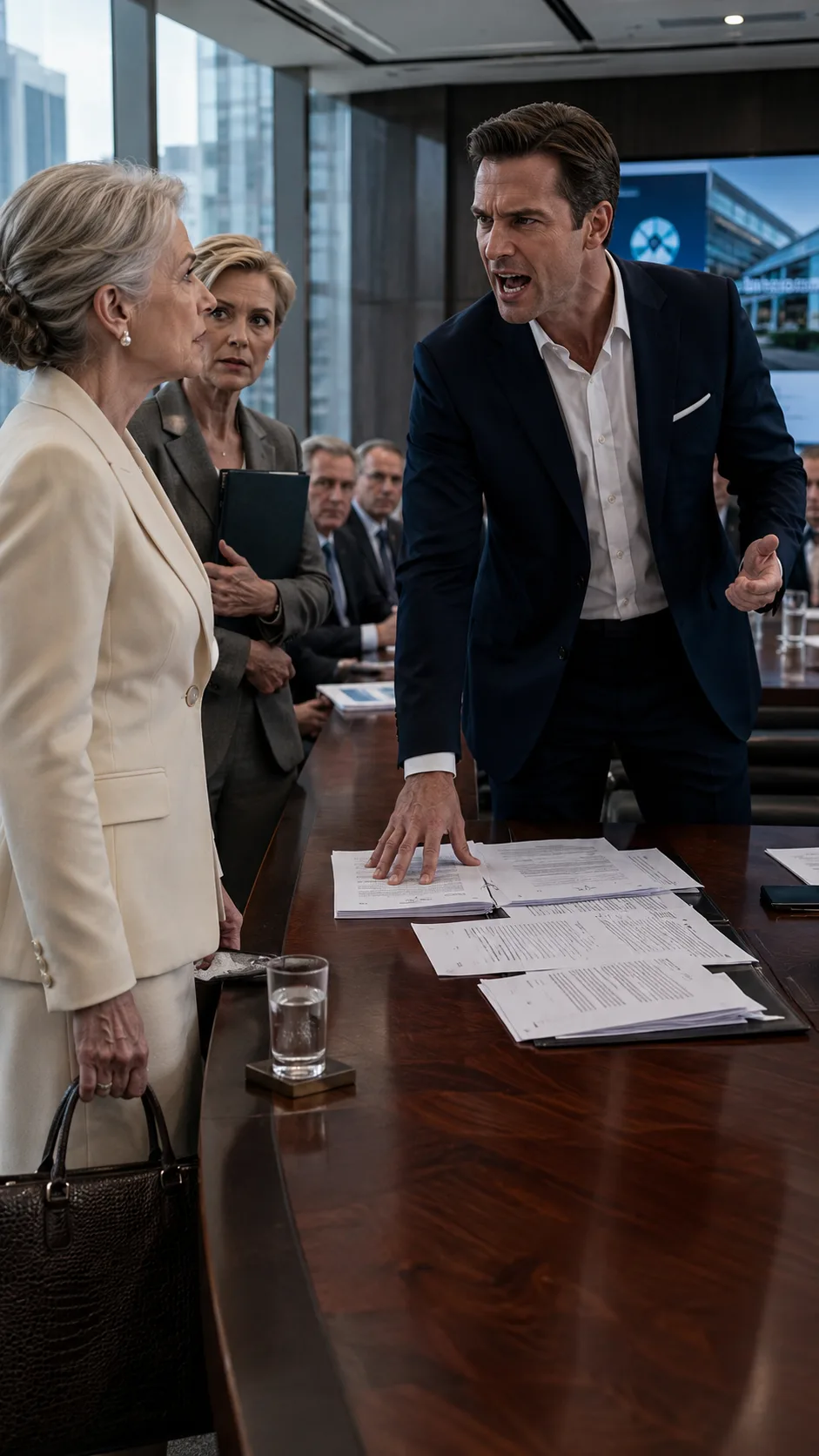
I stepped into the conference room.
Twenty-three people turned.
At the head of the long table stood my son.
Beside him stood Victor Lane.
And on the screen behind them, the Hamilton Foods logo faded into the Lane & Co. logo like a candle being blown out.
PART 2 — THE MEETING THAT BROKE ME
For three seconds, nobody spoke.
Ethan’s face changed first.
Not guilt.
Not fear.
Annoyance.
That hurt more than anything.
“Mom,” he said, forcing a smile. “This isn’t a good time.”
I walked farther into the room.
“I can see that.”
Victor Lane buttoned his jacket and gave me the same polished smile he had worn at every negotiation table for two decades.
“Rose,” he said. “It’s been a long time.”
“Not long enough, Victor.”
A few people shifted in their seats.
Ethan’s jaw tightened.
“Everyone, let’s take five,” he said.
“No,” I said.
The room went still again.
I looked at the screen. The new logo. The transition plan. The smiling stock photo of a family eating dinner under a slogan I had never approved.
“Continue,” I said. “I’d like to hear how my company is being buried.”
Ethan’s face flushed.
“Your company?” he repeated.
Something in his voice made Clara move closer to me.
“Yes,” I said. “My company.”
Ethan gave a short laugh.
“That’s exactly the problem, Mom. You still think this is 1984.”
“No. I think this is a room full of people pretending I’m already gone.”
That landed.
One of the older shareholders, Robert Ellis, looked down at his hands. Robert had invested in Hamilton Foods when nobody else would. His wife used to bring casseroles to my house after my husband died.
He could not look at me now.
Ethan stepped away from the screen.
“You retired.”
“I stepped back.”
“You gave me control.”
“I gave you leadership.”
He pointed toward the screen.
“And I’m leading.”
“No,” I said. “You’re selling.”
Victor cleared his throat.
“Rose, I understand this is emotional.”
I turned to him.
“Do not use that word to make betrayal sound like menopause.”
Someone coughed.
Victor’s smile disappeared.
Ethan slammed his palm on the table.
“That is enough.”
There he was.
Not my little boy.
Not the child who had clapped when I sold our first thousand jars.
A man in a tailored suit, angry that his mother had interrupted his victory.
“You don’t get to walk in here and embarrass me,” he said.
I stared at him.
“Embarrass you?”
“Yes,” he snapped. “You’ve done this my entire life. Every room, every dinner, every article, every speech. Rose Hamilton. The legend. The founder. The woman who did it all. Do you know what it’s like being your son?”
The words came out hot, years old.
“I know what it’s like raising one alone,” I said.
His face flickered.
Just for a second.
Then it hardened again.
“You built something great,” he said. “But you don’t know how to grow it anymore.”
“By selling it to a man who destroys family brands?”
“By accepting reality.”
I looked around the room.
“Did all of you accept this reality too?”
No one answered.
That silence told me everything.
Ethan picked up a stack of papers and tossed them onto the table.
“The votes are secured. The terms are agreed. The announcement goes out Monday.”
“You were going to tell me after?”
“I was going to tell you when it was done.”
My chest tightened.
“When it was done,” I repeated.
He leaned forward, both hands on the table, voice low but sharp.
“Yes. Because every time this company tries to move forward, you drag it backward with some speech about values and family and recipes written on index cards.”
I felt every eye in the room on me.
Clara’s hand brushed my elbow, steadying me without making it obvious.
Ethan kept going.
“You think loyalty makes payroll? You think tradition protects market share? You think people buy soup because your grandmother wrote something in pencil seventy years ago?”
I said nothing.
He mistook my silence for weakness.
His voice grew louder.
“You had your time, Mom.”
The room seemed to shrink.
He straightened his jacket, looked me dead in the eye, and said the sentence that ended the last soft place in my heart.
“Your era is over.”
No one moved.
Even Victor Lane looked uncomfortable.
I heard my own breathing.
I thought of all the nights I had gone hungry so Ethan could have new school shoes. I thought of the year I didn’t pay myself because the factory workers needed Christmas bonuses. I thought of bringing Ethan to the office after his baseball games because there was nobody else to watch him.
Your era is over.
I opened my purse.
Ethan’s eyes dropped to it.
“What are you doing?”
I removed a dark blue binder.
Old. Worn at the corners. The spine faded.
Clara inhaled softly beside me.
Ethan frowned.
“What is that?”
I placed the binder on the table.
“The beginning.”
Victor looked at it, then at me.
Ethan laughed once.
“Mom, we don’t need a scrapbook.”
“No,” I said. “You need a memory.”
I opened the binder.
Inside were the original founding documents of Hamilton Foods. Not the public version. Not the glossy corporate history printed for anniversaries.
The real beginning.
Handwritten notes. Early investor agreements. Board provisions from the year I formed the company.
Ethan’s expression sharpened.
“Where did you get that?”
“From my safe.”
“You kept corporate records at home?”
“I kept the soul of the company at home.”
He reached for the binder.
I put my hand on top of it.
He stopped.
I turned to a page marked with a yellow tab.
“This clause was created in 1984,” I said. “After my first investor tried to pressure me into selling before we’d even made a profit.”
Victor’s face changed.
He knew.
Maybe not the detail.
But he knew enough to stop smiling.
I read aloud.
“The founder, Rose Margaret Hamilton, shall retain one special Class A share with absolute veto authority over any sale, merger, acquisition, transfer of brand ownership, or dissolution of Hamilton Foods.”
The room went dead silent.
Ethan blinked.
“No.”
I looked at him.
“Yes.”
“No, that can’t still be active.”
Clara stepped forward.
“It is.”
Ethan turned on her.
“You knew?”
Clara’s face stayed calm.
“I suspected. Then I verified.”
His eyes widened.
“With who?”
“With independent counsel three weeks ago.”
The shareholders began whispering.
Victor Lane pulled out his phone.
Ethan pointed at Clara.
“You went behind my back?”
Clara said quietly, “You went behind hers.”
I saw the blow land.
Not physically. Worse.
Publicly.
Ethan looked around the room and realized the air had changed. Five minutes ago, he had owned it. Now it was slipping through his fingers.
“This is ridiculous,” he said. “One outdated clause can’t stop a multimillion-dollar transaction.”
“It can,” I said.
Victor’s phone was already at his ear, his voice low and urgent. But the panic in his eyes told me everything.
I turned to the shareholders.
“For forty years, I protected this company from men who wanted to buy our name and cheapen our products. I never imagined the final attempt would come through my own son.”
Ethan flinched.
Good.
Let him.
He had earned that pain.
“Mom,” he said, softer now. “You don’t understand what I was trying to do.”
“No, Ethan. I understand perfectly.”
“You never trusted me.”
“I trusted you with everything.”
He looked at the binder.
“I was trying to make us bigger.”
“You were trying to make yourself separate from me.”
His face cracked.
Just a little.
And for the first time that morning, I saw the boy beneath the suit. The boy who had grown up in my shadow and hated me for standing so tall.
But pity did not erase betrayal.
Robert Ellis stood slowly.
“I move that the proposed sale be withdrawn immediately.”
Another shareholder said, “Seconded.”
Ethan turned pale.
“Wait.”
Clara looked at him, then at the others.
“There is another matter.”
I closed my eyes briefly.
Because that was the part I wished she had not found.
Ethan looked at her.
“What matter?”
Clara opened her own folder and placed a report on the table.
“During negotiations with Lane & Co., Ethan authorized the closure of the Ohio plant as part of the transition plan.”
Gasps moved across the room.
My Ohio plant employed four hundred people.
Families.
Mortgages.
College funds.
Lives.
I stared at my son.
“You were going to close Ohio?”
Ethan swallowed.
“It was part of the efficiency model.”
I stood so fast my chair hit the wall behind me.
“Those people stayed with us during the fire.”
“Mom—”
“They worked double shifts when the freezer line failed.”
“I know—”
“They sent flowers when your father died.”
His mouth closed.
I leaned across the table, close enough that he had to look at me.
“You did not sell a company today, Ethan. You sold your own history.”
Chapter complete
You have reached the end of this chapter.
Continue reading
A few more worlds to get lost in after this chapter.