For a few seconds, no one moved.
Chapter 3
For a few seconds, no one moved.
Not Marissa.
Not Ryan.
Not me.
Even the venue manager seemed to regret saying the name out loud.
Walter Whitaker.
My husband had been dead for four years.
I heard a fork drop somewhere behind me. A guest whispered something. Someone at the head table pushed back a chair.
But all I could hear was Walter’s name echoing inside my chest.
“What do you mean,” I said slowly, “the card belongs to Walter Whitaker?”
The manager swallowed.
“I only mean the name on the deposit card for the after-party lounge is Walter Whitaker.”
“That is impossible.”
Marissa said it before I could.
Too fast.
Too sharp.
Too practiced.
Ryan turned to her. “Marissa?”
She lifted both hands, palms outward, as if calming a room full of children.
“I don’t know what he’s talking about,” she said. “This is some kind of mistake.”
But her face had changed.
I had watched
enough seven-year-olds lie about broken crayons to know when panic entered a person’s eyes.
“Show me,” I said.
The manager hesitated. “Mrs. Whitaker—”
“Show me.”
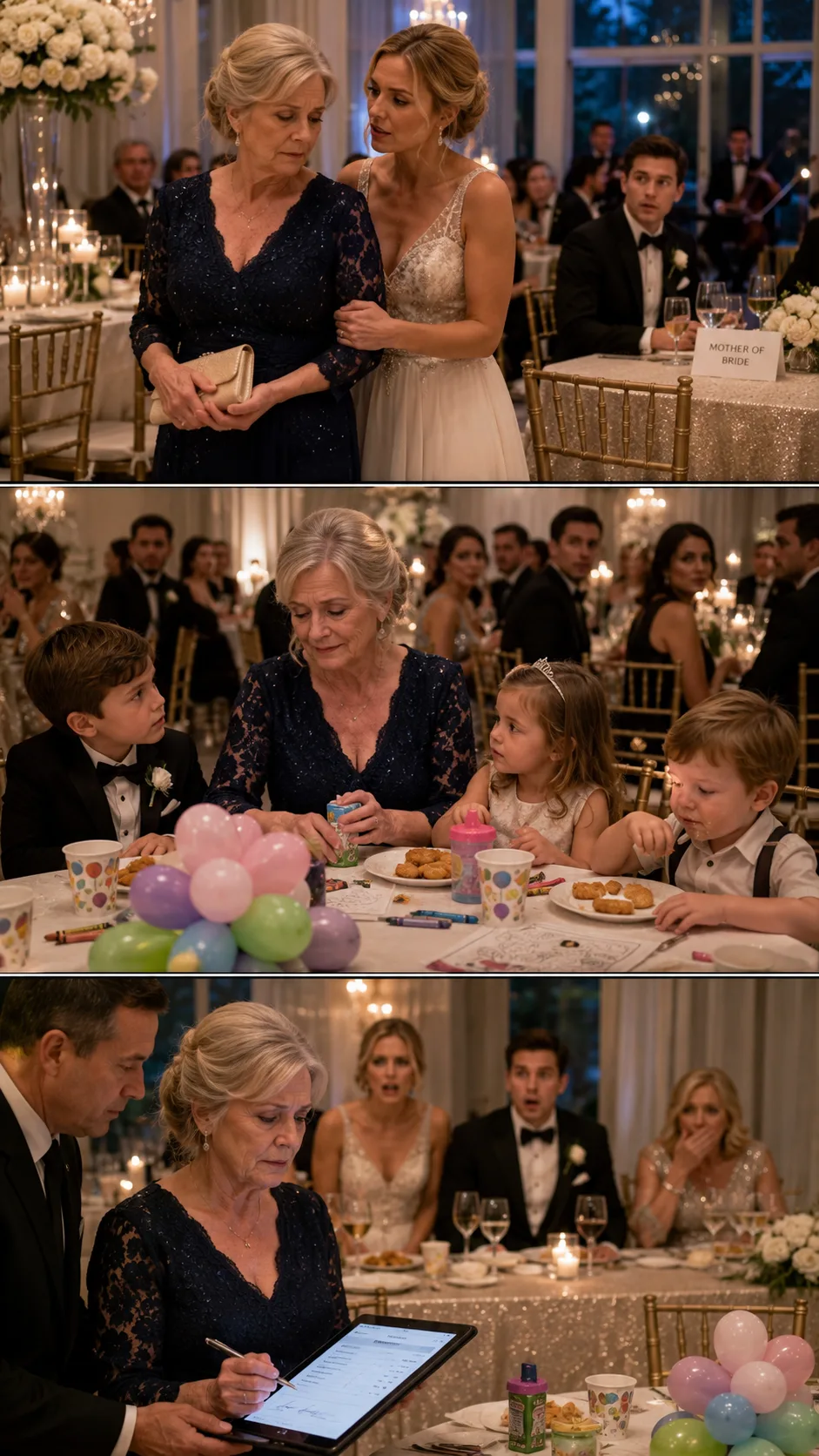
He angled the tablet toward me.
There it was.
Walter Whitaker.
A card ending in four digits I knew better than my own phone number.
My husband’s old business card.
The one I had closed after his funeral.
Or thought I had.
I looked at Ryan.
He had gone pale.
Not surprised pale.
Caught pale.
“You knew,” I said.
He rubbed a hand over his mouth. “Mom, it’s not what you think.”
That sentence has carried more lies than any other sentence in human history.
“Then explain it.”
Marissa snapped, “Ryan, don’t.”
That was enough.
The room heard it.
I heard it.
Ryan heard it too, because his shoulders dropped like something inside him had finally given up pretending.
He looked at the floor.
“I
needed a card for the lounge deposit,” he said quietly.
The words did not make sense at first.
My brain refused them.
“You used your father’s card?”
“It was still active.”
“No,” I said. “It was closed.”
“I reopened it.”
The ballroom disappeared for a second.
The candles became blurry. The flowers became colorless. Even Marissa’s white dress turned into a pale smear in front of me.
“You reopened your dead father’s credit card?”
Ryan’s face twisted. “Mom, please lower your voice.”
I almost smiled.
Even then, he was worried about volume.
Not theft.
Not fraud.
Not the fact that his dead father’s name had just appeared on a wedding bill.
Volume.
“How?” I asked.
He said nothing.
Marissa did.
“We were going to pay it back.”
I turned to her.
That was when everything became clear.
Not all at once, but piece by piece.
The sudden upgrades.
The private
lounge.
The extra photography hour.
The bridal suite extension.
The way Ryan had begged me for help while Marissa kept adding things behind my back.
This was not one bad decision.
This was a system.
My grief had been turned into credit.
My motherhood had been treated like a bank.
My husband’s name had been dragged into a ballroom so Marissa could have imported champagne.
I looked at Ryan again.
“Did you sign his name?”
He said nothing.
Marissa moved closer. “Eleanor, listen. This is your son’s wedding night. Don’t destroy it.”
I stared at her.
“My son’s wedding night survived me being seated with toddlers.”
Her mouth shut.
“So I think it can survive the truth.”
Ryan’s eyes filled with tears.
For a moment, I wanted to comfort him.
That instinct rose in me automatically, old and loyal. The same instinct that made me check his fever at midnight. The same instinct that made me send grocery money when he said things were tight. The same instinct that made me sell land I loved because he said the wedding was important.
But motherhood is not the same as surrender.
And love is not a lifelong contract to be used.
I turned to the manager. “Please print the full transaction record.”
He nodded immediately. “Yes, ma’am.”
Ryan stepped forward. “Mom, wait.”
“No.”
It was the smallest word I had ever given him.
It was also the hardest.
He stopped.
I looked at Marissa’s parents at the head table. Her mother would not meet my eyes. Her father stared at his plate. Her sister looked fascinated, as if the open bar had just become live entertainment.
Then I looked at the children.
The ring bearer was still watching me.
I wondered what he would remember from this night.
The flowers?
The cake?
The bride crying in anger?
Or the old woman at his table who finally stood up?
The manager returned with printed pages in a black folder.
I opened it.
There were charges I had never seen.
Not just the lounge.
A luxury car service.
A designer rehearsal dinner invoice.
A spa package.
A “bridal recovery brunch” scheduled for the next morning.
All charged under accounts connected to either me or Walter.
My hands started to shake then.
Not from fear.
From rage.
Quiet rage is a dangerous thing. It does not burn fast. It settles into the bones and becomes decision.
I closed the folder.
“Call the police,” I said.
Marissa’s face drained of color.
Ryan grabbed my arm. “Mom, don’t do this.”
I looked down at his hand.
He removed it.
“You did this,” I said. “I am only refusing to hide it.”
Marissa began crying then.
Not soft tears.
Performance tears.
The kind that asked the room to rescue her.
“I just wanted one perfect day,” she sobbed.
I nodded.
“And I wanted one seat near my son.”
That silenced her more than shouting ever could.
Ryan covered his face with both hands.
“I’m sorry,” he whispered.
The apology came too late to stop the damage.
But not too late for him to hear himself say it.
The police did not arrive with sirens. They came quietly, two officers speaking with the venue manager near the lobby while guests pretended not to stare.
I did not have Ryan arrested that night.
Not because he deserved protection.
Because I deserved peace.
I gave a statement. I handed over the folder. I paid only the original balance I had approved. Every unauthorized charge was removed from my account and transferred for investigation.
Then I left before cake.
Outside, the Connecticut night was cool and blue. The air smelled like cut grass and rain coming from far away.
I stood under the stone entrance with my small cream clutch in my hand, waiting for the valet.
Ryan came out after me.
His bow tie was loose now. His face looked younger, broken in a way I recognized. He stood three feet away like a boy waiting outside the principal’s office.
“Mom,” he said.
I turned.
“I’m sorry.”
This time, the words were complete.
But complete does not mean enough.
“I believe you are sorry tonight,” I said. “I don’t know yet if you are sorry enough to become different tomorrow.”
He cried then.
Quietly.
For once, I did not reach for him.
That was the moment I understood something women like me learn too late.
Sometimes a mother’s final gift is not rescue.
Sometimes it is consequence.
The next morning, I called my attorney.
By noon, I had frozen the remaining wedding payments, closed every account Ryan had access to, and reported the reopened card formally.
By the end of the week, I changed my will.
Ryan was not disinherited.
I was not cruel.
But his inheritance moved into a supervised trust with strict conditions: repayment, counseling, financial accountability, and no access through Marissa.
Walter’s land was gone.
My savings were thinner.
My heart was bruised in places I did not know a heart could bruise.
But I still had my house.
I still had my name.
And for the first time in years, I had my own silence.
Not the silence of swallowing pain.
The silence of a door finally closed.
Three months later, Ryan came to visit me alone.
No Marissa.
No excuses.
He brought flowers, not roses. He remembered I hated wedding roses now. He sat at my kitchen table and cried into his coffee like a man finally meeting the cost of his weakness.
I did not forgive him that day.
But I listened.
That was all I had to give.
As for Marissa, she returned most of the gifts, deleted her wedding photos, and moved back into her parents’ guest room before summer ended.
People asked me if I felt satisfied.
I told them satisfaction was too small a word.
I did not win.
I woke up.
And sometimes, for a woman who has spent her life paying for everyone else’s comfort, waking up is the most expensive and beautiful thing she will ever do.
THE END
Chapter complete
You have reached the end of this chapter.
Continue reading
A few more worlds to get lost in after this chapter.