PART 1 — The Woman Who Thought I Was in Her Way
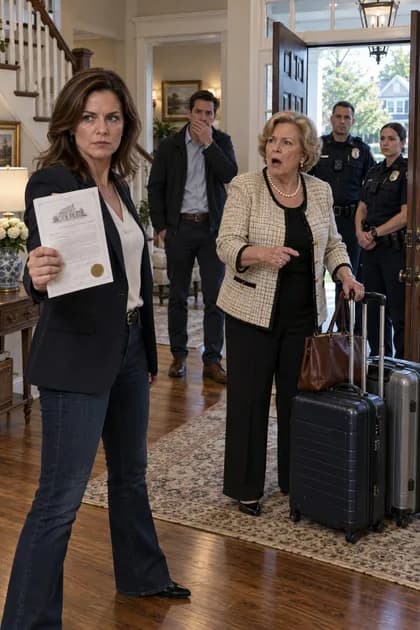
I stood at the airport gate with my hand wrapped around the handle of my carry-on, listening to my daughter-in-law’s words echo over the low noise of Denver International Airport.
Chapter 1
I stood at the airport gate with my hand wrapped around the handle of my carry-on, listening to my daughter-in-law’s words echo over the low noise of Denver International Airport.
“Stay out of our way,” Amber snapped. “You didn’t pay for this trip.”
For a second, the whole terminal seemed to shrink around me. The rolling suitcases, the boarding announcements, the smell of burnt coffee from the kiosk across the concourse, the sharp click of Amber’s heels on the polished floor—everything narrowed into that one sentence.
You didn’t pay for this trip.
She had said it loudly enough for strangers to hear. Loudly enough for the gate agent to look up from the scanner. Loudly enough for my son to lower his eyes like a boy caught doing something wrong.
What Amber didn’t know was that I had paid for it.
Every single penny.
The flights. The resort. The airport transfers. The extra bag fee she had tossed at me that very morning like I was a walking wallet. My credit card was still attached to their booking.
Or at
least, it had been.
My name is Carol Jensen. I am sixty-eight years old. I live in a quiet neighborhood outside Denver, in a two-story house my late husband Tom and I bought back when the maple trees along our street were still thin enough to bend in a storm. I have lived long enough to know that some humiliations do not happen all at once. They are built slowly, one small dismissal at a time, until the person hurting you becomes shocked when you finally stop standing still.
This happened three months ago, though some mornings I still wake up with the airport lights in my mind and the sound of Amber’s voice cutting through the terminal.
To understand why that moment mattered, you have to know what came before it.
My son Bradley is my only child. His father, Tom, passed away nine years ago from a sudden
heart attack on an ordinary Thursday afternoon. There was no dramatic warning, no long goodbye, no time to prepare ourselves for the empty chair at the kitchen table. One day Tom was checking the thermostat, reminding me to change the furnace filter before winter. The next, I was standing in a hospital hallway with Bradley’s arms around me while a doctor spoke in a soft voice I barely heard.
Tom had been a mechanical engineer. Practical, steady, gentle in the way truly strong men often are. He fixed things before they broke. He kept receipts in labeled folders. He drove the same pickup truck for seventeen years because, as he liked to say, “A car is for getting somewhere, not proving something.”
He worked hard and saved harder.
When he died, he left me comfortable. Not wealthy, not the kind of woman who could throw money around without thinking, but
secure. Life insurance, a pension, savings, the house nearly paid off. More than once, Bradley told me Dad had taken care of us even after he was gone.
Tom had also left me a handwritten letter in the top drawer of his desk. I still have it, folded into thirds, the paper worn soft at the edges.
Live life, Carol. Don’t spend the rest of it only surviving. See places. Eat good food. Help Bradley if he truly needs it. Be happy for both of us.
I tried.
For a long time after Tom died, Bradley and I leaned on each other. He called every day. He came over for Sunday dinners. We had a tradition of Tuesday night coffee on my porch in the summer and soup in the kitchen during winter. He would tell me about work, about friends, about whatever show he was watching, and I would listen because mothers learn to collect small details. They become proof that your child still lets you close.
Then Bradley met Amber.
It was four years ago at a tech conference in Austin. She worked in marketing for a startup and had the kind of polish that made people notice her before she even spoke. She was pretty in a controlled, expensive way. Blonde hair always styled, nails always perfect, clothes chosen to look effortless even though nothing about them was accidental.
When Bradley brought her to dinner the first time, I tried hard to like her.
I really did.
I made roast chicken, mashed potatoes, green beans with almonds, and the apple pie Bradley had loved since he was a boy. Amber arrived in a fitted black dress and a coat she left draped over the back of my chair without asking.
She smiled. She complimented the house. She asked questions about Tom in a voice so gentle I almost felt guilty for noticing how her eyes kept moving around the room, measuring things.
The china cabinet. The rugs. The framed photographs. The age of the furniture.
There was something under her charm that bothered me. A coolness when she thought no one was watching. A little calculation in the way she spoke to servers, cashiers, people she did not need to impress. She had a habit of turning her smile off too quickly, as if kindness were only a performance she had grown tired of holding.
Chapter complete
You have reached the end of this chapter.
Continue reading
A few more worlds to get lost in after this chapter.