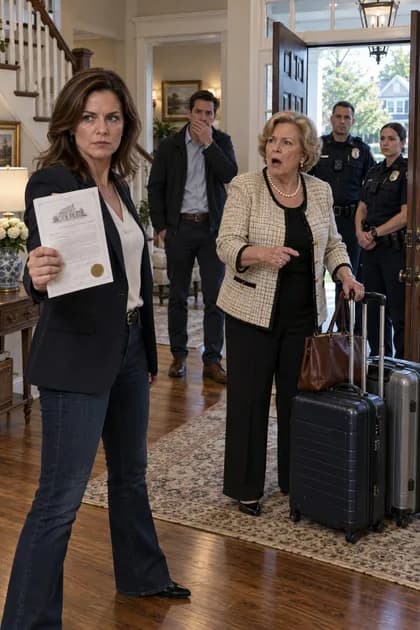
Joanna placed a flash drive on Daniel’s conference table and kept both hands wrapped around a paper cup she never drank from.
Chapter 4
Joanna placed a flash drive on Daniel’s conference table and kept both hands wrapped around a paper cup she never drank from.
Her attorney spoke first.
“My client is prepared to provide records showing that Beverly Lawson orchestrated the guardianship effort, directed the misuse of the emergency call, and misrepresented financial transactions involving funds received from your client.”
I looked at Joanna.
“You knew she was taking my money.”
Joanna’s face collapsed.
“Not at first.”
“That isn’t what I asked.”
She stared down at the cup.
“Yes.”
The word landed quietly.
I had expected anger when this moment came.
Instead, I felt grief.
Not because I had lost eighteen thousand dollars a month.
Because I finally understood that the money had not merely supported my family.
It had purchased their silence while they lied to me.
Joanna explained that three years earlier, Beverly had realized how easily I paid any expense labeled urgent. A roof leak. A medical premium. A car repair. Property taxes. Insurance. She began separating my transfers into categories,
then moving portions through different accounts.
Some money paid real bills.
Some went to Joanna.
Some went into the Tempe property.
And some was saved.
“How much?” Daniel asked.
Joanna looked at her attorney.
He nodded.
“Four hundred and eighty-seven thousand dollars.”
I thought I had misheard.
“Saved where?”
“In an investment account Beverly opened through a small business entity.”
The company was called BJL Family Services.
B for Beverly.
J for Joanna.
L for Lawson.
My former married name.
Beverly had used the story of family hardship to build nearly half a million dollars in reserves while continuing to tell me she could not afford insurance without my help.
Worse, she had begun telling Eric that the money would eventually help finance a legal fight over Maisie.
Joanna opened the files on the flash drive.
There were spreadsheets.
Transfer logs.
Scans of checks.
Screenshots of messages.
One column was
labeled “C contribution.”
C was me.
Another was labeled “M leverage.”
M was Maisie.
I stopped reading.
Daniel turned the laptop away from me.
“That’s enough for now.”
“No,” I said. “I want to understand.”
Joanna started crying again.
“Mom said you’d never notice because you make so much.”
That sentence hurt in a way I still cannot fully explain.
I did make good money.
I had built a career in corporate risk consulting after starting with nothing but a state-school degree and a willingness to travel when no one else wanted to.
But Beverly had turned my success into permission.
If I could afford the loss, then apparently it was not theft.
If I could replace the money, then apparently the betrayal did not count.
And if I loved my daughter, then Maisie could be used as leverage.
Daniel asked Joanna why she had finally decided to cooperate.
She
gave an answer I did not expect.
“Because Mom told me Harper could be next.”
I stared at her.
“What?”
“Last night she said if I talked, she’d tell social services I was unstable too. She said she knew things about me and could make sure Harper ended up with her.”
For the first time, Joanna looked less like my enemy and more like someone who had spent years standing inside the same machine I had funded.
That did not erase what she had done.
But it explained why Beverly always needed one daughter dependent and the other guilty.
Control had been her real income.
Money was only the instrument.
The legal consequences unfolded quickly after that.
The police review of the emergency call was referred for formal consideration because the messages strongly suggested it had been used to manufacture a record rather than respond to an actual emergency.
The school preserved Beverly’s written accusations and security footage.
The family court extended the protective order.
Daniel also referred the financial records to a forensic accountant and advised me that recovering money would be a separate civil matter, one we would pursue carefully rather than dramatically.
Eric signed a declaration acknowledging that Beverly had approached him about the guardianship plan and that he had accepted financial benefits connected to the Tempe property.
He did not lose his parental rights.
I did not ask for that.
Maisie loved him.
And whatever I felt about Eric, I refused to make the same mistake Beverly had made.
A child was not a weapon.
We revised the parenting arrangement so Eric’s contact with Maisie increased gradually under clear boundaries, with no communication through Beverly and no discussion of the case around our daughter.
For once, Eric did not argue.
Three weeks after the police incident, Beverly appeared at the protective-order hearing in a navy suit and pearl earrings.
She looked exactly like the mother I remembered from childhood.
Composed.
Respectable.
Certain that if she spoke calmly enough, everyone would eventually agree with her.
Her attorney argued that she had been a concerned grandmother who overreacted.
Daniel introduced the text message.
“We need an incident that creates a record.”
Then the next one.
“Relax. I know what I’m doing.”
The courtroom changed.
Not loudly.
There was no dramatic gasp.
No one shouted.
But Beverly’s certainty disappeared.
For the first time, she looked small.
When asked why she told Maisie that police might lock her away, Beverly said she had been trying to teach consequences.
When asked why she attempted to add herself as a guardian at school days later, she said she feared for Maisie’s welfare.
When asked why her draft guardianship plan existed before the police call, she stopped answering directly.
The judge extended the no-contact order and prohibited Beverly from approaching Maisie’s school, residence, childcare providers, or medical providers.
Then came the notice Beverly had never expected.
Not the protective order.
Not the police review.
Not even the forensic accounting.
It came from the bank that serviced the Tempe property.
Because the financial review exposed inconsistencies in the ownership documents and source-of-funds representations used during refinancing, the lender opened a compliance investigation and froze further transactions tied to the property until the discrepancies could be resolved.
The house Beverly had secretly built with money she told me was keeping her alive was suddenly no longer something she could quietly sell, refinance, or transfer.
At almost the same time, Joanna received a repossession notice on the car I had stopped paying for.
She came to my apartment alone.
She was not allowed inside because the order still applied to contact involving Maisie, so we met with Daniel present in the lobby of his office.
“I’m going to lose the car,” she said.
“Yes.”
“I can’t get Harper to preschool without it.”
“There’s a bus two blocks from your building.”
She looked stunned.
I had never spoken to her that way.
Not cruelly.
Just without rescuing her.
“What am I supposed to do now?” she asked.
I thought about all the years I had answered that question with my wallet.
Then I said, “Figure out what you can afford. Apply for work. Call the lender. Make a plan.”
She cried.
I did not.
“I’m sorry,” she whispered.
“I believe you’re sorry that this became real.”
“That’s not fair.”
“No. Fair would have been you protecting my daughter when Mom told a five-year-old she might be taken to jail.”
Joanna looked away.
I softened my voice, but not the boundary.
“If you want a relationship with me someday, it starts with accountability. Not emergencies. Not guilt. Not money.”
She nodded.
Months passed.
The civil case over the diverted funds did not end overnight. Real life rarely gives you a perfect courtroom victory in forty-five minutes.
Some money was traceable.
Some was not.
The Tempe property became part of the dispute.
Beverly hired new counsel and stopped contacting relatives about me after her lawyer warned her that public statements could complicate the case.
Joanna found part-time work at a dental office and sold several things she could no longer afford.
Eric began showing up consistently for Maisie.
Not perfectly.
Consistently.
That mattered more.
And Maisie changed too.
For weeks after the police incident, she froze whenever she heard sirens.
So one Saturday, with guidance from her therapist, we attended a community safety event where children could meet firefighters and police officers in a calm setting.
The same younger officer who had knelt beside her in my living room happened to be there.
Maisie recognized him first.
She hid behind my leg.
He crouched several feet away and smiled.
“Hey, Maisie. Remember what I told you?”
She nodded.
“You’re not a bad little girl,” she whispered.
“That’s right.”
She stepped out from behind me.
Then she asked the question that broke my heart and healed a piece of it at the same time.
“Do police take kids away when grandmas are mad?”
“No,” he said gently. “Grown-ups are supposed to help kids feel safe.”
Maisie looked up at me.
I squeezed her hand.
“Yes,” I said. “They are.”
That night, after I tucked her into bed, she reached for the birthday doll that had started the entire disaster.
One of its braids had come loose.
“Mommy?”
“Yes?”
“Can I keep it forever?”
“As long as you want.”
“Even if Harper wants it?”
“Even then.”
She smiled.
For years, I thought being a good daughter meant making sure my mother never struggled.
I thought being a good sister meant solving Joanna’s problems before she had to face them.
I thought generosity could hold a broken family together.
I was wrong.
Money had not kept us together.
It had only delayed the moment when everyone had to become responsible for who they really were.
The eighteen thousand dollars I stopped sending that night did not destroy my family.
It revealed it.
And the best thing I ever bought with that money was the one thing I finally stopped paying for.
Their control.
THE END.
Chapter complete
You have reached the end of this chapter.
Continue reading
A few more worlds to get lost in after this chapter.