My mother-in-law had spent eight months convincing me she was slowly losing her mind.
Chapter 1
THE PAPERS THEY THOUGHT I WOULD NEVER READ
5,405 words
I cooked every meal for her. I helped her bathe. I buttoned her sweaters, washed her hair, cleaned up after her accidents, and made sure she was never left alone.
And whenever I admitted to my husband that I was exhausted, Grant always gave me the same answer.
“She only trusts you, Natalie.”
So I stayed.
I gave up more and more of my life because I believed Vivian needed me.
Then, one cold Tuesday night in October, I walked past her bedroom and heard her talking on the phone.
Her voice wasn’t weak.
It wasn’t confused.
It wasn’t frightened.
It was completely normal.
And then she laughed.
“She still has no idea.”
I didn’t confront her.
I didn’t scream.
I didn’t even knock on the door.
I simply stood there in the dark hallway, holding a clean towel against my chest, and realized that the last eight months of
my life might have been built on a lie.
And by the next morning, I knew exactly what I was going to do.
Ten minutes later, Vivian came running out of her bedroom.
But to understand why, you need to know what happened before that night.
The laugh was what finally broke the spell.
For eight months, I had watched my mother-in-law supposedly forget how to use a spoon.
I had sat across from Vivian Mercer at the kitchen table while she stared helplessly at food as though she couldn’t remember what came next.
I had cut chicken into tiny pieces for her.
I had buttoned sweaters when her fingers supposedly wouldn’t cooperate.
I had washed shampoo from her silver hair while she sat quietly beneath the warm water.
I had changed her sheets after accidents she cried about.
I had helped her get dressed.
And I had spent afternoon
after afternoon sitting beside her while game shows played on television and she stared at the screen as if she couldn’t even understand the questions.
That became my life.
So when I passed Vivian’s bedroom shortly before midnight that Tuesday, I expected to hear the same wandering, uncertain voice I had grown accustomed to.
Instead, I stopped dead in the hallway.
“No, Grant, listen to me. Friday is the last step.”
My entire body went still.
The clean towel in my arms suddenly felt impossibly heavy.
Downstairs, the dryer was still running, making its soft mechanical thump every few seconds.
Thump.
Silence.
Thump.
Behind Vivian’s half-closed bedroom door, her voice continued.
Steady.
Sharp.
Perfectly focused.
Nothing like the woman I had spent months caring for.
“She signed what mattered,” Vivian said. “You worried for nothing. Natalie thinks those papers were related to my care.”
My mouth went dry.
Grant.
My
husband.
She was talking to my husband.
For a moment, I honestly wondered if exhaustion had finally caught up with me. Maybe I had misunderstood. Maybe there was an explanation.
Then there was a pause.
And Vivian laughed.
It wasn’t the small, uncertain chuckle she sometimes gave when she supposedly couldn’t follow a conversation.
This laugh was different.
Low.
Confident.
Satisfied.
“She still has no idea.”
I squeezed the towel against my ribs so tightly that my arms began to ache.
Eight months.
Eight months of meals.
Baths.
Laundry.
Appointments.
Sleepless nights.
Eight months of rearranging my entire existence around a woman I believed was slipping away.
And the strangest thing was that, underneath the shock, another feeling was beginning to rise.
Recognition.
Because some quiet part of me had apparently been collecting evidence for months.
I just hadn’t wanted to look at it.
My name is Natalie Harper.
I was thirty-four years old then, and until the year before all of this happened, I managed the front office of a busy dental practice in Kettering, Ohio.
I was good at my job.
Really good.
Four dentists.
Six hygienists.
Insurance claims.
Vendor invoices.
Payroll reports.
Scheduling conflicts.
Patients terrified of root canals.
Every day was a puzzle made of a hundred moving pieces, and I was the person responsible for keeping all of them in place.
Our accountant once told me I was the only person in the building who could look through a six-month ledger and find a seven-dollar mistake before lunch.
That detail matters.
Because I wasn’t careless.
I wasn’t naive.
And I definitely wasn’t the kind of person who normally signed paperwork without reading every line first.
At least, I hadn’t been.
Not before I became so exhausted that I could fall asleep sitting upright.
I met Grant Mercer six years earlier at a cookout.
He was tall, restless, funny without seeming like he was trying to be.
Grant sold commercial kitchen equipment throughout southern Ohio and northern Kentucky, so he spent most of his working life talking to restaurant owners, school administrators, contractors, and anyone else involved in putting together a professional kitchen.
And Grant could talk to anyone.
More than that, he could make anyone feel understood.
That was his gift.
You could disagree with him completely, and instead of arguing, he would tilt his head, give you that easy smile, and listen.
Then, somehow, five minutes later, you would feel like the two of you had reached the same conclusion together.
We married two years after we met.
And there was one detail about our marriage that suddenly became very important after I overheard Vivian’s phone call.
The house we lived in did not belong to Grant.
It had never belonged to Grant.
The house had belonged to my grandmother, June Harper.
Grandma June was the woman who raised me after my mother disappeared into a life too chaotic to make room for a child.
Her house was a sturdy brick two-story in Ohio, with squeaky oak stairs, a narrow kitchen, and an old maple tree in the front yard that covered the porch with helicopter seeds every June.
To most people, it was just a house.
To me, it was the safest place I had ever known.
It was where Grandma June had raised me.
Where I had grown up.
Where I had learned what stability felt like.
And when she died, she left that house to me.
Not to me and Grant.
Not to the Mercer family.
Not to Vivian.
To me.
There was no mortgage.
There was no co-owner.
There was only one name attached to that house.
Mine.
And standing outside Vivian’s bedroom that night, replaying the words I had just heard—
“She signed what mattered.”
“Friday is the last step.”
“She still has no idea.”
—I suddenly understood that whatever Grant and Vivian had been planning for the past eight months...
my grandmother’s house was somehow at the center of it.
And for the first time since Vivian had begun “losing her memory,” I stopped thinking like her caregiver.
I started thinking like the woman who could find a seven-dollar mistake hidden inside six months of numbers.
I walked quietly back down the hallway.
I said nothing.
I asked Grant nothing.
And Vivian never knew I had heard a word.
But the next morning, I did one thing.
Ten minutes later, Vivian came running out of her bedroom...
The next morning, I woke before Grant.
I made coffee, packed his lunch, and kissed him goodbye like nothing had changed.
Vivian shuffled into the kitchen twenty minutes later, wearing the same confused expression she had perfected for months.
“Where’s Grant?” she asked softly.
“Work,” I said.
Then I placed a folder on the kitchen table.
Her eyes flicked toward it.
Just once.
But I saw it.
Inside were copies of every document Grant had asked me to sign over the past several months.
I had stayed up nearly all night reading them.
One page made my stomach turn.
It wasn’t about Vivian’s medical care.
It was a property authorization.
And buried in the legal language was permission involving my grandmother’s house.
I didn’t confront Vivian.
Instead, I picked up my phone and made one call.
Then I quietly removed something Grant had hidden inside the desk drawer and placed it on the table beside the folder.
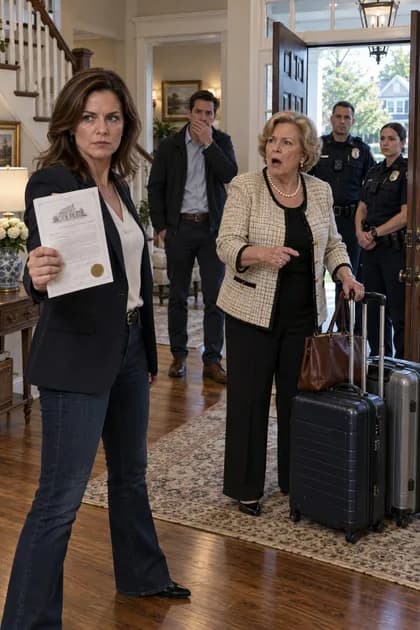
Ten minutes later, Vivian’s bedroom door flew open.
She came running down the hallway.
Not shuffling.
Not confused.
Running.
Her eyes locked on the table.
“What did you do?” she snapped.
For the first time in eight months, Vivian forgot to pretend.
I slowly stood up.
And then the front doorbell rang.
I looked at Vivian.
Vivian looked at the blue envelope sitting beside the folder.
Neither of us moved for two seconds.
Then I walked to the front door.
The woman standing on my porch was in her late fifties, wearing a charcoal coat and carrying a narrow leather briefcase.
Vivian recognized her before I said her name.
I knew that because all the color left her face.
“Good morning, Marianne,” I said.
Marianne Holt had handled Grandma June’s estate when she died.
I hadn’t spoken to her in almost four years.
But at three-thirty that morning, sitting at the kitchen table with paperwork spread around me, I had found her business card clipped to the original copy of Grandma June’s deed.
I called her as soon as her office opened.
I had expected a receptionist.
Marianne answered herself.
I told her three sentences.
I own an inherited house.
My husband had me sign documents I was told were related to his mother’s care.
I think he intends to use them against my property on Friday.
Marianne had gone very quiet.
Then she asked me to photograph every page and send them to her.
Twenty minutes later, she called back.
“Don’t sign anything else. Don’t destroy anything. And don’t let anyone take those originals.”
She had been headed toward downtown Kettering for a morning appointment.
My house was six minutes out of her way.
Now she stepped inside.
Vivian backed away from the foyer.
“What is she doing here?”
Her voice was perfectly clear.
Marianne looked from Vivian to me.
“I assume this is your mother-in-law.”
“Yes.”
Vivian’s jaw tightened.
Then something almost comical happened.
Her shoulders dropped.
Her eyes went unfocused.
She put one hand against the wall.
“Natalie?” she whispered. “Who is this woman?”
I stared at her.
Marianne stared at her.
Vivian held the performance for perhaps three seconds.
Then I picked up my phone from the entry table.
“I heard your entire conversation with Grant last night.”
Her hand dropped.
That was it.
The confused old woman disappeared.
“What exactly do you think you heard?”
There she was.
The real Vivian.
Cold.
Alert.
Calculating.
I had almost forgotten what she sounded like.
Marianne set her briefcase on the dining table.
“I’m not here to debate anyone’s medical condition,” she said. “I’m here because Natalie asked me to review documents affecting property she inherited from her grandmother.”
Vivian stepped toward the kitchen.
“That paperwork is private.”
“It’s my paperwork,” I said.
Her eyes snapped to mine.
“You don’t understand what Grant was trying to do.”
“Then explain it.”
She didn’t.
Instead, she reached for the blue envelope.
I put my hand over it first.
“Don’t.”
Vivian froze.
It was the first time I had ever spoken to her that way.
Not loudly.
Not angrily.
Just with no room for negotiation.
She pulled her hand back.
The blue envelope was what Grant had hidden underneath a stack of appliance warranties in the bottom desk drawer.
I had found it at two in the morning.
Across the top were the words:
RIDGEWAY TITLE SERVICES.
FRIDAY — 11:00 A.M.
Inside was a preliminary closing packet.
My address appeared eleven times.
My name appeared nineteen.
Grant’s appeared beside words like agent and attorney-in-fact.
And near the back was the number that finally explained everything.
$168,000.
The house Grandma June had left me free and clear was about to secure a six-figure line of credit.
In my name.
Marianne opened the folder.
“The document Natalie signed in July gives Grant unusually broad authority to act on her behalf regarding real estate and borrowing,” she said.
Vivian folded her arms.
“Natalie signed it.”
“Yes,” Marianne said.
“I didn’t know what it was,” I said.
Vivian gave me a thin smile.
“You should read things before you sign them.”
That sentence hurt more than I expected.
Not because it was clever.
Because she was right about one small piece of it.
I should have read it.
And six months earlier, I would have.
But the night Grant brought me that document, Vivian had supposedly wandered outside barefoot at two in the morning.
I had slept maybe three hours.
Grant had placed the papers beside my coffee the next morning.
He told me they would let him “handle the financial side of Mom’s care” so I didn’t have to keep dealing with insurance forms and bills.
He had even touched my shoulder and said, “You already have enough on you.”
I remembered being grateful.
That was the ugliest part.
They had created the exhaustion.
Then they had used it.
Marianne slid one document toward me.
“This authority can be revoked.”
Vivian’s expression changed.
Not much.
But enough.
“You can’t just interfere with Grant’s finances.”
I looked at her.
“My house is not Grant’s finances.”
“You’re married.”
“That doesn’t make Grandma June’s house his.”
“He’s lived here for four years.”
“So have you for eight months. Apparently with a fully functioning memory.”
Vivian’s face hardened.
Marianne removed two pages from her briefcase.
“I prepared a revocation after reviewing the documents Natalie sent me. She’ll need to sign it, and we’ll notify every party we can identify before Friday’s proposed transaction.”
Vivian grabbed her phone.
I knew exactly who she was calling.
Grant answered on the second ring.
I couldn’t hear his words.
I heard hers.
“You need to come home.”
A pause.
“No. Now.”
Another pause.
“She knows.”
Vivian turned away from me.
“The lawyer is here.”
Then she hung up.
The kitchen became silent.
Marianne pointed toward the chair.
“Sit down, Natalie.”
I did.
My hand shook when she gave me the pen.
Vivian watched it.
Maybe she thought the shaking meant I was uncertain.
It didn’t.
I signed my name.
Marianne turned the page.
I signed again.
Then she took out her phone and photographed the completed revocation.
Vivian stepped forward.
“You have no idea what you’re doing.”
That made me laugh.
Not because anything was funny.
Because eight months earlier, those words might have frightened me.
Now they sounded desperate.
“Then tell me.”
She looked away.
“No,” I said. “You’ve had eight months to act confused. You can spend five minutes being clear.”
Her eyes came back to mine.
“What was the money for?”
Silence.
“The hundred and sixty-eight thousand dollars.”
Vivian’s mouth tightened.
“That’s between you and your husband.”
“No. A debt secured by my house is very much between me and my husband.”
She said nothing.
So I asked the question that had been sitting inside me since midnight.
“Why did you fake being sick?”
For the first time that morning, something uncertain appeared in Vivian’s face.
Not confusion.
Shame, maybe.
Or the fear of finally having to say something out loud.
She sat across from me.
“Grant got into trouble.”
“What kind of trouble?”
“Business slowed down.”
“Grant sells equipment. He doesn’t own the company.”
“He borrowed money.”
My stomach tightened.
“How much?”
Vivian looked toward Marianne.
Marianne didn’t speak.
“How much, Vivian?”
“More than he told you.”
Of course.
I thought about all the evenings Grant had come home complaining that restaurant projects had been delayed.
All the times he told me commissions were “a little light this quarter.”
All the times I offered to sit down and go through our finances.
He always smiled.
We’re fine, Nat.
I’ve got it handled.
“What did he borrow money for?”
Vivian rubbed her thumb across the edge of the table.
“Some investments. Credit cards. A personal loan.”
“And you?”
Her silence answered before her words did.
“I helped him.”
“How?”
“I gave him most of my savings.”
Suddenly the plan made sense in a way that almost made it worse.
This hadn’t started with Vivian wanting my house.
It had started with Grant losing money.
Then lying about it.
Then borrowing more to cover what he had already lost.
Vivian had stepped in to rescue her son.
When her money wasn’t enough, they had looked around for the largest debt-free asset within reach.
Grandma June’s house.
Mine.
“You could have asked me,” I said.
Vivian gave a bitter little laugh.
“You would have said no.”
The answer came too quickly.
Too honestly.
And that was the moment I understood the entire scheme.
They had never needed my agreement.
They needed my signature.
Those were two very different things.
A car door slammed outside.
Vivian stood.
Grant walked up the porch steps less than thirty seconds later.
He didn’t ring.
He opened the front door and came straight into the kitchen.
His eyes moved from his mother to Marianne to the documents.
Then to me.
For one strange second, he looked like the husband I knew.
Concerned.
Confused.
Ready to solve a problem.
“Natalie, what’s going on?”
I almost admired the instinct.
Even now, he was going to try to talk his way into control.
“I heard Mom’s phone call last night.”
His face stopped moving.
Vivian looked at him.
Grant closed his eyes for half a second.
Then he pulled out a chair.
“Okay.”
That word was so calm it made my skin crawl.
“Okay?”
He leaned forward.
“Obviously this looks bad.”
Marianne quietly closed the folder.
Grant noticed her doing it.
“This is a family matter.”
Marianne’s expression didn’t change.
“Natalie asked me to advise her about property she owns. I’m doing that.”
Grant turned back to me.
“Nat, Mom shouldn’t have said what she said.”
I stared at him.
“That’s your explanation?”
“No.”
“Good. Because your mother talking normally is not the problem.”
He rubbed both hands across his face.
“I was going to tell you.”
“When?”
He hesitated.
I tapped the blue envelope.
“After Friday?”
His eyes dropped to it.
There it was.
The answer.
I felt something inside me settle.
Not break.
Settle.
For twelve hours I had still been looking for one detail that would let me believe my husband had not deliberately done this.
That look at the envelope took the last possibility away.
“What happened to the money?” I asked.
Grant leaned back.
“I made some bad decisions.”
“How much debt?”
“Natalie—”
“How much?”
“About a hundred and twenty.”
“Thousand?”
His jaw tightened.
“Yes.”
Vivian interrupted.
“He was fixing it.”
I turned toward her.
“With a $168,000 loan against my house?”
“The extra was for breathing room,” Grant said.
I looked at him.
He actually said it as if that made sense.
“Breathing room.”
“We could have paid it back.”
“We?”
“I have commissions coming.”
“You told me we had no debt except our regular credit cards.”
“I was trying not to worry you.”
I glanced toward the folder.
“You faked your mother’s dementia so I wouldn’t worry?”
Grant flinched.
“Mom’s idea got out of hand.”
Vivian’s head snapped toward him.
“My idea?”
Grant ignored her.
“At first she was just going to stay here for a while.”
Vivian stood.
“Don’t you dare put this on me.”
I almost laughed again.
Eight months of perfect cooperation collapsed in less than ten minutes once consequences arrived.
Grant pointed toward his mother.
“She said if you felt responsible for her, you’d stop asking questions about why I was handling everything.”
Vivian stared at him.
“You were the one who said Natalie would never sign if she had time to read it.”
Silence.
Grant looked at her.
Then at me.
He knew immediately what she had done.
She had said the sentence neither of them could take back.
Marianne’s eyes moved to me, but she remained silent.
I didn’t need her to tell me what mattered.
I already knew.
“You planned my exhaustion.”
Grant stood.
“No.”
“Did you?”
“It wasn’t like that.”
“Did you?”
He paced two steps away.
“Mom exaggerated some things.”
I thought of kneeling beside the bathtub while Vivian lifted her arms so I could wash beneath them.
I thought of cutting meat into tiny bites.
Changing sheets.
Canceling lunch with friends.
Leaving the dental practice because Grant told me his mother needed “someone she trusted.”
I looked at Vivian.
“Were the accidents real?”
She said nothing.
My stomach turned.
“Were they?”
“No.”
One word.
That was all it took.
I pushed my chair back.
Grant reached for me.
I stepped away before he could touch my arm.
“Natalie, please.”
“Don’t.”
“I know you’re angry.”
“You don’t know what I am.”
“We can fix this.”
I looked at the man I had married.
There was that tone again.
Calm.
Reasonable.
The tone that had convinced customers to buy industrial ovens.
The tone that had convinced me we were making decisions together.
“What exactly do you want to fix?” I asked. “The debt? The paperwork? Or the part where your mother made me wash fake urine out of sheets so I’d be too tired to read what you put in front of me?”
Grant’s face went red.
Vivian looked down.
No one answered.
I nodded.
“Thought so.”
Grant lowered his voice.
“Give me one chance to explain without Marianne sitting here.”
“No.”
“Natalie.”
“No.”
His expression hardened.
It was subtle.
But I saw it.
For years, Grant’s charm had worked because he rarely needed anything else.
Now it wasn’t working.
And behind the easy smile was a man who had expected his wife to remain manageable.
“This is my home too,” he said.
That sentence changed the room.
Marianne shifted in her chair.
I stayed very still.
“No,” I said. “This has been your home because I shared it with you.”
“We’re married.”
“For the moment.”
Grant stared at me.
Vivian whispered, “Natalie, don’t be ridiculous.”
I turned toward her.
“You pretended not to know what a spoon was for eight months.”
She closed her mouth.
Grant’s face changed again.
Fear this time.
“Are you threatening divorce?”
“No.”
I picked up my phone.
“I’m telling you what happens next.”
I had spent my career organizing chaos.
That skill returned faster than I expected.
“Marianne is sending the revocation to Ridgeway Title and the lender today. I’m also giving them written notice that I dispute the circumstances under which the original authorization was obtained.”
Grant opened his mouth.
I kept going.
“I’ve photographed every page in that drawer. Copies are in my email and cloud storage.”
His eyes narrowed.
I had guessed correctly.
He had been considering taking the documents.
“The originals stay with Marianne.”
“Natalie, you’re making this into something criminal.”
“I didn’t say criminal.”
“You’re acting like I stole from you.”
“You tried to put $168,000 of debt against property you knew I would never voluntarily mortgage.”
“For us.”
“No. For debt you hid from me.”
His voice rose.
“I was protecting our life!”
I looked around Grandma June’s narrow kitchen.
The scratches beside the pantry door where she had measured my height as a child were still faintly visible beneath two coats of paint.
The brass cabinet pull she always meant to replace still sat crooked.
My life had existed in this house long before Grant walked into it.
“You were protecting yourself from the consequences of your decisions,” I said.
That landed.
He looked away.
I turned toward Vivian.
“You need to make arrangements to live somewhere else.”
Her mouth fell open.
“You can’t throw an elderly woman into the street.”
“I’m not doing that. Marianne will make sure everything is handled legally. But you will not continue living here while pretending I owe you care.”
Vivian’s eyes filled with tears.
Real ones this time, I think.
“Natalie, I gave everything to my son.”
I believed her.
And for the first time all morning, I felt something other than anger toward her.
It lasted perhaps two seconds.
“You chose to give him your money,” I said quietly. “Then you decided I should give him mine without being asked.”
“This house is worth more than you need.”
There it was.
Not remorse.
Entitlement.
I nodded slowly.
“Thank you.”
“For what?”
“For reminding me why I can’t trust you.”
Grant followed me into the hallway when I walked toward the stairs.
“Where are you going?”
“To pack a bag.”
He stared at me.
“You’re leaving?”
“For today.”
His shoulders relaxed.
He thought distance would help him.
He thought I would calm down.
I knew because I had watched him do this with angry customers.
Give them space.
Call later.
Reframe.
Make the unacceptable sound complicated enough to negotiate.
So I stopped on the third stair.
“And Grant?”
He looked up.
“I’m not leaving you the house.”
His face tightened.
“I’ll be back this afternoon with Marianne. After that, all communication about the property goes through her.”
“This is insane.”
“No.”
I looked at Vivian.
“This was insane.”
Then I went upstairs.
The weeks after that were less dramatic than that morning.
They were also much harder.
Real consequences usually are.
There were no police officers waiting on the lawn.
No one was dragged away in handcuffs.
No judge appeared instantly to declare me victorious.
There were forms.
Emails.
Phone calls.
Certified letters.
Bank statements.
Credit reports.
Meetings.
And a marriage coming apart one document at a time.
Ridgeway canceled the Friday closing before any money was disbursed.
The lender froze the application when Marianne notified its compliance department that I had revoked Grant’s authority and disputed the circumstances under which the document had been signed.
Most importantly, no lien was placed on the house.
Grandma June’s property remained exactly where it had always been.
In my name.
Marianne referred me to a divorce attorney.
I hired her.
That afternoon, I opened every financial account I could access and discovered how carefully Grant had separated his problems from our daily life.
He had been paying minimums on credit cards I did not know existed.
He had taken out a personal loan eighteen months earlier.
Then another.
He had borrowed from Vivian.
Some of his so-called investments had lost money.
Others had simply been attempts to cover earlier losses.
Every new debt had been used to keep the previous one invisible.
By the time he finally admitted the truth, his problem wasn’t one bad investment.
It was the habit of believing the next decision would erase the consequences of the last one.
Vivian moved out eleven days after our confrontation.
Not because I physically removed her.
Because once my attorney made clear that the house was not going to become Grant’s financial rescue plan, Vivian suddenly preferred staying with a cousin near Cincinnati.
She packed her own clothes.
Carried her own suitcase.
Remembered every medication.
And walked down my porch steps without assistance.
I watched from the window.
Eight months earlier, I would have rushed outside to make sure she didn’t fall.
That day, I didn’t move.
Grant stayed longer.
For nearly three weeks, he tried every version of himself.
The apologetic husband.
The frightened husband.
The practical husband.
The angry husband.
The man who reminded me of our wedding.
The man who reminded me of vacations.
The man who said six years together should matter more than one terrible mistake.
But it hadn’t been one mistake.
That was what he never understood.
A mistake is forgetting an anniversary.
A mistake is losing money on an investment.
Even hiding debt might have been something we could have confronted if he had eventually come to me honestly.
This required planning.
It required his mother to perform helplessness every day.
It required him to watch me stop working.
Watch me stop seeing friends.
Watch me wake up at night because Vivian was supposedly wandering.
Watch me become so tired that I signed something I normally would have examined line by line.
And every time I told him I couldn’t keep going, he had looked into my face and said:
“She only trusts you, Natalie.”
That sentence ended our marriage more completely than the loan documents did.
One evening, about two weeks after Vivian left, Grant stood in the kitchen while I washed a coffee cup.
“I loved you,” he said.
I turned off the faucet.
I believed that too.
That was the hardest part.
People like Grant are easier to understand if you imagine they never loved anyone.
But I think he did love me.
He just loved the version of me who could be persuaded more than he respected the real one who could say no.
“You should have trusted me with the truth,” I said.
“You would’ve said no.”
He had said it again.
This time he heard himself.
His face changed.
I dried my hands.
“Yes,” I said. “I would have.”
He looked at the floor.
“And that was my right.”
There was nothing left to discuss after that.
Our divorce took seven months.
The house never became part of the fight in the way Grant initially threatened.
The inheritance records were clear.
The title was clear.
The proposed loan had never funded.
My attorney handled the rest.
Grant left with his debts, his belongings, and the consequences of decisions he had spent years trying to outrun.
Vivian called me twice during those seven months.
The first time, she said I had destroyed her son’s life.
I hung up.
The second time, months later, she said something different.
“I did love you like a daughter.”
I sat silently for a moment.
Then I asked her the only question that mattered.
“Would you have done that to your daughter?”
She didn’t answer.
I ended the call.
I never heard from her again.
As for me, I went back to the dental practice.
Not immediately.
At first I wasn’t sure I wanted the old life back.
But one morning I called Dr. Keller, one of the dentists I had worked with.
He answered with, “Please tell me you’re calling because you miss insurance disputes.”
I laughed for the first time in weeks.
I started three days a week.
Then four.
Within a few months, I was back behind the front desk with schedules open across two monitors, catching mistakes, fixing problems, and remembering that competence was something no one could take from me unless I handed it over.
The first seven-dollar discrepancy I found made me smile.
A year after the night in the hallway, I sat alone on Grandma June’s front porch.
It was October again.
The maple leaves had started turning.
The house was quiet.
Not the nervous quiet I had lived with while constantly listening for Vivian to call my name.
A peaceful quiet.
My quiet.
For months after everything happened, I blamed myself for signing that paper.
Sometimes I still wished I had read it.
But eventually I understood something.
Being exhausted did not make what Grant and Vivian did acceptable.
Trusting my husband did not give him the right to manufacture circumstances in which my consent became easier to steal.
And missing one dangerous paragraph did not mean I had to miss what came next.
I had caught it before Friday.
Before the loan.
Before my grandmother’s house became collateral for a secret I had never agreed to carry.
Grandma June used to tell me that a home wasn’t valuable because of the walls.
It was valuable because you should be able to close the door and feel safe on the other side.
For eight months, I had forgotten that.
Grant and Vivian had turned the safest place I had ever known into a place where I doubted my own judgment.
They almost convinced me that caring for someone meant surrendering every boundary I had.
They were wrong.
That night, I locked the front door.
Walked through the narrow kitchen.
Turned off the downstairs lights.
And paused at the bottom of the squeaky oak staircase.
A year earlier, I had stood in that same hallway clutching a clean towel and listening to a woman laugh because she thought I had no idea what was happening inside my own home.
This time there was no whisper behind the bedroom door.
No secret phone call.
No performance waiting for me upstairs.
Only silence.
I smiled.
Then I went to bed.
In my grandmother’s house.
Still mine.
THE END.
Chapter complete
You have reached the end of this chapter.
Continue reading
Find your next story
A few more worlds to get lost in after this chapter.