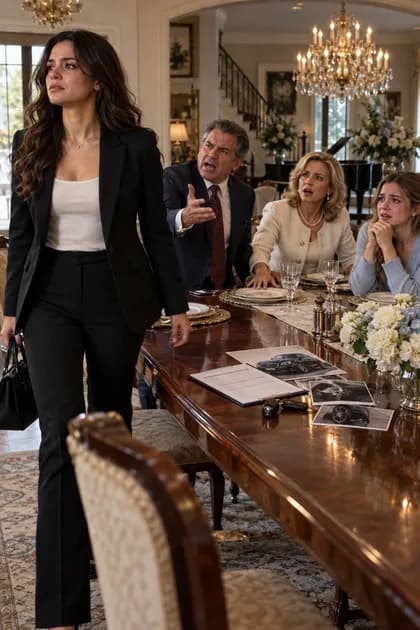
At my dad’s seventy-first birthday picnic, my mother said something to my eight-year-old son that made the entire family go silent.
Chapter 1
PART 1 - THE BIRTHDAY PICNIC WHERE GRANDMA FINALLY SAID IT OUT LOUD
1,255 words
She didn’t whisper it.
She didn’t pull me aside.
She looked directly at Noah, in front of everyone, and said,
“Next time, leave him at home.”
My son heard every word.
So did my brothers.
My aunts.
My cousins.
My father.
And for several unbearable seconds, not one person defended him.
Then a chair scraped violently across the pavement.
My seventeen-year-old daughter, Lily—the girl who hated confrontation more than almost anything—stood up.
She planted both hands on the table, stared straight at her grandmother, and said,
“Say that again.”
The entire picnic froze.
Just moments earlier, everything had been completely normal.
Burgers hissed on the grill.
Pitchers of lemonade sweated in the afternoon heat beside stacks of paper plates and napkins.
Children chased each other through the yard while adults laughed, traded stories, and celebrated Dad turning seventy-one.
It was supposed to be one of those ordinary family gatherings people
barely remember afterward.
Then Mom turned toward Noah.
“Next time, don’t bring the kid.”
My stomach dropped.
Noah froze with his plastic fork halfway to his mouth.
He was wearing his favorite navy dinosaur shirt, the one with the Triceratops on the front.
He had deliberately chosen the bench instead of sitting on the grass because he’d noticed ants crawling nearby.
From the second we arrived, he had been trying desperately not to bother anyone.
Earlier, my brother’s dog had rushed past him and knocked over his lemonade.
Noah had apologized immediately.
Twice.
Even though it hadn’t been his fault.
Then, while everyone else kept laughing and eating, he grabbed paper towels and cleaned up every drop himself.
That was Noah.
That was how hard he tried to belong.
And now his grandmother was telling him, in front of the whole family, that everyone would be happier if he simply
stayed home.
I stared at my mother.
“What did you just say?”
She didn’t look embarrassed.
She didn’t apologize.
She calmly wiped the corner of her mouth with a napkin.
“I said what everyone else is thinking, Marissa.”
My chest tightened.
“He changes the atmosphere whenever he comes.”
The words hurt.
But what frightened me most was that they didn’t completely surprise me.
This wasn’t the first time Mom had said something about Noah.
For years, her cruelty had arrived disguised as smaller things.
Little jokes.
Little complaints.
Little comments that could easily be dismissed if anyone challenged her.
Why does he always have to sit there?
Why can’t he just eat what everyone else is eating?
Why does everything have to be different when Noah comes?
Every time, someone found an excuse for her.
She was Grandma.
She hosted holidays.
She remembered everyone’s birthdays.
She could be warm, funny,
generous, and charming whenever she wanted.
So the family developed an unspoken habit.
Ignore it.
Change the subject.
Pretend she didn’t mean it that way.
But adults forget something important when they make excuses for cruelty.
Children don’t forget.
They remember the comments everyone else pretends not to hear.
I turned toward Noah.
His face had gone pale.
His shoulders slowly folded inward.
Then he lowered his plastic fork and placed it on his plate so carefully that it barely made a sound.
That tiny movement broke something inside me.
It was as though he believed even making noise might give Grandma another reason not to want him there.
I looked around the table, waiting for someone—anyone—to say something.
My sister suddenly became fascinated by her phone.
My brother turned toward the grill.
One of my cousins stared at his plate.
My father cleared his throat and looked away.
Nobody defended Noah.
Not one person told my mother she was wrong.
I opened my mouth.
Before I could speak, the chair beside me scraped loudly against the pavement.
Lily stood up.
That alone shocked everyone.
My seventeen-year-old daughter hated confrontation.
She hated being the center of attention.
If she needed to have a difficult conversation, she usually rehearsed it in her head first, sometimes for days.
But now she stood there with both hands planted firmly against the table.
Her face was tense.
Her voice was controlled.
And her eyes were locked on her grandmother.
“Say it again.”
Mom blinked.
“Excuse me?”
Lily didn’t move.
“Say it again.”
Nobody breathed.
“Look Noah in the face and tell him he shouldn’t come to family gatherings because having him here makes you uncomfortable.”
One of my aunts shifted nervously.
“Lily…”
“No.”
Her voice shook slightly.
But she didn’t sit down.
She didn’t look away.
“Everyone keeps acting like Grandma doesn’t mean these things,” Lily said. “Noah knows she means them. He always knows.”
Beside me, Noah stared down at the Triceratops printed across his shirt.
I reached under the table and found his hand.
The second my fingers touched his, he grabbed onto me tightly.
My mother leaned back in her chair.
Her expression hardened.
“You’re seventeen,” she said. “Stay out of conversations between adults.”
Lily’s expression didn’t change.
“This stopped being an adult conversation the second you decided to humiliate an eight-year-old in front of the entire family.”
Silence.
Absolute silence.
No one moved.
Behind us, grease crackled on the grill.
Somewhere near the driveway, someone slammed the lid of a cooler.
Even the children seemed farther away now.
Mom stared at Lily as though she couldn’t quite understand how the quietest person at the table had suddenly become the one person refusing to back down.
Then Lily reached toward the backpack hanging from the back of her chair.
And something changed in my mother’s face.
It happened so quickly I almost missed it.
It wasn’t exactly fear.
It was something closer to recognition.
That was when I realized something.
Lily hadn’t simply lost her temper.
She hadn’t suddenly decided, in that moment, to confront Grandma.
She had been expecting this.
Maybe not today.
Maybe not at Dad’s birthday picnic.
But she had known something like this was coming.
Lily opened her backpack.
She pulled out her phone.
Unlocked it.
Then she slowly placed it in the center of the table.
Everyone leaned closer.
An audio recording filled the screen.
I stared at the date.
It had been recorded three nights earlier.
My mother stared at it too.
For the first time all afternoon, she looked genuinely shaken.
Lily rested one finger just above the play button.
“You told me I was old enough to understand why Noah shouldn’t be invited anymore.”
Mom’s napkin slipped from her fingers and landed beside her plate.
My father looked sharply toward her.
My aunts stopped moving.
My brothers stared at Lily.
I felt Noah’s fingers tighten around mine.
Everyone looked from Lily…
to the phone…
and finally to my mother.
Whatever conversation had happened three nights earlier, it had happened without the rest of us knowing.
But Lily had been there.
And she had recorded it.
She had proof.
Proof of what Grandma said when she believed nobody else would ever hear it.
Proof that this wasn’t simply one cruel remark made at a birthday picnic.
Proof that her feelings toward Noah went much deeper—and had lasted much longer—than any of us had realized.
My mother opened her mouth.
“Lily, don’t—”
Lily looked directly at her.
Then she pressed her finger against the screen.
The recording began to play.
And the first words that came through the phone made every person at that table turn toward my mother.
Chapter complete
You have reached the end of this chapter.
Continue reading
Find your next story
A few more worlds to get lost in after this chapter.