The settlement conference took place eleven days after Santiago hit me.
Chapter 4
The settlement conference took place eleven days after Santiago hit me.
He arrived in a navy suit with a new attorney and the exhausted expression of a man who had finally discovered that charm did not work on documents.
Nancy was not permitted inside the conference room.
She waited in the lobby.
I knew because I passed her on the way in.
She looked smaller without my doorway behind her.
For years, Nancy had seemed enormous to me—not physically, but emotionally. Her criticism entered a room before she did. Her approval controlled Santiago. Her contempt shaped holidays, dinners, vacations, even the way I arranged furniture in my own home.
Now she sat beneath fluorescent lights clutching a handbag with both hands.
She opened her mouth when she saw me.
Then apparently remembered her attorney's advice.
She said nothing.
Neither did I.
Inside the conference room, Santiago stood when I entered.
For half a second, my body reacted before my mind did.
My shoulders tightened.
My breath shortened.
I hated that.
Not because it made me weak.
Because it reminded me that fear can outlive love.
Samantha touched the back of my chair.
I sat.
Santiago did too.
His attorney began with an apology so polished it sounded expensive.
“My client deeply regrets the incident that occurred during an emotionally charged family dispute.”
Samantha did not blink.
“Your client assaulted his wife.”
The attorney cleared his throat.
Santiago stared at the table.
The first proposed agreement asked me to keep the video confidential forever.
I refused.
The second asked me to provide a statement to his employer describing the assault as “an isolated domestic misunderstanding unrelated to professional integrity.”
I refused.
The third offered me money.
That almost made me laugh.
The number was $150,000.
Money borrowed, hidden, manipulated, and weaponized had always been Santiago's favorite language. He truly believed every uncomfortable
truth had a price.
I slid the page back across the table.
“I don't want his money.”
Santiago finally looked up.
“What do you want, Elena?”
It was the first time he had said my name since the night he hit me.
Not babe.
Not sweetheart.
Not dramatic.
Elena.
I had almost forgotten how it sounded in his mouth.
“I want the divorce,” I said. “I want the protective order respected. I want full compliance with every investigation. I want no contact except through counsel. And I want you to stop lying about what happened.”
His face hardened.
“I said I was sorry.”
“No. Your lawyer said you regretted an incident.”
He leaned back.
“I lost my job over this.”
“No. You lost your job because your company found out you lied on financial disclosures.”
His attorney interrupted.
At that point the company had not formally terminated him, but everyone
in the room knew what was coming. The internal review had expanded beyond the property misrepresentation. Investigators had found that Santiago used portions of the executive loan for expenses he had characterized as business-development costs, including renovations to Nancy's condo and payments to a consulting company owned by one of her friends.
Three days later, the company terminated him for cause.
The letter cited dishonesty in financial representations, misuse of company-affiliated lending resources, and conduct inconsistent with executive standards.
The assault had opened the door.
His own records had done the rest.
Santiago blamed me anyway.
Through his attorney, naturally.
The divorce itself was simpler than he expected.
Our prenup was clear.
The house remained mine.
My premarital investments remained mine.
My father's trust remained untouchable.
The property Santiago had purchased in his own name remained his, including a luxury car with an outstanding balance larger than its resale value and a boat I had never once wanted.
The joint account was divided after forensic review.
That review uncovered another surprise.
For almost two years, Santiago had been transferring small amounts into an account I did not know existed.
Never enough at once to draw my attention.
Eight hundred dollars one month.
Twelve hundred the next.
A few thousand after bonuses.
Altogether, more than $74,000.
Some of it had gone toward Nancy's condo.
Some toward her credit cards.
Some toward expenses no one could immediately explain.
Under the settlement, Santiago reimbursed the marital portion and assumed responsibility for debts connected to his undisclosed transfers.
Nancy sold the condo four months later.
I learned that from public records, not gossip.
I stopped asking mutual friends about them.
Healing became easier when I stopped treating their downfall as entertainment.
For a while, I thought revenge would feel like watching Santiago lose everything.
It didn't.
The satisfying moments were smaller.
Changing the sheets after he left.
Moving my father's desk back beneath the window where it had originally belonged.
Cooking dinner without wondering whether Nancy would criticize the seasoning.
Leaving a book open on the coffee table and finding it in the exact same place the next morning.
Silence became luxurious.
Three months after the divorce was filed, I attended a support-group fundraiser hosted by the foundation named in my father's trust.
I had donated to it for years without ever entering the building.
That evening I walked through the doors with Samantha.
Women stood at small tables discussing legal aid, emergency housing, childcare, job placement, and financial literacy.
Nothing about the room felt tragic.
It felt practical.
Alive.
One woman spoke about leaving a marriage after nineteen years.
Another described rebuilding credit after her partner destroyed it.
A third said something I carried home with me.
“The day I left wasn't the day my life fell apart. It was the first day the truth stopped falling apart around me.”
I understood exactly what she meant.
Six months after the night in the hallway, my divorce became final.
Santiago did not attend the final hearing in person.
His attorney appeared remotely.
The judge signed the decree at 10:42 a.m.
At 10:47, Samantha hugged me outside the courthouse.
At 11:15, I drove home.
The same home.
My home.
Nothing about the brick, windows, roofline, or garden had changed.
Yet everything looked different.
I parked in the driveway and sat inside the car for several minutes.
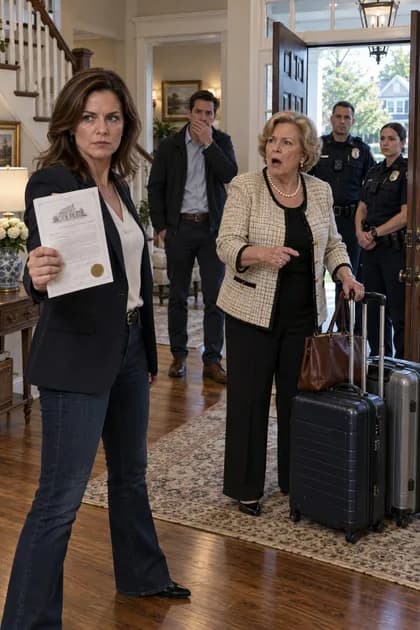
The last time Santiago had returned to that house at noon, his clothing covered the lawn and he had demanded to know what I had done.
Now the lawn was clean.
The snow was gone.
Tulips were pushing through the soil near the walkway.
I went inside and opened every curtain.
Then I walked upstairs to the bedroom we once shared.
For months, I had avoided changing it because some part of me still associated the room with the sound of his breathing while I sat awake downstairs with ice against my face.
That afternoon, I moved the bed.
Not far.
Just enough to change the shape of the room.
Then I removed the heavy gray curtains Santiago had chosen and replaced them with white linen panels my father once said made the house look awake.
At sunset, light spread across the floor.
I stood in the doorway and realized I was no longer measuring my day by someone else's mood.
A week later, I received one final envelope from Santiago.
No return address.
Inside was a handwritten letter.
He said he had started therapy.
He said he finally understood how much damage he had done.
He said losing the house, his position, and his marriage had forced him to confront himself.
He asked for nothing.
At the bottom he wrote, “I know sorry doesn't rebuild what I broke.”
I read the letter once.
Then I placed it in the same fireproof cabinet that still held the deed, the prenup, and my father's trust.
Not because I forgave him.
Not because I hated him.
Because it belonged with the other documents from a chapter that had already closed.
People later asked me when I knew the marriage was truly over.
They expected me to say it was when Santiago hit me.
Or when he told me to cover the bruise.
Or when the deputy served him beside his belongings.
But the truth was quieter.
It happened at 3:17 in the morning, when he mumbled in his sleep that his mother wanted roast chicken for lunch.
That was the moment I understood something painfully simple.
He could sleep peacefully beside the damage he had caused because he believed I would always wake up and clean it.
He was wrong.
The next morning, I did not cover the bruise.
I uncovered the truth.
And once the truth was visible, the house was never the most important thing I took back.
I took back my name.
My voice.
My peace.
My life.
THE END.
Chapter complete
You have reached the end of this chapter.
Continue reading
A few more worlds to get lost in after this chapter.