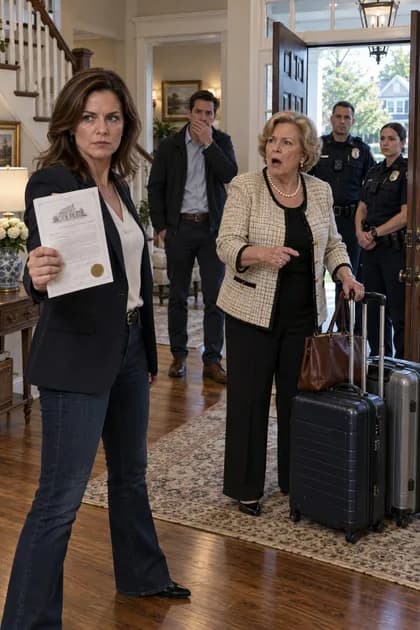
The U-Haul was backed up to my dead wife’s lake cabin like somebody had already decided I no longer owned it.
Chapter 1
THE CABIN DEED MY DEAD WIFE COULD NEVER HAVE SIGNED
5,443 words
For three years, I had kept that place exactly the way Margaret left it.
Then, on a cloudy Tuesday morning, I pulled into the driveway and found my son-in-law’s parents carrying their furniture through the front door.
And when I asked what they thought they were doing, Ron Mercer cracked open a beer, looked me straight in the eye, and smiled.
“Relax, Tom. My son gave us the door code. This cabin is going to be ours anyway.”
Eleven minutes later, the sheriff was coming up the driveway.
But by then, I was about to discover that someone had done far more than change the locks.
I had driven to Lake Norman that morning for one simple reason: the porch roof was leaking.
A storm had rolled through a few nights earlier, and one of the neighbors had called to tell me water was dripping near the front steps. I
figured I’d spend a few hours replacing shingles, clear some leaves from the gutters, and maybe sit on the dock for a while before heading home.
The cabin had belonged to Margaret and me for years.
She loved that place more than anywhere else in the world.
Margaret had been gone for three years, and I still hadn’t been able to change much inside.
Her coffee mug—the white one with tiny blue flowers—still hung on the hook beside the kitchen sink.
Her blue raincoat was still hanging near the mudroom door.
There were books on the nightstand she would never finish and a pair of gardening gloves in the shed with dirt still pressed into the fingertips.
The cabin wasn’t just property to me.
It was the last place where I could walk through a door and still feel like Margaret might be in the next room.
That was why
the U-Haul made no sense.
When I turned onto the gravel driveway and saw it backed almost against the porch, I actually slowed down and checked the house number.
For half a second, I wondered if I’d somehow taken the wrong turn.
Then I saw Linda Mercer coming down the porch steps carrying a cardboard box.
My son-in-law Derek’s mother.
Written across the box in thick black marker was one word:
KITCHEN.
I parked immediately.
Before I could even shut the truck door, Ron Mercer appeared in the cabin entrance carrying a brass lamp.
He set it down beside several boxes, walked to a cooler sitting near the U-Haul, and pulled out a beer.
Then he looked at me like I was the visitor.
“Morning, Tom.”
I stared at him.
Behind Ron, I could see furniture inside the cabin.
Their furniture.
A rolled-up rug was leaning against Margaret’s dining table.
Several boxes had been stacked near the fireplace. Someone had moved one of Margaret’s chairs away from the window.
“What are you doing in my house?”
Linda stopped halfway toward the truck.
Her expression changed immediately.
Ron’s didn’t.
He popped open the beer.
“Derek gave us the door code,” he said.
Then he took a long drink.
“This cabin is going to be ours anyway.”
For several seconds, I honestly thought I had misheard him.
“My daughter’s husband gave you permission to move into a property he doesn’t own?”
Ron shrugged like we were discussing a parking space.
“Claire inherits it.”
“Eventually.”
“Derek says they’re getting everything handled. Signing everything over.”
He gestured toward the lake.
“We’re planning to retire up here.”
Linda shifted the box in her arms.
“Ron…”
But he ignored her.
I walked past them toward the front door.
The cabin had an electronic keypad that Margaret and I installed years ago. The code had always been her birthday.
I entered it.
Red light.
Locked.
I tried again.
Nothing.
Then something clicked in my mind.
I punched in the final four digits of Derek’s phone number.
Green light.
The lock opened.
I stood there staring at the keypad.
Someone hadn’t simply entered my property.
Someone had deliberately changed the access code.
That was the moment I stopped debating with them.
I pulled out my phone.
At exactly 10:26 a.m., I called the Iredell County Sheriff’s Office.
I calmly explained that people were occupying my property without authorization and moving their belongings inside.
Ron actually laughed when he realized what I was doing.
“You’re seriously calling the cops on family?”
I looked at him.
“No.”
His grin faded slightly.
“I’m calling them on trespassers.”
Linda immediately put the KITCHEN box down.
“Maybe we should call Derek.”
“You should,” I said.
Ron shook his head.
“You’re making this way bigger than it needs to be.”
I didn’t answer.
We waited.
Eleven minutes later, tires crunched over the gravel.
A sheriff’s SUV pulled into the driveway.
Ron set his beer down.
Deputy Aaron Mills stepped out, looked at the U-Haul, the boxes scattered across the porch, and the four of us standing there.
He asked everyone to remain outside while he figured out what was going on.
Ron started talking first.
Naturally.
Deputy Mills turned to me.
“Sir, do you have documentation showing ownership?”
“I do.”
I had brought a folder with me because I’d planned to speak with the insurance company about the roof repair.
Inside were exactly the papers I needed.
I handed him my driver’s license.
Then the property-tax statement.
Then the documents for the Hale Family Trust.
Margaret and I had placed the cabin into that trust twelve years earlier as part of our estate planning.
The arrangement was simple.
The trust owned the property.
I was the sole trustee.
Our daughter, Claire, would inherit the cabin after my death.
Not before.
Deputy Mills read through the papers carefully.
Linda looked at Ron.
Ron wasn’t smiling anymore.
The deputy finally nodded.
“Mr. Hale appears to be the legal trustee.”
I looked at Ron.
“You need to get your belongings out.”
But Ron suddenly reached into his pocket.
“Hold on.”
He pulled out a folded document.
“Your son-in-law said this proves the cabin belongs to them.”
Deputy Mills took it.
His eyes moved across the page.
Then slowed.
His forehead tightened.
“What is it?” I asked.
He looked at me.
“It appears to be a quitclaim deed.”
My stomach dropped.
The document transferred ownership of the Lake Norman property from the Hale Family Trust to Derek and Claire Mercer.
I stepped closer.
There were signatures at the bottom.
Derek’s.
Claire’s.
Mine.
And Margaret’s.
For a moment, nobody said anything.
I took the paper from Deputy Mills and stared at my own name.
The signature looked disturbingly close to mine.
Then I saw Margaret’s.
My chest tightened.
I looked at the date.
And suddenly the driveway, the truck, Ron, Linda, even the deputy seemed to disappear around me.
Because according to that document, Margaret Hale had signed away our lake cabin six months earlier.
Margaret had been dead for three years.
“That’s impossible,” I said quietly.
Ron’s face had gone pale.
Linda whispered, “Derek told us everything was legal.”
I barely heard her.
I kept staring at the signatures.
My name.
Margaret’s name.
The trust.
The transfer.
Somebody hadn’t just changed the door code.
Somebody had created legal paperwork using the signature of my dead wife.
Deputy Mills’s expression had changed completely.
This was no longer a simple dispute over trespassing.
He reached for the document again.
“Mr. Hale, do you recognize this?”
Before I could answer, my phone started ringing.
I looked at the screen.
My attorney.
I answered immediately.
“Hello?”
“Tom?”
Her voice was sharp.
Urgent.
“Yes.”
“Are you at the cabin right now?”
“I am. The sheriff’s here.”
There was a brief silence.
Then she said something that made every person standing in that driveway suddenly seem very far away.
“Tom, do not let anyone leave with those papers.”
I looked at Ron.
Then Linda.
Then the forged deed in Deputy Mills’s hand.
“What’s going on?”
My attorney took a breath.
“We have a much bigger problem.”
“My attorney’s next words made my blood run cold.
“Tom, I checked the county records. That deed was filed two weeks ago.”
I stared at Ron.
“Two weeks ago?”
Deputy Mills immediately took the document back.
My attorney continued.
“And that’s not all. Someone also submitted paperwork attempting to remove you as trustee.”
Ron’s face went completely blank.
Linda covered her mouth.
“Derek never told us any of this.”
Just then, another vehicle tore down the gravel driveway.
Claire jumped out before it had fully stopped.
“Dad!”
Derek climbed out behind her, looking furious.
The second he saw the sheriff holding the deed, his expression changed.
Claire rushed toward me.
“Dad, I swear I didn’t know they were moving in.”
I held up the document.
“Did you sign this?”
She looked at it—and froze.
“No.”
Derek stepped forward.
“This is ridiculous. Dad, you’re making a family matter into a criminal investigation.”
Deputy Mills turned toward him.
“Mr. Mercer, I’d be careful what you say next.”
Derek went silent.
Then my attorney spoke through the phone loudly enough for all of us to hear.
“Tom, ask the deputy to check the notary listed on that deed.”
Deputy Mills looked down.
His eyes narrowed.
Then he slowly looked up at Derek.
“Sir… do you know a woman named Melissa Grant?”
Derek’s face lost all color.
And Claire whispered, “That’s his ex-girlfriend.”
For the first time since I had arrived, Derek didn’t have an answer ready.
He just stood there.
That silence told me more than anything he could have said.
Claire turned toward him slowly.
“Why is Melissa’s name on my father’s deed?”
Derek swallowed.
“She’s a notary.”
“I know what she does.”
Claire’s voice had changed.
It wasn’t loud.
That made it worse.
“I asked why your ex-girlfriend notarized a document transferring my father’s property to us.”
“She was convenient.”
“Convenient?”
Derek glanced at Deputy Mills.
“You’re all acting like I robbed a bank. Tom was going to leave the place to Claire anyway.”
There it was.
Not a denial.
An excuse.
I felt something in me become very calm.
“You changed my door code.”
Derek looked at me.
“I was trying to help my parents get settled.”
“You filed a deed.”
“It was paperwork.”
“With Margaret’s signature on it.”
His jaw tightened.
“I didn’t prepare every page.”
Deputy Mills raised a hand.
“Mr. Mercer, I strongly recommend you stop talking.”
But Derek was angry now, and angry men who believe they’re entitled to something often mistake talking for taking control.
He pointed toward the cabin.
“Claire is your only child. Who else is this going to? You’ve left that place sitting here like a museum for three years. Nobody uses it. Nobody benefits from it. My parents need somewhere to live, and eventually it all becomes Claire’s.”
Claire stared at him.
“You told your parents they could have it?”
Derek looked away.
Ron answered for him.
“He said you two had agreed.”
Claire’s face crumpled for half a second.
Then hardened.
“No. We never discussed giving your parents my mother’s cabin.”
Linda took a step backward.
“Derek told us Tom wanted out from under the taxes and maintenance.”
I looked at her.
“I have never said that.”
Ron’s eyes moved to his son.
“You said he was relieved we were taking it.”
Derek snapped, “Dad, not now.”
Ron flinched as if he’d been slapped.
That was when I understood something.
Derek hadn’t only lied to me.
He had built different versions of the same story for everyone standing in that driveway.
To Claire, the cabin was still mine.
To Ron and Linda, I had practically given it away.
And somewhere in the county records, I had apparently signed documents I had never seen.
I turned to Deputy Mills.
“I want everything documented.”
Derek stared at me.
“Tom.”
“Everything.”
“You don’t know what you’re doing.”
“No,” I said. “I know exactly what I’m doing now.”
Deputy Mills asked Ron and Linda to stop removing or adding anything to the cabin while he contacted a supervisor.
Then he asked Derek to remain near his vehicle.
My attorney stayed on the phone with me.
Her name was Sarah Bennett. She had handled Margaret’s estate after the funeral, amended the trust records after Margaret died, and knew exactly how that cabin was titled.
“Tom,” she said, “the document they filed is defective in several ways. Margaret’s signature alone makes that obvious. But the fact that it was recorded means we need to move quickly. Don’t sign anything Derek gives you. Don’t agree to any ‘correction.’ And photograph every page you can legally access.”
I did.
The deed.
The notary block.
The recording stamp.
The paperwork Ron had been carrying.
Every page.
While I photographed them, something bothered me about Margaret’s signature.
It wasn’t merely similar.
I had seen that exact signature before.
Not one like it.
That one.
The long upward stroke in the M.
The tiny break in the H.
The unusual way Margaret’s final e slanted almost straight down when her arthritis was bothering her.
I knew because I had watched her sign her name thousands of times.
Then I remembered.
“Sarah.”
“Yes?”
“Pull the deed from when Margaret and I originally transferred the cabin into the trust.”
There was a pause.
“Why?”
“Just do it.”
She was quiet for less than a minute.
Then I heard her inhale.
“Oh my God.”
“What?”
“They copied it.”
Claire looked at me.
“Copied what?”
Sarah explained over the phone.
Twelve years earlier, Margaret and I had both signed the deed placing the cabin into the Hale Family Trust.
Those signatures were public record.
Derek’s new document appeared to use versions of those old signatures.
That explained Margaret.
Whoever created the new deed hadn’t needed access to some secret family file.
They had gone into public records, found an old document with both our signatures, and reproduced them.
But they had made a fatal mistake.
They copied a dead woman’s name onto a document dated three years after her funeral.
Claire sat down on the porch step.
Her face had gone gray.
Derek heard enough to understand what Sarah had found.
“It proves nothing,” he said.
I turned toward him.
“You want to keep talking?”
He shut his mouth.
Deputy Mills’s supervisor arrived twenty minutes later.
By then the scene felt nothing like a family argument.
The original paper Ron had brought was placed in an evidence sleeve.
Statements were taken separately.
Ron and Linda were told they did not have authority to occupy the property based on the documents currently available.
Ron didn’t argue anymore.
He and Linda began carrying their boxes back toward the U-Haul.
The transformation in Ron was almost difficult to watch.
An hour earlier he had been standing in my driveway drinking my beer weather, telling me my home would soon belong to him.
Now he looked ten years older.
When he passed Derek, he stopped.
“You told us this was done.”
Derek stared at the gravel.
Ron continued.
“You told me Tom signed everything.”
“Dad—”
“I sold our condo.”
Everyone went still.
Even Derek looked up.
Linda closed her eyes.
Claire whispered, “What?”
Ron’s voice cracked.
“We close next Friday. Derek said we could move here permanently, so we accepted an offer.”
I looked at Derek.
That was the first moment I saw real fear in his face.
Not fear of the sheriff.
Fear of his own lies collapsing all at once.
Linda turned on him.
“You knew we sold our home.”
“I was going to fix this.”
“Fix what?”
Derek rubbed both hands over his face.
“The title issue.”
“What title issue?” Claire demanded.
He snapped.
“Your father refusing to let go of something nobody else can use.”
I took one step toward him.
“This was never about using the cabin.”
He looked at me.
“What?”
“You didn’t forge a deed just so your parents could sit on my dock.”
His eyes changed.
Just slightly.
But I saw it.
So did Claire.
“What did you do?” she asked.
Derek said nothing.
I remembered something Sarah had told me a few minutes earlier.
Someone hadn’t just recorded a deed.
Someone had attempted to remove me as trustee.
That was a lot of effort for a retirement arrangement.
I lifted my phone.
“Sarah, what happens if the deed stands?”
She understood the question immediately.
“Then Derek and Claire appear as owners of record until the fraud is challenged.”
“And as apparent owners?”
“They could attempt to sell, borrow against, or otherwise encumber the property.”
Claire turned toward her husband.
“Borrow against it?”
Derek looked away.
That was answer enough.
Claire walked toward him.
“How much?”
He didn’t respond.
“How much, Derek?”
“Claire, this isn’t the place.”
She laughed once.
There was no humor in it.
“My dead mother’s signature is on a fake deed to her cabin, your ex-girlfriend notarized it, your parents are unloading a moving truck, and a sheriff is standing five feet from us. I think this is exactly the place.”
Derek’s shoulders dropped.
“I needed liquidity.”
Ron muttered, “Jesus Christ.”
Claire stared at Derek.
“For what?”
“My company had a bad quarter.”
“A bad quarter?”
“Two bad quarters.”
“You told me the business was fine.”
“It will be.”
“How much?”
Derek didn’t answer.
Claire reached into her purse, took out her phone, and opened their banking app.
I watched her face.
At first she looked confused.
Then alarmed.
Then furious.
“What is this?”
Derek moved toward her.
“Give me the phone.”
She stepped back.
“What is Mercer Development Holdings?”
His face went rigid.
Deputy Mills immediately said, “Sir, stay where you are.”
Claire kept scrolling.
“There are transfers out of our savings.”
“Those were temporary.”
“Thirty-two thousand dollars?”
“I was covering payroll.”
“You told me that money was untouched.”
“I was going to replace it.”
“When?”
Derek said nothing.
Claire looked at the cabin.
Then at the deed.
Then back at him.
“You were going to borrow against Dad’s property.”
Derek’s voice lowered.
“I was trying to save our future.”
“No. You were stealing his.”
That sentence shut down the entire driveway.
Even Ron stopped moving boxes.
Derek looked toward me.
“Tom, I would have paid every dollar back.”
I almost laughed.
Instead I asked him one question.
“Did Melissa know Margaret was dead?”
His expression told me I had hit something.
Claire saw it too.
“Derek.”
He rubbed his jaw.
“Melissa didn’t ask questions.”
“That isn’t what Dad asked.”
Derek stayed silent.
Deputy Mills told him again not to answer further questions without counsel.
This time Derek listened.
But the important part had already happened.
His certainty was gone.
By early afternoon, Ron and Linda had removed everything they could identify as theirs.
Before they left, Linda came over to me.
She looked embarrassed.
“I’m sorry, Tom.”
I nodded.
She looked toward the cabin.
“We should have called you.”
“Yes.”
“We believed him.”
“You also believed you were entitled to move into a dead woman’s home without speaking to her husband.”
Her eyes dropped.
There wasn’t anything else to say.
Ron approached next.
He didn’t apologize.
Not exactly.
He looked at the beer he had abandoned beside the cooler, picked it up, and threw it into a trash bag.
Then he said, “I was an ass.”
“That you were.”
He nodded.
For Ron Mercer, that was apparently as close to humility as nature allowed.
They drove away in the U-Haul.
Derek was told to leave separately after providing identification and contact information.
Claire didn’t go with him.
When he realized that, he stopped beside his car.
“You’re staying with him?”
Claire looked exhausted.
“I’m staying away from you.”
His face hardened.
“Don’t do something stupid because everybody’s emotional.”
She stared at him.
“You forged my name.”
“You don’t know that.”
“My signature is on that deed.”
“I said you don’t know who put it there.”
Claire looked at him for several seconds.
Then she removed her wedding ring.
She didn’t throw it.
She didn’t make a speech.
She simply slipped it into her purse.
Derek watched her do it.
That hurt him more than shouting would have.
He got into his car and left.
As soon as the dust settled, I walked through the cabin.
It looked violated.
There was no other word for it.
Margaret’s chair had been dragged across the room.
Someone had pushed her books together to make space on a shelf.
A box of Linda’s dishes sat beneath Margaret’s flowered coffee mug.
I took the box outside.
Then I put Margaret’s chair back beside the window.
Claire stood in the doorway watching me.
“I’m sorry, Dad.”
I didn’t turn around.
“For what?”
“For Derek.”
“You aren’t responsible for what your husband did.”
“I brought him into this family.”
I finally looked at her.
“And I gave him the door code years ago. Neither one of us gave him permission to forge documents.”
She wiped her eyes.
“What happens now?”
I looked at the keypad on the door.
“Now we stop reacting.”
That afternoon I called a locksmith.
I didn’t just change the code.
I replaced the entire lock.
Then, with Sarah’s help, I began doing something I should have done the moment I realized how far Derek’s scheme went.
I made a list.
Every document.
Every date.
Every person.
Every contradiction.
The trust paperwork showed I was the sole acting trustee after Margaret’s death.
The county record showed the new deed had been filed two weeks earlier.
The deed contained a signature from a woman who had been dead for three years.
Claire denied signing it.
I denied signing it.
Melissa Grant’s notary seal appeared on the document.
And Derek had already told his parents the cabin belonged to him and Claire before anyone in my family knew a transfer had supposedly occurred.
That wasn’t one misunderstanding.
It was a chain.
And chains can be followed.
Sarah obtained certified copies of the recorded documents and filed an emergency challenge to the transfer.
She also notified the title insurer and the county office that the deed was being disputed as fraudulent.
Two days later, we learned why Derek had been in such a hurry.
A lender had received an application seeking a substantial line of credit secured by the cabin.
The borrower listed on the application was an entity tied to Derek’s development company.
The value he claimed for the property was $640,000.
The amount he wanted to borrow was $410,000.
Claire was sitting across from me in Sarah’s office when we heard the number.
She closed her eyes.
“Four hundred and ten thousand dollars.”
Sarah nodded.
“The loan hadn’t funded. The title issue stopped it.”
I leaned back in my chair.
Suddenly every piece fit.
Derek’s company was failing.
He had emptied part of their savings.
He needed more money.
Claire was due to inherit the cabin someday.
And instead of facing his wife, his creditors, or me, he had decided that “someday” was close enough to “now” if he could manufacture the right paperwork.
His parents moving in wasn’t the scheme.
It was collateral damage.
He had promised them the cabin because their presence helped make his lie feel real.
The next surprise came from Ron.
He called me three days later.
I almost didn’t answer.
“I found something,” he said.
“What?”
“Emails Derek sent me.”
I waited.
Ron sounded different now.
Smaller.
“He told me not to contact you about the cabin because you were embarrassed about needing money. Said you wanted the transfer handled quietly.”
“I never needed money.”
“I know that now.”
“What’s in the emails?”
“One says the deed was already recorded. Another says Linda and I should establish residency as soon as possible.”
I sat up.
“When did he send that?”
“Last week.”
That mattered.
Derek hadn’t merely expected his parents to move in eventually.
He had encouraged them to occupy the cabin immediately after the deed was recorded.
“Send everything to Sarah,” I said.
Ron hesitated.
“Tom?”
“Yes?”
“I’m sorry.”
This time he actually said it.
I believed him.
Not because he had become innocent.
He hadn’t.
Ron had seen something he wanted and asked very few questions because the answers suited him.
But there is a difference between entitlement and forgery.
He was beginning to understand that difference.
Melissa Grant understood it too.
A detective contacted her the following week.
I wasn’t present for the interview, but Sarah later told me the important parts after they became part of the case.
Melissa initially claimed she had notarized signatures presented to her by Derek.
Then investigators asked how Margaret Hale had appeared before her six months earlier when Margaret Hale’s death certificate showed she had died three years before that.
Her story changed.
Then it changed again.
Finally, her attorney got involved.
A few days later, investigators obtained messages between Melissa and Derek.
Claire and I were not shown every message, but we learned enough.
Derek had contacted Melissa months earlier.
He told her the property was “family land” that would eventually belong to Claire.
He said I was being difficult about paperwork.
He said everyone had already agreed to the transfer.
Melissa asked why Margaret’s signature was required.
Derek told her not to worry about it.
Then came a payment.
Five thousand dollars.
Not enough to buy a cabin.
More than enough to buy someone’s willingness not to ask questions.
But the message that stayed with me was one Derek sent after the deed was recorded.
DONE. NOW I JUST NEED THE OLD MAN OUT OF THE WAY ON THE TRUST.
The old man.
That was me.
For years, I had included Derek at Thanksgiving.
I had helped him repair his first house.
Margaret had treated him like a son.
When his business struggled during its first year, I was the one who told Claire not to panic.
And in a message to the woman helping him forge my family’s documents, I had become the old man standing in the way.
That was the day I stopped wondering whether I could somehow preserve Claire’s marriage by handling things quietly.
There was nothing left to preserve.
Claire reached the same conclusion before I said a word.
She filed for separation.
Derek responded exactly the way I expected.
First came apologies.
Then explanations.
Then blame.
Then threats.
He told Claire he had done everything for them.
When that failed, he told her she would regret destroying his company.
When that failed, he told her I had manipulated her against him.
Then one evening he appeared at my house.
I saw him through the front window.
I did not open the door.
He rang twice.
Then knocked.
“Tom, we need to talk.”
I stayed inside.
“I have nothing to discuss with you.”
“You’re destroying my life.”
I almost answered angrily.
Instead I remembered the driveway.
The U-Haul.
The deed.
Margaret’s dead hand being dragged into a lie because Derek thought my grief made me weak.
I walked close enough to the closed door for him to hear me clearly.
“No, Derek. You mistook consequences for sabotage.”
Silence.
Then he said, “If you keep pushing this, Claire loses too.”
I opened the small panel beside the door but left the main door locked.
“No. Claire lost the moment you decided her inheritance was yours to spend before either of us was dead.”
His face tightened.
“You could make this go away.”
That was the point.
He still believed this was mine to forgive.
As though a false deed disappeared if the victim became polite enough.
“I’m not making anything go away.”
“You’d really let them charge me?”
“I’m going to tell the truth.”
“I’m family.”
“You were.”
His expression changed.
I closed the panel.
He stood outside another minute.
Then he left.
The court process took months, not days.
Real life usually does.
The fraudulent deed was eventually declared invalid.
The attempted trustee change went nowhere.
The cabin remained in the Hale Family Trust under my control.
The lender never advanced Derek the $410,000.
His company did not survive.
Without the credit line he had expected to obtain from property that wasn’t his, the financial problems he had hidden became impossible to conceal.
Several subcontractors were owed money.
Taxes were behind.
Two business loans were already delinquent.
The cabin hadn’t been his opportunity.
It had been his last desperate bet.
Derek and Melissa were both charged in connection with the forged documents and attempted property fraud.
I didn’t celebrate when I heard.
Margaret wouldn’t have.
She hated cruelty, even toward people who had earned consequences.
But she also hated bullies.
And she believed people showed you who they were when they thought nobody could stop them.
Derek had shown us.
Ron and Linda managed to cancel the sale of their condo before closing, though it cost them money.
A few months later, Ron came to the cabin.
This time there was no U-Haul.
No cooler.
No beer.
He stood at the gate and waited for me to invite him in.
That mattered.
He handed me an envelope containing copies of every email and text Derek had sent about the property.
“I should’ve questioned him sooner,” Ron said.
“Yes.”
He looked toward the porch.
“I saw what I wanted to see.”
“Yes.”
He gave a tired smile.
“You never make forgiveness easy, do you?”
“I’m not sure easy forgiveness teaches much.”
He nodded.
Then he held out his hand.
After a moment, I shook it.
That didn’t make us friends.
It didn’t erase what happened.
But boundaries aren’t the same thing as revenge.
Sometimes the door stays closed.
Sometimes it opens two inches.
Both can be enough.
Claire came to the lake with me the following spring.
For the first time since Margaret died, I let someone help me change something.
We repainted the porch railing.
Replaced two warped boards.
Cleared the shed.
When Claire found Margaret’s old gardening gloves, she sat on the steps holding them.
“I miss her,” she said.
“So do I.”
“I think she’d be furious.”
“At Derek?”
Claire looked at me.
“At you for leaving these gloves covered in dirt for three years.”
I laughed.
A real laugh.
It surprised both of us.
Later that afternoon, I finally took Margaret’s blue raincoat off the mudroom hook.
Claire watched me carefully.
“You sure?”
I folded it and placed it in a cedar chest with some of Margaret’s other things.
“I was keeping this place exactly the way she left it because I thought changing anything meant losing more of her.”
Claire said nothing.
I looked around the room.
The chair beside the window.
The flowered coffee mug.
The repaired porch beyond the glass.
“But Margaret didn’t love this cabin because nothing changed here.”
I ran my hand across the table we had bought together twenty-seven years earlier.
“She loved it because we lived here.”
That evening Claire and I sat on the dock while the lake turned gold beneath the setting sun.
The legal fight wasn’t entirely over.
Her divorce wasn’t over.
There would still be hearings, paperwork, bills, and difficult conversations.
But the thing that mattered most had already changed.
Fear no longer controlled the door.
Before we left, Claire stood beside the new keypad.
“What’s the code now?”
I looked at her.
She smiled faintly.
“Too soon?”
“Much too soon.”
She laughed.
Then I added, “Ask me next summer.”
She hugged me.
After she drove away, I went back inside alone.
Margaret’s flowered coffee mug was still hanging beside the sink.
I took it down.
For three years, I had refused to touch it.
That night, I washed it.
I made coffee.
Then I carried the mug out to the porch and sat in Margaret’s old chair while darkness settled over Lake Norman.
The cabin didn’t feel like a tomb anymore.
It didn’t feel stolen.
And it didn’t feel like something I was guarding for the day I died.
It felt like what Margaret and I had always meant it to be.
A home.
My home.
And someday, if Claire still wanted it, hers.
But someday would come honestly.
Not through a forged signature.
Not through a changed lock.
Not through somebody deciding that loving an inheritance meant they were entitled to take it early.
I looked toward the new front door keypad.
For the first time in three years, Margaret’s birthday was no longer the code.
I had finally changed it.
Not because I was forgetting her.
Because I had remembered what she taught me.
Love doesn’t require you to leave the door unlocked for people who betray you.
THE END.
Chapter complete
You have reached the end of this chapter.
Continue reading
Find your next story
A few more worlds to get lost in after this chapter.