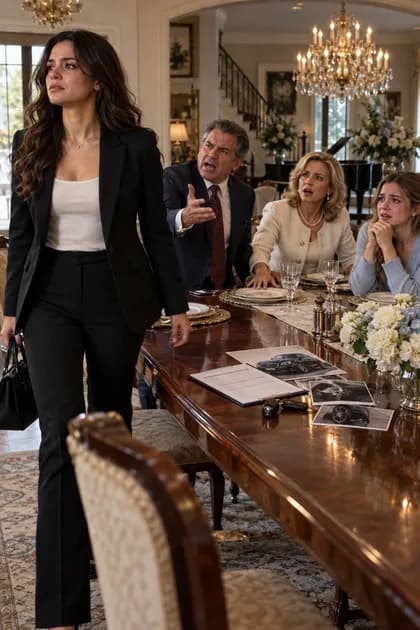
Qui Song stared at Dong Lani as though the room had shifted beneath him.
Chapter 4
PART 4 - THE FINAL ACCOUNTING FOR THE FAMILY THAT CHOSE HER OVER ME
1,480 words
“You what?”
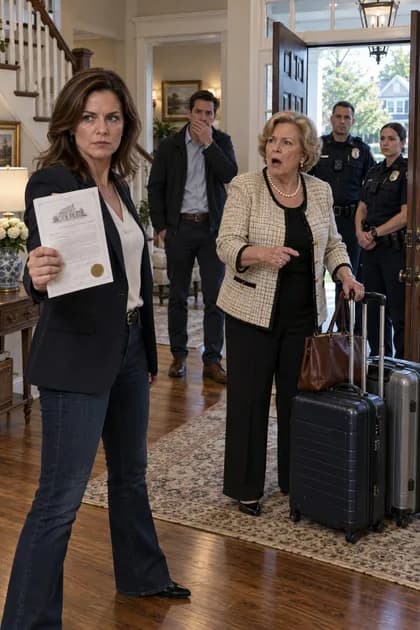
She tightened her grip on the bags.
“I told them you said the warehouses were yours. I told them you said your wife had no legal control over them. I told them you promised that after the promotion you could reorganize the assets.”
“You ungrateful—”
“Careful,” my aunt said from behind me. “There are witnesses in this house.”
Qui Song stopped.
For years, he had relied on other people being embarrassed before he was.
That advantage was gone.
My children stood near the doorway, suddenly very small in a conflict they had once treated like a game.
My daughter moved toward me.
“Mommy, can we stay here tonight?”
I looked at her face.
Three days earlier she had begged me not to embarrass Dong Lani.
Now she wanted shelter from the household she had chosen.
I wanted to gather both children into my arms and erase the entire
week.
But love without boundaries had helped create this problem.
“You may stay,” I said. “You are my children. But we are going to talk about what happened, and no one is going to pretend it didn’t matter.”
My son looked down.
Qui Song laughed bitterly.
“So this is your victory? Turning my own children against me?”
I looked at him.
“No. They came here because the life you promised them disappeared the moment my money did.”
His face flushed.
“That money supported our family.”
“Yes. And you taught everyone to believe it was proof of your power.”
Dong Lani placed her bags beside the wall.
“I didn’t leave because the servants are gone,” she said quietly.
Qui Song looked at her.
“Then why?”
“Because when the money disappeared, so did the man you pretended to be.”
That was cruel.
It was also accurate.
She explained that after I left,
Qui Song became obsessed with the investigation. He accused the children of being ungrateful whenever they complained. He blamed Dong Lani for failing to keep them quiet. He demanded she sell the jewelry he had given her to help cover expenses.
Most of that jewelry, as my ledgers had shown, had been purchased from household funds.
She had returned what remained.
The rest was being documented for the settlement.
My aunt asked the children to wait in another room.
Then she handed Qui Song a notice.
“The formal review is tomorrow morning. My niece will attend.”
He looked at me.
“You’re enjoying this.”
“No.”
That seemed to confuse him more than anger would have.
“I am ending it.”
The formal review lasted most of the next day.
The officials did not care about our failed marriage, Dong Lani’s position, my humiliation, or the children’s feelings.
They cared about documents.
That
suited me.
Documents did not shout.
They did not charm.
They did not rewrite the past when the truth became inconvenient.
The examiners compared Qui Song’s declarations to the registered ownership records. They reviewed the withdrawals, the contract application, the draft holding arrangement, and the statements he had made to Dong Lani about his authority over the assets.
His defense rested on one claim: he had acted under the reasonable assumption that marital access gave him practical control.
The problem was the marriage agreement.
It was explicit.
Separate property remained separate.
Major transfers required my written authorization.
The warehouses could not be pledged without my signature.
And there was no signature.
By the end of the review, the promotion was formally withdrawn.
The public contract application was rejected.
The examiners referred the financial misrepresentation for administrative penalties and ordered a full accounting of any funds Qui Song had improperly represented or redirected.
He was not dragged away in chains.
Life is rarely that theatrical.
Instead, he suffered the consequence he feared most.
His reputation became ordinary.
The people who had praised his rise learned how much of it had depended on resources he did not own.
Some colleagues stopped calling.
Others became very careful about what they put in writing.
His current position was reduced while the final disciplinary review proceeded, and he was required to repay documented personal expenses taken from the household account as part of the divorce settlement.
When we left the hearing room, he followed me into the corridor.
“Seven years,” he said. “After seven years, this is what you do to me?”
I turned.
“No. This is what you did while assuming I would never count.”
He stared at me.
For once, he had no answer.
The divorce itself took longer.
There were arguments over ordinary marital property, household debts, and custody schedules. I did not demand everything.
I demanded what was mine.
The mansion remained mine under the dowry agreement.
Qui Song was given time to relocate.
The Wei business interests and investment accounts returned entirely to my control.
The children’s education trusts remained protected for them.
Ordinary assets acquired jointly during the marriage were divided according to the settlement.
I refused to use the children as punishment.
They spent scheduled time with their father.
They also returned to live primarily with me after both admitted they no longer wanted Dong Lani or anyone else used as a replacement mother.
Dong Lani did not become my friend.
That would have been dishonest.
She left Qui Song before the divorce was final and returned to teaching elsewhere.
Before she left the city, she sent me one letter.
There were no excuses in it.
Only one sentence I remembered.
I thought taking your place would prove I mattered, but I never asked what it had cost you to stand there.
I did not answer.
Some lessons do not require reconciliation.
My children’s apology came more slowly.
My son was the first.
One evening, he found me reviewing school accounts at my desk.
“Are the certificates really still there?” he asked.
“Yes.”
“The ones I said I didn’t need?”
“Yes.”
He swallowed.
“Why didn’t you take them away?”
“Because they were prepared for your education, not as a reward for loving me correctly.”
His eyes filled.
“I thought Dad had more.”
“I know.”
“I thought you were trying to scare us.”
“I know that too.”
He stood there for a long time.
Then he said, “I’m sorry I laughed.”
It was not enough to erase what happened.
But it was real.
My daughter’s apology came on my next birthday.
She entered my room carrying a small wooden box.
Inside was no expensive gift.
Just a red ribbon she had braided herself and a drawing of a phoenix.
“I know Grandma’s bracelet was never mine to give away,” she said.
I looked at her.
“And?”
“And I cared more about Miss Dong being embarrassed than you being hurt.”
Her voice shook.
“I’m sorry.”
I opened the drawer where I now kept the real red phoenix bracelet.
For months after recovering it, I had been afraid to wear it.
That morning, I fastened it around my wrist.
My daughter watched.
“Will it be mine someday?”
“Maybe.”
Her face fell slightly.
I touched her hand.
“An heirloom is not something you receive because you expect it. It is something someone trusts you to protect.”
She nodded.
For the first time, she seemed to understand.
Years later, people would tell the story as though I had ruined Qui Song with one ruthless move.
That was never true.
I did not destroy his career.
I withdrew what he had falsely treated as his own.
I did not take his children.
I stopped competing for affection with a woman he had installed in our home.
I did not leave him penniless.
I separated his life from the assets he had spent years pretending belonged to him.
The difference mattered.
Qui Song eventually found work again, though never with the same influence. He learned to live within what he actually earned. Our relationship became civil because the children required it, but it was never close.
He once asked me, years after the divorce, whether I had planned everything the night he announced Dong Lani would move in.
“No,” I told him.
He looked surprised.
“I planned nothing until our daughter gave away my mother’s bracelet and you told me not to make things difficult for the woman wearing it.”
His face changed.
That was the moment he finally understood where the marriage had ended.
Not when the investigators arrived.
Not when the servants packed.
Not when the promotion disappeared.
It ended when he expected me to surrender my dignity so everyone else could remain comfortable.
I looked down at the red phoenix on my wrist.
My mother had been right.
Generosity was not surrender.
Love was not surrender.
Marriage was not surrender.
And silence, when used carefully, was not weakness.
Sometimes silence was simply the sound a woman made while counting what was hers before she walked away.
THE END.
Chapter complete
You have reached the end of this chapter.
Continue reading
Find your next story
A few more worlds to get lost in after this chapter.