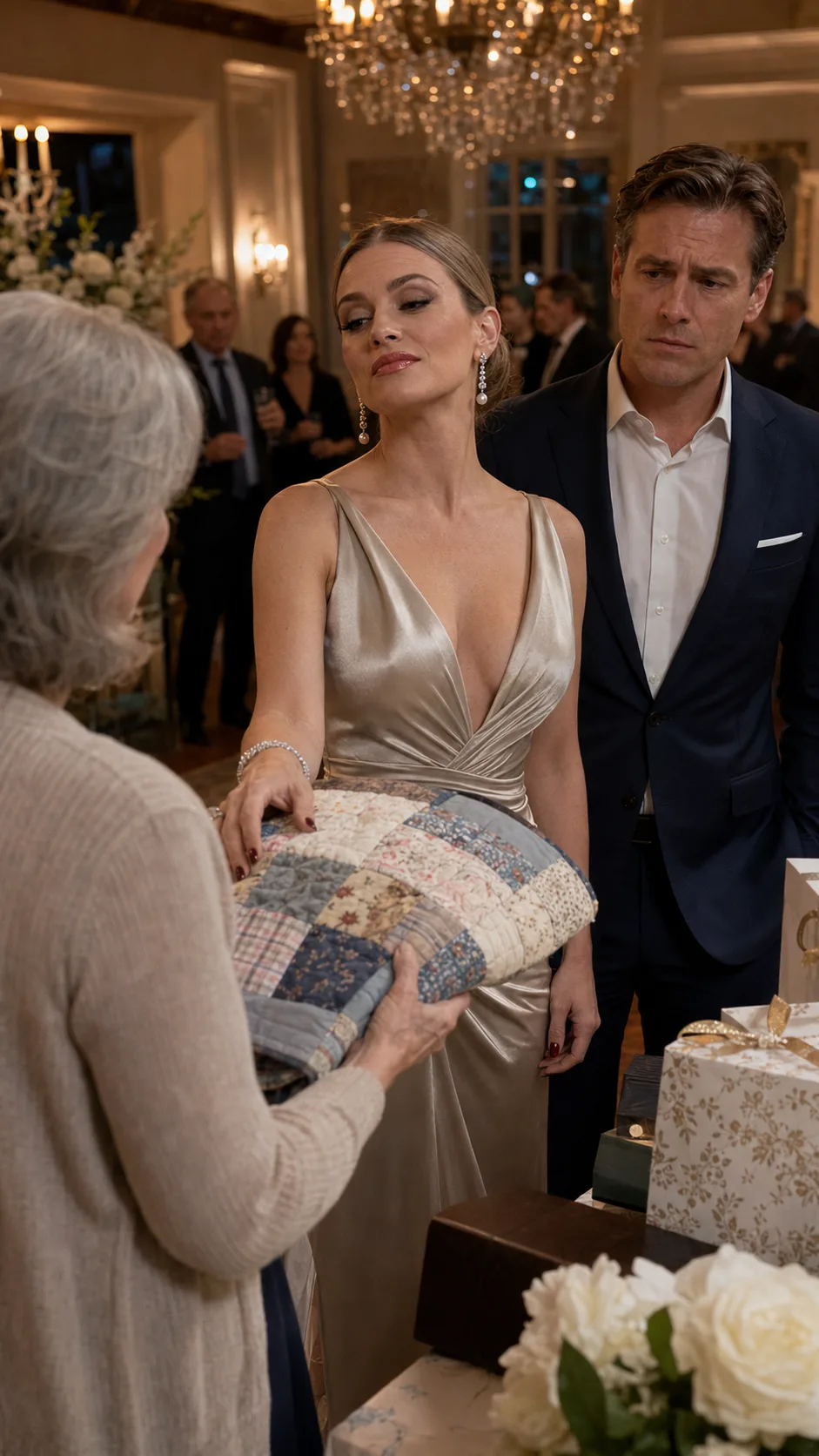
“THAT’S FROM A FLEA MARKET” — MY SON’S FIANCÉE TOSSED MY HANDMADE GIFT ASIDE AT THE PARTY — SO I …
PART 3 — THE TRUTH AT THE KITCHEN TABLE
He came the next morning.
Chapter 3
“THAT’S FROM A FLEA MARKET” — MY SON’S FIANCÉE TOSSED MY HANDMADE GIFT ASIDE AT THE PARTY — SO I …
PART 3 — THE TRUTH AT THE KITCHEN TABLE
He came the next morning.
I made coffee, and we sat at the kitchen table again.
I put Gary’s folder between us and let him read it himself.
I didn’t editorialize.
I just let him sit with the facts on the page. The HELOC, the numbered company, the client trust account irregularities, and let him work through it in his own order.
It took about 20 minutes.
When he was done, he closed the folder and put his hands flat on the table.
“I didn’t know,” he said.
“I believe you.”
“The quilt,” he said suddenly.
I waited.
“At the party, I saw her put it down. I didn’t… I should have said something.”
His voice cracked slightly on the last word, the way it used to when he was 14 and trying to be stoic about something that was breaking him.
“I just stood there.”
“You did.”
“I’m sorry, Mom.”
I reached over and
put my hand on his.
He was 41 years old, and he looked in that moment like the boy I used to drive to practice in the dark.
“I know,” I said.
He ended the engagement three weeks later.
I won’t pretend it was clean or simple. It wasn’t.
There were calls from the Hartley family that I didn’t take.
There was a voicemail from Simone’s mother that used the word sabotage four times in 90 seconds.
There was a period where Darren went very quiet, and I wasn’t sure what was happening inside him, but he came for dinner every Saturday.
He started mentioning his old friends from Nepean again.
He drove his own car.
Eight months after the engagement party, I sold the Fairvale property.
Not because of any of this. I’d been considering it for a while, and the market in the valley had moved in my
favor.
I sold it to a young couple from Carleton Place who wanted to run it as a sustainable event venue, sourcing everything locally, partnering with farmers in the region.
They were nervous about the price.
I took less than market value.
With part of the proceeds and some restructured investments, I set up a small bursary fund at Algonquin College for students in hospitality and trades programs.
The kind of students who might spend their careers doing work that is invisible until it isn’t done and who deserve to know that work builds things.
I named it after my mother, who cleaned other people’s houses for 40 years and never once complained about the work.
Darren helped me with the paperwork.
He sat across from me at the kitchen table, the same table, always the same table, and went through the documents with the careful focus of a man
who’d learned that some things needed to be built slowly, on purpose.
“Can I ask you something?” he said at one point.
“Yes.”
“Why didn’t you ever tell me about the properties, the investments? Why the secret?”
I thought about this honestly before I answered.
“I wanted you to see that the work itself was worth something,” I said. “Not the result. The work. And I was worried that if you knew about the money, you’d skip to the end. You’d see the number and miss the 30 years it took to get there.”
He nodded slowly.
“Did it work?”
I looked at him across the table.
My son, sitting at my kitchen table at 41, helping me set up a bursary fund in his grandmother’s name on a Saturday morning with nowhere else he needed to be.
“I think so,” I said.
He smiled.
It was the smile I remembered from before he’d started editing himself.
The quilt is still in my front closet.
He brought it back when he came to help with the Algonquin paperwork.
He didn’t make a big moment of it. Just set it on the chair by the door when he came in.
It was washed and folded, the flannel square from his childhood shirt visible on top.
I haven’t put it back in the closet yet.
I keep finding reasons to leave it on the chair.
I’m not sure this story has a tidy lesson.
Life mostly doesn’t.
But I’ve spent 31 years in rooms that people walked through without seeing, and I know this much.
The work you do in private shapes everything that happens in public.
Every dollar I saved alone at this kitchen table, every property I purchased when everyone said it was too much risk, every morning I drove in the dark without anyone watching, it all mattered.
Not because it added up to a number, because it added up to a life I chose on my own terms, without asking anyone’s permission.
And because when my son finally sat down across from me and really looked, he saw something worth seeing.
If this story landed somewhere real for you, leave a comment.
Tell me if you’ve ever been underestimated because of what you do.
Tell me if you’ve watched someone you love get lost for a while.
I read everything, and if someone in your life needs to hear that their work has value, that what they build in private matters, share this with them.
Subscribe for more stories about ordinary people doing extraordinary things quietly, without applause, for a very long time.
Thank you for staying until the end. It means more than you know.
I’ve thought a lot about cause and consequence since all of this settled.
Not in the abstract way, in the very specific, practical way you think about things when you’re 63 and you’ve had enough time to watch choices play out to their ends.
Simone didn’t lose Darren because I made a phone call.
She lost him because of who she’d been for a long time before I got involved.
The billing irregularities at her firm, the money moved through the numbered company, the way she introduced me to her mother’s friends at that party.
None of that started the night of the engagement.
It had been accumulating for years, quietly, the way debt does when you’re not paying attention.
I just happened to be paying attention.
And Darren, my son standing at that table watching his fiancée set my quilt down without a word, he didn’t fail me in that moment because he was a bad person.
He failed me because he’d been slowly trading away pieces of himself for a version of his life that looked a certain way from the outside.
That’s not a character flaw.
That’s a very human thing to do.
I’d seen it happen to people I respected. I’d come close to it myself early on, before I understood that other people’s opinions of your work are mostly a reflection of their own limitations and almost never a measurement of your actual worth.
What I know is this: the way you spend your private hours is the truest autobiography you’ll ever write.
Nobody reads it while you’re writing it.
You’re alone at the kitchen table at midnight, or you’re in a cold car at 5:30 in the morning, or you’re reading a financial pamphlet left on a nightstand by a retired accountant who noticed something in you worth encouraging.
Nobody applauds those moments.
There’s no audience.
But those are the moments that build everything else.
I spent 31 years in rooms that people walked through without seeing me.
I don’t say that with bitterness.
I say it because it taught me something essential.
Invisibility is only a problem if you’ve confused being seen with mattering.
I mattered in those rooms.
The families who came back to the same hotel year after year because their room was always exactly right.
I was part of that.
The work was real whether or not anyone acknowledged it.
The quilt Darren brought back is still on the chair by my front door.
I keep finding reasons not to put it away.
The flannel square from his childhood hockey shirt sits on top, and some mornings when I walk past it, I think about the eight months of evenings I spent at this table stitching it together after my shift.
I wasn’t thinking about legacy when I was making it.
I was thinking about him, about wanting him to have something that carried some of the years in it.
That’s what I’d want anyone to take from this.
If there’s something to take, character is built in the hours no one witnesses.
Wisdom comes from paying attention to things other people walk past.
And the resilience you develop, not from hardship alone, but from choosing over and over to keep building something even when no one is watching and no one is applauding, and the only person who knows what you’re doing is you.
Darren came for dinner last Saturday.
He brought butter tarts from a bakery in the Glebe and sat at my kitchen table for three hours.
On his way out, he stopped at the door, looked at the quilt on the chair, and said, “I’m glad you kept it out.”
So am I.
THE END.
Chapter complete
You have reached the end of this chapter.
Continue reading
A few more worlds to get lost in after this chapter.