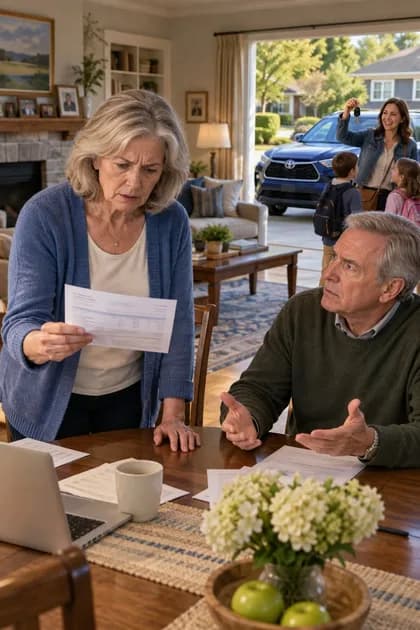
“Pack a bag.”
That was how my mother-in-law greeted me in my own foyer.
Chapter 1
THE MORNING MY HUSBAND TRIED TO MOVE ME OUT
4,769 words
Not hello. Not, “Can we talk?” She stood inside my front door with two rolling suitcases and a leather tote, then said, “I’m moving in. This is my son’s house.”
I stared at her.
“What?”
“I don’t want this to become ugly, Melissa.”
Considering she had arrived expecting me to leave my own home, it already had.
“Brandon said you’d probably make this difficult,” Carol added.
It was 9:46 on a Friday morning. Exactly sixty-four minutes earlier, my husband had texted me from work:
Mom is moving in today.
I thought he meant she was visiting.
For what? I replied.
His answer came immediately.
To live with us. Her lease is over. We’ve discussed this enough.
We had discussed Carol’s housing problem.
We had never agreed she was moving in.
Carol was sixty-eight and had rented the same two-bedroom apartment in Cary, North Carolina, for seven years. The building had
changed ownership, and her renewal came with a major increase.
Months earlier, Brandon had suggested she might stay with us “for a little while” while she looked for somewhere else.
I hadn’t refused.
I had said, “If it ever gets to that point, we need to talk about how long, which room, money, privacy, and what the actual plan is.”
That was it.
No move-in date.
No agreement.
And definitely no agreement that I would leave.
My name is Melissa Hart. I was forty-two. Brandon was forty-four. We had been married eight years.
And the house was mine.
Literally.
I bought the three-bedroom craftsman near Cary three years before marrying Brandon, using equity from a condo I had owned in Raleigh. The mortgage and deed were in my name.
Brandon moved in after we married. We split household expenses. He contributed to repairs and utilities. We built a life there.
But we never changed the deed.
Brandon knew that.
Apparently, Carol didn’t.
She rolled one suitcase farther inside.
I stopped it with my foot.
“Why did you tell me to pack a bag?”
She looked surprised that I even had to ask.
“Because this cannot work with both of us here.”
“Both of us?”
She sighed.
“Brandon said you two have been having problems. He said you might stay with your sister for a while.”
My sister Lauren lived twenty-five minutes away.
Something tightened behind my ribs.
“Did he?”
Carol softened her voice.
“I don’t want to get between a husband and wife.”
I looked at her luggage.
“That concern arrived very late.”
Her face tightened.
“I lost my apartment because of this plan.”
“What plan?”
“The plan for me to move here.”
“There is no plan.”
“Of course there is. Brandon said everything was settled.”
“It isn’t.”
“He said
you would say that.”
I froze.
“What?”
“He told me you’d be emotional about it at first.”
And suddenly, I understood.
Brandon had prepared her for my objection.
Any “no” from me had already been categorized as temporary resistance.
I called him.
Straight to voicemail.
I sent one message.
Come home.
Then I faced Carol.
“You are not moving in today.”
Her eyebrows rose.
“Excuse me?”
“My son lives here.”
“Yes.”
“And he agreed.”
“I didn’t.”
Carol gave a humorless laugh.
“You always have to make everything complicated.”
I pointed toward the door.
“Take the luggage back outside until Brandon gets here.”
“I’m not dragging everything back out.”
“You brought two suitcases.”
“The movers have the rest.”
I stopped cold.
“What movers?”
“My furniture.”
My pulse jumped.
“When are they coming?”
“This afternoon.”
That was when the situation became something entirely different.
This wasn’t a spontaneous decision Brandon had made that morning.
A moving company was already scheduled.
Carol’s belongings were packed.
Someone had planned all of this.
For how long?
“What room are you expecting to use?”
“The back bedroom.”
“My office?”
“That’s what Brandon said.”
My office wasn’t decorative.
I worked from home two days a week as a procurement manager for a pharmaceutical manufacturer in Research Triangle Park.
Two monitors.
Locked files.
Printer.
Equipment.
Work calls.
“He said your desk could go downstairs,” Carol continued.
“Downstairs where?”
“The dining room for now. The guest bed can go into storage. I’m bringing mine.”
I just stared at her.
My husband had assigned my office to someone else, scheduled movers, decided where my desk would go, and informed me less than two hours before his mother arrived.
“Carol, none of that is happening.”
“You agreed.”
“No.”
“Brandon said you did.”
“Did he actually use the word agreed?”
She hesitated.
I noticed.
“He said it was handled.”
“That is not the same thing.”
I grabbed one suitcase and rolled it toward the front door.
Carol seized the handle.
“Stop. Do not touch my things.”
“Then move them yourself.”
Her face reddened.
“This is my son’s home too.”
“He lives here.”
“It is his home.”
“Yes.”
“Then he has every right to have his mother here.”
“Not like this.”
“You don’t get to decide everything.”
I stared at her.
“That is an astonishing sentence to say while attempting to move into my office without asking me.”
Carol pulled out her phone and called Brandon.
He answered her.
Not me.
I could hear his muffled voice from across the foyer.
“She won’t let me move in,” Carol told him.
Pause.
“No.”
Another pause.
“She’s telling me to put my things outside.”
She listened again, then looked at me.
“He says to wait. Brandon is leaving work.”
“Good.”
Then she said, “I think you should take a few days at your sister’s house and calm down.”
“No.”
“That would be best for everybody.”
“No.”
“You said yourself you could stay with Lauren.”
“When?”
She frowned.
“Brandon told me.”
“I’m asking what he told you I said.”
She shook her head.
“I’m not debating every word.”
“Then we have nothing else to discuss until he arrives.”
I opened the front door fully.
“Suitcases outside.”
Carol didn’t move.
Neither did I.
For maybe thirty seconds, we just stood there staring at each other.
Then she said something I almost couldn’t believe.
“If you refuse to leave, I’ll have someone make you.”
For a second, I thought she was bluffing.
Then she dialed 911.
“I need help removing someone from my son’s house,” she told the dispatcher.
My entire body went cold.
Not from fear.
From disbelief.
She gave them my address.
Then she looked directly at me and said into the phone:
“She refuses to leave.”
I walked into the kitchen, opened the file drawer where I kept the house documents, and pulled out my deed copy and property-tax record.
Then I sat down and waited.
Two Cary police officers arrived about fifteen minutes later.
Carol immediately started talking.
“This is my son Brandon’s house.”
One officer raised his hand.
“Ma’am, one at a time.”
Then he turned to me.
“Do you live here?”
“Yes.”
“Do you have identification with this address?”
I handed him my driver’s license.
Carol interrupted.
“She’s his wife, but they’re having problems.”
The officer looked at me again.
“Is this your residence?”
“Yes.”
“And whose name is on the property?”
“Mine.”
Carol actually laughed.
“That’s not true.”
Without arguing, I handed the officer the deed.
He read it.
Then he looked at Carol.
“Ma’am, what legal right are you claiming to occupy the residence?”
“It belongs to my son.”
“No,” I said quietly.
Carol turned toward me.
Furious.
Then confused.
“No?”
“No.”
I had expected that moment to feel satisfying.
It didn’t.
Because Carol looked genuinely blindsided.
Then Brandon’s car pulled into the driveway.
He got out quickly.
He saw the police.
He saw his mother.
Then he saw the deed in the officer’s hand.
His entire face changed.
Carol pointed at me.
“She says this house is hers.”
Brandon said nothing.
I looked straight at my husband.
“You never told her?”
His eyes dropped to the porch floor.
Carol slowly turned toward him.
“Told me what?”
Brandon swallowed.
Finally, he said:
“Mom… the house was Melissa’s before we married.”
Carol went completely still.
I watched her replay the entire morning in her head.
The suitcases.
The movers.
The police.
The demand that I leave.
Her son’s house.
Then she looked at Brandon.
Carol stared at Brandon as if she were seeing her son for the first time.
“You told me Melissa was leaving.”
Brandon’s head snapped up.
My stomach dropped.
One of the officers glanced between us, but no one interrupted.
Carol pointed a shaking finger at him. “You said the marriage was basically over. You said this house would eventually be yours, and that Melissa had already agreed to stay with her sister.”
I turned slowly toward my husband.
“Brandon?”
His face had gone completely white.
“That’s not exactly what I said.”
Carol laughed bitterly.
“Oh, yes, it is.”
Then she reached into her leather tote.
“I gave up my apartment because of you. I paid the movers because of you. And you told me I could use Melissa’s office because she wouldn’t need it anymore.”
Every word hit harder than the last.
Brandon stepped toward her.
“Mom, stop.”
But Carol was already pulling out her phone.
“No. She deserves to know.”
She unlocked the screen, opened her messages, and held the phone toward me.
There were dozens of texts between them.
Then I saw one message from Brandon that made my blood run cold.
It wasn’t about Carol moving in.
It was about what he planned to do with my house after I was gone.
I looked up at him.
“What did you do?”
Brandon glanced at the officers.
“Melissa, this is not what it looks like.”
I looked back at Carol’s screen.
The message had been sent eleven days earlier.
Once she’s at Lauren’s, don’t let her talk you into leaving. Get settled. She won’t throw a sixty-eight-year-old woman onto the street. Give me a few weeks and I can get her to agree the house needs to be sold.
Under it, Carol had replied:
And then what?
Brandon’s answer:
I found a place in Apex with a downstairs bedroom for you. If Melissa sells, there should be enough equity to make the next place work. I’m tired of living in a house where everything is hers.
For several seconds, nobody spoke.
I read the last sentence again.
I’m tired of living in a house where everything is hers.
Eight years.
That was what eight years had become.
Not our kitchen.
Not our porch.
Not the room where we put up a Christmas tree every December.
A house where everything was mine.
A problem to be solved.
I handed Carol’s phone back to her.
“Is there more?”
Brandon stepped forward.
“Melissa.”
I didn’t look at him.
“Carol. Is there more?”
She scrolled.
Her anger had changed. It wasn’t aimed at me anymore.
“Yes.”
“Mom, enough.”
“No,” she said sharply. “You’ve said enough for both of us.”
She turned the screen toward me again.
There were messages stretching back almost six weeks.
Brandon had told her our marriage was “barely functioning.”
He had told her I was considering moving in with Lauren.
He had told her I hated working from home and wanted to give up my office.
He had told her that once she moved in, I would “complain for a few days and then adjust.”
None of it was true.
Then I found another message.
Carol had asked:
Does Melissa know you want to sell?
Brandon had written:
Not yet. She gets territorial about the house. If I bring it up now she’ll shut down. Better to change the situation first, then talk when she sees keeping it doesn’t make sense anymore.
I felt something inside me go very quiet.
Not calm.
Finished.
One of the officers cleared his throat.
“Ma’am,” he said to Carol, “if you don’t have permission from the homeowner to move belongings into the residence, I would strongly suggest you make other arrangements.”
Carol nodded slowly.
For the first time that morning, she looked embarrassed.
“I understand.”
Brandon turned toward me.
“Can we please talk without an audience?”
I folded my arms.
“We can talk.”
“Privately.”
“No.”
His jaw tightened.
“Melissa.”
“You arranged for your mother to occupy my office, convinced her I had agreed to leave, and planned to use her presence here to pressure me into selling my house. You don’t get privacy because being overheard is uncomfortable.”
“That’s not what I was doing.”
I pointed at the phone.
“You wrote it down.”
“I was trying to solve a problem.”
“What problem?”
He opened his mouth.
Nothing came out.
I waited.
Finally he said, “I don’t have a place in this marriage.”
Carol stared at him.
I almost laughed.
Instead I said, “You have lived here for eight years.”
“That’s not what I mean.”
“Then say what you mean.”
His face flushed.
“You bought this place before me. The deed is yours. The mortgage is yours. Every time we talk about renovating something, you remind me we have to protect the value of the house. Every major decision comes back to the fact that it was yours first.”
I searched my memory.
I had reminded him twice that we couldn’t remove a load-bearing wall without an engineer.
Apparently that had become oppression.
“You wanted your name on something,” I said.
“Yes.”
“Then you could have told me.”
“I did.”
“No. You complained that the den was too small. You complained about the commute. You sent me listings twice. You never once said, ‘I resent living in a house you bought before we met, and I want us to discuss buying something together.’”
He looked away.
Because he knew I was right.
Carol sank onto the bench near the foyer.
“What did you tell Melissa about me?”
Brandon didn’t answer.
She stood again.
“What did you tell her?”
I answered for him.
“That your lease was increasing and you might need somewhere temporary.”
Carol gave a short, stunned laugh.
“Temporary.”
She looked at him.
“You told me you were creating a home for both of us.”
Brandon rubbed both hands over his face.
“I was trying to make everybody happy.”
“No,” I said. “You were trying to make everybody agree to different things without letting us compare notes.”
That landed.
Even Brandon stopped arguing.
A truck engine rumbled outside.
Carol looked through the front window.
“Oh, God.”
The moving company.
Two men climbed from the cab while a third walked around to open the rear door.
Carol closed her eyes.
“I paid for the whole move.”
Brandon started toward the door.
“I’ll handle it.”
“No,” Carol said.
He stopped.
She picked up her tote and walked outside herself.
I followed as far as the porch.
The officers remained for another minute, long enough to make sure the situation wasn’t escalating.
Carol spoke to the crew leader.
There was a long conversation.
A clipboard came out.
She pointed at the truck, then at Brandon.
Whatever cancellation fee she was being quoted made her shoulders sag.
Brandon stepped toward her.
“I’ll pay it.”
“You certainly will.”
It was the first thing she had said all morning that nearly made me smile.
The moving truck eventually pulled away with everything still inside.
Carol stood beside her suitcases at the curb.
Suddenly she looked less like the woman who had threatened to have me removed and more like a sixty-eight-year-old woman who had surrendered her apartment because her son had promised her a future that did not exist.
I still wasn’t ready to forgive her.
But I could see the difference between being entitled and being deceived.
Carol had been both.
“Where are you going?” I asked.
She looked almost surprised I had spoken to her.
“I don’t know.”
Brandon said, “Mom can stay here tonight while we sort this out.”
I looked at him.
“No.”
He exhaled hard.
“Melissa, come on.”
“No.”
“Where is she supposed to go?”
“That question should have occurred to you before you ended her lease based on a lie.”
Carol lifted a hand.
“Stop.”
She looked at me.
“I have a friend in Durham with a guest room. I can stay there for a few nights.”
Then, after a pause, she added, “I’m sorry.”
Brandon stared at her.
I did too.
Carol swallowed.
“I should never have walked into your house and told you to leave. I believed things I wanted to believe because Brandon made them convenient for me to believe.”
That was more honest than I expected.
“I called the police on you,” she continued. “There isn’t an excuse for that.”
“No,” I said. “There isn’t.”
She nodded.
“I know.”
Then she turned to Brandon.
“You’re taking me to Susan’s.”
He looked toward me.
“Can we talk first?”
I shook my head.
“You need to take your mother where she has somewhere to sleep.”
“And then?”
“Then you come back.”
Hope flashed across his face.
I killed it immediately.
“To pack a bag.”
His expression changed.
“Melissa.”
“You were very comfortable telling me to pack one this morning.”
“That was Mom.”
“No. That was you.”
Carol looked at him.
Brandon didn’t deny it.
The officers left.
Carol’s suitcases went into Brandon’s trunk.
Before she got into the passenger seat, she came back to the porch and held out her phone.
“What?”
“I’m forwarding you everything.”
Brandon stepped out of the car.
“Mom, don’t.”
She didn’t even turn around.
“You used me to do your dirty work.”
Then she tapped the screen.
A few seconds later, my phone began vibrating.
Screenshot after screenshot.
Weeks of messages.
Weeks of lies.
Brandon had counted on Carol and me never sitting in the same room long enough to compare what he had told us.
Instead, he had summoned the police to the exact place where the comparison happened.
They drove away.
I went inside and locked the door.
Then I stood in the foyer staring at the scuff mark Carol’s suitcase had left on the hardwood.
I wanted to cry.
I didn’t.
I opened my laptop.
Not because I had suddenly become cold.
Because I finally understood that my husband had been making plans around me, and emotion was not going to protect me from whatever else I had not yet seen.
I changed the passwords on my personal email, cloud storage, and banking login.
I downloaded copies of our joint account statements.
I photographed the deed, mortgage records, tax statements, and the messages Carol had forwarded.
Then I emailed copies to myself at a separate account Brandon could not access.
After that, I called Lauren.
She answered on the second ring.
“Hey. What’s wrong?”
I looked at the two empty spaces where Carol’s suitcases had been.
“Can you come over?”
She heard something in my voice.
“I’m leaving now.”
Brandon returned a little after three.
Lauren was sitting with me at the kitchen island.
He stopped when he saw her.
“So we’re doing this now?”
Lauren stood.
“I can leave.”
“No,” I said.
Brandon laughed once without humor.
“Of course.”
I looked at him.
“You wanted me at Lauren’s so you could move your mother into my office.”
His expression tightened.
“That isn’t fair.”
“Fair stopped being the relevant word around nine forty-six this morning.”
He dropped his keys onto the counter.
“I never intended to steal your house.”
“I didn’t say steal.”
“That’s what you’re implying.”
“No. I’m saying you intended to manufacture a situation where selling became easier than resisting you.”
He looked at Lauren, then back at me.
“I wanted us to buy something together.”
“Then why didn’t you ask me?”
“Because I knew what you’d say.”
“What would I say?”
“No.”
I stared at him.
There it was.
The entire marriage, reduced to one sentence.
Because I knew what you’d say.
“So instead of asking,” I said quietly, “you decided my answer shouldn’t matter.”
“That’s not—”
“It is exactly that.”
He paced toward the dining room.
“I have put money into this house for eight years.”
“And I have never denied that.”
“I replaced the HVAC.”
“We paid for it from the joint account.”
“I rebuilt the deck.”
“We hired a contractor.”
“I’ve paid utilities, repairs, taxes—”
“You’ve paid part of the expenses of the home you lived in.”
His voice rose.
“I’m your husband!”
“And that gave you the right to promise my office to your mother?”
“No.”
“To tell her I was leaving?”
“No.”
“To tell her the house would eventually be yours?”
He stopped.
“No.”
“To plan a sale I had never agreed to?”
Silence.
I nodded.
“That is the first honest conversation we’ve had today.”
He leaned against the counter.
“What do you want me to say?”
“The truth would have been useful six weeks ago.”
“I was scared.”
That caught me off guard.
Not enough to soften me.
But enough to make me listen.
“Of what?”
He looked around the kitchen.
“Of being forty-four years old and realizing nothing in my life felt like mine.”
Lauren shifted beside me.
I raised a hand slightly, asking her to let him finish.
Brandon continued.
“My job is fine. I’m not going anywhere there. This house was yours. Your career took off faster than mine. Every year it felt like I was living inside a life you had already built.”
There was bitterness in it.
But there was shame too.
For the first time, I understood his motive.
I also understood that motive did not excuse the method.
“You felt small,” I said.
His eyes met mine.
“Yes.”
“So you made me smaller.”
He flinched.
“You decided the way to feel like an equal was to take away my ability to say no.”
“That wasn’t how I saw it.”
“I know.”
That was the problem.
He walked toward me.
“I’m sorry.”
I stepped back.
Not dramatically.
One step.
It stopped him more effectively than shouting would have.
“I believe you’re sorry this happened.”
“That’s not fair.”
“I don’t know yet whether you’re sorry you did it.”
His face crumpled slightly.
“What does that mean?”
“It means you need somewhere else to stay tonight.”
“This is my home too.”
The irony was so sharp Lauren actually looked down.
I held Brandon’s gaze.
“Yes. It has been your home for eight years. Which is why I’m not changing locks, throwing your clothes onto the lawn, or calling police and pretending you don’t belong here.”
He went silent.
“But I cannot sleep beside you tonight.”
He stared at me for a long moment.
Then he nodded.
“I’ll get a hotel.”
“No,” I said. “Get enough clothes for several days. We’re not fixing this over breakfast tomorrow.”
He went upstairs.
Twenty minutes later he came down with one suitcase.
The same size as Carol’s.
He paused at the front door.
“Are you really ending our marriage over this?”
I looked at him.
“No.”
Hope returned for half a second.
Then I said, “I’m deciding what happens to our marriage because you spent six weeks lying to your mother about me, lying to me about her, and creating a situation designed to override my consent.”
His hand tightened around the suitcase handle.
“That’s different.”
“Yes.”
I opened the door.
“It is.”
The following Monday, I met with a family-law attorney.
Not because I had decided every detail of my future.
Because Brandon had already spent six weeks making decisions without me, and I refused to spend another day uninformed.
I brought everything.
The deed.
Mortgage statements.
Joint-account records.
Carol’s messages.
The texts Brandon had sent me.
I was advised to preserve documents, avoid impulsive financial moves, and make no agreements about the property without understanding exactly what I was signing.
So I didn’t.
For the next several weeks, Brandon tried every version of the apology.
He apologized for involving Carol.
He apologized for not telling me he resented the house.
He apologized for making plans before talking to me.
Then, occasionally, the apology would crack.
He would say he had “only wanted a place that felt like ours.”
He would say he had “never actually listed the house.”
He would say I was acting as if he had committed some enormous crime when all he had done was “handle things badly.”
That phrase settled it for me.
Handle things badly.
As if the moving truck had taken a wrong exit.
As if Carol had misunderstood a dinner invitation.
As if my husband had not deliberately created facts on the ground because he believed I would be easier to pressure once his mother was already inside.
I stopped arguing.
I started deciding.
Brandon rented a furnished apartment.
We separated our day-to-day finances with professional guidance and documented what belonged where.
He came back for his personal belongings in scheduled trips.
I stayed polite.
He kept waiting for anger because anger would have meant there was still something he could fight.
What he got instead was clarity.
Carol contacted me three weeks after the police incident.
She did not call.
She sent an email.
It was short.
I was wrong to enter your home the way I did. I was wrong to threaten you, and I was wrong to call the police. Brandon lied to me, but I chose to treat you like an obstacle instead of calling you and asking whether any of it was true. That part belongs to me.
Then she attached the full message thread.
Not screenshots.
The entire exported conversation.
I read it once.
Then I saved it with the rest of my records.
I replied with two sentences.
Thank you for taking responsibility. I hope you find somewhere stable.
We did not become friends.
Real life rarely wraps betrayal in a bow that neat.
But Carol stopped blaming me.
More importantly, she stopped helping Brandon blame me.
She found a smaller apartment two months later.
Brandon paid her moving costs.
Every dollar.
That seemed appropriate.
My marriage did not recover.
There had been problems before that Friday.
Normal ones, I had thought.
Work stress.
Arguments about money.
His resentment when I worked late.
My frustration that he avoided difficult conversations until he exploded over something small.
Those things might have been repairable.
What I could not repair was the knowledge that when Brandon feared hearing no, he did not negotiate with me.
He went around me.
He created a fictional version of our marriage for his mother.
He moved pieces into position.
Then he planned to confront me only after he believed resistance would be more painful than surrender.
Months later, when we sat across from each other in a mediator’s conference room discussing the practical end of our marriage, Brandon looked exhausted.
He stared at the documents in front of him.
“I really thought if we bought a different house, things would get better.”
I believed him.
That was the saddest part.
“You never needed a different house,” I said.
He looked up.
“You needed to tell me you were unhappy.”
He swallowed.
“I didn’t think you’d understand.”
“You didn’t give me the chance.”
He nodded.
For once, there was no argument.
No defense.
No revised history.
Just consequence.
When I returned home that evening, the house was quiet.
The back bedroom was still my office.
My desk had never moved to the dining room.
My monitors were exactly where they had been that Friday morning.
For weeks, the small scuff from Carol’s suitcase remained near the foyer.
I could have polished it out.
I didn’t.
Not at first.
Every time I passed it, I remembered standing there while someone told me to pack a bag because she believed my home belonged to somebody else.
Then one Saturday morning, I knelt down with a cloth and wood cleaner.
The mark disappeared in less than a minute.
I sat back on my heels and looked at the floor.
That surprised me.
Something that had seemed permanent wasn’t.
I had spent months thinking the greatest betrayal was that Brandon wanted the house sold.
It wasn’t.
A house can be sold.
A mortgage can be refinanced.
Walls can be repainted.
The betrayal was that my husband had decided my consent was an inconvenience he could engineer around.
And once I understood that, the rest became simpler.
I did not keep the house because I had defeated him.
It had never been a prize we were fighting over.
I kept it because it was my home, and I finally stopped allowing other people to treat my boundaries as the opening position in a negotiation.
The morning Carol arrived, she told me to pack a bag.
I never did.
Brandon did.
THE END.
Chapter complete
You have reached the end of this chapter.
Continue reading
Find your next story
A few more worlds to get lost in after this chapter.