Ten days before my son’s wedding, I came home from a doctor’s appointment and discovered something hanging in my bedroom closet that made me stop cold.
Chapter 1
THE AGREEMENT MY SON HAD NO RIGHT TO SIGN
4,285 words
A wedding dress.
Not mine, obviously.
Chloe’s.
My future daughter-in-law’s expensive white satin gown was hanging exactly where my winter coats were supposed to be.
At first, I didn’t even notice the suitcases blocking my hallway.
Or the strange man smoking on my balcony.
Or the fact that someone had shoved my coffee table halfway across the living room.
All I could see was that dress.
For one confused second, I honestly wondered if I had walked into the wrong apartment.
Then Brenda—Chloe’s mother—appeared in my living room with her hands on her hips, rearranging my furniture like she owned the place.
Her husband, Gary, was smoking on my balcony.
Their son, Kyle, was sprawled across my sofa with his shoes planted on my cushions.
Their younger daughter, Madison, was standing in my kitchen using my Italian coffee maker.
And Chloe?
She turned away from my closet and gave me
that sweet, innocent smile she always wore when she wanted everyone to believe she couldn’t possibly mean any harm.
“Oh, Eleanor,” she said brightly. “Hi. Come in. Make yourself at home.”
I stared at her.
Make myself at home.
In my own home.
My name is Eleanor Morales. I’m sixty-seven years old, retired, and I spent forty years working so I could afford that apartment.
Forty years of waking before sunrise.
Packed lunches.
Bus rides.
Overtime.
Skipped vacations.
Saying no to things I wanted because I was saving for the one thing I believed nobody could ever take away from me.
A home.
Three bedrooms. Two bathrooms. A sunny kitchen window. A little balcony where I kept two plants I watered every evening.
It wasn’t luxurious.
But every square foot was mine.
My son Nathan knew what that home meant to me better than anyone.
I had raised him alone
since his father left when Nathan was three.
I worked until my feet ached to pay for braces, school trips, college applications, deposits—whatever I could manage.
I never resented it.
Nathan was my son.
For most of my life, he was my whole world.
So when he introduced me to Chloe six months earlier, I tried sincerely to like her.
She was attractive, polite, well-spoken.
The first time she came to dinner, she brought flowers and complimented my curtains.
When Nathan told me they were getting married, I cried after he left.
Not because I was sad.
Because I was proud.
I thought I had raised a good man.
I had no idea that good man was quietly making plans to give away my home.
Standing in my doorway with my keys still in my hand, I finally asked, “What exactly is going on?”
Chloe laughed lightly and took my
arm.
“Oh, everything happened so quickly. Mom thought it would be wonderful if our families spent time together before the wedding. And you have so much space, so Nathan let everyone in while you were at your appointment.”
I stiffened.
“Nathan gave you my keys?”
“Well, he has his own set,” she replied. “Besides, we’re going to be family.”
Family.
That word became their excuse for everything.
Family meant Brenda could rearrange my living room because she disliked its “energy.”
Family meant Madison could use my face cream and promise to replace it later.
Family meant Kyle could smoke on my non-smoking balcony and flick ashes into my plants.
Family meant they could eat everything in my refrigerator.
By six o’clock, the chicken I had bought for the entire week was gone.
So were the eggs.
The cheese.
Most of my groceries.
Then I asked the obvious question.
“Where are all of you planning to sleep?”
Chloe answered casually.
“Madison and I can take the guest room. Kyle and Dad can use the couches. Mom can sleep in your room with you. Your bed is big enough.”
“No.”
Brenda stared at me.
“No?”
“I’m not sharing my bedroom.”
A thin smile crossed her face.
“Oh, Eleanor. Families don’t really have privacy. We share things.”
Something cold moved through my chest.
I called Nathan immediately.
Before I could finish explaining, he said, “Mom, please. It’s only ten days. Can’t you do this for me?”
“They’ve eaten my food. They’ve moved my furniture. Chloe’s mother thinks she’s sleeping in my bedroom.”
“You’re exaggerating.”
That word hurt.
I was surrounded by people I had never invited into the home I had spent my life earning, and somehow I was the problem.
“After the wedding, everything will settle down,” Nathan said. “Just be nice. They’re my new family.”
Then he hung up.
That night, I barely slept.
Kyle watched videos until after three.
Gary coughed constantly.
Brenda snored in the living room.
At one point, Chloe tried opening my bedroom door without knocking.
When I called out, she claimed she was looking for a drinking glass.
Then she added casually:
“Since this is going to be my house too after the wedding, I figured it was okay.”
My blood went cold.
The next morning, Brenda sat at my kitchen table drinking my coffee and criticizing my apartment.
The cabinets were outdated.
The walls needed a modern color.
My furniture looked old.
Then Madison walked in.
“Did you tell her about the bedroom?”
I slowly turned toward Brenda.
“What bedroom?”
Brenda folded her hands.
“Well, after the wedding, Chloe and Nathan should obviously have the master bedroom. Newlyweds need privacy. You can move into the guest room. It’s smaller, but one person doesn’t need much space.”
One person.
Forty years of work, and these people were discussing downsizing me inside my own home.
I called Nathan again.
This time, I asked one question.
“Did you tell Chloe you two could move into my apartment after the wedding?”
His silence answered before he did.
“Mom, we were going to discuss it.”
“When?”
Another pause.
“After the wedding.”
I understood immediately.
They weren’t waiting because everyone would be calmer.
They were waiting because I would be trapped.
Once the vows were exchanged, saying no could be painted as an attack on my son’s marriage.
But it got worse.
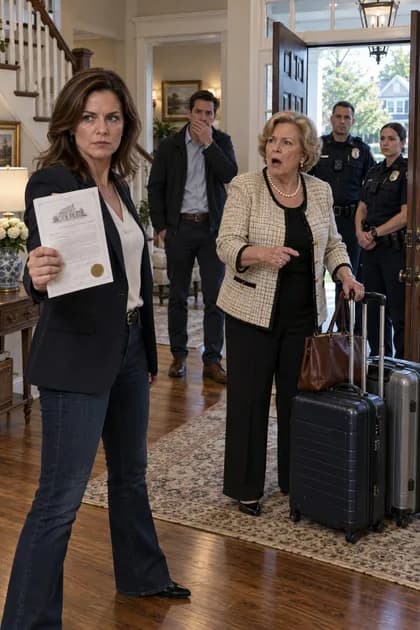
That evening, I came home from a walk and found twenty strangers inside my apartment.
Music blasted through the rooms.
Beer bottles covered my coffee table.
People I had never seen before were laughing in my kitchen.
And there was Chloe, sitting beside Nathan on my sofa, holding a drink like she was already hosting parties in her own house.
I looked at my son.
He looked away.
“Everyone out,” I said.
The apartment went silent.
Chloe immediately started crying.
Brenda accused me of trying to destroy the wedding.
And then the truth finally came spilling out.
Brenda and Gary had sold their house.
They had nowhere permanent to live.
And Nathan had promised them my apartment.
Not for ten days.
For a year.
Maybe two.
They had deliberately planned to tell me after the wedding because they believed it would be harder for me to refuse once everyone was officially family.
I stared at Nathan.
At the little boy I had carried through fevers.
The child whose school plays I never missed.
The young man I helped through every financial crisis and difficult season.
“You promised them my home?”
He couldn’t meet my eyes.
“I thought you’d agree.”
Chloe suddenly pulled off her engagement ring and dropped it onto the coffee table.
“If you refuse to support us,” she said, “maybe there shouldn’t be a wedding.”
Everyone stared at me.
They expected panic.
They expected me to beg Chloe to put the ring back on.
They expected me to sacrifice myself one more time for Nathan.
Instead, I heard my own voice say:
“Then cancel it.”
Absolute silence.
Brenda stepped toward me.
Her voice changed.
Lower.
Harder.
“You can’t throw us out. We’ve already been living here for three days. We have rights.”
Chloe wiped her tears and nodded.
Nathan stood between us, his face pale with anger.
Then my son said something that destroyed whatever remained of the person I thought I had raised.
“If you call the police, I’ll tell them you’re confused. I’ll say you invited us here and forgot.”
I looked at him for a long moment.
Then I took out my phone.
Dialed 911.
And when the operator answered, I said calmly:
“There are people inside my home who are refusing to leave.”
The moment I finished speaking to the 911 operator, Nathan’s face changed.
“Mom, you didn’t actually call them, did you?”
I didn’t answer.
Brenda rushed toward the hallway.
“Everybody grab your things. She’s trying to humiliate us!”
But nobody moved fast enough.
Ten minutes later, the doorbell rang.
One of the officers turned to me.
“Ma’am, did you give any of these people permission to live here?”
“No.”
“Did you agree to let them stay for a year?”
“Absolutely not.”
Nathan interrupted.
“She knew we were coming!”
The officer looked at him.
“That’s not what she said.”
For the first time all evening, Nathan went silent.
The officers told everyone to gather their belongings and leave.
Brenda protested until she realized arguing wasn’t helping.
But just before Chloe walked out, she turned around and stared at me.
“You think you won,” she whispered. “You have no idea what Nathan already signed.”
My stomach dropped.
I slowly looked at my son.
“What did you sign?”
And the expression on his face told me the police were only the beginning.
Nathan’s mouth opened.
Nothing came out.
That frightened me more than an answer would have.
Brenda stopped halfway through lifting a suitcase.
Gary looked at the floor.
Chloe folded her arms.
The officer glanced between all of us.
“Signed what?”
“It’s nothing,” Nathan said quickly.
Chloe laughed once.
There was no sweetness in it now.
“Tell her.”
“Chloe.”
“You told me it was handled.”
“I said I would handle it.”
“No. You said it was handled.”
Brenda dropped the suitcase.
“Both of you stop talking.”
That was when I understood something important.
They weren’t united anymore.
The moment the police arrived, every person in that room had begun worrying about a different thing.
I was worried about my home.
Brenda was worried about where she would sleep.
Chloe was worried about whether Nathan had lied to her.
And Nathan?
Nathan was worried about a piece of paper.
So I focused on the paper.
“What did you sign?”
Nathan rubbed both hands over his face.
“An agreement.”
“What kind of agreement?”
“A temporary occupancy agreement.”
My heart thudded once, hard.
“For my apartment?”
He said nothing.
The officer asked, “Are you the owner?”
“No,” Nathan admitted.
“I am,” I said.
The officer turned back toward him.
“Then on whose authority did you sign it?”
Nathan’s jaw tightened.
“It’s complicated.”
“No,” I said. “It suddenly seems very simple.”
Brenda pointed at him.
“You said your mother had already agreed.”
“I said she would agree.”
“You said you were authorized to arrange it.”
Nathan’s head snapped toward her.
“Brenda, shut up.”
Gary stepped forward for the first time.
“Don’t talk to my wife like that.”
Chloe stared at Nathan as if she had never seen him before.
Then she said quietly, “They paid you because you said the agreement was legitimate.”
The room went completely still.
I looked at my son.
“They paid you?”
Nathan’s face went gray.
“It wasn’t rent.”
“What was it?”
“A family contribution.”
Brenda barked out a bitter laugh.
“Thirty-eight thousand dollars is a hell of a family contribution.”
For a moment, I thought I had misheard her.
“Thirty-eight thousand dollars?”
Gary nodded.
“We sold our house. Nathan said if we helped cover some wedding expenses and gave him money up front, he would arrange housing here while we looked for something permanent.”
“How long?”
Brenda looked at me.
“Up to two years.”
There it was.
The year.
Maybe two.
Nathan hadn’t simply made an irresponsible promise.
He had put a price on my home.
And collected it.
I turned to the officer.
“I want that documented.”
Nathan immediately said, “This is a civil disagreement.”
“Maybe,” I replied. “But I want it documented anyway.”
The officer nodded and continued taking information.
I looked at Brenda.
“I want a copy of whatever he signed.”
“You’ll get it from my attorney,” she snapped.
“Fine.”
Chloe lifted her suitcase.
As she passed Nathan, she didn’t look at him.
He reached for her arm.
She pulled away.
“Don’t.”
Then they were gone.
Nathan was the last one at the door.
He stood there looking at me, and for one terrible second I saw the little boy he used to be.
“Mom.”
“No.”
“Please let me explain.”
“You threatened to tell the police I was confused.”
His face collapsed.
“I was angry.”
“You tried to use my age against me because I wouldn’t give you my home.”
“I didn’t mean—”
“You meant every word until the police arrived.”
That stopped him.
I held out my hand.
“My key.”
He stared at it.
“Mom.”
“My key, Nathan.”
Slowly, he removed my spare key from his ring.
He placed it in my palm.
I closed my fingers around it.
Then I shut the door.
I didn’t cry until I heard the elevator doors close.
But I didn’t spend the night crying.
That mattered.
I photographed everything.
The beer bottles.
The ashes in my plants.
The furniture that had been moved.
The scratches on my hallway wall from their suitcases.
The empty refrigerator.
The guest room.
The closet where Chloe’s wedding dress had hung.
Then I wrote down everything I could remember while the words were still fresh.
Especially Nathan’s threat to tell the police I was confused.
Especially Chloe’s statement about what he had signed.
Especially the thirty-eight thousand dollars.
The next morning, I contacted the building office and had every access code connected to Nathan deactivated.
I had the lock changed.
I also requested a copy of my ownership records and confirmed what I already knew.
My name.
My apartment.
No co-owner.
No authorized agent.
No Nathan.
Then I sent my son one message.
I want a complete copy of every document you signed concerning my home. Send it today. Do not come here.
He called three times.
I declined all three.
At 2:17 that afternoon, a PDF arrived in my email.
Nathan must still have believed the document frightened me, because his message contained only one sentence.
You need to understand this before you make things worse.
I opened the attachment.
Eight pages.
The heading read:
TEMPORARY FAMILY OCCUPANCY AGREEMENT.
The first page listed my address.
The second listed Nathan and Chloe.
Then Brenda and Gary.
The proposed occupancy period began two days after the wedding and could continue for up to twenty-four months.
My hands began trembling when I reached the signature page.
Nathan had signed his name beneath the words:
AUTHORIZED REPRESENTATIVE FOR PROPERTY OWNER.
He had declared, in writing, that he had authority to grant access to my apartment.
He had none.
Attached to the agreement was a payment schedule showing a thirty-eight-thousand-dollar “relocation and household contribution” paid directly to Nathan.
I sat very still.
Then I did something I had spent most of my life avoiding.
I called an attorney.
Not because I wanted revenge.
Because my son had just shown me that hoping he would do the right thing was no longer protection.
The attorney read the agreement that afternoon.
His first question was simple.
“Did you ever give your son written or verbal authority to make housing agreements for you?”
“No.”
“Power of attorney?”
“No.”
“Ownership interest?”
“No.”
“Did you receive any of this money?”
“Not one dollar.”
He leaned back.
“Then Nathan has a problem.”
I expected to feel relieved.
Instead, I felt sick.
“That document doesn’t automatically give these people a right to your home merely because your son represented himself as your agent,” he explained. “But because money changed hands, you need to preserve everything. Do not negotiate with them directly. Do not sign anything. And do not let anyone back inside because they claim this agreement gives them permission.”
For the first time in days, I could breathe.
Then he asked whether there were texts or emails showing what Nathan had promised.
“I don’t have them.”
“Someone does.”
He was right.
Three days later, Brenda sent them to me herself.
Not because she liked me.
Because she was furious with Nathan.
There were seventeen screenshots.
In one, Brenda had asked:
Does Eleanor really know we may need the apartment longer than a few months?
Nathan had replied:
She’ll complain at first, but once Chloe and I are married she won’t say no.
In another, Chloe wrote:
Mom needs certainty before they sell. Tell her it’s guaranteed.
Nathan answered:
It is. I can handle my mother.
Then came the message that hurt worst of all.
Brenda had asked what would happen if I refused.
Nathan wrote:
She always gives in eventually. I’m her only son.
I read that sentence four times.
Not because I didn’t understand it.
Because I finally did.
For years, every time I had rescued Nathan from a late bill, helped with a deposit, forgiven a broken promise, or rearranged my life because he needed something, I had called it love.
Nathan had learned to call it certainty.
He believed there would always be one more yes inside me.
One more sacrifice.
One more rescue.
One more piece of myself I would hand over because he was my son.
The messages also revealed something Chloe hadn’t known.
Nathan had already spent most of the thirty-eight thousand dollars.
Some had gone toward the wedding.
Some toward the honeymoon.
A large portion had gone toward debts Chloe thought he had paid months earlier.
When Brenda discovered that, the argument between the two families became far uglier than anything that had happened in my apartment.
I didn’t witness it.
I didn’t need to.
Chloe called me four days before the wedding.
Her voice was different.
No sweetness.
No confidence.
Just exhaustion.
“Did you know he was in debt?”
“I knew he had struggled before. I didn’t know what he currently owed.”
“He told me everything was paid.”
I stayed silent.
“He lied to me too,” she said.
“That doesn’t erase what you did here.”
“I know.”
It surprised me that she said it.
Then she added, “My parents sold their house because of what he promised.”
“And you knew you were planning to move them into mine without asking me.”
Another silence.
“Yes.”
There are apologies people offer because they understand the damage they caused.
And there are apologies people offer because the plan stopped working.
I wasn’t sure which kind Chloe was capable of yet.
So I didn’t comfort her.
“What do you want from me?”
Her voice became smaller.
“If you told my parents you’d let them stay temporarily, maybe we could keep everything from collapsing.”
There it was.
Even after everything, the solution was still supposed to come out of my home.
“No.”
“Eleanor—”
“No. Nathan lied to them. You helped create the pressure you thought would force me to agree. I’m not going to make that scheme legitimate because all of you are unhappy with the consequences.”
She began crying.
This time, it didn’t move me.
“I’m sorry,” she whispered.
“I hope someday you understand what you’re sorry for.”
Then I ended the call.
The wedding was canceled the next morning.
For real this time.
Not as a threat.
Not as leverage.
Canceled.
The venue kept a portion of the deposit.
The honeymoon was nonrefundable.
Chloe returned the ring.
Brenda and Gary moved into a short-term rental and began demanding their money back from Nathan.
Their attorney initially sent a letter mentioning my property.
My attorney responded with the ownership records, the police incident report, Nathan’s agreement, and the screenshots proving he had represented himself as authorized when he wasn’t.
They never demanded access to my apartment again.
Their fight became a fight with Nathan.
Exactly where it belonged.
Nathan called constantly for the first week.
Then he started emailing.
At first, the messages were defensive.
You don’t understand how much pressure I was under.
Then angry.
You didn’t have to involve lawyers.
Then desperate.
Brenda says they’re going to sue me.
Then accusatory.
If you had just helped for a few months, none of this would have happened.
I answered none of them.
Because that last sentence told me he still hadn’t understood.
Eventually, Brenda and Gary filed a civil claim seeking repayment.
The police report and documents were also reviewed because Nathan had represented himself as having authority over property he did not own.
I never followed the matter for entertainment.
I didn’t need to watch my son suffer.
But I also did not rescue him from consequences he had created.
Months later, Nathan reached a repayment agreement with Brenda and Gary.
He sold his car.
He moved into a small rented room.
He took extra work.
The glamorous honeymoon disappeared.
So did the wedding.
So did the version of his life he had tried to finance with promises about things that belonged to other people.
Five months after the night I called the police, Nathan came to my door.
He didn’t use a key.
He didn’t have one anymore.
He knocked.
I checked the peephole before opening it.
That small act told me how much had changed.
He looked thinner.
Tired.
Older somehow.
“Can I talk to you?”
I stepped into the hallway and closed the door behind me.
His eyes dropped to the lock.
“You changed it.”
“Yes.”
He nodded.
“I deserved that.”
I waited.
“I’ve been trying to figure out what to say to you.”
“Try the truth.”
His eyes filled.
“I thought you would give in.”
“I know.”
“I knew you wouldn’t like it. But I kept telling everyone that once the wedding happened, you’d accept it because you wouldn’t want to lose me.”
There was no point pretending those words didn’t hurt.
They did.
But pain and surrender were no longer the same thing.
Nathan swallowed.
“I used that.”
“Yes.”
“I used the fact that you loved me.”
“Yes.”
His voice cracked.
“I’m sorry.”
I looked at my son for a long time.
Then I said something I never could have said a year earlier.
“I believe you’re sorry that your life fell apart.”
He flinched.
“I’m also trying to believe you’re becoming sorry for what you did to me. Those are not necessarily the same thing.”
He wiped his face.
“That’s fair.”
It was the first time in months I had heard him say something without trying to change the outcome.
He told me he had begun repaying Brenda and Gary.
He told me Chloe had moved on.
He told me he was seeing a counselor.
He told me he had finally admitted how often he expected me to solve problems he created.
Then he asked, “Do you think we can ever be okay again?”
I looked at the closed door behind me.
“My loving you never stopped.”
His face crumpled.
“But trusting you did.”
He nodded slowly.
“And trust doesn’t come back because somebody asks for it. You rebuild it.”
“I understand.”
“I hope you do.”
He started to leave.
Then he stopped.
“Mom?”
“Yes?”
“I’m not asking for the key back.”
For the first time that evening, I almost smiled.
“Good.”
It wasn’t reconciliation.
Not yet.
But it was the first honest conversation we had had in a very long time.
Nathan and I began having coffee once every few weeks.
Always somewhere outside my apartment at first.
He never asked me for money.
Never asked me to call Brenda.
Never asked me to make his repayment easier.
And whenever he complained about how difficult his situation had become, I listened without fixing it.
That was harder than I expected.
For him.
And for me.
But sometimes love means refusing to rescue someone from the lesson their own choices created.
My apartment slowly returned to normal.
I moved the coffee table back.
I replaced the groceries.
I scrubbed the balcony.
Kyle’s cigarette ashes had killed one of my plants, so I bought another.
Something stubborn and green.
I put it in the same spot.
And one evening, while hanging my winter coats back in my bedroom closet, I stopped.
For a moment, I could still see Chloe’s white wedding dress hanging there.
The dress that had made me wonder whether I had walked into the wrong apartment.
I touched the sleeve of my old blue coat and looked around the bedroom Brenda had once informed me I should surrender because “one person doesn’t need much space.”
Then I laughed.
Quietly.
Because she had been wrong about more than the bedroom.
One person does need space.
Space to live.
Space to think.
Space to say no.
Space to remain a person instead of becoming whatever her family needs her to be.
For forty years, I had worked to buy those rooms.
It took me only a few days to understand what they were really worth.
Not the walls.
Not the balcony.
Not the kitchen.
The right to decide who crossed the door.
The right to decide what I would give.
And the right to stop giving when love became entitlement.
That night, I made myself coffee with my Italian machine, carried it to the balcony, and watered my two plants.
Nobody criticized my furniture.
Nobody opened my bedroom door.
Nobody told me family didn’t have privacy.
The apartment was silent.
My home was mine.
And this time, so was my life.
THE END.
Chapter complete
You have reached the end of this chapter.
Continue reading
Find your next story
A few more worlds to get lost in after this chapter.