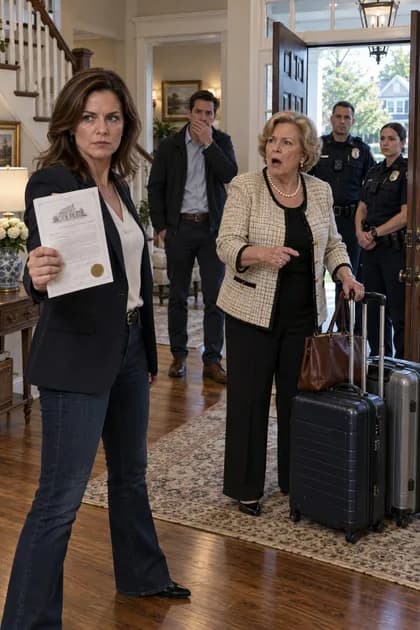
The bank statement shook in my hand, but my husband’s voice was perfectly calm.
Chapter 1
THE TRANSFER THAT EXPOSED WHO REALLY CONTROLLED OUR RETIREMENT MONEY
5,016 words
“Your trip was a choice. Rachel needed a car.”
That sentence changed the way I looked at forty-two years of marriage.
I stood at the end of our dining table, staring at one number:
$8,900.
Transferred from the joint money-market account David and I had spent decades building for retirement.
Sent to our daughter Rachel.
Without one word to me.
My name is Marianne Cole. I was sixty-seven, David was sixty-nine, and we lived in a brick ranch outside Richmond, Virginia. He had retired after a career as an electrical engineer. I had retired from the Henrico County school system, where I worked as a librarian.
We were not wealthy. We were comfortable because we had been careful.
David especially.
He tracked our Social Security deposits, investments, property taxes, Medicare premiums, reserve account, withdrawal rate—sometimes even the price of eggs.
His caution had served us well. The house was paid
off. We had no car loans. Our reserve savings were for big retirement expenses: a roof, travel, car replacement, home repairs, or helping family if we both agreed.
Two years earlier, after an HVAC replacement and a surprise dental bill hit in the same month, we made a rule:
Anything over $1,500 from retirement savings had to be discussed first.
I agreed completely.
Then my friend Nancy called.
Nancy, Irene, Joan, and I had been friends since our twenties. In thirty years, we had taken exactly one trip together without husbands, children, parents, weddings, funerals, or some other obligation.
Charleston. 1994. Four days.
Ever since, we kept saying, “We should do that again.”
Then came babies, jobs, sick parents, teenagers, college tuition, grandchildren, Joan’s husband’s heart surgery, and my mother’s dementia.
There was always a reason to wait.
Last March, Nancy finally said, “I am seventy next year, and if
we say ‘someday’ one more time, someday is going to file a restraining order.”
Her plan was Santa Fe.
Five nights in late September. A small hotel near the Plaza. Two women per room. Flights, one rental car, a cooking class, a day trip, and a few dinners.
My share: about $2,360.
That evening, I told David.
“Twenty-three hundred?” he asked. “For five nights?”
“About twenty-three sixty.”
He took off his reading glasses. “Marianne, that’s a lot for a girls’ trip.”
Girls’ trip.
Four women with seven grandchildren between us, still apparently “girls” when the expense was mine.
He mentioned the roof we might need in two or three years, rising property taxes, and retirement income.
Finally I said, “I feel like you’re explaining our finances to the person who helped build them.”
He softened.
“I’m not trying to do that.”
“Then what are you saying?”
“That we agreed big
withdrawals need both of us.”
He was right.
So I cut the trip cost. I found a flight $170 cheaper, skipped the single-room option Nancy had offered, and reduced one nice dinner.
New estimate: $2,115.
David still hesitated.
“Can we wait until next month?”
“Why?”
“I just want to see where the first-quarter numbers land.”
I was disappointed, but it sounded reasonable.
That was what made everything later hurt so much.
Around the same time, Rachel called about her twelve-year-old Honda CR-V. The transmission repair would cost almost $4,200.
Rachel was thirty-eight, married to Marcus, with two children. She worked as a speech-language pathologist in an elementary school. Marcus worked in logistics. They were doing fine, but one large expense could still make a month stressful.
David said repairing such an old car made no sense.
I agreed.
Rachel began looking at replacements and sent me a link to a dark-blue Toyota RAV4.
I replied: Pretty.
She wrote back: Pretty expensive.
A few weeks later at dinner, she said she would probably buy it.
“I can make the payment work,” she said.
Marcus nodded. “We just hate putting so little down.”
David asked, “How little?”
Rachel groaned. “Dad. I know that face.”
“What face?”
“The face where you start doing math with somebody else’s life.”
We laughed.
Rachel never asked us for money.
David never offered any in front of me.
Then, a month after my Santa Fe conversation, I was reviewing financial statements in our home office when I noticed our reserve balance was lower than expected.
I checked the transactions.
ACH TRANSFER — $8,900.
Rachel.
For a moment, I assumed I had forgotten a conversation.
Forty-two years of marriage trains you to question your memory before you question your spouse.
I walked into the den, where David was watching baseball.
“Did we send Rachel money for the car?”
A tiny pause.
“Yes.”
“How much?”
“Eighty-nine hundred.”
“When?”
“A few weeks ago.”
“Why didn’t you tell me?”
“She needed help.”
“That wasn’t my question.”
He muted the television.
“Her car was done.”
“And you gave her almost nine thousand dollars?”
“I helped with the down payment.”
“From our retirement reserve?”
“Yes.”
“And you didn’t discuss it with me.”
His face tightened. “Marianne, her situation was different.”
“Different how?”
“She needed reliable transportation. She has two kids. She drives for work sometimes. This was urgent.”
Then he said it.
“Your trip is a choice.”
There it was.
The rule still existed.
He had simply decided my request belonged underneath it, while his decision belonged above it.
“You gave Rachel almost four times what I asked to spend.”
“That isn’t the point.”
“What is the point?”
“One was necessary.”
“And you decide necessary?”
“Obviously somebody has to use judgment.”
“We had a rule so neither one of us got to be that somebody alone.”
He grew frustrated. “I’m not going to apologize for helping our daughter.”
“I didn’t ask you to.”
“Then what are we doing?”
“I’m asking why the rule changed.”
“It didn’t.”
I held up the statement. “This says it did.”
“You are comparing a vacation to transportation.”
“No,” I said calmly. “I’m comparing my need for your agreement to your need for mine.”
For the first time, he stopped talking.
I went back to the office.
Not because the argument was over.
Because I needed to know exactly when he moved the money.
The transfer date was April 2.
I opened my calendar.
Then Nancy’s email with the Santa Fe estimate.
Then the note I had written after my conversation with David.
April 6.
My stomach dropped.
April 6 was the night he had sat across from me and said:
“We agreed big withdrawals need both of us.”
Four days earlier, he had already transferred $8,900 to Rachel.
I carried the statement back into the den.
David looked at my face.
He knew I had found something.
I placed the paper on the coffee table and pointed to the date.
“You had already sent Rachel the money when you told me we needed joint agreement for Santa Fe.”
David looked down.
And this time, he had no explanation ready.
David stared at the date for a long moment.
Finally, he rubbed a hand across his face.
“I was going to tell you.”
“When?” I asked. “After I canceled Santa Fe?”
His eyes lifted to mine.
That silence answered more than words ever could.
Then my phone rang.
Rachel.
I almost ignored it, but something made me answer.
“Mom?” Her voice sounded nervous. “Dad told me you found out about the money.”
I looked straight at David.
“You knew I didn’t know?”
Rachel went quiet.
Then she whispered, “Dad told me you both had agreed.”
My chest tightened.
David stood quickly. “Rachel, this is between your mother and me.”
“No,” I said. “Not anymore.”
Rachel began apologizing, insisting she never would have accepted the $8,900 if she had known I hadn’t agreed.
And suddenly, the worst part wasn’t the money.
David hadn’t simply broken our rule.
He had made Rachel believe I had approved it.
Then he had looked me in the eye four days later and used that same rule to make me feel irresponsible for wanting one trip with my oldest friends.
I ended the call and turned toward him.
“Why, David?”
He looked exhausted.
But this time, he answered.
“Because I knew you might say no.”
I felt something inside me go completely still.
“So you never wanted a rule,” I said. “You wanted veto power.”
His face changed.
And what he said next made me realize the $8,900 was only the beginning.
“I’ve done it before.”
I stared at him.
“What?”
David leaned back against the sofa as though the cushions could somehow absorb the sentence he had just spoken.
“Not amounts like this.”
My mouth went dry.
“What amounts?”
“Smaller things.”
“How many?”
He exhaled sharply. “Marianne—”
“How many?”
“I don’t know exactly.”
That was when I knew he was lying again.
David knew exactly.
This was a man who could tell me our average electric bill for the previous twelve months without opening a statement.
“You know,” I said.
He looked away.
“Probably eight or nine times.”
“To Rachel?”
“Mostly.”
“Mostly?”
He rubbed his forehead. “School things for the kids. That tree they had taken down. Their water heater. A couple of things when Marcus’s hours got cut.”
“And every time you told Rachel I knew?”
He said nothing.
That was my answer.
“How much?”
“They were small.”
“That is not a number.”
“None of them was over fifteen hundred.”
The room went quiet.
Not one over $1,500.
I heard the sentence differently than he intended.
He had not forgotten our rule.
He had studied it.
“You kept them under the limit.”
“I didn’t do it like that.”
“You just said none of them was over fifteen hundred.”
“Because they weren’t major withdrawals.”
“David.”
“I was helping our daughter.”
“David.”
He finally looked at me.
“Did you deliberately keep the transfers below fifteen hundred so you wouldn’t have to talk to me?”
His jaw tightened.
“I knew you’d want a discussion every time.”
I almost laughed.
Not because anything was funny.
Because after forty-two years, my husband had just described talking to his wife about joint retirement money as an administrative inconvenience.
I walked toward the office.
He followed me.
“Where are you going?”
“To count.”
“Marianne, don’t turn this into something it isn’t.”
I stopped in the doorway.
“I don’t know what it is yet.”
Then I looked at him.
“That is why I’m counting.”
I spent the next two hours going through twenty-four months of statements.
David hovered for the first fifteen minutes, offering explanations I hadn’t asked for.
Rachel’s tree removal.
The grandchildren’s summer program.
A dental bill.
A plumbing repair.
A property-tax shortage.
Each reason sounded reasonable by itself.
That was the brilliance of it.
Every individual transaction could be defended.
The pattern could not.
Nine transfers.
The smallest was $680.
The largest was $1,450.
Together they totaled $9,860.
Add the car money and David had sent Rachel $18,760 from our retirement reserve without discussing a dollar of it with me.
Nearly nine times the cost of Santa Fe.
I wrote the total on a yellow legal pad.
$18,760.
David sat across from me.
“She’s our daughter.”
“I know who she is.”
“You would have helped her too.”
“Probably.”
He blinked.
That answer surprised him.
“Then why are you acting like this?”
“Because you keep arguing about what I would have decided instead of admitting that you made sure I never got to decide.”
He opened his mouth.
I raised one finger.
“No. I want you to hear this without answering.”
He actually stopped.
“I might have agreed to every single one of those transfers. I might have said yes to the tree, the water heater, the kids’ program and even the car.”
I tapped the legal pad.
“That is not the point.”
His eyes dropped to the total.
“The point is that you converted partnership into permission. You decided your judgment represented both of us.”
“That’s not fair.”
“Then explain what is fair.”
He leaned forward.
“I spent my entire career planning ahead. I know what things cost. I know what we can afford.”
“So do I.”
“You don’t pay attention to it the way I do.”
There it was.
Not an accident.
Not a misunderstanding.
A hierarchy.
“I spent thirty-four years working,” I said. “I paid the mortgage with you. I helped put Rachel through college. I cared for my mother while working full time. I sat with you through every retirement meeting. My pension goes into this household every month.”
“I never said it didn’t.”
“You just said your attention to the numbers gives you more authority over them.”
“That isn’t what I meant.”
“It is exactly what you meant.”
David stood.
His face had gone red.
“Someone has to be responsible.”
The words hit harder than I expected.
I looked at him for several seconds.
Then I asked, “Responsible for what?”
“For making sure we don’t run out of money.”
“And what does that make me?”
He hesitated.
I watched him realize there was no safe answer.
Finally he said, quieter, “That’s not what I meant.”
I closed the folder.
“I think it is.”
That night, David slept in our bedroom.
I slept in the guest room.
Not because he ordered me there.
Because I wanted a closed door between us.
At six the next morning, I made coffee, carried it into the office, and did something David had always done better than I did.
I made a plan.
First, I downloaded every statement from every joint account I could access.
Then I made a list of balances, recurring bills, pension deposits, Social Security deposits, insurance premiums, and automatic transfers.
Not because I thought David was stealing from me.
Because I had spent years assuming access and involvement were the same thing.
They weren’t.
By nine-thirty, I had opened an individual checking account at our bank.
I did not move a dollar from the joint reserve.
I did not empty anything.
I did not hide anything.
I changed the direct deposit instructions for my pension so that beginning the following month, it would land in my individual account.
Then I set up an automatic transfer from that account to the joint checking account for my share of our household expenses.
At ten-fifteen, I emailed David exactly what I had done.
He walked into the office seven minutes later.
“You opened another account?”
“Yes.”
“Without discussing it with me?”
I turned slowly in the desk chair.
“I informed you immediately.”
“That isn’t the same as discussing it.”
“No. It isn’t.”
His expression hardened.
“So now we just make financial decisions separately?”
“No. I made a decision about where my future pension deposit lands. I have not touched our joint savings. I have not withdrawn retirement money. I have not given away our money. And I have not lied to you about any of it.”
He flinched.
I continued.
“I am still contributing to the mortgage-free house we both live in, the utilities, insurance, groceries, taxes, and everything else we share.”
“We have always combined everything.”
“Yes.”
“And suddenly that isn’t good enough?”
“Suddenly I discovered that combined money did not mean combined authority.”
He stared at me.
Then his eyes moved to the Santa Fe itinerary on my desk.
“You’re still thinking about that trip?”
“I’m going.”
His face changed instantly.
“Marianne.”
“I called Nancy this morning.”
“You said we would discuss it.”
“We did.”
“I said it was too much.”
“No. You said we should wait for the first-quarter numbers.”
“I’m telling you now that I don’t think it’s a good idea.”
I folded my hands.
“I heard you.”
He stared at me as if those three words were more threatening than shouting.
“So you’re just doing whatever you want.”
“No.”
I shook my head.
“I’m doing something I wanted to do before I was angry.”
“You’re spending over two thousand dollars to make a point.”
“No, David. That’s the part you still don’t understand.”
I stood.
“The trip was never the point.”
I tapped the bank statement.
“This was.”
He left the room.
For the rest of that day, we barely spoke.
The next morning Rachel called again.
“I talked to Marcus,” she said.
“You don’t have to solve this.”
“I know. But we’re giving the money back.”
“Rachel—”
“We should never have taken it.”
“You took it because your father told you I agreed.”
“That’s exactly why I can’t keep pretending it’s fine.”
I closed my eyes.
“Can you afford to return almost nine thousand dollars?”
“Not all at once.”
“Then don’t.”
She was silent.
I could hear children in the background.
Finally she said, “Marcus and I can repay it monthly. We already budgeted for a car payment. We’ll treat Dad’s money like a zero-interest loan and put it back into the reserve.”
“I don’t want you punished for something you didn’t know.”
“I’m not doing it as punishment.”
Her voice became firmer.
“I’m doing it because Dad made me part of a lie.”
That sentence stayed with me.
Three nights later, Rachel and Marcus came over.
David knew they were coming, but I had not told him why.
Rachel carried an envelope.
She placed it on the dining table between us.
Inside was a check for $500.
The first repayment.
David’s eyes immediately moved to her.
“You don’t need to do this.”
“I do.”
“No, Rachel. I gave you that money.”
“You gave me Mom’s money too.”
His face tightened.
“Your mother and I are married. It’s our money.”
Rachel looked at me.
Then back at him.
“Exactly.”
Marcus remained quiet, but his hand rested on the back of Rachel’s chair.
David noticed.
“So everybody has decided I’m the villain now.”
“No,” I said.
He looked at me.
“You’re the one saying that.”
Rachel leaned forward.
“Dad, I love you.”
His expression softened slightly.
“But you told me Mom agreed.”
“I was trying to keep you from feeling guilty.”
“No.”
Rachel shook her head.
“You were trying to keep me from asking her.”
David went still.
She continued.
“You knew if I called Mom to thank her, you might get caught.”
He looked wounded.
For a moment, I almost felt sorry for him.
Then I remembered April 6.
The reading glasses.
The patient voice.
We agreed big withdrawals need both of us.
David pushed his chair back.
“You have no idea how much pressure I feel trying to make sure everyone is okay.”
Rachel stared at him.
“Who asked you to make sure everyone is okay?”
“I’m your father.”
“I’m thirty-eight.”
“You have children.”
“And a husband. And a job.”
She paused.
“I needed help with a car. I did not need you to lie to Mom for me.”
David looked toward Marcus, perhaps expecting another father or husband to understand him.
Marcus only said, “We would have financed more.”
Simple.
No accusation.
Which somehow made David look smaller.
Rachel slid the check toward me.
I did not pick it up.
“Put it into the reserve electronically,” I said. “That way there is a record.”
David let out a bitter laugh.
“Of course. Now we need records for everything.”
I turned to him.
“Yes.”
That silenced the room.
After Rachel and Marcus left, David walked onto the back patio.
I found him there twenty minutes later.
He sat in the old metal chair beneath the porch light, looking toward the dark yard.
I stayed by the door.
Finally he said, “When I retired, I thought I would feel relieved.”
I waited.
“I didn’t.”
His voice had changed.
The defensiveness was gone.
“I spent forty-six years knowing what I was supposed to do every morning. Solve the problem. Check the numbers. Make sure the system worked. Then one day they gave me a cake, shook my hand, and I came home.”
I had known retirement was hard for him.
I had not known this was where he was going.
He rubbed his palms together.
“Everything started feeling like something that could go wrong. The market. Medicare. The roof. Inflation. One of us getting sick. Rachel needing help.”
“And Santa Fe?”
He gave a tired laugh.
“You sounded excited.”
I frowned.
“That bothered you?”
“Yes.”
At least he answered.
“Why?”
He looked out at the yard.
“Because you had this whole thing planned that had nothing to do with me.”
I felt my anger change shape.
Not disappear.
Just sharpen.
“You didn’t want me to go because you were afraid I’d enjoy five days without you?”
“That sounds pathetic when you say it.”
“It sounds controlling when you do it.”
He looked at me.
I continued.
“You were afraid of retirement. You were afraid of money. You were afraid of not being needed.”
My voice stayed quiet.
“So instead of telling me any of that, you turned the bank accounts into the place where you could still be in charge.”
David looked down.
I waited for him to deny it.
He didn’t.
After nearly a minute, he said, “I didn’t realize I was doing that.”
“I believe you.”
He looked relieved.
Then I finished.
“That doesn’t make it harmless.”
The relief vanished.
“I don’t know what you want from me.”
“I do.”
I had spent three days figuring that out.
“I want complete financial transparency. No more private help to Rachel from joint money. No transfers from retirement savings without both of us agreeing, regardless of amount if it is a gift. I want equal personal spending accounts so neither one of us has to justify every dinner, hobby, book, or trip to the other person.”
His mouth tightened.
“And I want us to meet with someone.”
“A financial adviser?”
“One who works with couples in retirement.”
He nodded slowly.
“And a marriage counselor.”
His head came up.
“Marianne.”
“That one is not optional if you want me to pretend this marriage is functioning normally.”
“I’m not going to sit in an office and have some stranger tell me I’m controlling.”
“Then don’t.”
He blinked.
I opened the back door.
“But if you refuse, I am going to start making decisions about what my life looks like separately from yours.”
He stared at me.
“Are you threatening divorce?”
“No.”
I looked directly at him.
“I’m telling you I will not spend the rest of my life asking permission to participate in my own marriage.”
For once, David did not have a calculation ready.
He slept in the guest room that night.
The following morning, there was a business card beside my coffee cup.
Dr. Ellen Pierce.
Licensed marriage and family therapist.
An appointment time was written on the back.
Thursday, 2:00 p.m.
David was in the kitchen making toast.
I held up the card.
He did not look at me.
“I called before you woke up.”
It was not an apology.
But it was an action.
For the moment, I accepted that.
Our first counseling session was ugly.
David spent the first fifteen minutes explaining retirement mathematics.
Dr. Pierce finally interrupted him.
“Mr. Cole, I understand compound interest.”
I almost smiled.
He did not.
Then she asked him a question.
“If the decision to give Rachel money was unquestionably correct, why did you need to hide it?”
David stopped talking.
The answer took most of the next three sessions.
Fear.
Pride.
Habit.
Control.
And something harder for him to admit: he had spent so many years viewing himself as the person responsible for protecting the family that he had slowly stopped noticing the difference between responsibility and authority.
None of that excused what he did.
It did make it understandable.
There is a difference.
Understanding explains the road.
It does not erase where the road led.
The financial meeting was easier.
We created three categories.
Joint obligations.
Joint reserves.
Individual discretionary money.
Our regular household expenses remained joint.
Our emergency and retirement reserves remained joint and fully visible to both of us.
Any gift to family from joint savings required both of us to agree.
Our individual accounts were funded equally each month from retirement income after shared obligations were covered.
What I spent from mine was my business.
What David spent from his was his.
For the first time in decades, I did not need to justify the price of lunch with Nancy.
And David did not need to explain every piece of fishing equipment he ordered.
It was almost embarrassingly simple.
Rachel and Marcus continued repaying the $8,900.
I told them repeatedly they did not have to.
Rachel replied the same way every time.
“I know.”
By September, they had returned $2,000.
Then Santa Fe arrived.
The night before my flight, my suitcase was open on the bed.
David stood in the doorway.
Months earlier, that sight would have started an argument.
Instead he asked, “Do you have the charger for your phone?”
“Yes.”
“Medication?”
“Yes.”
“Printed copy of the hotel reservation?”
I looked at him.
“David.”
He gave me a small smile.
“Right. Librarian.”
I zipped the suitcase.
He remained in the doorway.
“I hope you have a good time.”
There were twenty different things I could have said.
I chose the true one.
“Thank you.”
He nodded.
Then he said, “I’m sorry I tried to make you feel guilty for wanting to go.”
That mattered more than the words he had used months earlier.
Because this time he named what he had actually done.
Not helped Rachel.
Not protected our retirement.
Made me feel guilty.
“I’m still angry about some of it,” I said.
“I know.”
“And trust is not fixed because you scheduled three appointments and learned to say the right thing.”
“I know that too.”
I studied him.
The old David would have added an explanation.
This one didn’t.
The next morning, he drove me to the airport.
Nancy was waiting at the curb.
She opened the back door before the car had fully stopped.
“You came!”
“I said I was coming.”
“I know, but after forty years of knowing you, I also know you can talk yourself out of having fun with astonishing efficiency.”
David laughed.
I looked at him.
“So can other people.”
His smile faded just slightly.
He understood.
Then he got my suitcase from the trunk.
He hugged me.
Not possessively.
Not nervously.
Just goodbye.
Santa Fe was everything I had hoped it would be.
Nancy bought a ridiculous turquoise hat she wore exactly once.
Irene got lost walking back from the restroom inside a restaurant that had only four rooms.
Joan cried during sunset at the overlook and denied it while wiping both cheeks.
We took the cooking class.
We ate the nice dinner I had originally cut from the budget.
I ordered dessert.
Not because I was proving something.
Because I wanted dessert.
On our fourth morning, I woke before the others and walked outside with coffee.
The sky above the adobe rooftops was turning pale pink.
For years, I had thought freedom would feel dramatic.
A door slammed.
A suitcase packed.
A declaration.
Instead it felt like standing alone in cool morning air, holding a paper cup, and realizing nobody was waiting to tell me whether the moment was worth what it cost.
I thought about David.
I still loved him.
That surprised some people when I told them later.
It shouldn’t have.
Love and anger can live in the same house.
So can betrayal and history.
Forty-two years do not vanish because of a bank statement.
But forty-two years do not excuse one either.
When I returned home, David had not transformed into another man.
He was still obsessive about utility bills.
He still checked the thermostat after I touched it.
He still believed every road trip required calculating gas mileage.
But something important had changed.
He asked.
That November, Rachel called because their furnace needed a repair.
David listened.
Then he came into the kitchen with the estimate.
“Rachel asked whether we could help with fifteen hundred.”
I looked at the paper.
“What do you think?”
“I think we can afford it.”
“So do I.”
He waited.
I smiled slightly.
“Yes.”
He nodded.
Then he called Rachel from the kitchen where I could hear him.
“Your mother and I agreed.”
Four words.
Nothing dramatic.
No courtroom.
No screaming.
No ruined family.
Just four words that should never have required forty-two years to become true.
By the following spring, Rachel and Marcus had repaid more than half the car money.
David and I were still in counseling once a month.
There were days I trusted him completely.
There were days I remembered April 6 and felt the old anger return.
When that happened, I no longer told myself I was being unreasonable.
I said it.
And he listened.
One afternoon, nearly a year after I found the transfer, I cleaned out the drawer in our home office.
At the bottom was the original bank statement.
ACH TRANSFER — $8,900.
For months I had kept it because I thought I might need proof.
Proof that the money moved.
Proof that the date was real.
Proof that I had not misunderstood.
I looked at it for a long time.
Then I fed it through the shredder.
Not because what happened no longer mattered.
Because I no longer needed a piece of paper to validate what I knew.
David had believed being careful with money gave him the right to control it.
I had believed keeping peace was the same thing as having a partnership.
We had both been wrong.
The difference was that only one of those mistakes had required me to become smaller.
I stopped.
And once I stopped, something unexpected happened.
My marriage did not end.
The version of it that required my permission to matter did.
I still went to Santa Fe.
Rachel still drove the blue RAV4.
David still watched baseball in the den.
The roof eventually did need replacing.
We paid for it together.
And every time money left that reserve account afterward, there were two people at the table.
Not a manager and an assistant.
Not a husband and the woman he informed afterward.
Two partners.
Exactly what I had thought we were all along.
THE END.
Chapter complete
You have reached the end of this chapter.
Continue reading
Find your next story
A few more worlds to get lost in after this chapter.