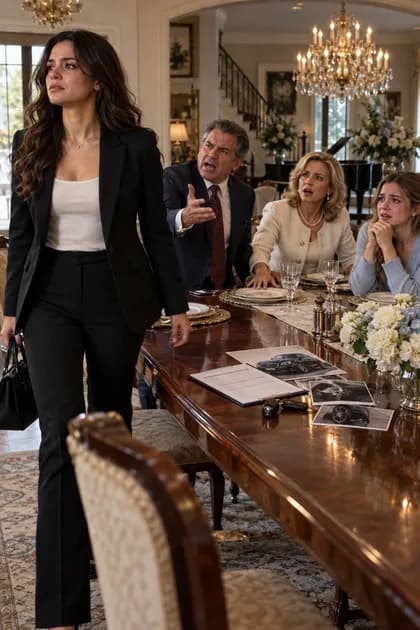
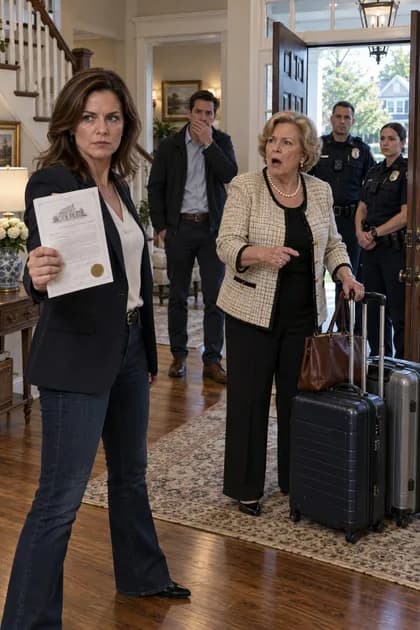
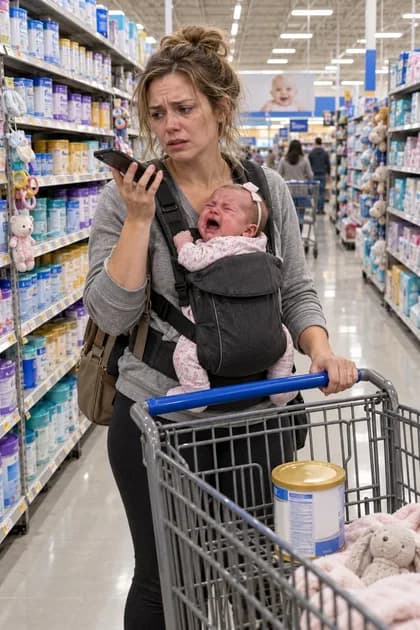
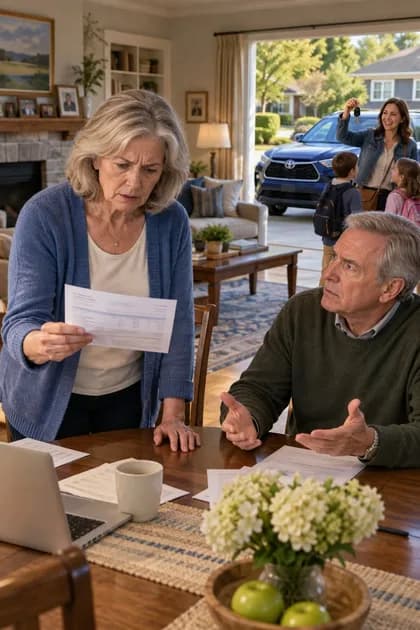
The hearing room was smaller than I expected.
Chapter 4
PART 4 - THE DAY I STOPPED CARRYING THE CONSEQUENCES FOR THEIR CHOICES
1,659 words
No dramatic courtroom.
No jury.
Just a judge, a clerk, child services, my parents and their attorney, Mrs. Johnson, Mr. Hughes, and me.
But when I walked in, it felt like every moment from the past month had followed me there.
The empty refrigerator.
The rejected credit card.
The dry cereal in my hand.
The word EVIDENCE across the first page of my notebook.
Mom sat perfectly straight beside her attorney.
Dad sat beside her.
But they did not look at each other.
The judge began with the basics.
Child services summarized the investigation.
An eleven-year-old left alone while both parents traveled internationally.
No adult caregiver.
Insufficient food.
An unusable emergency card.
Minimal contact.
A known cancellation of the original childcare arrangement twelve days before departure.
Attempts afterward to influence my account of what happened.
Then the recording from the supervised visit was played.
Mom’s voice filled the room.
“You
have made your point.”
“If you tell them you feel safe, this can end.”
“We can go back to normal.”
My mother stared at the table.
Her attorney did not object.
When the recording stopped, the judge asked her a simple question.
“What did you mean by normal?”
Mom looked up.
For once, she did not have a polished answer ready.
“I meant our family being together.”
The judge waited.
Mom added, “I love my daughter.”
Nobody disputed that.
That was the strange part.
I believed she loved me.
I also believed she cared deeply about appearances, control, being right, and never being seen as the kind of mother who could make a terrible decision.
Both things could be true at once.
The judge turned to Dad.
“Mr. Carter, do you agree with your wife’s account that the decision to leave Sydney was primarily yours?”
Mom’s head moved sharply.
Dad
stared straight ahead.
“No.”
Her face changed.
Their attorney whispered something, but Dad kept going.
“We both made the decision.”
The judge asked whether he had evidence.
Dad handed over printed messages.
I recognized the dates.
Twelve days before the trip.
Aunt Laura: I’m so sorry. I cannot stay with Sydney. The surgery was moved up. You need another plan.
Dad: We should cancel.
Mom: Absolutely not. Everything is paid.
Dad: She cannot stay alone a month.
Mom: She is eleven, not five. She can handle herself.
Dad: This is a bad idea.
Mom: Then activate the card, stock the kitchen, and stop making her helpless.
There were more.
Dad had written: I still think we should cancel.
Mom had replied: If we lose eight thousand dollars because Sydney cannot be alone, she will learn that panicking gets her what she wants.
I read that sentence twice.
Eight thousand dollars.
That was the price of the lesson.
My mother had spent more on a vacation than she was willing to lose to keep me safe.
But my father’s messages did not make him innocent.
The judge made that clear.
“You raised concerns and then boarded the plane anyway.”
Dad nodded.
“Yes.”
“Why?”
His voice broke.
“Because I wanted the trip too.”
For the first time since all of this started, I heard an adult answer without dressing it up.
No independence.
No trust.
No misunderstanding.
He wanted the trip.
So he went.
The judge thanked him for answering directly.
Then it was my turn.
I had written a statement.
Three pages.
I carried it to the small table and unfolded it.
My hands shook so badly that the paper made noise.
I began.
“When my parents left, I thought being scared meant I was immature. I thought being hungry meant I had failed to plan. I thought asking for help would prove I was a baby.”
I looked at Mom.
She was crying.
I kept reading.
“But now I know being independent does not mean adults are allowed to disappear. It means I can tell the truth when something is wrong.”
My voice cracked.
I stopped, breathed, and continued.
“I do not want my parents punished because I hate them. I do not hate them. I want them to understand that I was eleven. They were supposed to make the plan. Not me.”
The judge asked what I wanted.
That was the hardest question.
Part of me wanted to go home.
I missed my room.
My books.
The blue blanket at the foot of my bed.
Even the sound of Dad making coffee before work.
But I remembered what Mrs. Johnson had said.
Home and safe were not automatically the same thing.
“I want to see them,” I said. “But I do not want to live with them yet.”
Mom covered her mouth.
Dad closed his eyes.
“I want them to stop asking me to fix this for them.”
The room stayed quiet.
The judge’s order did not destroy my parents’ lives.
That is not what happened.
There were no handcuffs.
No dramatic arrest.
The consequences were quieter.
And, in some ways, harder.
I remained temporarily with Mrs. Johnson under a kinship-style placement approved by the court.
My parents received supervised visitation that could increase only if they followed the safety plan.
They had to complete parenting education.
They had to participate in family therapy.
They were prohibited from pressuring me to change my statements or discussing the legal case with me outside approved sessions.
The court also required a real emergency-care plan before reunification could even be considered.
Names.
Phone numbers.
Backup caregivers.
School notification.
Accessible money.
Food.
The basic things they should have arranged before they ever packed a suitcase.
After the hearing, Mom tried to approach me in the hallway.
The caseworker stepped nearby but did not interrupt.
Mom looked older than she had a month before.
“Sydney,” she said, “I am sorry.”
I waited.
Then she added, “I never thought anything bad would happen.”
That was not the same as taking responsibility.
I think she knew it too.
So I said nothing.
Dad came over after her.
He did not ask me to forgive him.
He did not tell me families protect each other.
He just said, “I should have stayed.”
That sentence hurt more than any excuse.
Because it was true.
Over the next four months, things changed slowly.
Dad stopped defending himself in therapy.
When I said I had been hungry, he stopped saying they thought the card worked.
He said, “You were hungry because we left you without a working way to get food.”
When I said I had been scared, he stopped saying I could have called someone.
He said, “You were scared because we made you responsible for a situation you should never have been responsible for.”
Mom took longer.
At first, every apology had a “but.”
I’m sorry, but you could have called.
I’m sorry, but we thought you were mature.
I’m sorry, but nobody expected this to become a case.
Our therapist began stopping her every time.
“No ‘but.’ Try again.”
It made Mom furious.
Then, eventually, it made her quieter.
One afternoon, almost five months after the trip, she sat across from me in therapy and said something I had never heard from her before.
“I called you independent because it made me feel less guilty about leaving.”
I looked up.
She was crying.
“I knew Laura canceled. I knew we should have changed our plans. I told myself you would be fine because I wanted to go.”
No excuse followed.
Just the truth.
That was the first day I believed we might someday have a different relationship.
Not the old one.
I did not want the old one back.
By the time I returned home, there were rules.
Not rules for me.
Rules for them.
If both parents traveled, an adult caregiver had to be physically present.
Emergency contacts were posted on the refrigerator.
Mrs. Johnson had a key.
The school had written authorization to contact backup adults.
There was a prepaid card in my name with a working PIN, but nobody called it proof of my independence.
It was just emergency money.
The first night back, I walked into the kitchen alone.
For a second, the room looked exactly like it had before.
Same table.
Same counter.
Same refrigerator.
Then I noticed something on the shelf beside the phone.
My notebook.
The one with EVIDENCE written across the front.
I had forgotten it at Mrs. Johnson’s house.
Mom must have brought it over.
A note sat on top.
I expected an apology.
Instead, it said:
Keep this.
You were right to write it down.
I stood there for a long time.
Then Mom came into the kitchen.
She did not ask whether I forgave her.
She did not ask whether we could forget everything.
She opened the refrigerator.
It was full.
Then she looked at me and said, “If you ever feel unsafe, you call someone. Even if you think I will be angry.”
I nodded.
“And if I am angry,” she added, “that is my problem to manage. Not yours.”
For the first time, independence meant something different.
It did not mean surviving alone.
It did not mean swallowing fear so adults could keep their plans.
It did not mean protecting my parents from the consequences of their own choices.
It meant knowing when something was wrong.
Knowing I was allowed to speak.
And knowing that asking for help was not failure.
Years later, I still have the notebook.
The first page is childish.
Big block letters.
Uneven handwriting.
EVIDENCE.
Underneath it are four lines written by an eleven-year-old girl who thought she might need proof that she had been left behind.
Left alone at 11.
$20.
No food plan.
No check-ins.
I used to look at that page and remember how scared I was.
Now I see something else.
That was the first time I believed my own version of what happened strongly enough to write it down.
And that decision changed everything.
THE END.
Chapter complete
You have reached the end of this chapter.
Continue reading
Find your next story
A few more worlds to get lost in after this chapter.