My mother left me alone for a month when I was eleven years old.
Chapter 1
PART 1 - THE MONTH MY PARENTS CALLED ABANDONMENT A LESSON IN INDEPENDENCE
1,445 words
She gave me twenty dollars, an unusable credit card, and one piece of advice.
“You’re independent now.”
Four weeks later, when she finally came home from Europe, she walked into our kitchen, saw the people waiting for her, and stopped dead.
Her face went white.
“No… no, this can’t be happening.”
Mom had stepped through the front door wearing a stylish trench coat, her suitcase rolling behind her, looking like someone returning from the vacation of a lifetime.
My father followed with several shopping bags dangling from one hand and his phone in the other.
For about three seconds, neither of them understood what they were looking at.
Then the silence hit.
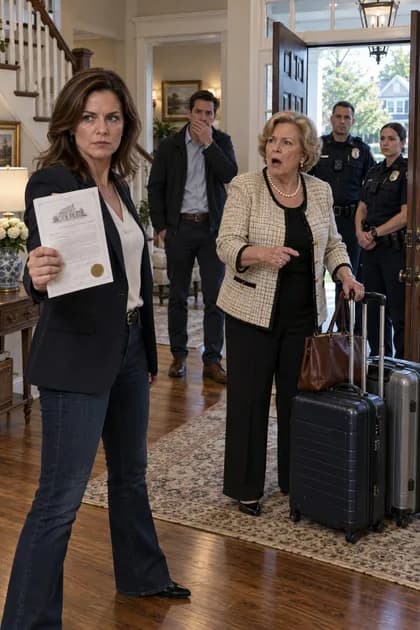
My school counselor, Mr. Hughes, stood beside the kitchen counter.
Our neighbor, Mrs. Johnson, waited near the doorway with her arms folded.
A child services caseworker sat at our kitchen table.
Her supervisor was beside her.
Documents, photographs,
and notes were spread across the table.
And then there was me.
Eleven years old.
Standing beside an open notebook and my phone, trying desperately to keep my hands from shaking.
My mother’s vacation smile disappeared instantly.
“What is this?” she demanded.
Nobody answered fast enough for her.
Her eyes snapped toward me.
“Sydney, what did you tell them?”
That look made my stomach tighten.
For one second, I felt small again.
Not because I had lied.
Not because I had done something wrong.
But because my mother had always been able to make me feel guilty just by looking at me.
A week earlier, everything had been different.
I could still see her rolling that same suitcase through the front door, excited about Europe, barely paying attention as she dug through her purse.
Then she pulled out a crumpled twenty-dollar bill and pressed it into my hand.
“See?” she
said brightly. “You’re independent now. You’re not a baby anymore. Just order food if you need to.”
There was supposed to be an emergency credit card.
That was the plan, anyway.
Except the card had never been activated properly, and I didn’t know the PIN.
I tried using it.
Every food app rejected it.
So after my parents left, I stood alone in our kitchen with twenty dollars in my hand, a half-empty refrigerator behind me, and nearly an entire month stretching out in front of me.
At first, I tried to make it feel like an adventure.
A challenge.
Something a “mature” kid could handle.
I sliced pieces of bread thinner than normal.
I carefully rationed peanut butter.
I poured cereal into my hands and ate it dry because I wanted the milk to last.
Every time I felt scared, I remembered what Mom had said.
Independent.
Mature.
Not
a baby anymore.
I convinced myself that asking someone for help would mean she had been wrong about me.
Worse, it would mean I had failed.
By day three, it wasn’t an adventure anymore.
By day five, standing up too quickly made the room spin.
By day seven, I understood something no eleven-year-old should have to learn.
Sometimes adults call you “independent” because it sounds better than admitting they left you to deal with something alone.
That was the day I found an old notebook.
I sat at the kitchen table, opened to a blank page, and wrote one word across the top in large letters.
EVIDENCE.
Underneath it, I began making a list.
Left alone at 11.
$20.
No food plan.
No check-ins.
I didn’t fully understand what I was doing.
I wasn’t trying to build a case.
I wasn’t thinking like an adult.
I just had this terrifying thought that if something happened to me, somebody might eventually ask what happened.
And I wanted there to be proof.
So I started recording videos on my phone.
The first one was short.
My face looked pale on the screen.
I kept my voice low even though there was nobody else in the house.
“Day three,” I whispered into the camera. “I am still alone.”
I filmed the kitchen.
The shelves.
The refrigerator.
The food disappearing little by little.
Part of me hoped nobody would ever see those videos.
Another part of me wanted to save every second.
Because someday, if my mother tried to say everything had been fine, I wanted the truth to already exist.
Then Mr. Hughes came.
My school counselor had apparently been trying to reach my parents.
They weren’t answering.
When I opened the door and he stepped inside, I watched his expression change almost immediately.
He noticed the dishes.
The empty counter.
The nearly bare fruit bowl.
And maybe most of all, he noticed the silence.
The kind of silence that only happens when a child has been alone long enough for it to feel normal.
He looked at me.
“Who is staying with you?”
I hesitated.
“Just me.”
His face changed.
Completely.
Not long afterward, Mrs. Johnson came over.
Then child services arrived.
The caseworker checked everything.
The refrigerator.
The pantry.
My parents’ call logs.
The credit card.
The messages from my mother.
The card was useless.
There was no PIN.
And the messages?
One selfie from Paris.
One heart emoji.
That was it.
No call asking whether I had eaten.
No call asking whether someone was with me.
No call asking whether I felt safe.
When the caseworker eventually asked me whether I wanted my parents to hear what that week had actually been like, I said yes.
Which brought us back to the kitchen.
Back to the moment my parents came home.
Dad recovered first.
Or tried to.
He gave an uncomfortable laugh.
“We obviously left money and a card. She knows how to use delivery apps.”
The supervisor didn’t argue.
She simply picked up a sheet of paper and slid it across the table.
“The card was never set up with a PIN.”
Dad’s smile vanished.
The supervisor placed another page beside it.
“These are photographs of the refrigerator and pantry one week into your trip.”
Mom slowly sat down.
But her voice remained sharp.
“Expired food does not mean she was starving. We checked in.”
The supervisor reached for another set of documents.
The call logs.
She placed them beside the photographs.
Nobody spoke.
One airport photo.
One Paris selfie.
Nothing else.
Dad finally looked at me.
His voice had changed.
“We told you to order food, Sydney. We trusted you.”
I stared at him.
For an entire week, I had swallowed hunger.
Fear.
Loneliness.
The urge to call someone and admit that I couldn’t do this by myself.
So when I answered him, I didn’t yell.
I didn’t cry.
I just said the truth.
“You trusted me to survive.”
Mom’s jaw tightened.
“This is being blown completely out of proportion,” she snapped. “You know how dramatic she can be.”
Mrs. Johnson turned toward her.
“She was dizzy from hunger when we found her.”
Mom looked directly at me.
Not with concern.
Not with relief that I was okay.
She looked at me like I had betrayed her.
And suddenly I remembered the phone call from two days earlier.
She hadn’t asked if I was safe.
She hadn’t asked if I had enough food.
She hadn’t even asked if I was scared.
She wanted to know what people were saying.
She wanted to know what this would do to her reputation.
Then, before hanging up, she had said something I could still hear word for word.
“We’re going to have a serious conversation about consequences, young lady.”
Now she was sitting at our kitchen table surrounded by photographs, call records, caseworkers, my counselor, and our neighbor.
And for the first time, the word consequences didn’t seem to belong to me.
The supervisor turned toward the phone beside my notebook.
“Sydney,” she said gently, “are you comfortable showing them what you recorded?”
Everything changed.
Mom’s eyes followed hers.
Straight to my phone.
For the first time since she walked through the door, Mom didn’t look furious.
She looked uncertain.
Maybe even afraid.
I reached for the phone.
The screen lit up.
There I was.
My own tired face from day three filled the display, frozen in the moment right before I had started speaking.
Mom stared at it.
Dad slowly lowered the papers in his hands.
Nobody in the kitchen moved.
I could hear my own breathing.
My mother looked from the phone to me.
“What exactly did you record?”
I wrapped my fingers around the phone.
Then I placed it on the table where both of them could see.
My thumb hovered over the play button.
And I pressed down.
Chapter complete
You have reached the end of this chapter.
Continue reading
Find your next story
A few more worlds to get lost in after this chapter.