The first warning sign wasn’t the poker nights.
Chapter 1
THE FORTY-THREE-DOLLAR FORMULA AND THE MONEY MARK HID
4,426 words
It wasn’t the bar tabs, the steakhouse dinners, or the weekends my husband spent with his friends while I stayed home with our newborn.
It was four words.
“Full is full.”
My husband said them while our six-week-old daughter was screaming so violently against my chest that her tiny face had turned the color of raw shrimp.
I was standing in the baby aisle at Meijer outside Indianapolis, Indiana, exhausted enough that the fluorescent lights felt like they were drilling into my skull.
Ellie was strapped to my chest.
A can of the hypoallergenic formula our pediatrician had specifically recommended sat in my cart.
And my husband, Mark, was on speakerphone telling me to put it back.
“It’s forty-three dollars for one can,” he said. “Buy the cheaper one. Full is full.”
I stared down at Ellie.
Her fists were clenched.
Her cheeks were blotchy.
She had spent weeks crying
after feeds, arching her back like something inside her hurt.
And Mark was talking about her formula like I was choosing between two brands of paper towels.
That sentence stayed with me.
Not because it was ignorant.
Because he said it with the confidence of a man who believed hunger, pain, digestion, and my postpartum reality were all abstract topics he could win by sounding practical.
My name is Claire Jensen.
I was thirty-one, married to Mark, thirty-four, and Ellie was our first baby.
Mark worked in HVAC sales.
I worked in billing for a dental practice, though I was on maternity leave at the time.
Before Ellie was born, Mark loved describing himself as “the financially responsible one.”
He handled the mortgage.
The auto-payments.
The bigger bills.
He knew exactly when everything was due, and he loved phrases like “living within our means” and “being smart with money.”
I
handled everything else.
Groceries.
Pharmacy runs.
Birthday gifts.
Dog food.
Cleaning supplies.
Pantry restocks.
And the hundred invisible purchases that kept our house functioning.
Before the baby, our arrangement mostly worked.
After Ellie was born, it became a weapon.
Ellie was not an easy newborn.
She had reflux.
A rash appeared and disappeared across her cheeks and neck.
Some evenings, feeding her felt like torture.
She would eat, arch her back, pull away, scream, calm down, try again, and scream harder.
At first, everyone told me the same thing.
“Babies cry.”
But at our four-week appointment, the pediatrician started paying closer attention.
Ellie seemed worse after certain feeds.
Then there was a diaper with tiny streaks that should not have been there.
The doctor told us to stop switching formulas.
He recommended a hypoallergenic brand and told us to use it consistently.
Mark was sitting right beside me.
He heard
everything.
He nodded.
He even took the sample can from the doctor.
But the moment we reached the parking lot, he looked at it and said, “Doctors always recommend the expensive option.”
I stopped walking.
“She’s in pain.”
Mark shrugged.
“She’s a baby.”
That was when I should have understood.
The problem was never that Mark refused to spend money.
He only refused to spend it on things that didn’t matter to him.
Suddenly, he had opinions about diapers.
“Does she really need the premium brand?”
Wipes.
“How many wipes can one baby possibly use?”
The nipple cream my lactation consultant recommended after I tried pumping through cracked, bleeding skin.
“Isn’t that basically just expensive lotion?”
Even my pelvic-floor physical therapy became a debate.
“Women used to just recover at home, Claire.”
There was always a speech.
Too expensive.
Not urgent.
Can wait.
Probably marketing.
But every other Thursday, Mark still went to poker night.
He would come home smelling like beer, grilled meat, and the freedom of someone whose life had barely changed.
Some weekends, he met friends in Broad Ripple or downtown Carmel and spent money like it offended him by sitting in our checking account.
Eighty-seven dollars here.
One hundred twenty-three there.
Ninety-six dollars for his share of a steakhouse dinner.
A brewery tab.
Golf.
Money toward a rental house for a football weekend in Bloomington.
There was never one enormous purchase I could point to and say, “This is insane.”
Instead, there were dozens of medium-sized ones.
And somehow those were always acceptable.
Whenever I questioned them, Mark leaned back and said the same thing.
“I work hard. I’m allowed to have a life.”
Apparently, I wasn’t.
At seven weeks postpartum, my life was milk stains, burp cloths, spit-up, and sleep that came in broken fragments.
I ate meals standing over the kitchen counter.
My showers lasted less than four minutes.
I timed bathroom breaks according to how long Ellie would tolerate the swing.
One afternoon, I was clipping coupons at the kitchen counter when Mark walked in and watched me for a moment.
“You’ve gotten intense about spending,” he said.
I laughed.
It wasn’t a kind laugh.
“I’m trying to make sure we have enough.”
He frowned.
“We do have enough.”
Technically, he was right.
We had enough.
What he really meant was:
We have enough for what I choose.
Then his mother, Diane, started getting involved.
She lived twenty minutes away and loved reminding me that she had raised three children “without all this modern nonsense.”
One afternoon, she watched me prepare Ellie’s bottle.
She looked at the can.
Then at me.
“Forty dollars for powder? Honey, we used store-brand and my boys survived.”
Survived.
I hated that word.
I looked at her.
“Did your babies scream after every bottle?”
She gave me the patient smile people use when they’ve already decided you’re irrational.
“New mothers worry too much.”
Later, Mark told me, “You don’t need to argue with Mom.”
“I wasn’t arguing. I was answering her.”
“You make everything into a bigger issue than it is.”
And there it was.
Something worse than the money.
Mark wasn’t just refusing necessary expenses.
He was building a version of me.
Claire the anxious new mother.
Claire the overspender.
Claire who overreacted.
Claire who bought expensive things because a doctor told her to.
And apparently, he had already started sharing that version with other people.
I realized how serious everything had become at Ellie’s two-month weight check.
She had gained weight.
Just not enough.
The pediatrician wasn’t dramatic about it.
He was calm.
That frightened me more.
He asked whether we had kept Ellie consistently on the hypoallergenic formula.
My stomach tightened.
I hesitated.
Because the truthful answer was humiliating.
Not perfectly.
Sometimes Mark bought the cheaper “sensitive” formula instead and insisted we finish it because throwing it away would be “wasting money.”
The pediatrician looked directly at both of us.
“She needs consistency,” he said. “If this is the formula she tolerates, this is not optional.”
He printed the recommendation.
Then he underlined the brand.
Underneath it, he wrote:
DO NOT SUBSTITUTE.
In the parking lot, Mark crumpled the paper once in his fist.
Then he flattened it again.
“I can’t believe he actually wrote down a brand.”
I stared at him.
“Maybe because you keep ignoring him.”
His jaw tightened.
Neither of us said another word on the drive home.
That night, Ellie screamed through another feed.
I sat on the nursery floor with her against my chest, rocking back and forth while tears slid silently down my face.
And something inside me finally became clear.
This wasn’t a disagreement about budgeting anymore.
I was arguing with my own husband about whether our daughter’s basic comfort counted as a necessary expense in her own home.
The next afternoon, I drove to the pharmacy alone.
The pediatrician’s note was inside my bag.
Ellie was with me.
I picked up the exact hypoallergenic formula the doctor had told us not to substitute.
Forty-three dollars.
I carried it to the register.
For once, I didn’t call Mark first.
I didn’t ask permission.
I didn’t compare prices.
I didn’t reach for a coupon.
I just put the can on the counter and pulled out our card.
The cashier scanned it.
I inserted the card.
For one second, everything seemed normal.
Then the machine beeped.
The cashier looked at the screen.
My stomach dropped.
I tried again.
Another beep.
“Do you have another card?” she asked gently.
I felt heat rush into my face.
There should have been money in that account.
More than enough.
I knew what bills had been paid.
I knew approximately what groceries had cost.
I knew we had not spent enough on the baby to explain this.
With one hand holding Ellie against my chest, I opened our banking app.
The balance loaded.
I stared at it.
Then I started scrolling.
One transaction.
Then another.
Then another.
Bars.
Restaurants.
A transfer I didn’t recognize.
Another charge from the weekend Mark had told me he was “just having a couple beers with the guys.”
My fingers went cold.
Because suddenly, standing there with the formula our daughter medically needed waiting beside the register, I realized something that made every argument we had ever had about money look completely different.
We had never been unable to afford Ellie’s formula.
Mark had simply decided our money belonged somewhere else.
And then I saw the transaction that made me stop breathing.
The transaction was for $1,850.
At first, I thought I was reading it wrong.
I blinked and looked again.
A transfer to an account I had never seen before.
My hands started shaking.
Behind me, Ellie whimpered against my chest while the cashier pretended not to notice my face.
I paid for the formula with my personal credit card and walked straight to my car.
Then I called Mark.
He answered on the fourth ring.
“What?”
My voice came out quieter than I expected.
“Where did eighteen hundred and fifty dollars go?”
Silence.
Not confusion.
Not surprise.
Silence.
That was when I knew he recognized the number.
“Claire, I’m at work.”
“I asked you a question.”
He exhaled sharply. “It’s not what you think.”
My stomach twisted.
Those six words terrified me more than any explanation could have.
“What do I think, Mark?”
Another pause.
Then he said, “We’ll talk when I get home.”
“No. We’ll talk now.”
He lowered his voice.
“I moved some money. That’s all.”
“For what?”
He didn’t answer.
I opened the transaction details.
And underneath the transfer was a name.
A woman’s name.
Someone I knew.
Someone who had been inside my house, held my daughter, and smiled in my face.
I stared at the screen.
Then Mark whispered, “Claire… don’t do anything until I get home.”
That was the moment I realized he wasn’t worried about our marriage.
He was worried about what I had just discovered.
The name was Diane Jensen.
Mark’s mother.
For a few seconds, I just sat there in the driver’s seat staring at her name while Ellie made small hungry noises against my chest.
I almost called Diane.
Then I remembered Mark’s warning.
Don’t do anything until I get home.
So I did exactly the opposite of what he expected.
I stopped reacting.
And I started documenting.
I took screenshots of the transfer.
Then I downloaded the last several months of statements.
The first $1,850 transfer wasn’t the only one.
There had been three others.
Smaller.
Easy to miss among the mortgage, utilities, groceries, and all the ordinary movement of our life.
Seven hundred dollars.
Nine hundred fifty.
Eleven hundred.
Then eighteen hundred fifty.
Four thousand six hundred dollars transferred to Diane in less than two months.
At the same time, Mark had spent freely on poker nights, restaurants, golf, breweries, and weekends with his friends.
I sat in that parking lot with the air-conditioning blowing across my face and added the numbers twice because I did not trust myself the first time.
Then I looked at the receipt beside me.
Forty-three dollars.
That was what had embarrassed me at the register.
Forty-three dollars for the formula our pediatrician had underlined and written DO NOT SUBSTITUTE beneath.
Mark had moved more than one hundred times that amount out of our account without telling me.
I drove home.
Ellie fell asleep in the car seat.
The house was quiet when I carried her inside.
I put the formula on the kitchen counter.
Then I placed the pediatrician’s note beside it.
Then I printed the bank statements.
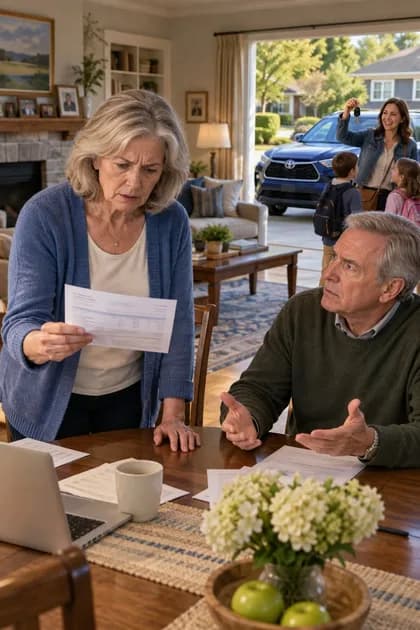
By the time Mark came through the garage door just after six, the three things were lined up in front of me like exhibits.
Formula.
Doctor’s note.
Statements.
He stopped when he saw them.
His face changed before he said a word.
Not guilt.
Calculation.
“Where’s Ellie?”
“Asleep.”
He put his keys on the counter.
“Okay. Let’s not turn this into some huge thing.”
I almost laughed.
Instead, I slid the top statement toward him.
“Why have you sent your mother forty-six hundred dollars since Ellie was born?”
His eyes dropped to the page.
Then back to me.
“I told you. I moved some money.”
“To your mother.”
“She’s holding it.”
“For what?”
“For us.”
“Then why didn’t I know it existed?”
His jaw tightened.
“Because every time I try to talk about money lately, you get emotional.”
There it was again.
The version of me he had been building.
I kept my voice flat.
“What emergency was Diane holding forty-six hundred dollars for?”
Mark rubbed a hand over his mouth.
“You’re on maternity leave. Expenses are up. You’re buying the most expensive version of everything. I wanted a cushion somewhere safe.”
I looked down at the formula can.
“Somewhere safe from whom?”
He didn’t answer.
I asked again.
“Safe from whom, Mark?”
His voice hardened.
“From being spent.”
“By me.”
“I didn’t say that.”
“You didn’t have to.”
He paced toward the refrigerator, then turned back.
“Claire, I am the one bringing in a full paycheck right now. I’m trying to keep this family stable.”
I stared at him.
For weeks, that sentence would have made me defend myself.
I would have listed groceries.
Diapers.
Doctor co-pays.
Dog food.
The electric bill.
I would have tried to prove I was not irresponsible.
But the statements were sitting between us now.
So I did not defend myself.
I pointed.
“Tell me which of those charges is mine.”
He looked at the pages.
“Don’t do this.”
“Show me.”
“Claire.”
“Show me the reckless spending.”
He said nothing.
I had highlighted my purchases.
Pharmacy.
Meijer.
Target.
The pediatric office.
A nursing bra.
Diapers.
Wipes.
Household supplies.
Then I had highlighted his.
Bar.
Steakhouse.
Golf course.
Brewery.
Poker transfer.
Another restaurant.
Another bar.
Another weekend charge.
The paper did not care which one of us sounded more reasonable.
It just sat there telling the truth.
Mark’s face reddened.
“I work hard.”
“And Ellie doesn’t?”
His eyes snapped to mine.
“What is that supposed to mean?”
“It means she has spent eight weeks working harder to eat without pain than you have spent trying to understand what she needs.”
“That’s ridiculous.”
“No. What’s ridiculous is letting your card decline over forty-three dollars while forty-six hundred dollars is sitting in your mother’s account because you decided I couldn’t be trusted.”
He opened his mouth.
The doorbell rang.
I knew who it was before he moved.
Diane.
Mark had called her.
Of course he had.
He opened the door, and she walked in carrying her purse against her side, eyes already narrowed with concern.
Not for me.
For him.
“Claire,” she said carefully. “Mark told me you found the transfers.”
I looked at Mark.
“You called your mother before you came home?”
“She’s involved.”
“That’s the first accurate thing you’ve said tonight.”
Diane set her purse on a chair.
“I think everyone needs to calm down.”
I felt something inside me go completely still.
“Did you know he was moving our money to you without telling me?”
Her lips pressed together.
“Mark was worried.”
“About what?”
She glanced at him.
That glance answered me before she did.
“He said things had been difficult since the baby.”
“Difficult how?”
“Claire, you’re exhausted. You’ve been anxious. You’ve been spending a lot. He was concerned you might make an emotional decision.”
I stared at her.
“What kind of emotional decision?”
Another glance at Mark.
Then Diane said, “Leaving. Taking Ellie. Emptying the account. Something impulsive.”
The room seemed to narrow around me.
Suddenly, every conversation from the last two months rearranged itself.
Claire the anxious new mother.
Claire the overspender.
Claire who overreacted.
Claire who made everything bigger than it was.
It had not just been a story Mark told when he wanted sympathy.
It was a justification.
He had been creating a reason to move money away from me before I even knew I needed protection from him.
I looked at my husband.
“You thought I was going to leave you?”
“I thought you were unstable.”
The words came out too quickly.
Too honestly.
Diane inhaled sharply.
Mark froze.
I did not.
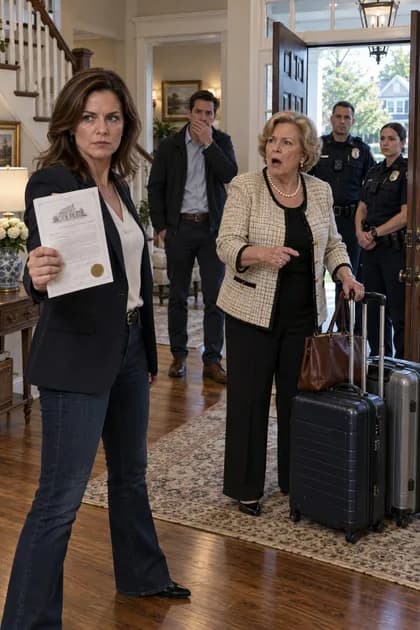
I reached into my bag and pulled out the pediatrician’s note.
I flattened it on the counter in front of both of them.
“Read the bottom.”
Neither moved.
So I read it for them.
“DO NOT SUBSTITUTE.”
I placed the pharmacy receipt on top of the bank statement.
“Forty-three dollars.”
Then I tapped the transfer to Diane.
“Eighteen hundred fifty.”
Another statement.
“Eleven hundred.”
Another.
“Nine hundred fifty.”
Another.
“Seven hundred.”
I looked at Diane.
“He told you I was unstable because I wanted to buy what our daughter’s doctor told us to feed her.”
Diane shifted.
“He told me you were buying unnecessary things.”
“Did he tell you about the golf?”
She looked at Mark.
“Did he tell you about the steakhouse dinners?”
Her expression changed.
“Did he tell you the card declined today when I tried to buy Ellie’s formula?”
That got her.
Diane turned fully toward him.
“The card declined?”
Mark threw up his hands.
“It was a timing issue.”
“No,” I said. “It was a priority issue.”
Diane’s voice sharpened.
“You told me the household account had plenty in it.”
“It does.”
“It had less than fifty dollars available when I was at the pharmacy,” I said.
Mark looked at me as if I had betrayed him by saying it aloud.
Diane’s face went pale.
For the first time since she entered the house, she stopped looking at me like the problem.
“Mark,” she said. “You said I was holding extra money.”
“You are.”
“Extra means the bills are covered.”
“They are covered.”
I pointed to the formula.
“Our daughter’s food is a bill.”
Silence.
A long one.
Then Mark did what controlling people do when the facts stop cooperating.
He changed the subject.
“You went through months of statements behind my back.”
I actually smiled.
“They’re our statements.”
“You’re trying to make me look bad.”
“I didn’t make the charges.”
“You always do this. You take one thing and make it into proof that I’m some monster.”
I looked at the man I had married.
And for the first time, I did not feel the desperate need to convince him I understood his side.
I understood it perfectly.
His side was that he should get the final vote.
On money.
On the baby.
On my recovery.
On which doctor’s instructions counted.
On whether I was rational.
On how much of our own account I was allowed to know existed.
He did not want a partner.
He wanted an audience that called his control responsibility.
I turned to Diane.
“Is all forty-six hundred still in your account?”
She hesitated.
“Yes.”
“Don’t move it tonight.”
Mark spun toward me.
“What?”
“I want the trail exactly where it is.”
His face changed.
That frightened him.
Good.
I picked up my phone.
“I already saved every statement. Tomorrow I’m speaking to someone about my options. Until then, I’m not signing anything, moving joint money, or arguing about whether this happened.”
Mark laughed once, hard and ugly.
“Your options? You’re blowing up our marriage over baby formula.”
“No.”
I looked at the can between us.
“I’m finally seeing our marriage because of baby formula.”
That night, Mark slept in the guest room.
Diane left without hugging him.
Before she walked out, she paused at the door and looked back at me.
“I really did think I was helping.”
I believed her.
That did not excuse her.
“You were helping,” I said. “Just not me.”
The next morning, I made three calls.
One was to the pediatrician.
I told the nurse exactly what had been happening with the formula substitutions and asked that the feeding recommendation remain clearly documented in Ellie’s chart.
The second was to my employer.
I changed where my next paycheck would be deposited when my leave ended.
The third was to a family-law attorney.
I did not call because I had decided, in one dramatic night, to destroy my marriage.
I called because I had spent two months being told I was irrational, and I wanted one conversation in which facts mattered more than Mark’s confidence.
The attorney did not promise me victory.
She did not tell me to empty accounts or lock Mark out of the house.
She told me to preserve records, understand what was jointly owned, and make decisions slowly.
That was exactly what I needed.
Not rescue.
Clarity.
When Mark came home that evening, he had already heard from Diane.
She had told him she was returning the money.
He was furious.
“She had no right.”
I was feeding Ellie in the rocking chair.
For the first time in days, Ellie drank without arching away.
I kept my eyes on my daughter.
“It’s our money. Why should your mother have more right to it than I do?”
Mark stood in the nursery doorway.
“You turned her against me.”
“No. The declined card did that.”
He flinched.
Then he lowered his voice.
“We can fix this.”
I looked up.
“What does fixed look like to you?”
He had no answer ready.
So I gave him one.
“Full access to every account. No money moved without both of us knowing. Ellie gets the formula her doctor prescribed. My medical care is not something you get to approve or reject. And if you tell people I’m unstable because I disagree with you, I will correct the record every single time.”
Mark stared at me.
“You’re making demands.”
“Yes.”
“That’s not how marriage works.”
I almost smiled.
“No. What you were doing is not how marriage works.”
For two weeks, we tried to live under the same roof.
It did not improve.
Mark apologized for “how it looked.”
He never apologized for believing he had more right to our money because I was on maternity leave.
He said Diane “overreacted” by returning the transfers.
He said the pediatrician had “scared me.”
He said I had “weaponized the bank statements.”
Every apology bent itself into another accusation.
Then, during one counseling session, he said the sentence that ended the marriage for me.
“I just don’t think Claire understands what it feels like to be responsible for everyone financially.”
I looked at him.
Ellie had been awake three times the night before.
I had spent the morning washing bottles, calling the insurance company, scheduling her weight check, and trying to answer work emails with one hand.
And Mark still believed responsibility was the thing he did because his paycheck was larger during my leave.
I stopped arguing.
That surprised him more than anger ever had.
A week later, I asked for a separation.
Not because of one transfer.
Not because of one can of formula.
Because when our daughter needed something basic and medically necessary, Mark had treated her pain as negotiable and my judgment as a threat.
Then he had moved money out of my reach and called it protection.
The separation was not cinematic.
There was no screaming in the driveway.
No shattered glass.
No crowd of people discovering who Mark really was.
There were forms.
Schedules.
Bank records.
Hard conversations.
Boxes.
A temporary parenting arrangement.
A thousand small logistical decisions that felt almost insultingly ordinary compared with how enormous my life felt.
But the statements mattered.
The pediatrician’s note mattered.
The transfers mattered.
Mark could say I was reckless.
The numbers showed what I had actually bought.
He could say the formula was my expensive preference.
The medical record showed it was not.
He could say the money with Diane was still “for the family.”
The bank trail showed I had been deliberately kept out of decisions about money that belonged to both of us.
Diane returned every dollar she had been holding.
She and I never became close.
Some things do not repair just because someone finally admits they were wrong.
But she stopped commenting on the formula.
She stopped calling me anxious.
And once, several months later, when she picked Ellie up for an afternoon with Mark, she quietly said, “I should have asked more questions.”
I nodded.
“So should I.”
That was as much forgiveness as I had to give.
The best consequence was not what happened to Mark.
It was what happened to Ellie.
Once we stopped switching formulas, the screaming eased.
Not overnight.
But enough that I noticed.
Then her rash faded.
Her feeds became calmer.
At her next weight check, the pediatrician studied the chart and smiled.
“She’s moving in the right direction.”
I cried in the parking lot afterward.
But those tears felt nothing like the ones I had cried on the nursery floor.
Those had come from helplessness.
These came from relief.
Months later, after I returned to work, I stopped at the same Meijer where my card had been declined.
Ellie sat in the cart, older now, rounder in the cheeks, kicking one socked foot against the seat.
I walked down the baby aisle.
The same formula was on the shelf.
The price had gone up two dollars.
I picked up two cans.
No call.
No permission.
No debate.
At the register, I put them on the belt and reached for my own card.
The cashier scanned the first can.
Then the second.
I looked at Ellie.
She grinned at me around the corner of her pacifier.
For months, Mark had reduced everything to whether it was “necessary,” whether it was “too expensive,” whether a cheaper version should be good enough.
But I had learned the question underneath all of those questions.
Who gets to decide what your needs are worth?
I never let him answer that for me again.
And I never let anyone answer it for my daughter.
THE END.
Chapter complete
You have reached the end of this chapter.
Continue reading
Find your next story
A few more worlds to get lost in after this chapter.