“Closing went perfectly.
Chapter 1
THE NIGHT MY FAMILY CELEBRATED SELLING WHAT WAS MINE
4,713 words
One-point-two million dollars.”
My brother Ethan said those words like he’d just pulled off the deal of a lifetime.
Then he popped the champagne.
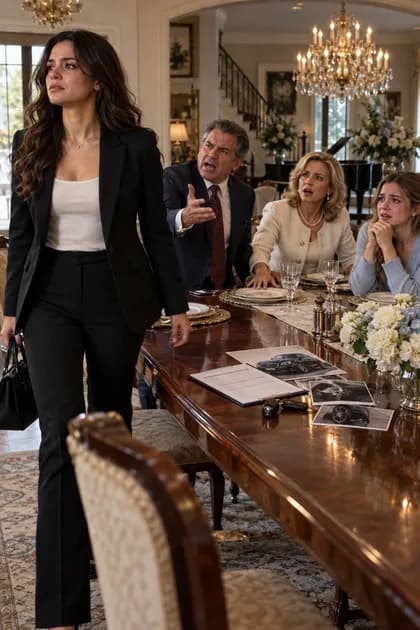
The cork slammed into my parents’ dining room ceiling, and eighteen members of my extended family burst into laughter and applause.
Everyone was celebrating.
Everyone except me.
Because the property Ethan had just sold for $1.2 million…
was mine.
And I had never agreed to sell it.
---
The sound of that champagne cork is burned into my memory now.
Pop.
One sharp little explosion of celebration.
Crystal glasses clinked around the long walnut dining table. My mother’s lemon-rosemary chicken filled the room with the smell of garlic, herbs, and roasted vegetables. Warm light spilled from the chandelier over plates of food and smiling faces.
Cousins.
Aunts.
Uncles.
My parents.
Eighteen relatives packed into the room, all looking at Ethan as if he’d just won the
lottery.
And, in a way, my older brother thought he had.
“To new beginnings,” Ethan announced.
He stood at the head of the table with one hand wrapped around a champagne flute and the other resting casually against the back of his chair.
“And,” he added with a grin, “to the best deal I’ve ever closed.”
Glasses immediately went into the air.
“That’s incredible!”
“To Ethan!”
Someone whistled.
My mother looked ready to burst with pride.
I didn’t move.
I was sitting near the far end of the table between my cousin Rachel and Uncle Peter, my fork frozen halfway between my plate and my mouth.
Something about Ethan’s wording bothered me.
“What deal?” I asked.
The room quieted just enough for him to hear me.
Ethan turned toward me.
Then he smiled.
Not a nervous smile.
It was the satisfied grin of a man who believed he had already
won.
“The farmhouse.”
For a second, I genuinely didn’t understand what he meant.
My farmhouse was used for events all the time, so I assumed he was talking about some major booking.
Maybe a wedding.
Maybe a corporate retreat.
Maybe one of the commercial shoots that occasionally rented the entire property for several days.
Because there was absolutely no other possibility.
I owned the farmhouse.
Three years earlier, I had purchased the restored 1890s property outside town for $340,000.
It sat on twenty-three acres of meadow surrounded by old maple trees, far enough from town to feel private but close enough to attract clients.
The house itself was beautiful.
But the barn was what made the property special.
I had spent months transforming it into a high-end event venue while carefully preserving everything that gave the building its character—the hand-hewn beams, the original stone foundation, the enormous sliding wooden doors.
It had taken money.
Time.
Endless paperwork.
Contractors who missed deadlines.
Inspections.
Permits.
Sleepless nights.
But eventually, it worked.
The farmhouse became one of my best investments.
Weddings booked months in advance.
Executive retreats.
Commercial photo shoots.
Holiday dinners.
Private concerts.
Before expenses, the property brought in roughly $180,000 a year.
And Ethan?
He sometimes helped me with bookings.
That was it.
He did not own the farmhouse.
His name was not on the property.
He had never invested in it.
He occasionally helped coordinate clients when I was busy, and I had trusted him because he was my brother.
Nothing more.
So when he lifted his champagne glass again and casually said—
“Sold for $1.2 million.”
—I felt like the room tilted.
My fork slipped from my fingers.
It touched the china with a tiny metallic click.
“What?”
Ethan took a sip of champagne.
“You heard me.”
My mother, Diane, leaned across the table and immediately refilled his glass.
“He finally sold that old place,” she said proudly.
I stared at her.
For several seconds, I honestly thought maybe I had misunderstood.
Maybe there was another farmhouse.
Another property.
Some investment Ethan had never mentioned.
Then Mom continued.
“California couple. Cash-heavy buyers.”
She smiled at Ethan.
“Apparently they fell in love with the barn.”
The barn.
My barn.
I slowly put both hands on the table.
“Mom.”
She glanced at me.
“That’s my property.”
The reaction was immediate.
My father’s smile disappeared.
“Natalie.”
One word.
That was all he said.
But I knew that tone.
Dad had about a dozen different ways of saying my name, and I had learned every one of them growing up.
This particular version meant:
Don’t make a scene.
Don’t embarrass us.
Don’t ruin Ethan’s moment.
I looked directly at him.
“What?”
He sighed.
“Don’t start this again.”
I blinked.
“Start what?”
“Making everything about you.”
For half a second, nobody spoke.
Then I laughed.
I couldn’t help it.
There was absolutely nothing funny about what was happening, but sometimes reality becomes so absurd that your body chooses the wrong reaction.
“Making everything about me?”
My voice came out sharper than I intended.
“The farmhouse is literally mine.”
Rachel shifted uncomfortably beside me.
Uncle Peter stared down at his plate.
Across the table, a few relatives exchanged awkward glances.
Nobody seemed willing to ask the obvious question.
How could Ethan sell a property he didn’t own?
Ethan simply rolled his eyes.
There it was.
That expression.
Here we go.
He had worn that expression my entire life whenever I challenged him.
Whenever I questioned something.
Whenever I refused to accept his version of reality.
He leaned back in his chair as if I were the unreasonable one.
“You always do this, Natalie.”
“Do what?”
“Turn everything into a fight.”
“A fight?”
I stared at him.
“You just announced that you sold my property for one-point-two million dollars.”
Dad put his napkin beside his plate.
“Keep your voice down.”
“I am keeping my voice down.”
“Then act like an adult.”
I almost couldn’t believe what I was hearing.
Ethan had apparently sold a property worth seven figures without my permission, and somehow I was the one being lectured about manners.
Mom sighed dramatically.
“Can we please have one nice family dinner?”
I looked around the table.
Nobody was laughing anymore.
The champagne suddenly didn’t seem so celebratory.
Ethan, however, still looked completely relaxed.
Too relaxed.
That was when something cold settled into my stomach.
Because Ethan wasn’t acting like someone who had made a stupid joke.
He wasn’t confused.
He wasn’t exaggerating.
He genuinely believed the farmhouse had been sold.
“Who handled the closing?” I asked.
Something flickered across his face.
Just for a second.
Then his smile returned.
“It’s done, Natalie.”
“That wasn’t my question.”
My phone began vibrating against the table.
Everyone looked down.
The screen lit up.
A number I didn’t immediately recognize.
I almost ignored it.
Then I noticed the caller identification beneath the number.
The title company.
My heartbeat changed instantly.
Ethan saw the screen too.
And for the first time that entire evening, his expression shifted.
I picked up the phone.
“Hello?”
A woman spoke on the other end.
“Ms. Natalie?”
“Yes.”
“This is regarding the closing on your farmhouse property.”
Every person at the table seemed to stop breathing.
I stood slowly.
“Yes,” I said. “I’m listening.”
There was a pause.
Then the woman’s voice became very careful.
“We need to confirm something with you immediately.”
I looked directly at Ethan.
His champagne glass was halfway to his mouth, but he wasn’t drinking anymore.
“What?”
Another pause.
Then came the words that changed everything.
“Our records indicate that you never authorized this sale.”
My fingers tightened around the phone.
The woman continued.
“And because the funds have already been wired, we’re initiating a wire fraud investigation immediately.”
Ethan’s face went completely white.
For several seconds, nobody at the table moved.
Then Ethan slowly lowered his champagne glass.
“That’s ridiculous,” he said. “There’s no fraud.”
My stomach dropped.
“You’re saying someone forged my signature?”
Every face at the table turned toward Ethan.
He stood abruptly.
“Natalie, don’t do this here.”
“Do what? Ask why my name is on documents I never signed?”
Dad stepped between us.
“There has to be an explanation.”
“There is,” I said, staring at Ethan. “And I think he knows exactly what it is.”
Ethan grabbed his jacket from the back of his chair.
Mom rushed toward him.
“Ethan, where are you going?”
But before he could answer, the woman on the phone said something else.
Something that made me stop breathing.
“The wire hasn’t cleared completely,” she said. “But we traced the receiving account.”
I tightened my grip on the phone.
“Whose account is it?”
There was a pause.
Then she gave me the name.
I looked across the room, stunned.
Because the account didn’t belong to Ethan.
It belonged to someone else sitting at that dinner table.
My mother.
For a moment, I actually wondered if I had heard the woman incorrectly.
“I’m sorry,” I said. “Could you repeat that?”
She did.
My mother’s full legal name.
The same woman standing three feet from me with one hand still resting on Ethan’s arm.
I lowered the phone slowly.
Mom’s face changed before I said a word.
Not shock.
Not confusion.
Recognition.
Rachel noticed it too.
“Oh my God,” she whispered.
I stared at Mom.
“The money was wired to your account.”
Dad turned toward her.
“What?”
Mom’s eyes flashed toward Ethan.
It lasted less than a second.
But it was enough.
“Diane?” Dad said.
She released Ethan’s arm.
“It’s not what it sounds like.”
That sentence did something to me.
Maybe because innocent people usually ask what happened.
They don’t begin by explaining what something isn’t.
I lifted the phone again.
“Please put an immediate fraud hold on everything you can,” I told the title representative. “And email me every document bearing my name.”
“We’re already coordinating with the receiving bank,” she said. “I’m sending the seller package and fraud affidavit now. Do not approve or confirm anything you didn’t personally sign.”
“I won’t.”
“And Ms. Natalie?”
“Yes?”
“You should preserve any communications involving the transaction.”
My eyes went to Ethan.
“I will.”
I ended the call.
Nobody spoke.
Ethan moved toward the doorway.
“Stop.”
He looked back.
“I’m not staying here for this circus.”
“You were happy to stay when everyone thought you’d made one-point-two million dollars.”
His jaw tightened.
“Move on, Natalie.”
“No.”
I reached for my laptop bag, which I had dropped near my chair when I arrived.
Ethan laughed once.
“What are you doing?”
“Fixing the mistake I made when I trusted you.”
I opened the laptop on the dining table.
The farmhouse had a shared administrative drive for vendor agreements, booking schedules, permits, insurance certificates, and client documents.
Ethan had access because he sometimes covered bookings when I was unavailable.
I logged in.
Then I removed him.
His phone buzzed almost immediately.
He looked at the screen.
His face hardened.
“You locked me out?”
“Yes.”
“You can’t do that.”
Rachel actually laughed.
It was a short, incredulous sound.
“It’s her business, Ethan.”
He ignored her.
“You’re overreacting.”
“I haven’t even started reacting yet.”
I reset the password to the venue email.
Then the cloud storage.
Then the booking platform.
Then the payment processor.
Every account where Ethan had ever been given access.
With each security notification that hit his phone, his confidence drained a little more.
Mom stepped toward me.
“Natalie, sweetheart, just listen.”
I looked up.
“Did you know I hadn’t agreed to sell?”
She hesitated.
That hesitation answered me.
Dad stared at her.
“Diane.”
“I knew she hadn’t signed anything yet,” Mom said quickly. “That’s different.”
The room erupted.
“What?”
“Are you serious?”
Uncle Peter pushed his chair back.
Mom raised both hands.
“Everybody calm down.”
I stared at her.
“You knew.”
“We were going to explain everything.”
“We?”
Ethan slammed his jacket onto the chair.
“Oh, come on. Stop acting like we robbed a bank.”
My eyes went to him.
“You forged documents to take $1.2 million for property you don’t own and wired the money to Mom.”
His expression twisted.
“I handled that place for years.”
“No. You occasionally handled bookings.”
“I brought in clients.”
“You answered emails when I was busy.”
“I helped build the business.”
“I paid you when you helped.”
“Not what it was worth.”
There it was.
For the first time all night, Ethan stopped pretending the sale had somehow been legitimate.
This wasn’t confusion.
It wasn’t a paperwork mistake.
He believed he deserved my property.
Mom moved closer to him.
“He gave up a lot of weekends for you.”
I looked at her.
“So you helped him steal the farmhouse?”
“Don’t use that word.”
“What word would you prefer?”
Mom’s mouth tightened.
“We were going to make sure you were taken care of.”
The room became strangely quiet again.
I closed the laptop halfway.
“What does that mean?”
Mom glanced around at the relatives watching her.
“I don’t think we should discuss numbers in front of everyone.”
“You popped champagne in front of everyone.”
That stopped her.
“Discuss the numbers.”
Dad sank slowly into his chair.
Mom exhaled.
“You paid three hundred forty thousand for the property.”
“Yes.”
“You’ve already made money from it.”
My pulse thudded in my ears.
“How much were you planning to give me?”
Ethan answered.
“Four hundred.”
I stared at him.
“Four hundred thousand dollars.”
“You’d still make sixty grand over what you paid.”
For a second, I couldn’t speak.
Then Uncle Peter said what everyone else was thinking.
“What happened to the other eight hundred thousand?”
Ethan looked away.
Mom answered.
“Investments.”
Rachel folded her arms.
“Whose investments?”
Silence.
“Ethan’s,” I said.
Mom’s expression told me I was right.
Ethan started pacing.
“I had an opportunity.”
I almost smiled.
Of course he did.
People like Ethan never stole because they thought of themselves as thieves.
They stole because they had an opportunity.
They took because they deserved it.
They lied because the other person would eventually understand.
“I found a property development deal,” he said. “If I could get in before the financing closed, it would triple.”
“And you needed my money.”
“I needed capital.”
“You needed my money.”
“You have a business generating nearly two hundred thousand a year.”
“Before expenses.”
“You’re doing fine.”
“That doesn’t make my property yours.”
Mom stepped in.
“We’re family.”
I turned toward her.
“I bought that farmhouse with my money. I renovated it. I paid the taxes, the insurance, the contractors, the permits. When the roof leaked during the first winter, I paid for it. When the county delayed the occupancy approval for three months, I carried the mortgage with no event income. Where was this family ownership then?”
Nobody answered.
“When it was a liability, it was mine.”
I pointed toward Ethan.
“When it became worth $1.2 million, suddenly it became ours.”
Mom looked wounded.
“You don’t have to make us sound horrible.”
“I’m describing what you did.”
My laptop chimed.
An email had arrived from the title company.
SELLER CLOSING DOCUMENTS.
I opened it.
There were twenty-seven pages.
I scrolled.
Purchase agreement.
Seller disclosures.
Transfer documents.
Wire instructions.
And then I saw it.
My signature.
Or something designed to look like it.
The letters were nearly perfect.
Nearly.
I zoomed in.
A chill ran across my skin.
I had seen that exact signature before.
Not something similar.
That exact signature.
Because it had been copied.
Two years earlier, I had signed a vendor authorization form for the farmhouse’s liquor licensing paperwork. I remembered scanning it because Ethan had asked where to find the permit documents for a wedding inspection.
The file was in the shared drive.
The drive I had just locked him out of.
I looked at him.
“You copied my signature.”
His face went still.
Mom whispered, “Ethan?”
He didn’t answer.
I kept scrolling.
Then another detail appeared.
The seller identification package included a scan of my driver’s license.
I felt sick.
That scan had been stored in the same administrative folder because the county had required identification with one of the permit applications.
Ethan had never needed to break into anything.
I had handed him the key.
Trust had done the work for him.
Rachel stood behind me now.
“Is that your license?”
“Yes.”
I kept reading.
The email address used for the closing looked like mine at first glance.
But there was an extra letter buried in the domain name.
A fake account.
The phone number attached to the seller verification wasn’t mine either.
I recognized the final four digits.
Mom’s cell phone.
I turned the laptop around.
Dad leaned forward.
Mom froze.
“You received the verification codes.”
She said nothing.
“You knew they were pretending to be me.”
“Natalie—”
“You knew.”
Her eyes filled.
“I thought Ethan had everything handled.”
“That isn’t an answer.”
She lowered her voice.
“He said you would never agree if we asked first.”
I stared at her.
Dad whispered, “Diane, what did you do?”
Mom snapped toward him.
“Don’t act innocent, Robert. You knew he was selling it.”
“I thought Natalie had agreed.”
“I told you she would come around.”
“That is not the same thing.”
Their argument barely registered.
Something inside me had gone very calm.
For years, whenever my family crossed a line, I had been trained to debate whether the line really existed.
Maybe Ethan didn’t mean it.
Maybe Mom was helping.
Maybe Dad was trying to keep peace.
Maybe I was too sensitive.
Tonight, there was no maybe.
There were documents.
There were authentication records.
There was a bank account.
There was my copied signature.
And suddenly I realized I didn’t need any of them to agree that what they had done was wrong.
My phone buzzed again.
The title company had sent a second message.
The receiving bank had placed a temporary hold while the wire recall was being processed.
I read it twice.
Then I closed my laptop.
Ethan noticed my expression.
“What?”
“The money is frozen.”
His face collapsed.
“What do you mean frozen?”
“The bank put a hold on it.”
Mom grabbed her phone.
“You had them freeze my account?”
“I reported a fraudulent transfer into your account.”
“I have other money in there!”
“That sounds like something you can explain to the bank.”
Ethan stepped toward me.
“You need to call them back.”
“No.”
“Call them.”
“No.”
“You’re going to destroy everything.”
I looked directly at him.
“No, Ethan. I’m stopping you from destroying what belongs to me.”
“You don’t understand what’s at stake.”
“Then explain it.”
His breathing changed.
The anger disappeared.
Fear replaced it.
“I already committed the money.”
The room went silent.
I frowned.
“To what?”
“My investment.”
“You just closed today.”
“I signed an agreement based on the proceeds.”
Mom covered her mouth.
Apparently even she hadn’t known that part.
“If the money doesn’t clear,” Ethan continued, “I lose the deposit.”
“How much?”
He didn’t answer.
“How much, Ethan?”
“Two hundred thousand.”
Rachel whispered, “Jesus.”
“Your two hundred thousand?”
His eyes shifted.
That told me enough.
Mom turned on him.
“You said you were waiting until the transfer cleared.”
“I had a deadline.”
“You told me there was no risk.”
Ethan exploded.
“There wouldn’t have been if Natalie hadn’t turned this into a federal case!”
Something changed around the table.
Not loudly.
But completely.
The relatives who had spent years smiling through Ethan’s arrogance were no longer looking at me like the difficult sister.
They were looking at him.
Uncle Peter stood.
“You forged her signature.”
Ethan rubbed both hands over his face.
“You don’t understand.”
“No,” Peter said. “I understand perfectly.”
Mom looked desperately around the room.
“This was supposed to help everybody.”
Rachel stared at her.
“How?”
Mom said nothing.
Rachel shook her head.
“You weren’t celebrating Ethan selling his property tonight.”
Her eyes moved to the champagne bottle.
“You were celebrating getting away with selling Natalie’s.”
Nobody raised a glass after that.
One by one, relatives began collecting coats.
Aunt Susan hugged me before she left.
Uncle Peter squeezed my shoulder.
Rachel stayed.
Dad remained seated at the table with both hands over his face.
Mom stood near the kitchen doorway.
Ethan stared at the floor.
The party had ended exactly where it began.
Under the little dent in the ceiling where the champagne cork had struck.
Only now nobody was celebrating.
I drove directly to the farmhouse that night.
Rachel followed me in her car.
I changed the alarm code.
Then the keypad on the equipment room.
I collected the physical spare keys Ethan kept for vendors and replaced the lock cylinders the next morning.
By midnight, I had downloaded the shared-drive access history, archived every email connected to the sale, saved the title documents in three locations, and written a timeline while every conversation was still fresh.
At 8:04 the next morning, I called the attorney who had handled the farmhouse purchase three years earlier.
At 8:31, I signed the title company’s fraud affidavit.
Before noon, I filed a formal report and provided the copied signature, the fake email address, the verification records, and the banking information investigators requested.
I didn’t need a powerful stranger to walk in and save me.
I needed records.
And Ethan had left them everywhere.
The fake seller email had been accessed repeatedly from the same devices he used for farmhouse bookings.
The electronic closing system showed authentication requests going to Mom’s phone.
The shared drive showed Ethan opening the file containing my identification days before the forged documents were created.
Then investigators found the messages between him and Mom.
Those were worse.
Ethan: She’ll never sell if we ask.
Mom: Then don’t ask until it’s finished.
Ethan: Once she sees the number she’ll calm down.
Mom: Put enough aside to give her what she originally paid plus something extra.
Ethan: 400?
Mom: More than fair.
More than fair.
I read those words three times.
That was the part that hurt more than the signature.
My mother had assigned a price to my consent.
The California buyers were horrified when they learned what had happened.
They had believed Ethan was authorized to negotiate for me and that the electronic seller package was legitimate.
Through the title company, I spoke with them once.
I apologized for the nightmare.
They apologized to me.
Neither side blamed the other.
The transaction was unwound before they ever took possession, and the title company returned the buyers’ money after the fraud process was completed.
The farmhouse never stopped being mine.
Ethan’s development deal did not survive.
Without the stolen proceeds, he couldn’t meet his funding deadline.
He lost the deposit he had committed.
That loss became his problem instead of mine.
And when the investigation expanded, the carefully rehearsed story he and Mom tried to tell fell apart.
At first, Ethan claimed he believed I had given him verbal authority.
Then investigators showed him the fake email.
He said an assistant created it.
He didn’t have an assistant.
Then he claimed Mom misunderstood the verification process.
The text messages showed otherwise.
Mom insisted she had believed I would approve the sale afterward.
That argument didn’t improve when investigators asked why the proceeds had been wired to her personal account instead of mine.
There was no dramatic courtroom confession.
No surprise witness.
No billionaire stepping through a door.
Just months of documents, interviews, attorneys, and consequences.
Ethan eventually accepted responsibility for fraud and forgery-related charges rather than take the evidence to trial.
The exact legal penalties mattered less to me than what came with them.
Restitution.
Legal costs.
The loss of his development deal.
And a record he could not dismiss with an eye roll.
Mom avoided the worst of Ethan’s consequences, but the evidence of her involvement was impossible to pretend away.
Her account remained restricted during the investigation, she spent thousands on legal representation, and she was forced to admit formally that she had knowingly participated in a transaction I had never approved.
Dad wasn’t charged.
There was no evidence he had helped create the documents.
But that didn’t mean everything went back to normal.
He called me a few weeks after the investigation began.
“Natalie,” he said quietly, “your mother made a terrible mistake.”
I was sitting in the farmhouse office overlooking the meadow.
“No.”
He paused.
“She did.”
“No, Dad. A mistake is sending money to the wrong account. A mistake is forgetting a deadline. She received verification codes while Ethan pretended to be me. She let him wire $1.2 million into her account. That required decisions.”
He was silent.
Then he said the sentence I had expected.
“She’s still your mother.”
I looked through the window at the barn.
“And I’m still her daughter.”
Another silence.
“She knew I hadn’t agreed.”
“I know.”
“She did it anyway.”
“I know.”
“So stop asking me to protect her from the consequences of something she chose.”
He never asked again.
For a while, my family fractured.
Some relatives accused me of taking things too far.
Most didn’t.
Rachel became one of my strongest supporters, mostly because she had been there from the first champagne toast to the final silence.
Uncle Peter told me something I still remember.
“We all knew Ethan was favored,” he said. “I don’t think any of us understood how far everyone had learned to bend reality around him.”
Neither had I.
That was the real thing I lost that night.
Not the farmhouse.
I kept that.
I lost the belief that if something were serious enough, my parents would finally recognize the line and stand beside me.
There was always another excuse.
Another reason Ethan needed understanding.
Another reason I was expected to absorb the cost.
So I stopped waiting for them to become different people.
I stopped giving Ethan access to anything connected to my business.
I separated every shared family account and authorization that still existed.
I hired part-time administrative help for the venue instead of relying on relatives.
I created individual access permissions for every contractor.
Nobody received financial documents unless they actually needed them.
Trust became something people earned, not something genetics automatically entitled them to.
And the farmhouse kept going.
The first wedding after everything happened took place on a cool Saturday evening in October.
The maple trees had turned orange and red.
White lights hung from the old barn beams.
Nearly a hundred guests filled the room.
Music drifted through the open doors toward the meadow.
I stood near the back wall watching a newly married couple cross the floor.
Then someone opened a bottle of champagne.
Pop.
My entire body went still for half a second.
The sound carried through the barn.
So similar to that night at my parents’ house.
Except nobody was celebrating something stolen.
Nobody was raising a glass over a decision made behind someone else’s back.
The bride laughed.
The groom kissed her forehead.
Everyone cheered.
I walked outside.
The air smelled like fallen leaves and wood smoke from the firepit.
Across the meadow, the farmhouse windows glowed beneath the darkening sky.
Three years earlier, I had stood on that same land when it was still mostly an expensive gamble.
I remembered broken gutters.
Permit delays.
A contractor disappearing halfway through the barn restoration.
Months when I wondered whether buying the place had been the worst financial decision I had ever made.
Nobody had called it a family asset then.
Nobody had volunteered to share the risk.
That happened only after the risk became valuable.
For most of my life, I thought boundaries were things you explained until other people understood them.
I know better now.
A boundary isn’t something another person has to approve.
Sometimes it is a password you change.
A key you take back.
A document you refuse to sign.
A phone call you make even when the person on the other end shares your last name.
And sometimes it is simply the moment you stop allowing people to call theft love because the thief happens to be family.
I looked toward the barn as another round of applause rose inside.
The farmhouse was still standing.
Still mine.
Not because Ethan had finally respected me.
Not because Mom had apologized enough.
Not because Dad had chosen my side.
It was mine because it had always been mine.
The only thing that changed was that I finally stopped asking my family for permission to protect it.
THE END.
Chapter complete
You have reached the end of this chapter.
Continue reading
Find your next story
A few more worlds to get lost in after this chapter.