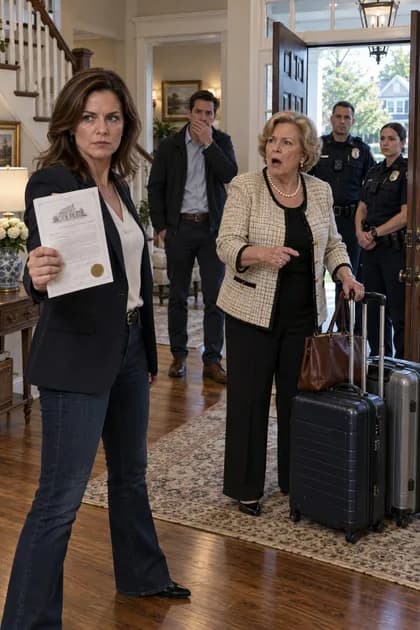
The moment my mother started crying in court, I knew she thought she had already won.
Chapter 1
THE NIGHT MY FAMILY TRIED TO TAKE MY HOME
4,040 words
There was only one problem.
Her eyes were completely dry.
Beatrice Lancaster sat across the courtroom in a perfectly tailored navy dress, dabbing a tissue beneath her eyes like she was performing for a television audience. Beside her, my father stared straight ahead with the stiff, disappointed expression he always used when he wanted everyone to believe I had failed some sacred family duty.
And next to him sat my younger sister, Penelope.
She was scrolling through her phone.
In court.
During a lawsuit.
Over my home.
Her ripped designer jeans probably cost more than my first month’s rent after college. Her glossy hair fell over one shoulder, one leg crossed lazily over the other, while she looked completely bored by the legal battle she had helped create.
I had a pretty good idea what she was looking at.
Furniture.
For my penthouse.
My $3 million penthouse on the eighteenth
floor of a luxury building in Capitol Hill.
The home I had bought after six brutal years of working, saving, negotiating, and living like one financial mistake could destroy everything I had built.
Floor-to-ceiling windows.
Marble countertops.
A quiet office where nobody interrupted me.
A balcony overlooking Elliott Bay.
It was the first truly beautiful thing I had ever owned that belonged entirely to me.
And my family had dragged me into court because they believed Penelope deserved it more.
That was their argument beneath all the legal language.
Penelope hadn’t paid a cent toward the penthouse.
She hadn’t helped me buy it.
She had no ownership stake whatsoever.
But according to my parents, Penelope was “struggling.”
And I was “selfish.”
Their attorney stood before Judge Sylvia Thornton, speaking dramatically about family obligation, parental sacrifice, and my supposed moral responsibility to help my younger sister “recover.”
Recover from what?
Being
twenty-five years old and finally being asked by our parents to contribute toward rent?
That was Penelope’s crisis.
She had spent her entire life being rescued before consequences could reach her.
I had spent mine learning how to hit the ground without making a sound.
Growing up, Penelope had the master bedroom.
Bay window. Walk-in closet. Plenty of space.
I lived in a converted storage room beside the utility closet.
During winter, I could sometimes see my breath near the door.
In summer, the walls trapped heat like an oven.
Mom called it “cozy.”
Penelope received a monthly allowance simply for existing.
I worked twenty hours a week at a grocery store so I could buy school supplies and decent shoes.
When I came home with straight A’s, my parents barely looked up.
“That’s nice, dear.”
But when Penelope passed her driving test on the third attempt?
They threw a
backyard barbecue for forty people.
Then they bought her a car.
That was how our family worked.
Penelope received celebrations.
I received lessons about character.
When I got accepted into a computer science program, I paid my own way through scholarships, loans, and jobs that left me so exhausted I once fell asleep standing in line at the campus café.
There had supposedly been a college fund for me.
My parents gave it to Penelope for community college.
She quit after two semesters because morning classes were “emotionally draining.”
Then came my graduation.
I remember standing backstage in my cap and gown, searching the crowd for my parents.
They were gone.
Penelope had called with an emergency.
She needed help moving apartments.
So Mom and Dad left before my name was announced.
After the ceremony, I stood alone holding the diploma I had sacrificed years to earn.
Nobody from my family had stayed long enough to watch me receive it.
That was the day I stopped expecting them to show up for me.
And for years, they didn’t.
Not when I landed my first technology job.
Not when my salary doubled.
Not when I became a senior software architect.
Not when I saved $640,000 for a down payment by working seventy-hour weeks and saying no to almost everything fun, easy, or comfortable.
My success meant nothing to them.
Until they saw my penthouse.
Inviting them over was my mistake.
Some embarrassingly hopeful part of me still wanted my parents to walk through the door, see what I had built, and finally say the words I had wanted my entire life.
“Genevieve, we’re proud of you.”
Instead, Mom walked into the master bathroom, took pictures, and immediately sent them to Penelope.
Dad asked how much the penthouse cost.
When I told him, he scoffed.
“Must be nice wasting our money like this.”
I laughed because I genuinely thought he was joking.
He wasn’t.
Dad calmly explained that because he and Mom had given me what he called “superior genetics,” they were partially responsible for my ability to earn a high salary.
Therefore, in his mind, they had contributed to the penthouse.
I should have thrown them out immediately.
Two weeks later, the concierge called me.
He sounded uncomfortable.
My parents and Penelope were standing in the lobby demanding access to my floor.
I told him absolutely not.
Within minutes, my phone showed seventeen missed calls.
Then Mom left a voicemail.
She was screaming.
Penelope needed a “stable and beautiful environment” for her mental health.
I already had a successful career.
I could move into a studio apartment.
I needed to stop being selfish and give Penelope the penthouse.
Hand her the keys.
Just like that.
I blocked all three of them.
Two days later, someone served me legal papers.
My parents had filed a civil lawsuit.
They claimed they had supplied the down payment for my penthouse and argued ownership should be transferred to them so Penelope could live there.
They didn’t merely tell the lie.
They put it into a legal document.
Signed it.
Hired an attorney.
And walked into court expecting a judge to believe them.
Now Mom was pretending to cry while their lawyer described me as a greedy technology executive hoarding luxury from my fragile younger sister.
Judge Thornton listened from behind the bench, reading glasses low on her nose.
Eventually, she raised one hand.
The attorney stopped talking.
“Counselor,” she said sharply, “where is the evidence that your clients actually provided this alleged down payment?”
Silence.
Their lawyer hesitated.
That was the first crack.
My attorney, Valerie Chen, stood.
She didn’t need theatrics.
“Your Honor, the plaintiffs have produced no bank statements, no wire transfers, no canceled checks, and no financial documentation showing they contributed anything toward the purchase.”
Dad shifted.
Mom pressed the tissue beneath her still-dry eyes.
Valerie continued.
“We, however, have documentation establishing that every dollar came from my client’s personal income.”
Then she turned toward me.
“Genevieve, please bring up our first exhibit.”
I stood.
My legs felt strangely weightless.
But my hands were steady.
I carried a tablet to the evidence table and placed it down.
Across the courtroom, Penelope finally looked away from her phone.
For the first time all morning, she seemed interested.
I tapped the screen.
The courtroom monitor flickered to life.
Security footage appeared.
The hallway outside my penthouse.
April 28.
2:17 a.m.
And there was Penelope.
Standing directly outside my front door.
Trying to force a metal key into my lock.
The entire courtroom went silent.
Mom’s tissue froze halfway to her face.
Dad’s confidence vanished so fast it looked like the blood had drained from his body.
On-screen, Penelope shoved against the door.
Then she kicked the frame.
Once.
Twice.
Finally, she turned toward someone standing just outside the camera’s view.
Her voice came through the courtroom speakers perfectly clearly.
“I’ll just wait until she gives me the code.”
Judge Thornton leaned toward the monitor.
Penelope’s face went pale.
Valerie didn’t smile.
She simply reached toward the tablet.
“Your Honor,” she said calmly, “that was only the first recording.”
Penelope’s eyes widened.
My mother slowly lowered the tissue from her completely dry face.
My father turned toward my sister as if, for the first time, he had realized they might not be walking out of this courtroom with my penthouse.
Then Valerie tapped the screen.
The second security video began to play.
And the instant Penelope saw what was on it, the smug expression she had worn all morning disappeared completely...
The second video started at 2:23 a.m.
This time, Penelope wasn’t alone.
My mother appeared from around the corner.
A stunned murmur rippled through the courtroom.
On the screen, Mom handed Penelope something small and silver.
Another key.
Dad immediately leaned toward their attorney, whispering frantically, but Judge Thornton raised her hand.
“Quiet.”
The footage continued.
Mom glanced directly at the security camera and said, “Try that one. Your father said Genevieve keeps a spare key in her desk.”
My stomach tightened.
They hadn’t just shown up at my building.
They had planned this.
Penelope tried the key, failed again, then slammed her fist against my door.
“This is ridiculous,” she snapped. “She doesn’t even need this place. She’s barely home.”
Mom’s response made Valerie slowly turn toward the judge.
“Once you’re inside, change the code. She’ll eventually give up.”
Across the courtroom, my mother’s face had gone completely white.
Judge Thornton paused the video.
“Mrs. Lancaster,” she said, “you filed a sworn statement claiming your daughter voluntarily agreed to transfer this property to your family.”
Mom opened her mouth.
Nothing came out.
Then Valerie stood.
“Your Honor, there is one final recording.”
My father suddenly jumped to his feet.
“No!”
Every person in the courtroom turned toward him.
And that was when I realized the last video contained something even I hadn’t known.
Judge Thornton stared at my father for several seconds.
“Mr. Lancaster,” she said, her voice flat, “sit down.”
Dad remained standing.
“Our attorney hasn’t reviewed whatever that is.”
Their attorney turned slowly toward him.
The look on his face told me that was not the defense Dad thought it was.
“Mr. Lancaster,” the lawyer said under his breath, “I strongly suggest you sit.”
Dad sat.
Valerie pressed play.
The timestamp on the final recording read 1:58 a.m., nineteen minutes before Penelope first appeared at my door.
The camera angle was different.
It showed the service hallway near the elevators.
My father stepped into frame carrying a small black envelope.
Then my mother appeared.
Then Penelope.
Dad opened the envelope and handed Penelope a key.
My spare key.
The one I kept in the locked drawer of my home office.
For a second, I forgot how to breathe.
I had invited my parents into my home once.
Once.
During that visit, Dad had wandered into my office while Mom took pictures of the bathroom and Penelope complained over video call that the guest bedroom was too small.
I had assumed he was looking for me.
Now I knew what he had actually been doing.
On the recording, Penelope examined the key.
“Are you sure this is hers?”
Dad nodded.
“I took it from the desk.”
There was a soft sound from somewhere in the courtroom.
Someone inhaling sharply.
My hands curled together beneath the table.
I had known they felt entitled to my home.
I had not known my father had searched my desk and stolen a key while I was standing twenty feet away trying to make coffee for him.
The video kept playing.
Mom looked nervous.
“What if she calls security?”
Dad gave the same dismissive little shrug he had given me my entire life whenever I objected to something.
“Then Penny says Genevieve invited her.”
Penelope laughed.
“She’ll deny it.”
“She denies everything when she’s being difficult,” Dad said. “That’s why we keep the story simple.”
Their attorney stopped writing.
He was staring at the screen now.
Dad continued.
“We helped with the down payment. Genevieve agreed the property was for the family. Penelope was supposed to move in. That’s it.”
Mom lowered her voice.
“But we didn’t help with the down payment.”
Dad looked straight at her.
“We raised her.”
My entire childhood seemed to compress into those two words.
We raised her.
As if every meal they had fed me had been a loan.
As if every winter in that freezing storage room had been an investment.
As if giving birth to me had created a permanent lien against anything I might someday earn.
Mom glanced toward the elevator.
“And if she takes it to court?”
Dad smiled.
Not a warm smile.
A confident one.
“She won’t want the embarrassment. Genevieve hates scenes. She’ll settle before she lets strangers hear family business.”
Then Penelope asked the question that finally explained the entire thing.
“So once I’m in, she’ll really leave?”
Dad answered without hesitation.
“She always gives in eventually. She just needs pressure.”
The recording ended.
Nobody moved.
For years, my family had treated my silence as proof that they were right.
In reality, I had been quiet because fighting them never changed anything.
They had mistaken exhaustion for surrender.
Judge Thornton removed her glasses.
“Counsel,” she said to my parents’ attorney, “did you know your clients intended to rely on a down-payment allegation they themselves acknowledged was false?”
The attorney stood so quickly his chair rolled backward.
“No, Your Honor.”
Dad leaned toward him.
“Now wait—”
The attorney stepped away from the table.
“No. I need the court to understand that the financial representation provided to me was made by my clients in signed declarations.”
Valerie rose.
“Your Honor, we have copies of those declarations in Exhibit Twelve.”
“I have read them,” Judge Thornton said.
Then she looked at my parents.
My mother finally started crying.
This time, there were tears.
Real ones.
But they were not for me.
They were for the first consequence she had not been able to talk her way around.
Judge Thornton called a recess.
The moment we stepped into the hallway, Dad came toward me.
Valerie moved between us.
“Do not speak to my client.”
Dad ignored her.
“Genevieve, you have no idea what you’ve done.”
I looked at him.
For most of my life, that sentence would have worked.
It would have sent me searching through my own behavior for the exact moment I had become the problem.
This time, I didn’t search.
“I showed the truth.”
“You humiliated your mother.”
My mother stood several feet away with Penelope, crying into the same tissue she had used as a prop ten minutes earlier.
I almost laughed at the symmetry.
“No,” I said. “You humiliated yourselves.”
Penelope pushed past Mom.
“You could have just helped me.”
There it was.
Not an apology.
Not even denial.
A complaint that I had made stealing from me unnecessarily difficult.
“You tried to break into my home.”
“I was not breaking in. I had a key.”
“You had a stolen key.”
Her face tightened.
“You have three bedrooms.”
I stared at her.
“What does that have to do with anything?”
“You’re one person.”
“So are you.”
Her mouth opened.
Nothing came out.
For once, arithmetic had defeated entitlement.
Valerie touched my arm.
“We’re going back in.”
When court resumed, my family’s attorney asked to withdraw the property-transfer claim.
Valerie stood immediately.
“With prejudice, Your Honor, and we are requesting sanctions based on false sworn representations, litigation costs caused by those representations, and preservation of all evidence related to the attempted entry.”
Dad whispered something furious.
Judge Thornton heard him.
“Mr. Lancaster, I have already warned you once.”
He went silent.
The judge looked through the exhibits for several minutes.
The room felt different now.
When we had entered that morning, I had been the daughter defending herself against three people who had spent years telling her she was selfish.
Now they were simply plaintiffs who had made claims they could not support.
That difference mattered more than I expected.
Finally, Judge Thornton spoke.
“The claim seeking transfer of Ms. Lancaster’s property is dismissed with prejudice.”
My mother covered her mouth.
Penelope stared at the table.
The judge continued.
“The court will set a separate hearing concerning sanctions and fees. The defendants’ evidence raises serious concerns regarding the veracity of sworn filings submitted in this case. I am also ordering that the relevant recordings and declarations be preserved.”
She paused.
“And for clarity: raising a child does not create an ownership interest in property that child later purchases with her own money.”
Dad looked as if she had slapped him.
I felt something inside me loosen.
Not triumph.
Something quieter.
Permission to stop arguing with insanity.
Outside the courthouse, reporters were not waiting.
There was no dramatic crowd.
No one applauded.
Real consequences are usually less cinematic than people imagine.
Valerie and I walked half a block before she stopped.
“You did well.”
“I barely said anything.”
“You preserved the footage. You saved your bank records. You refused to let them into the building. You hired counsel instead of trying to negotiate with people who had already lied in a complaint.”
She gave me a small smile.
“That is doing something.”
I thought about that all the way home.
The concierge met me in the lobby.
He had already received a copy of the court order from Valerie’s office.
“We’ve removed all three names from visitor authorization,” he said. “Security has also flagged them. They will not be sent upstairs.”
“Thank you.”
He hesitated.
“Ms. Lancaster, I’m sorry this happened.”
The kindness in his voice nearly undid me more than the courtroom had.
I nodded and went upstairs.
Inside the penthouse, everything was exactly where I had left it.
The marble counters.
The quiet office.
The windows filled with gray Seattle light.
My desk.
I stood in front of it for a long time.
Then I opened the drawer where I had kept the spare key.
Empty.
I had already known it would be.
Still, seeing that space made the betrayal physical.
Dad had stood in this room while I was trying to impress him.
He had opened my desk.
Taken my key.
And walked out believing he had every right.
I called the locksmith anyway.
Not because the electronic code had been compromised.
Not because the key had worked.
It hadn’t.
I changed everything because I wanted the old access gone.
Keys.
Codes.
Building permissions.
Emergency contacts.
Every little doorway my family had once assumed belonged to them.
Over the next three weeks, Valerie handled the rest.
My parents sent messages through relatives.
At first they were angry.
Then wounded.
Then suddenly concerned about “healing.”
An aunt I had not spoken to in two years called to tell me that my mother was devastated.
I asked if Mom had told her why.
There was a pause.
“She said there was a misunderstanding about your apartment.”
“Penthouse.”
Another pause.
“And there was security footage.”
My aunt became very quiet.
I never heard from her about it again.
Penelope tried a different tactic.
She emailed me from a new address.
I read the message once.
She said Mom and Dad had made everything worse.
She said she never thought it would become a lawsuit.
She said she had only wanted somewhere nice to live while she “got herself together.”
Then, three paragraphs later, she wrote:
You know you could have prevented all of this by just letting me stay there for a while.
That sentence erased whatever sympathy the first half of the email had almost created.
I forwarded it to Valerie.
I did not reply.
At the sanctions hearing, my parents looked ten years older.
Their original attorney was gone.
Their new lawyer spoke carefully and briefly.
The bank records were straightforward.
No money from my parents had ever entered the account used for my down payment.
No transfer.
No gift.
No loan.
Nothing.
My $640,000 had come from my earnings, investments, and savings.
The judge did not need a family history lesson.
Numbers were enough.
The court ordered my parents to reimburse a substantial portion of the legal fees I had been forced to spend defending the fabricated ownership claim.
The attempted entry and false statements were also referred through the appropriate channels for review.
I did not cheer.
I did not ask for more.
I had spent too much of my life being accused of cruelty whenever I refused to give Penelope something.
I was not going to turn consequences into revenge just because I finally had the power to.
After the hearing, Mom caught my eye from across the corridor.
“Genevieve.”
Valerie looked at me.
I could have kept walking.
Instead, I stopped.
Mom approached alone.
Without the navy courtroom dress and the tissue and the performance, she looked smaller.
“I hope someday you understand we were trying to keep this family together.”
I almost admired the sentence.
Even now, she could take an attempted break-in, a stolen key, and a false lawsuit and rename all of it love.
“What family?” I asked.
Her face changed.
I went on.
“The one where Penelope gets the room and I get the storage closet? The one where my college fund becomes hers? The one where you leave my graduation because she needs help moving? Or the one where Dad steals a key from my desk and you help her try my lock at two in the morning?”
Mom’s lips trembled.
“She needs more help than you do.”
There it was.
The family constitution.
Spoken aloud.
I nodded.
“I know.”
She looked relieved for half a second, as if she thought I finally understood.
Then I finished.
“And that is exactly why none of you will ever have access to my home again.”
Her relief vanished.
“Genevieve—”
“I spent my whole life being punished for needing less. I worked more, so you gave me less. I succeeded, so you expected more. Penelope struggled, so everything became hers before I was even asked.”
Mom started crying again.
I did not move toward her.
“I’m not doing it anymore.”
“What are you saying?”
“I’m saying you can love Penelope however you want. You can support her. Pay her rent. Give her your house. Give her everything you own.”
I held her gaze.
“But you cannot give her mine.”
Then I walked away.
That was the last conversation I had with my mother for a long time.
My father never apologized.
Penelope never did either.
Eventually, the messages stopped.
The silence that followed surprised me.
For the first few days, it felt unnatural.
I kept expecting my phone to light up.
I kept expecting the concierge to call.
I kept expecting another envelope from another lawyer.
None came.
One Saturday morning, I made coffee and carried it onto the balcony.
Elliott Bay was silver beneath the clouds.
Behind me, sunlight moved slowly across the hardwood floor.
My home was quiet.
Not the tense quiet of my childhood storage room, when I learned to listen for footsteps and judge everyone’s mood before opening the door.
A different kind.
Safe quiet.
Chosen quiet.
I thought about the graduation ceremony my parents had left early.
The grocery-store shifts.
The student loans.
The seventy-hour weeks.
The first time I saw the penthouse and almost walked away because wanting something beautiful still felt vaguely selfish.
For years, I had believed that if I accomplished enough, one day my family would finally decide I had earned the same consideration they gave Penelope automatically.
Court taught me something my success never had.
I did not need their verdict.
Judge Thornton had dismissed their claim to my home.
But the more important claim was the one I dismissed myself.
Their claim on my guilt.
Their claim on my silence.
Their claim that everything I built remained available for redistribution whenever Penelope wanted it.
I finished my coffee and looked through the glass doors at the office where my father had stolen the key.
The drawer was locked now.
The codes were changed.
The names were removed.
And for the first time in my life, I did not feel selfish for protecting something that belonged to me.
My family had spent years teaching me that Penelope always deserved the better room.
They were wrong.
This one was mine.
And I was finally done apologizing for closing the door.
THE END.
Chapter complete
You have reached the end of this chapter.
Continue reading
Find your next story
A few more worlds to get lost in after this chapter.