My ex-husband spent eight years telling himself I had lied about being pregnant.
Chapter 1
THE CHRISTMAS DINNER THAT ENDED EIGHT YEARS OF DENIAL
5,984 words
Eight years believing I had invented a baby just to stop him from leaving.
Eight years building a new life around a version of our divorce where he was the reasonable one—and I was the desperate ex-wife who couldn’t let go.
So when Major Ethan Caldwell invited me to his family’s Christmas dinner, I accepted.
He thought I would arrive alone.
He had no idea that, just before dinner, a military helicopter would descend toward the snow-covered field beside his family’s Colorado estate.
He had no idea I would be the first person to step out.
And he definitely had no idea that four eight-year-old boys would climb down behind me.
The second Ethan saw their faces, the smile vanished from his.
Because all four boys looked enough like him to make eight years of denial collapse in a single heartbeat.
But that wasn’t where the story began.
It started
three weeks earlier, at my kitchen table in Colorado Springs.
I had just poured myself a cup of coffee when my laptop chimed.
One new email.
The subject line immediately caught my attention.
The Caldwell Family Christmas Dinner.
I almost deleted it without opening it.
Almost.
Then curiosity won.
The message inside was painfully polite.
Grace,
My parents are hosting Christmas dinner this year. Since we’ve both moved on, I thought it might be nice to put the past behind us. My fiancée, Natalie, will be there with the rest of the family.
You’re welcome to join us.
Ethan.
I read it twice.
Then I laughed.
Not because anything about it was funny.
Because I knew Ethan.
And I knew exactly what this invitation was.
Ethan Caldwell never did anything without a reason.
He had recently gotten engaged, and according to mutual acquaintances, his parents were turning Christmas into a
formal celebration to welcome Natalie into the family.
Natalie was beautiful.
Polished.
Accomplished.
The kind of woman who looked perfectly at home in expensive family photographs and elegant holiday dinners.
From everything I had heard, she was exactly what the Caldwell family had always imagined for Ethan.
And then there was me.
Grace Bennett.
The ex-wife.
The embarrassing chapter everyone had agreed to close.
During our divorce, Ethan had described me as a woman who “couldn’t accept that it was over.”
His family believed him.
For years, he allowed them to think I was lonely, bitter, and still emotionally trapped in a marriage that had ended almost a decade earlier.
Apparently, inviting me to Christmas was Ethan’s way of proving how completely he had moved on.
He would sit beside his beautiful fiancée.
His parents would admire the perfect couple.
And I would arrive alone.
The supposedly childless ex-wife.
The
woman who had once been desperate enough, in Ethan’s version of history, to invent a pregnancy just to keep him from leaving.
I leaned back in my chair and stared at the invitation.
Because that was the part that had always hurt the most.
Not the divorce.
Not even the way Ethan had walked away.
It was the pregnancy.
Before our divorce became final, I told Ethan I was pregnant.
I still remembered the silence on the other end of the phone.
Then his voice.
Cold.
Disbelieving.
“You’re making this up.”
At first, I thought I had misunderstood him.
I told him I had taken multiple tests.
He said tests could be faked.
I told him I had medical records.
He refused to look at them.
I begged him to come to one appointment.
Just one.
He called it emotional manipulation.
“Grace, this isn’t going to make me stay.”
Those words stayed with me for years.
Not because I wanted him to stay.
By then, our marriage was already shattered.
I just wanted him to understand that whatever happened between us, something bigger than our anger was happening too.
He didn’t want to hear it.
Then came the ultrasound.
I went alone.
I remember lying on the examination table beneath the thin paper sheet, staring at the ceiling while the technician moved the wand across my stomach.
Her expression changed.
She stopped.
Looked closer.
Then called someone else into the room.
For a terrifying few seconds, I thought something was wrong.
“What is it?” I asked.
The technician smiled.
Then she turned the screen toward me.
“There’s baby number one.”
My breath caught.
She moved slightly.
“And baby number two.”
I stared at her.
She kept going.
“Baby number three.”
I honestly thought I might faint.
Then she pointed again.
“And… baby number four.”
Four.
Not one heartbeat.
Four.
Four tiny lives flickering on that screen.
Four babies.
Quadruplets.
I cried before I even realized I was crying.
And despite everything Ethan had said, despite every cruel accusation, my first instinct was still to call him.
I stepped into the hallway afterward with shaking hands and dialed his number.
No answer.
I called again.
Nothing.
I left a message.
“Ethan, please call me. It’s important. The ultrasound—there are four babies.”
He never called back.
The response came from his attorney.
Formal.
Detached.
Clinical.
Any further communication regarding the divorce was to go through legal counsel.
That was the moment something inside me finally changed.
I stopped begging a man to believe me.
I stopped sending proof to someone determined not to look at it.
And I stopped trying to force Ethan Caldwell to participate in a truth he had already decided was a lie.
Months later, after a pregnancy filled with specialists, hospital visits, fear, and more prayers than I could count, my sons were born prematurely.
Lucas.
Henry.
Jack.
Sam.
Tiny.
Fragile.
Stubborn.
Determined to survive from their very first breaths.
And they did.
They grew.
Four cribs became four toddler beds.
Four bottles became four lunch boxes.
Four pairs of tiny sneakers appeared by the front door.
My quiet house filled with scraped knees, superhero costumes, cereal disasters, soccer balls, unfinished homework, arguments over video games, and four voices yelling “Mom!” from different rooms at exactly the same time.
They became my entire world.
And Ethan knew nothing about them.
Not because I had hidden the pregnancy.
I had told him.
I had offered proof.
I had begged him to come.
He had chosen disbelief.
For eight years, he never asked again.
So when I looked at his Christmas invitation, I wondered what he expected me to do.
Decline politely?
Protect him from the consequences of his own certainty?
Let him spend another Christmas surrounded by relatives who believed the story he had told them?
I looked toward the living room.
Lucas and Henry were arguing over a controller.
Jack was stretched across the couch reading.
Sam was sitting on the floor trying to convince our dog to wear a Santa hat.
All four boys had Caldwell eyes.
Ethan’s eyes.
That unmistakable gray-blue.
Lucas had Ethan’s serious expression whenever he concentrated.
Henry had his crooked smile.
Jack had the same stubborn jaw.
And Sam—
Sam sometimes tilted his head when he was confused in exactly the same way Ethan used to.
My phone chimed again.
A follow-up message.
Hope you can make it.
I stared at those words.
Then I smiled.
This time, I wasn’t laughing.
I typed back two words.
I’ll come.
Three weeks later, Christmas evening arrived under a sky heavy with snow.
The Caldwell estate glowed in the distance, warm golden lights outlining the enormous house as relatives gathered inside.
Ethan expected his ex-wife to appear quietly at the front door.
Instead, the sound of helicopter blades rolled across the property.
Guests moved toward the windows.
Outside, snow exploded into the air as the military helicopter descended toward the field.
Ethan stepped onto the back terrace with Natalie beside him.
His parents followed.
So did half the family.
The helicopter touched down.
The side door opened.
I stepped into the snow.
For one second, Ethan simply stared.
Then his familiar, confident smile appeared.
Exactly the smile of a man who thought he understood the situation.
I moved away from the helicopter.
A smaller figure appeared behind me.
Lucas jumped down first.
Then Henry.
Then Jack.
Then Sam.
Four eight-year-old boys in winter coats walked across the snowy field beside me.
One by one, Ethan’s relatives stopped talking.
I didn’t look at them.
I looked only at him.
Ethan’s smile disappeared.
His face went completely still.
His eyes moved from Lucas…
to Henry…
to Jack…
to Sam.
And then back to me.
He didn’t need medical records.
He didn’t need an ultrasound.
He didn’t need anyone to explain.
Because standing twenty feet away from him were four living answers to the question he had refused to ask for eight years.
Ethan took one slow step forward.
His face had gone pale.
And as the boys came closer, he finally whispered—
“Grace… what have I done?”
For several seconds, nobody moved.
Ethan stared at the four boys as if the snow beneath his boots had suddenly disappeared.
“Grace…” His voice cracked. “Are they—”
“Yours?” I finished quietly.
Natalie turned toward him, confusion spreading across her face.
Ethan’s mother covered her mouth.
I looked at Lucas, Henry, Jack, and Sam. They stood close together, watching the man they had only ever seen in an old photograph.
“You told everyone I lied,” I said. “You refused the medical records. You refused the ultrasound. Your attorney told me not to contact you again.”
Ethan’s face drained of color.
“I never knew there were four.”
“You never wanted to know there was even one.”
That landed harder than I expected.
His father stepped forward. “Ethan… is this true?”
Ethan couldn’t answer.
Then Lucas looked up at me.
“Mom,” he whispered, “is that our dad?”
The entire Caldwell family went silent.
Ethan’s eyes filled with tears as he slowly lowered himself to one knee in the snow.
“Yes,” he whispered. “I think I am.”
But before any of the boys could respond, Natalie suddenly stepped between us.
“There’s something all of you need to know,” she said.
And the look on Ethan’s face told me he already knew exactly what she meant.
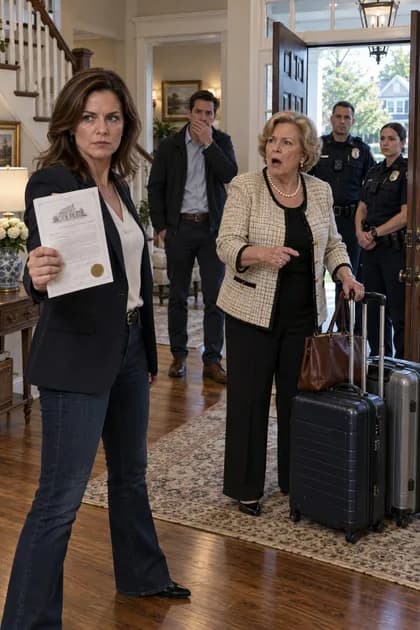
Natalie reached into the pocket of her cream-colored coat.
When her hand came back out, she was holding a folded piece of paper.
Not an ultrasound.
Not a photograph.
A letter.
She looked at Ethan first.
“You told me you never had any reason to believe Grace was pregnant.”
Ethan stood slowly.
“Natalie.”
“No.”
Her voice wasn't loud.
That made it worse.
“You've spent the last six months telling me your ex-wife fabricated a pregnancy during your divorce. You told me there was never documentation. Never medical evidence. Never anything except phone calls you thought were manipulative.”
Ethan glanced toward me.
Then toward his parents.
“Natalie, this isn't the time.”
“I think eight years late qualifies as the time.”
She unfolded the paper.
My stomach tightened before I even knew why.
Natalie looked at me.
“I found this two weeks ago.”
“Where?”
“In Ethan’s old divorce file.”
I felt something inside me go cold.
Ethan’s father turned sharply toward his son.
“What file?”
Natalie continued before Ethan could answer.
“We've been organizing financial and legal documents before the wedding. Ethan gave me a box from his storage room and told me most of it could be shredded.”
She held up the page.
“This was inside.”
Ethan closed his eyes.
Natalie read the heading.
“Correspondence from Hargrove and Pierce. Family Law Division.”
I knew the name instantly.
Ethan’s divorce attorney.
Natalie’s voice changed as she read.
“Mr. Caldwell, your spouse has again notified this office that she is pregnant and has offered medical documentation. She has requested that you attend a prenatal appointment or authorize counsel to review the records. Please advise how you wish to proceed.”
No one breathed.
Natalie lowered the letter.
“At the bottom, Ethan wrote his response.”
She looked directly at him.
“Do you want to tell them what you wrote?”
Ethan didn't move.
So Natalie did.
“‘Do not engage. She is trying to delay the divorce. I will not participate in this.’”
The snow kept falling.
Soft.
Almost peaceful.
Nothing about the people standing in it was peaceful anymore.
Ethan’s mother made a sound like someone had struck her.
I stared at him.
Not because the letter told me anything I hadn't already known.
I had lived it.
But for eight years, some small part of me had wondered whether the attorney had filtered things.
Whether Ethan truly hadn't understood how serious I was.
Whether paperwork had disappeared into some legal office while two angry people dismantled a marriage.
Apparently not.
He had known there was documentation.
He had simply decided evidence was something he didn't need to see.
“You kept that?” I asked.
Ethan looked ashamed.
“I forgot it existed.”
I almost laughed.
“You forgot.”
“Grace—”
“You forgot the letter where your attorney told you your wife was offering medical proof that she was carrying your child.”
“I was angry.”
“So was I.”
“I thought you were trying to manipulate me.”
“And apparently that thought was convenient enough that you never had to check.”
His jaw tightened.
For the first time all night, I saw something familiar in him.
Not confidence.
Defensiveness.
The reflex that had destroyed us.
“You know what our marriage was like at the end.”
“Yes.”
“You know what we were doing to each other.”
“Yes.”
“You told me you didn't want the divorce.”
“For three weeks after you filed, Ethan. Then I accepted it.”
His eyes dropped.
I took one step closer.
“But you needed me to stay desperate in your version of the story. Because if I stopped trying to save our marriage, then you had to explain why I kept calling.”
He said nothing.
“The baby explained it.”
I pointed toward the letter.
“So you refused the explanation.”
His father exhaled slowly.
“My God.”
Ethan’s mother stared at the boys.
Then at me.
“We believed him.”
There was horror in her voice.
I met her eyes.
“Yes.”
She flinched.
“I’m sorry.”
I didn't answer.
Not because I wanted to punish her.
Because some apologies are too large to accept while they're still warm.
Natalie folded the letter again.
“I asked him about it when I found it.”
That surprised me.
I looked at Ethan.
He wouldn't meet my eyes.
“When?” I asked.
“Two weeks ago,” Natalie said.
My chest tightened.
One week before his invitation.
Natalie continued.
“He said the letter didn't prove anything. He said you had claimed pregnancy, but he still believed you could have been lying.”
Ethan’s father swore under his breath.
“And then,” Natalie said, “I asked him a simple question.”
Her eyes stayed on Ethan.
“If you were so certain she lied, why don't you contact her now?”
I already knew the answer before she gave it.
“He didn't want to.”
Natalie swallowed.
“So I told him I couldn't marry a man who had spent eight years accusing someone of something that serious without ever checking whether he was right.”
She glanced at me.
“The invitation came the next morning.”
Everything inside me went still.
I looked at Ethan.
“You didn't invite me because you'd moved on.”
He rubbed a hand over his face.
“Grace—”
“You invited me because Natalie found the letter.”
He stepped toward me.
“I thought if you came—”
“What?”
His silence answered first.
I understood.
And the realization was almost impressive in its cruelty.
“If I came alone,” I said, “you were going to use that as proof.”
Ethan’s face collapsed.
Nobody needed him to confirm it.
Natalie did anyway.
“He told me if there really were children, you would bring them up.”
I stared at him.
Eight years.
Four NICU bassinets.
Four sets of first steps.
Four first days of school.
Eight birthdays multiplied by four.
And Ethan had turned Christmas dinner into one more test I hadn't known I was taking.
Henry suddenly spoke.
“Did you think Mom was lying about us?”
His voice was small.
Every adult looked at him.
Ethan went pale again.
This was the moment he could have hidden behind divorce lawyers.
Anger.
Confusion.
Youth.
Pride.
He could have turned himself into the victim of a misunderstanding.
Instead, maybe because there were four children looking at him, he finally stopped.
“Yes,” he said.
Henry blinked.
Ethan’s voice shook.
“I did.”
“Why?”
Ethan looked at me as if I might rescue him.
I didn't.
That was his question to answer.
He crouched again, but he stayed several feet away this time.
“Because I was angry at your mom,” he said. “And I convinced myself that because I was angry, I didn't have to listen to her.”
Jack frowned.
“That doesn't make sense.”
“No,” Ethan said.
A tear slipped down his cheek.
“It doesn't.”
Sam tilted his head.
That tiny familiar gesture hit Ethan like a physical blow.
“So you didn't know us because you were mad?”
Ethan swallowed.
“I didn't know you because I made a terrible decision. Then I kept making the same decision for a very long time.”
Lucas, always the most serious, looked directly at him.
“Mom showed us the messages.”
I glanced at Lucas.
We had talked about what they were allowed to know.
Age-appropriate truth.
No poison.
No pretending.
“We know she told you,” he continued.
Ethan nodded.
“I know.”
Lucas shoved his hands into the pockets of his coat.
“Then you weren't missing.”
Ethan looked confused.
“What?”
“You weren't missing,” Lucas repeated. “You just didn't come.”
Ethan closed his eyes.
There are sentences adults spend thousands of dollars in therapy trying to find.
My eight-year-old found his in nine words.
When Ethan opened his eyes again, he looked older.
“Yes,” he said.
“I just didn't come.”
Nobody rushed to comfort him.
That mattered.
For eight years, Ethan had lived inside a story designed to protect him from discomfort.
That Christmas, no one protected him.
His mother began crying.
His father walked several steps away and stared across the field.
Natalie looked down at the engagement ring on her left hand.
Then she pulled it off.
Ethan saw.
“Natalie.”
She held the ring in her palm.
“I can understand making a terrible mistake during a divorce.”
He took a step toward her.
“Then please—”
“I can even understand fear making someone avoid the truth for a while.”
His hope lasted exactly one second.
“But eight years?”
She shook her head.
“And then when the truth found you again, you still didn't ask Grace directly. You invited her here to test her.”
“That isn't—”
“It is.”
“Natalie, please.”
She closed his fingers around the ring.
“I was supposed to marry you in April.”
He stared at her.
“I know.”
“I cannot marry a man who needs evidence to lose before he'll admit it exists.”
Then she stepped away.
Ethan didn't follow her.
Maybe because he finally understood that chasing one person while four children stood ten feet away would be grotesque.
Maybe because he had no idea which disaster he was supposed to address first.
His father did.
He walked back toward us.
“Grace.”
I turned.
Robert Caldwell had always been an imposing man.
Even in his sixties, he carried himself like someone used to people listening.
But there was nothing imposing about him now.
“I owe you an apology.”
I waited.
“When Ethan told us what happened during the divorce, I believed my son.”
“That part I understand.”
His eyes flickered.
“But I repeated it.”
I said nothing.
“To relatives. Friends. People who asked why the marriage ended.”
Ethan looked at him sharply.
His father continued.
“I helped turn his assumption into your reputation.”
That was the first apology of the night that reached somewhere deeper.
Because it named the damage.
Not just the intention.
The damage.
“I can't undo that,” Robert said. “But I can correct it.”
I nodded once.
“Then correct it.”
Ethan’s mother stepped closer.
“And the boys?”
All four immediately moved nearer to me.
I rested my hand on Sam's shoulder.
“The boys aren't a family inheritance you just discovered.”
Her face crumpled.
“I didn't mean—”
“I know.”
I softened my voice without softening the boundary.
“They're children. They don't owe anyone instant affection because you share DNA.”
Ethan looked at me.
“What happens now?”
There it was.
The question that mattered.
Not what have I done.
What happens now.
I had spent three weeks thinking about it.
I hadn't brought my sons here without preparing for what might happen afterward.
“You take a paternity test.”
He nodded immediately.
“Yes.”
“You don't introduce yourself at school.”
“Okay.”
“You don't show up at my house.”
“I won't.”
“You don't call them whenever you're lonely or guilty.”
His mouth tightened.
“I understand.”
“No, Ethan. I don't think you do yet.”
I stepped closer.
“You're feeling eight years of regret in one night. They're feeling one night of confusion after eight years of stability.”
He looked at the boys.
I continued.
“Your urgency is not their emergency.”
That silenced him.
“We verify paternity. Then we work with a family therapist who understands reunification. If the boys want contact, it happens gradually.”
“What if they don't?”
The question nearly broke his voice.
“Then you respect that.”
His eyes filled again.
“For how long?”
“As long as they need.”
He nodded.
“And if they do want me?”
“Then you show up.”
I held his gaze.
“Not when it's convenient. Not when your career allows you to feel heroic. Not when your parents want photographs. You show up for ordinary things.”
He listened.
“Homework. Dentist appointments. Soccer games where nobody scores. Fevers at two in the morning. Birthdays that aren't about you. Conversations where they're angry. Questions you won't enjoy answering.”
I took a breath.
“And you never, ever ask them to make you feel better about what you did.”
Ethan nodded slowly.
“I won't.”
“We'll see.”
I wasn't being cruel.
Promises were exactly how people like Ethan got ahead of consequences.
I wanted behavior.
Lucas tugged my sleeve.
“Can we go inside?”
Every adult stared at him.
He shrugged.
“I'm freezing.”
Henry immediately nodded.
“And I saw cookies through the window.”
For the first time that evening, I laughed.
A real laugh.
Short.
Surprised.
The tension cracked just enough to let everyone breathe.
I looked at the boys.
“Thirty minutes.”
Sam grinned.
“Forty-five?”
“Thirty.”
“Thirty-five?”
“Inside.”
They ran toward the house.
Not toward Ethan.
Toward warmth.
Food.
Christmas lights.
Normal things.
I watched Ethan notice.
That might have been his first real lesson in fatherhood.
Children's lives do not stop because an adult has finally arrived.
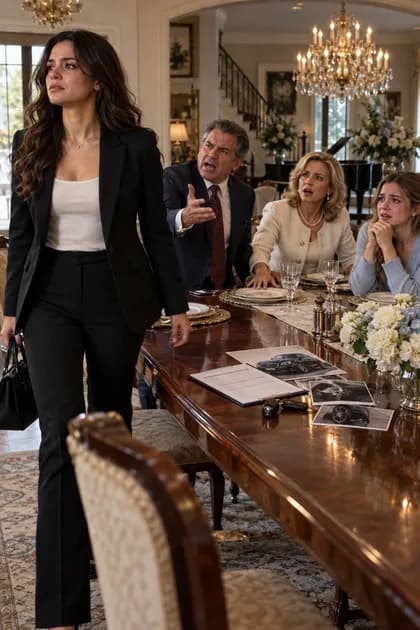
Inside, the Caldwell dining room looked exactly as I had imagined.
Tall candles.
Crystal glasses.
Silver serving dishes.
A Christmas tree large enough for a hotel lobby.
And at the center of the table, place cards.
ETHAN.
NATALIE.
ROBERT.
MARGARET.
Then relatives.
Then me.
Grace.
One card.
No boys.
Of course.
Margaret saw it at the same moment I did.
Her face changed.
She began gathering extra chairs herself.
“No,” I said gently.
She froze.
The boys were already in the adjoining room inspecting a gingerbread house with two cousins.
“They don't need formal seats tonight.”
Margaret looked confused.
“We have plenty of room.”
“I know.”
I lowered my voice.
“They've had enough adults staring at them for one evening.”
She understood.
A few minutes later, the boys ate cookies at the kitchen island while the carefully staged Caldwell Christmas dinner fell apart around them.
Natalie did not return to Ethan's side.
Robert disappeared into his study and made two phone calls.
Later I learned one was to Ethan's sister and the other to an uncle who had repeated the story about my supposedly fake pregnancy for years.
Robert didn't ask my permission to apologize.
He simply began correcting what he had helped spread.
That mattered too.
Ethan stood near the fireplace watching the boys.
He didn't approach them.
Not until Jack approached him.
Jack held a Christmas cookie shaped like a reindeer.
“You're really a major?”
Ethan blinked.
“Yes.”
“What do you do?”
For the first time that night, Ethan's face changed in a way that wasn't grief.
He answered Jack's question.
Simply.
No speech.
No attempt to become Dad in thirty seconds.
Jack listened for maybe a minute.
Then said, “Okay,” and wandered away.
Ethan looked at me.
I could see what that one minute had done to him.
I didn't rescue him from that either.
Thirty-five minutes later—because Sam had successfully negotiated five extra—I told the boys it was time to leave.
Ethan followed us to the foyer.
“Grace.”
I turned.
He was holding the old attorney letter Natalie had found.
“I want you to have this.”
I looked at it.
“No.”
He seemed surprised.
“Why?”
“Because I don't need it.”
I zipped Sam's coat.
“You do.”
Ethan stared at the page.
“For eight years, I had my records. I had the ultrasound images. I had the voicemail I left you. I had four children waking up in my house every morning.”
I met his eyes.
“I never needed one more piece of paper to know what happened.”
His fingers tightened around the letter.
“You did.”
He understood.
I opened the front door.
Cold air rushed in.
“Keep it.”
Then we left.
The paternity results came back in January.
There was no dramatic courtroom reveal.
No gasps.
No surprise.
Four separate results confirmed what every person standing in that snowy field had already known.
Ethan Caldwell was the biological father of all four boys.
He called me after receiving the report.
I answered because we had agreed communication about the children would remain direct and documented.
For several seconds, neither of us spoke.
Then he said, “I got the results.”
“So did I.”
“I don't know why part of me thought seeing it on paper would change something.”
“Did it?”
“No.”
A pause.
“It made it worse.”
I looked through the kitchen doorway.
Henry was pouring far too much syrup onto a waffle.
Sam was wearing one sock.
Lucas was reminding Jack about a school project.
A normal Saturday morning.
“For you,” I said.
“Yes.”
Another pause.
“I've opened accounts for them.”
I closed my eyes.
“Ethan.”
“I'm not trying to buy anything.”
“Good. Because you can't.”
“I know.”
His voice steadied.
“I spoke to an attorney. I want to establish support properly. Whatever I'm legally responsible for going forward, I will do. And if there are educational or medical expenses you want me contributing to—”
“We'll handle it through counsel.”
“Okay.”
“And the therapist sent possible appointment dates.”
“I'll take any of them.”
“That isn't what I asked.”
He stopped.
Old Ethan would have argued that flexibility proved commitment.
This Ethan caught himself.
“Right.”
I heard papers moving.
“Tuesday at five works. Thursday at four doesn't because I'm on duty. Saturday morning works.”
“Tuesday.”
“Tuesday.”
That was how it began.
Not with hugs.
Not with forgiveness.
Appointments.
Boundaries.
Consistency.
The boys met Ethan for the first time outside the Caldwell estate three weeks later in a therapist's office with beanbag chairs, board games, and a basket of plastic dinosaurs in the corner.
They called him Ethan.
He didn't correct them.
Lucas asked why he had believed I was lying.
Ethan answered.
Henry asked whether he had other children.
He said no.
Jack asked whether Natalie hated them because the wedding was canceled.
Ethan's face tightened.
“No. Natalie doesn't hate any of you.”
“Does she hate you?” Sam asked.
I nearly choked.
Even the therapist had to look away for a second.
Ethan gave the only honest answer available.
“She is very angry with me.”
Sam considered that.
“Mom used to be angry too.”
Ethan looked at me.
“Yes,” he said.
“She had a reason.”
That was the first time I heard him defend me without needing me to hear it.
Over the following months, he kept coming.
That sounds small.
It wasn't.
He came when Lucas refused to speak to him.
He came when Henry spent an entire session asking ridiculous questions about helicopters.
He came when Jack accused him of only wanting them because Natalie had left.
He came when Sam announced that sharing DNA didn't make someone a dad because “Mom says family is what people do.”
I had said something close to that once.
Leave it to Sam to sharpen it.
Ethan didn't argue.
He said, “Your mom is right.”
The first soccer game he attended was in March.
He arrived twenty minutes early.
No uniform.
No entourage.
No Caldwell relatives.
Just Ethan in jeans and a dark jacket holding four bottles of sports drink because he still hadn't learned that only two of the boys were playing that day.
I watched from several rows away.
He didn't sit beside me.
That was part of the boundary.
During halftime, Henry noticed him.
He ran over to the fence.
“You came.”
Three syllables.
Ethan looked like he'd been awarded a medal.
“I said I would.”
Henry nodded.
Then ran back onto the field.
That was all.
But Ethan stayed until the parking lot was almost empty.
His relationship with his parents changed too.
Robert corrected the story everywhere he had helped spread it.
Not delicately.
Not with euphemisms.
When a relative called the situation “a misunderstanding,” Robert stopped him.
“No,” he said. “My son was told. He chose not to verify it. We believed him and repeated his version. Those are the facts.”
Margaret asked before sending gifts.
She asked before requesting photographs.
She asked before referring to herself as Grandma around the boys.
The first time Sam voluntarily called her Grandma, she cried in my driveway and tried to hide it behind a grocery bag.
I pretended not to notice.
Natalie moved out of Ethan's house before New Year's.
I heard that from Ethan, not because he complained, but because the boys asked why she wasn't at his house during one of their later visits.
Months afterward, Natalie sent me one message.
I almost didn't open it.
Grace,
I owe you an apology too.
When Ethan first told me about you, I believed his version because it made my life easier to believe it.
Finding that letter forced me to ask questions I should have asked sooner.
For what it's worth, I'm sorry you were turned into a villain in a story built to protect someone else from his own choices.
I hope you and the boys are well.
Natalie.
I read it twice.
Then I wrote back.
Thank you.
That was enough.
Ethan never asked me to forgive him.
Not after the first few months.
Maybe therapy taught him that asking would still make his guilt my responsibility.
Maybe he finally understood it himself.
One evening in August, almost eight months after Christmas, he came to return the boys after an afternoon at the aviation museum.
They piled through my front door talking over one another.
“Mom, Dad showed us—”
Henry stopped.
The whole porch went silent.
Ethan froze.
So did I.
Henry's eyes widened as if he'd accidentally sworn.
He looked at his brothers.
Then at Ethan.
Then at me.
“I mean Ethan.”
Ethan's expression didn't change.
But his hand tightened around the strap of the backpack he was carrying.
I could see how badly he wanted to say something.
He didn't.
“Either one is fine,” I told Henry.
Henry studied me.
Then looked at Ethan.
“Okay.”
He ran inside.
Ethan stood on the porch after the other boys followed.
For several seconds, he couldn't speak.
Finally he said, “I didn't ask him to.”
“I know.”
“I never would.”
“I know.”
His eyes were wet.
He looked toward the doorway.
“I don't deserve how much they've given me.”
“No.”
He flinched, but I wasn't finished.
“You didn't deserve to miss them either.”
He looked at me.
“That was your choice.”
The truth of it settled between us.
Not cruel.
Not comforting.
Just true.
Ethan nodded.
“I know.”
I had imagined that conversation in different forms for years.
In some versions I screamed.
In others, he begged.
In one particularly satisfying version from the hardest NICU nights, I shut the door in his face before he could finish apologizing.
But standing there eight years later, I realized revenge had never been the thing I wanted.
I wanted the truth to stop being negotiable.
I wanted my sons protected from someone else's pride.
I wanted Ethan to understand that regret did not create entitlement.
And I wanted the life I had built without him to remain mine.
All of that had happened.
“There's something else,” Ethan said.
I waited.
“I corrected my military emergency records.”
I frowned.
“They list the boys now.”
Something in my chest shifted.
He continued.
“And I changed the person authorized to receive notification if something happens to me. My attorney has the documents. There are provisions for all four boys.”
“Ethan—”
“I know paperwork isn't fatherhood.”
His voice was quiet.
“But eight years ago, paperwork was offered to me and I refused to look at it.”
He glanced down.
“I don't do that anymore.”
That was when I knew he had finally understood the letter.
Not as evidence against me.
As evidence against the man he'd allowed himself to become.
I nodded.
“Good.”
He stepped off the porch.
Then stopped.
“Grace.”
“Yes?”
“Thank you for bringing them that Christmas.”
I thought about that night.
The snow.
The helicopter blades.
The horrified faces behind the terrace windows.
Four boys walking beside me without understanding that their existence was about to demolish eight years of lies.
“I didn't bring them for you.”
He smiled sadly.
“I know.”
That answer mattered more than the thank-you.
I watched him walk to his car.
Behind me, four voices erupted from the kitchen.
One wanted a snack.
One couldn't find his charger.
Someone had apparently stolen someone else's hoodie.
And Sam was yelling that the dog had eaten half a sandwich he absolutely had not been given permission to make.
I closed the door.
For years, people had spoken about my life as if Ethan leaving had been the defining event.
It wasn't.
The defining events were everything that happened afterward.
Four premature babies surviving.
Four first words.
Four first steps.
Four little boys learning to ride bicycles while I ran behind them.
Four children becoming people while the man who doubted they existed built his life somewhere else.
Christmas didn't give me revenge.
It gave Ethan reality.
There was a difference.
He didn't get his old family back.
There had never been an old family to restore.
He was given the chance to build a relationship with four boys who had every right to decide what place he would occupy in their lives.
Sometimes they called him Ethan.
Sometimes, eventually, they called him Dad.
He learned not to react too strongly to either.
His parents became grandparents slowly.
Natalie built a life that no longer required her to ignore questions she was afraid to ask.
And me?
I stopped carrying the strange, invisible burden of being the only person who knew exactly how the story had happened.
The truth was finally where it belonged.
Out in the open.
Not because a letter had survived eight years in a box.
Not because a laboratory printed four paternity results.
And not because Ethan finally admitted he had been wrong.
The truth had been alive the entire time.
Lucas.
Henry.
Jack.
Sam.
Four boys who never needed their father's belief in order to exist.
On Christmas night, Ethan had looked at them and whispered, “What have I done?”
Eight months later, standing in my quiet doorway after he left, I finally knew the answer.
He had lost eight years.
He could never get them back.
But for the first time, he had stopped wasting the years still ahead.
And that was the only ending I was willing to give him.
THE END.
Chapter complete
You have reached the end of this chapter.
Continue reading
Find your next story
A few more worlds to get lost in after this chapter.