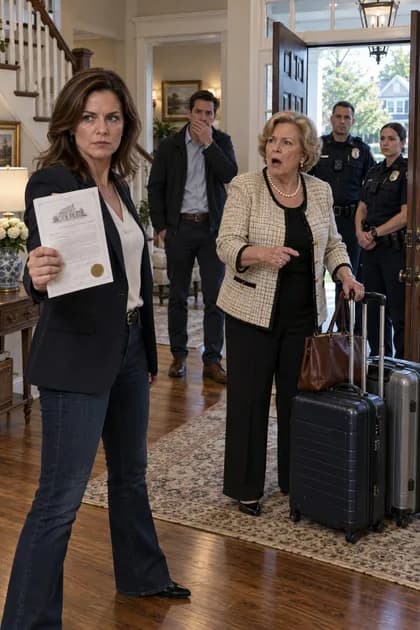
No one spoke for several seconds.
Chapter 4
No one spoke for several seconds.
Then Malcolm Reed asked the question every director was thinking.
“Which board member?”
Sienna shook her head.
“I don’t know. Garrick never said a name. I saw envelopes and a ledger once. He caught me near the safe and told me if I ever touched it, I would regret it.”
Raymond looked toward the detectives.
“Secure the office.”
Because the safe belonged to a residence tied to a corporate entity and the contents could relate to an active criminal investigation, no one simply marched upstairs and opened it.
That mattered.
Procedure matters most when everyone in the room already believes they know the truth.
Raymond obtained consent from the property company’s authorized counsel to preserve the room while detectives sought the proper warrant.
For the next two hours, the Ashford mansion became a place none of the people who had ruled it recognized.
Phones were collected where legally appropriate.
Statements
were taken separately.
Dr. Chen arranged for Sienna to be transported for imaging.
Before she left, she refused to go upstairs alone to pack.
So I went with her.
Her bedroom looked beautiful from the doorway.
Cream carpets.
Silk curtains.
A sitting area facing the garden.
Then I noticed the lock on the inside of the closet.
Not the bedroom door.
The closet.
Sienna saw me staring at it.
“He would tell me to go in there when I embarrassed him in front of his family.”
I looked at her.
“How long would he keep you there?”
“Sometimes an hour.”
She swallowed.
“Once until morning.”
I closed my eyes.
There are moments when a mother wants to rewrite time with her bare hands.
I could not.
So I helped her pack.
Not everything.
Just enough for a week.
Clothes.
Medication.
Her father’s watch.
A framed photograph of the three of
us at Lake Michigan when she was twelve.
At the bottom of a drawer, she found an old birthday card I had sent six months earlier.
It was unopened.
She stared at it.
“He told me you were trying to control me.”
I sat on the edge of the bed.
“And what did you think?”
“At first, that he was jealous.”
She gave a broken little laugh.
“Then he started saying you looked down on him. That you hated his family. That every time I spoke to you, I came home disrespectful.”
She looked at the unopened card.
“Eventually it was easier not to call.”
Isolation rarely arrives looking like a locked door.
Sometimes it arrives as exhaustion.
As guilt.
As one canceled dinner at a time.
I put the card in her bag.
“You can open it whenever you want.”
At the hospital, imaging confirmed a fracture near the
shoulder and two healing rib injuries.
The report did not decide the criminal case.
But it documented what had happened to her body.
That night, Sienna came home with me.
Not to the house where she grew up.
I had sold that after Daniel died.
She came to the smaller townhouse I bought because I no longer wanted rooms that echoed.
At two in the morning, I found her standing in my kitchen staring at the refrigerator.
“Can I have something?”
The question nearly destroyed me.
“It is your home too.”
She nodded but did not move.
“What do you want?”
“I don’t know.”
So I made scrambled eggs the way Daniel used to make them, with too much butter and black pepper.
She ate half.
Then she slept for eleven hours.
The warrant for Garrick’s office was executed the next morning.
Inside the safe, investigators found the ledger.
They also found cash, encrypted drives, signed vendor approvals, and copies of messages Garrick apparently believed would protect him if anyone in the scheme betrayed him.
The board member receiving payments was not Malcolm.
It was Walter Vance, chairman of the compensation committee.
Walter had quietly supported Garrick’s promotion for eighteen months.
In exchange, according to the ledger, he received consulting payments routed through a company owned by his son-in-law.
By noon, Walter resigned.
By three, federal investigators had been contacted.
Ashford Industries issued a public statement announcing an independent investigation, the suspension of Garrick Ashford, the resignation of Walter Vance, and a full review of related-party transactions.
No mention of Sienna appeared.
That was her choice.
For once, the company did not get to use her pain as public relations.
Miriam hired attorneys.
Garrick hired three.
North Coast’s accounts were frozen.
Victor Shaw began cooperating.
The criminal process moved more slowly than people expect.
There was no dramatic trial the next morning.
No judge banging a gavel before lunch.
Real consequences take paperwork, interviews, motions, evidence, and time.
But Garrick’s world changed immediately.
The promotion vanished.
His access to the company disappeared.
The lenders who had counted on his executive compensation moved against him.
His social circle stopped returning calls.
And the family members who had laughed at Sienna during Sunday dinner discovered that cruelty becomes less entertaining when investigators ask who witnessed it.
Garrick’s sister called Sienna first.
She apologized.
Sienna listened.
Then she said, “You watched.”
There was a long silence.
“I was afraid of him too,” his sister said.
Sienna’s face softened, but not enough to erase the truth.
“So was I.”
She did not forgive her that day.
She did not have to.
Three weeks later, Sienna filed for divorce.
She also sought a protective order.
For the first hearing, she asked me to sit behind her.
Not beside her.
Behind her.
“I need to do the talking,” she said.
I understood.
In court, Garrick’s attorneys described their marriage as volatile.
They called the injuries accidental.
They suggested Sienna had exaggerated events after learning her mother controlled significant voting power in the company.
Then the security footage was introduced.
Not every room had cameras.
But the hallway outside Garrick’s office did.
It showed Sienna stumbling into view, clutching her shoulder.
It showed Miriam approaching her.
And it captured enough audio to make the courtroom silent.
Miriam’s voice said, “Cover that bruise before Sunday. Your mother notices everything.”
Garrick’s lawyer stopped speaking.
The judge granted the protective order.
Outside the courthouse, reporters waited behind barriers.
Sienna could have walked out the side entrance.
Instead, she chose the front steps.
She did not make a speech.
She did not accuse the entire Ashford family.
She simply said, “I am safe. I am cooperating with the investigation. I hope anyone living in fear tells one person they trust.”
Then she walked to the car.
That sentence appeared on local television all evening.
Six months later, Ashford Industries completed its internal review.
The board recovered millions through insurance claims, settlements, and frozen assets.
Several executives left.
New compliance rules were adopted.
The trust I controlled did not take over the company.
That surprised people.
I could have forced more changes.
I could have demanded a chair.
Instead, I nominated three independent directors with no ties to the Ashford family.
Power is most dangerous when people start believing possession makes them righteous.
I had watched one family make that mistake.
I had no intention of repeating it.
Sienna began therapy.
She rented an apartment with enormous windows and no formal dining room.
The first time I visited, she served takeout noodles in mismatched bowls.
When she dropped a fork, she froze.
Only for a second.
Then she bent down, picked it up, and laughed at herself.
That laugh stayed with me.
A year after that Sunday dinner, Garrick accepted a plea agreement on financial charges connected to North Coast while the assault case proceeded separately under state law.
Miriam also faced financial charges tied to the shell company.
The outcomes were complicated, imperfect, and slower than anger would have preferred.
But Sienna no longer measured justice by what happened to them.
She measured recovery by what returned to her.
Sleep.
Friends.
Music in the kitchen.
Sleeveless dresses.
The ability to disagree without bracing for impact.
One Sunday, she invited me to dinner.
I arrived ten minutes early.
The door was unlocked.
Inside, Sienna stood at the stove with both arms free, stirring sauce while music played.
She turned and smiled.
Not the careful smile from the mansion.
Her real one.
“Mom, you’re early.”
This time her voice did not shake.
I set my handbag down.
“Need help?”
She looked at the table, then back at me.
“No.”
She smiled wider.
“But you can pour the wine.”
So I did.
And for the first time in a very long time, Sunday dinner was only dinner.
THE END.
Chapter complete
You have reached the end of this chapter.
Continue reading
A few more worlds to get lost in after this chapter.