PART 1 — The Letter Inside My Locked Apartment
I retired quietly and bought a new home without telling anyone.
Chapter 1
PART 1 — The Letter Inside My Locked Apartment
I retired quietly and bought a new home without telling anyone.
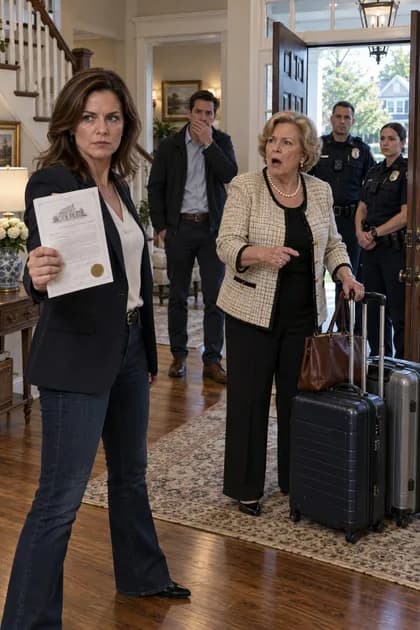
When my son called and casually asked, “Which side of town is it on?” I checked the security cameras—and saw his entire family already inside, walking through the rooms as though the place belonged to them. I didn’t confront them. I simply called my attorney, and the documents he prepared changed their plans completely…
The Letter Inside My Locked Apartment
The letter was waiting on my kitchen counter when I came home from Minnesota.
It had not been pushed beneath the door or placed in my mailbox. It sat beside my coffee maker, weighted down by the ceramic rooster my husband bought me at a county fair in 1987. Someone had moved the rooster six inches from its usual place, set the folded page beneath it, and left my blue pen on top as though my kitchen were a hotel desk.
I remained in the doorway with my coat buttoned
and my suitcase behind me.
My keys were still in my hand.
The apartment smelled faintly of microwave popcorn and the lavender spray my daughter-in-law used on everything she considered insufficiently fresh. A small plastic cup was wedged between the sofa cushions. There was a child’s handprint on the balcony door and a grocery receipt on the floor beside the trash can.
I did not need to unfold the letter to know who had written it.
Claire’s handwriting leaned forward with the same determined neatness she brought to party invitations, thank-you cards, and lists of things other people should improve.
I placed my suitcase against the wall, removed my coat, and washed my hands before touching the page. That detail may sound strange, but I wanted to feel composed. I had spent most of the flight home imagining this moment, and I refused to meet it with trembling fingers.
The
note contained six sentences.
Ellen,
We needed a place to stay while work was being done at the house, and since you were out of town, we used the apartment. The children had a wonderful time at the park. Nothing was damaged, and we cleaned before leaving. Matt will explain how we got the extra building fob. Please do not turn this into something larger than it needs to be.
Claire
At the bottom, in smaller writing, she had added:
You weren’t using it.
I read that last sentence three times.
You weren’t using it.
As if a home belonged only to the person standing inside it at a particular hour. As if my absence had converted the apartment into unused family inventory. As if thirty-one years of work, careful saving, and quiet sacrifice could be set aside because my son’s family wanted a convenient weekend near downtown.
I placed
the note back on the counter.
Then I looked around the apartment I had purchased without telling them.
The framed photograph of my husband, Paul, had been moved from the end table to the bookshelf. Two kitchen cabinets stood slightly open. The blanket I kept folded over the armchair had been used and returned inside out. A package of children’s crackers sat beside my tea, and someone had changed the temperature on the thermostat.
They had not only entered.
They had settled in.
The apartment was new to me, but the feeling was not. I had spent years watching my son and his wife treat my time, money, and attention as resources waiting to be reassigned.
The difference was that this time they had crossed a locked door.
I was sixty-three years old when I finally understood that being needed was not the same as being loved.
That realization did not arrive at once. It came in pieces, beginning years earlier with small requests that seemed reasonable.
My husband died on a Tuesday morning in October, eleven years before I found that letter.
Paul had been drinking coffee at our kitchen table when he stopped in the middle of a sentence and pressed one hand against his chest. One moment he was telling me the gutter above the garage needed cleaning. By lunchtime, I was sitting beneath fluorescent lights with his wedding ring in my palm.
We had been married twenty-six years.
He was a quiet man who believed repairs should be made before they became emergencies and bills should be paid before the envelope had time to gather dust. He kept every receipt, labeled every tool drawer, and wrote the date of purchase inside the cover of every appliance manual.
I used to tease him about it.
After he was gone, I found comfort in those dates. His handwriting remained in places grief could not reach: behind the furnace panel, inside the breaker box, on the cardboard sleeve of a replacement faucet.
Our son, Matthew, was twenty-two when his father passed.
He cried at the memorial service and called me every Sunday for several months. At first, those calls lasted an hour. Then thirty minutes. Then ten.
Eventually, they became occasional messages sent while he was driving somewhere else.
I told myself that was normal. Young adults built their own lives. I did not want to become the mother who treated independence like abandonment.
Matt met Claire the following year.
She was polished, organized, and confident. She entered a room the way a real estate appraiser entered a property, noticing everything within seconds. She had opinions about my curtains, my neighborhood, the age of my appliances, and the way I arranged dishes in the dishwasher.
“Plates should face inward,” she told me during her second visit.
“They still get clean.”
“It’s more efficient this way.”
She rearranged them while I stood beside her holding a dish towel.
I decided she was particular.
That was the word I used whenever her behavior made me uncomfortable.
Particular.
Direct.
Ambitious.
I avoided words like controlling because those words required action.
Chapter complete
You have reached the end of this chapter.
Continue reading
A few more worlds to get lost in after this chapter.