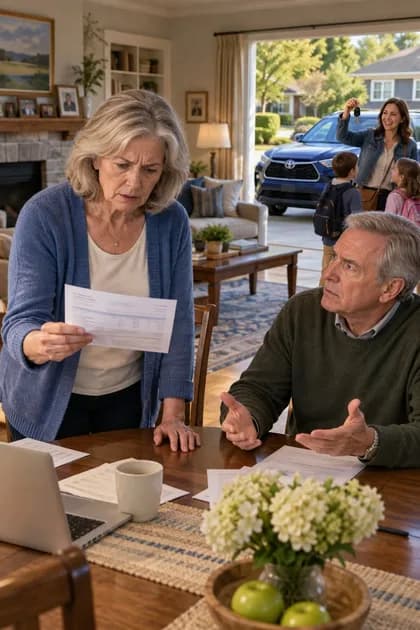
The moment my son asked me to pay $600 a month for his guest room, I told myself not to make it personal.
Chapter 1
THE SIX HUNDRED DOLLARS THAT CHANGED WHAT FAIR MEANT
4,888 words
Then I discovered his mother-in-law had been living downstairs for fourteen months.
Rent-free.
That was when “keeping things fair” suddenly became a very interesting phrase.
And just when I was ready to confront everyone in that house, Marjorie looked me straight in the eye and said, “Come downstairs at 5:45 tomorrow.”
But I’m getting ahead of myself.
Trent waited until my third morning in his house to mention the money.
We were standing in the kitchen. I was making coffee while he divided grapes between two plastic containers for the kids’ lunches.
“Mom, Allison and I talked.”
I slowly lowered my coffee mug.
That sentence has never introduced anything enjoyable.
“About?”
He snapped the lid onto one container.
“We thought six hundred a month would be fair while you’re here.”
I stared at him.
“Rent?”
“Not really rent.”
I raised an eyebrow.
“What do you call money someone pays every
month to live somewhere?”
He gave me that patient little smile adult children use when they think their parents are being deliberately difficult.
“You know what I mean.”
Actually, I didn’t.
My name is Paula Whitmore. I was sixty-three, newly retired after twenty-eight years of bookkeeping, and temporarily homeless for exactly seven weeks.
Not homeless in the tragic sense.
My townhouse had simply sold much faster than I expected.
The condo I’d bought in a fifty-five-plus development technically belonged to me already, but new flooring and a delayed kitchen repair meant I couldn’t move in yet.
Originally, I planned to rent a furnished apartment.
Trent stopped me.
“Why waste the money?” he’d said.
He and Allison had a four-bedroom house, two kids, an upstairs guest room, and a finished basement bedroom.
“Stay with us,” Trent insisted.
“You’ll barely know I’m there,” I promised.
Apparently, what I should have asked was
whether the invitation came with a rate sheet.
Instead, I moved in with two suitcases, one box of important papers, and enough clothes to survive seven weeks without touching my storage unit.
Now my own son was asking me for $600.
I could afford it.
That wasn’t what bothered me.
The townhouse sale had gone well. I had retirement savings and no debt other than the small mortgage on my new condo.
Six hundred dollars wasn’t going to hurt me.
Still, I asked, “Why didn’t you mention this before I moved in?”
Trent looked genuinely surprised.
“I didn’t think it would be a big deal.”
“That isn’t an answer.”
“Food. Utilities. Water. You’re here every day now.”
I looked into my coffee.
“Every day is generally how living somewhere works.”
He laughed.
I didn’t.
Then Allison walked in carrying four-year-old Ivy’s shoes.
“Did you talk to her?”
Trent nodded.
Allison
turned to me.
“We’re not trying to make money off you.”
“I didn’t say you were.”
“We just thought everybody contributing would keep things comfortable.”
Everybody.
That word caught my attention.
But I let it go.
That afternoon, I transferred the $600.
I even labeled the payment:
September household.
Not rent.
Apparently, that distinction mattered to everyone except me.
For the first week, things were fine.
Actually, better than fine.
My seven-year-old grandson, Carter, wandered into my room before school to ask dinosaur questions I had absolutely no qualifications to answer.
Ivy considered my jewelry box public property.
Allison worked three long days a week at a physical therapy office. Trent managed inventory for a regional plumbing supplier.
Everyone was constantly coming and going.
Except one person.
Allison’s mother.
Marjorie Bell.
She was sixty-five, widowed, and retired from an elementary school cafeteria.
As far as I knew, she was visiting.
I’d seen plenty of Marjorie over the years—birthday parties, Christmas dinners, school programs.
She was quieter than me.
Better with children.
Much worse with directions.
We got along well enough, but we’d never developed a friendship independent of our children.
On my fifth night in the house, I went downstairs looking for a phone charger.
The basement door was open.
Marjorie was sitting on the bed, folding towels.
I stopped in the doorway.
“I didn’t know you were staying tonight.”
She glanced up.
“I stay every night.”
I waited for her to laugh.
She didn’t.
“Since when?”
“Last summer.”
My brain stalled.
“Last summer?”
She nodded.
Fourteen months.
Then I really looked around.
Framed photographs sat on the dresser.
Shoes were lined neatly beneath a chair.
There was a quilt I remembered from Allison’s old apartment, a television, a small desk, toiletries in the bathroom.
These weren’t guest-room belongings.
This was a life.
“Oh.”
Marjorie folded another towel.
“Nobody told you?”
“Apparently not.”
She chuckled.
“Welcome to the communication department.”
The next morning, I waited until breakfast.
“Marjorie lives here?”
Trent looked up from his phone.
“Yeah.”
“For fourteen months?”
“Something like that.”
I asked the question before I could soften it.
“Does she pay rent?”
Allison turned toward me.
“No.”
One word.
I waited.
Nothing else came.
Finally, Trent said, “It’s different.”
Of course it was.
“How?”
“She helps with the kids.”
Allison quickly added, “A lot.”
I glanced toward the basement door.
“How much is a lot?”
Neither of them answered.
Instead, Trent sighed.
“Mom, please don’t turn this into some fairness thing.”
That sentence accomplished exactly the opposite of what he intended.
For the next two days, I noticed everything.
Marjorie ate dinner with us.
She used the washing machine.
She had food in the refrigerator.
She had her own bathroom downstairs.
She paid zero dollars.
Meanwhile, I had Venmoed my son $600 because apparently my showers threatened the household economy.
I became petty.
I’m not proud of it.
I noticed when Marjorie opened a fresh carton of milk.
I noticed her laundry basket.
I noticed her packing leftovers into containers.
Once, she held up the last yogurt and asked if anyone wanted it.
I nearly said, Apparently it’s included in your lease.
Somehow, I stopped myself.
Barely.
Then Saturday morning, Allison and I were unloading groceries when Marjorie came through the door carrying Ivy, asleep against her shoulder.
Marjorie looked exhausted.
Allison immediately said, “Mom, put her down. You’ve had them all morning.”
Marjorie carried Ivy upstairs.
I stared at the grocery receipt in my hand.
Then at Allison.
“So she really pays nothing?”
Allison’s shoulders stiffened.
“Paula.”
“I’m asking.”
“No. She doesn’t pay rent.”
“And I’m paying six hundred.”
“Mom does more than enough.”
There was that word again.
Enough.
“What exactly does she do?”
Allison shut the refrigerator harder than necessary.
“Why does this matter so much to you?”
I didn’t have a flattering answer.
Because somewhere inside me, it felt like her mother had been declared valuable...
while I had been handed an invoice.
That evening, I sat alone on the back patio.
After a few minutes, the door opened.
Marjorie stepped outside and lowered herself into the chair beside me.
Neither of us spoke at first.
Then she said, “You think I’m freeloading.”
I turned toward her.
“I didn’t say that.”
“You don’t have to.”
Heat climbed into my face.
She was right.
“I’m sorry.”
“No, you’re not.”
That irritated me enough that I almost got up.
Then Marjorie smiled.
Just a little.
And the expression on her face changed something.
Not anger.
Not embarrassment.
Something closer to exhaustion.
She stood.
“Come downstairs tomorrow at 5:45.”
I frowned.
“For what?”
“Nothing special.”
Then she opened the patio door and glanced back at me.
“Just come see what free looks like.”
At 5:45 the next morning, I walked downstairs expecting an explanation.
Instead, I found Marjorie already dressed, packing two lunches while a load of laundry spun behind her.
“Quiet,” she whispered. “You’ll wake the kids.”
Before six, she had started breakfast, laid out Carter’s school clothes, found Ivy’s missing shoe, and cleaned up the cereal Trent had spilled the night before.
At 6:20, Allison came downstairs looking half-awake.
“Thanks, Mom,” she murmured, grabbing coffee.
At 6:45, Trent rushed through the kitchen.
“Can you take Carter to school today?”
Marjorie nodded.
“And Ivy has preschool at nine,” Allison added. “Then could you pick up my prescription?”
Another nod.
Nobody asked whether she had plans.
Nobody offered money.
By eight o’clock, I had watched Marjorie cook, clean, organize backpacks, referee a fight over a stuffed dinosaur, and buckle two children into the car.
She looked at me before leaving.
“This is what I do every weekday.”
I swallowed.
Suddenly, fourteen months of free rent looked very different.
But then Marjorie lowered her voice.
“And Paula… there’s something else you don’t know about that six hundred dollars.”
My stomach tightened.
“What?”
She glanced toward the stairs.
“Ask Trent where your money is really going.”
I stood there for a moment after she drove away.
Then I went upstairs.
Trent was in the kitchen staring at his phone while eating toast over the sink.
“Where’s my six hundred dollars going?”
He stopped chewing.
That was all the answer I needed to know that Marjorie hadn’t been guessing.
“What?”
“You heard me.”
“Toward the house.”
“That’s not what I asked.”
He put the toast down.
“Mom, I have to leave for work.”
“Then this should be a very fast conversation.”
His eyes flicked toward the stairs.
“Allison and I agreed—”
“No.”
I held up one hand.
“I’m not asking what you agreed. I’m asking what happened to the six hundred dollars I transferred.”
He exhaled through his nose.
“It went into savings.”
I stared at him.
“For utilities?”
“Not exactly.”
“For food?”
“No.”
“For the extra water I’ve apparently been recklessly consuming?”
“Mom.”
“What savings?”
Trent rubbed the back of his neck.
That nervous habit had been there since he was twelve.
Finally he said, “Vacation savings.”
For a second, I genuinely thought I had misheard him.
“Excuse me?”
“We have a family trip booked for November.”
I looked at him.
Then I laughed.
Not because anything was funny.
It was the kind of laugh that escapes when your brain hasn’t decided whether you should yell.
“You charged me six hundred dollars for household expenses and put it toward a vacation?”
“It’s all household money.”
“No, Trent. Words still have meanings.”
He straightened.
“You said you could afford a furnished apartment. You were going to spend way more than six hundred anyway.”
There it was.
Not necessity.
Not utilities.
Opportunity.
I felt something in me go very still.
“So because I could afford to spend money somewhere else, you decided you were entitled to some of it.”
“That’s not what I said.”
“It is exactly what you said.”
Allison appeared in the doorway.
“What’s going on?”
I looked at her.
“Apparently I’m helping fund your November vacation.”
Her face changed.
Not surprise.
Recognition.
“You told her?” she asked Trent.
That hurt more than I expected.
Because until then, some small part of me had hoped this was Trent’s stupidity alone.
“You knew.”
Allison crossed her arms.
“We both knew.”
“Why?”
She glanced at Trent, then back at me.
“Because we thought it was fair.”
That word again.
Fair.
I leaned against the counter.
“Explain it.”
Allison’s voice sharpened.
“My mother contributes here every single day. She watches the kids. She cooks. She helps with laundry. You don’t.”
I blinked.
“I’ve been here nine days.”
“That’s not the point.”
“It seems highly relevant.”
“You came here as an adult with retirement income. Mom came here because we needed her.”
From the way she said it, you might have thought that settled everything.
But now I had seen Marjorie at 5:45 in the morning.
I had seen her tired face.
I had watched everyone hand her tasks without asking.
So instead of defending myself, I asked something else.
“How many hours a week does your mother watch the kids?”
Allison hesitated.
“I don’t know.”
“You’ve lived this arrangement for fourteen months and you don’t know?”
“It varies.”
“Thirty?”
No answer.
“Forty?”
Trent picked up his keys.
“Mom, this is getting ridiculous.”
“Actually, it’s finally becoming clear.”
I had spent twenty-eight years doing books for small businesses.
I knew what happened when people used vague words like contribution instead of numbers.
Numbers made people uncomfortable when numbers told the truth.
I looked at Allison.
“If your mother’s labor is her contribution, fine. But then call it labor.”
“She doesn’t mind.”
A voice came from behind us.
“Yes, I do.”
We all turned.
Marjorie stood near the basement stairs.
She had returned without my noticing.
Carter was beside her, clutching his backpack.
Allison’s face dropped.
“Mom.”
Marjorie looked at her daughter.
“I love helping with the children.”
Her voice was calm.
“That is not the same thing as not minding being on call every day.”
Nobody spoke.
Carter looked between the adults.
Marjorie touched his shoulder.
“Go get your water bottle, sweetheart.”
He disappeared down the hallway.
Then she continued.
“When I moved in, the agreement was three afternoons a week and mornings when Allison worked early.”
Allison looked away.
My eyes moved to Trent.
“What happened?”
“Life happened,” he said.
Marjorie gave him a tired smile.
“Yes. And somehow life kept happening onto my calendar.”
That sentence landed harder than shouting would have.
Allison unfolded her arms.
“Mom, if you felt that way, why didn’t you say anything?”
“I did.”
“When?”
“March.”
Silence.
“April.”
Allison’s face flushed.
“And June.”
Trent muttered, “We talked about getting another sitter.”
“You talked about it,” Marjorie said. “Then you saw what sitters cost.”
I almost smiled.
Not because I enjoyed their discomfort.
Because the bookkeeping part of my brain had just found the missing column.
Marjorie’s rent wasn’t free.
It was simply being paid in a currency no one had bothered to count.
I looked at my son.
“And my six hundred?”
He sighed.
“We needed to rebuild the vacation account after we had to use part of it for Carter’s summer camp.”
“So you charged me.”
“You were staying here.”
“After inviting me not to rent an apartment.”
Nobody had an answer for that.
I went upstairs and closed my bedroom door.
For ten minutes, I did what I had done for nearly three decades whenever emotion threatened to make a financial problem harder than it needed to be.
I made a spreadsheet.
It wasn’t elaborate.
Hours.
Tasks.
Estimated local childcare rates.
Meals.
School runs.
Preschool pickups.
Laundry.
Even using the conservative numbers, Marjorie was contributing well over two thousand dollars a month in labor.
Probably closer to three.
Then I opened the furnished-rental listing I had saved before Trent talked me out of it.
The apartment was still available.
A small one-bedroom twelve minutes away.
Month-to-month.
More expensive than Trent’s guest room, certainly.
But it came with something his guest room apparently didn’t.
Clear terms.
I called.
By lunch, I had a move-in date for Wednesday.
Then I called the contractor working on my condo and told him I wanted an updated completion schedule in writing.
After that, I sent Trent one text.
We need to talk tonight. All four adults.
He responded almost immediately.
Mom, don’t make this dramatic.
I stared at those words for several seconds.
Then I typed back:
I’m a bookkeeper. I’m making it specific.
At seven that night, Carter and Ivy were upstairs.
The four of us sat around the dining table.
I brought one sheet of paper.
Trent saw it and groaned.
“Seriously?”
“Yes.”
I slid copies across the table.
“This is an estimate of what Marjorie contributes every month based only on the schedule I personally observed and what she told me the original agreement was.”
Allison scanned the page.
Her lips parted slightly.
Trent barely looked at his.
“This is ridiculous. She’s their grandmother.”
Marjorie’s expression changed.
Not much.
But enough.
I turned toward him.
“And I’m your mother.”
He went quiet.
I continued.
“You can’t use family when it benefits you and market rates when it benefits you.”
Allison pushed the paper away.
“We never asked her to calculate her time.”
“No. That appears to be the problem.”
Marjorie spoke before Allison could answer.
“I don’t want three thousand dollars.”
We looked at her.
“I want Tuesdays and Thursdays to myself.”
Allison frowned.
“But Thursday is my late day.”
“Then you need a sitter on Thursday.”
“Mom—”
“And I want Saturday mornings back unless you ask me in advance.”
Allison looked stunned.
Marjorie folded her hands.
“I will help because I love you. I will not be automatically available because I live downstairs.”
That was the first boundary.
Mine came next.
“I’m moving out Wednesday.”
Trent looked at me.
“What?”
“The furnished apartment I originally planned to rent is still available.”
“Mom, come on.”
“I’m not angry because you asked for money. You have every right to charge someone to live in your house.”
He looked relieved too soon.
I continued.
“But you don’t have the right to invite me here specifically so I won’t spend money on a rental, wait until I unpack, then invent a fee and lie about what it’s for.”
“We didn’t lie.”
I looked directly at him.
“You told me food, utilities, and water.”
He said nothing.
“That was a lie.”
Allison’s eyes dropped to the table.
I pushed one final piece of paper toward Trent.
It was a printout of my transfer.
September household.
“I want the six hundred returned.”
His eyebrows went up.
“You stayed here.”
“Yes. And if you had told me before I arrived that the room cost six hundred, I would agree with you.”
I tapped the paper.
“But you didn’t.”
“This is petty.”
“No. Petty was me counting how many yogurts Marjorie ate.”
Marjorie covered a smile.
“This is a boundary.”
Trent leaned back.
“So you’re really going to blow up the family over six hundred dollars?”
There are questions that tell you more about the person asking them than any answer ever could.
I looked at my son.
“No. I’m moving twelve minutes away because you turned hospitality into a transaction after the transaction had already begun.”
He stared at me.
“And because when I questioned it, you made me feel unreasonable instead of simply telling me the truth.”
Nobody spoke.
Then Marjorie added quietly, “She’s not the one who made it about money.”
That ended the conversation.
The next morning, something strange happened.
The house ran late.
Marjorie did not come upstairs at 5:45.
She came up at 7:15.
By then Trent had burned toast, Allison had discovered Carter’s homework still sitting on the printer, and Ivy was wearing two different socks while insisting one shoe had been stolen by a squirrel.
I sat at the table drinking coffee.
Nobody asked me to fix anything.
I didn’t.
That part was harder than I expected.
At 7:27, Trent looked toward the basement door.
“Is Marjorie sick?”
I almost choked on my coffee.
“No,” Marjorie said, appearing behind him fully dressed.
“I slept until seven.”
Allison stared at her.
“Mom, Carter’s going to be late.”
Marjorie picked up her purse.
“Then you should leave.”
“Where are you going?”
“Breakfast.”
“With who?”
Marjorie looked at me.
“Paula.”
I had not known about this plan.
But I stood immediately.
“Absolutely.”
We left them in the kitchen.
At a diner three blocks away, Marjorie laughed so hard she had to put down her coffee.
“I’ve wanted to do that for six months.”
“You could have warned me.”
“You’re retired. I assumed you were free.”
I pointed my fork at her.
“Careful. Apparently freedom has a monthly rate.”
She laughed again.
Then her expression softened.
“I owe you an apology too.”
“For what?”
“I knew they were charging you before I said anything.”
I frowned.
“How?”
“I heard Allison and Trent talking the night before they asked.”
That surprised me.
“Why didn’t you tell me?”
“Because at first I thought it wasn’t my business.”
She looked down at her coffee.
“Then Allison said something that bothered me.”
“What?”
Marjorie hesitated.
“She said, ‘Paula was willing to pay for an apartment anyway. We might as well keep some of that money in the family.’”
I sat very still.
There it was.
The part that hurt.
Not the six hundred.
The calculation.
I nodded slowly.
“Thank you for telling me.”
“I almost didn’t.”
“I’m glad you did.”
Wednesday morning, I packed my two suitcases.
Carter was devastated.
“You’re leaving forever?”
“I’m moving twelve minutes away.”
“That’s basically another country.”
At seven, geography is emotional.
I hugged him.
“You can visit.”
“Can I bring my dinosaurs?”
“Only the polite ones.”
He considered that.
“None of them are polite.”
“Then I suppose I’ll have to take the risk.”
Ivy contributed three plastic bracelets to my luggage and told me I was not allowed to lose them.
Trent carried my suitcase downstairs.
He had barely spoken to me since Monday night.
At the front door, he finally said, “I sent the money back.”
My phone had already notified me.
“I saw.”
He shifted his weight.
“I shouldn’t have said it was for utilities.”
“No.”
“And we should have talked about it before you moved in.”
“Yes.”
He gave me a tired look.
“You could make this easier.”
I picked up my purse.
“I did that for you for most of your childhood.”
That almost made him smile.
Almost.
Then his face became serious.
“Are you mad at me?”
I thought about it.
“Yes.”
His eyes dropped.
“But I’m not done loving you.”
He looked up.
“Those are different things, Trent.”
That was something I wished more families understood.
Love does not require pretending something was acceptable when it wasn’t.
And forgiveness does not require returning to the exact arrangement that caused the problem.
I moved into the furnished apartment that afternoon.
It was small.
The sofa was ugly.
The kitchen had exactly one drawer that opened without sticking.
I loved it immediately.
Three days later, Marjorie called.
“You’ll enjoy this.”
“What?”
“They hired a sitter.”
I sat up.
“They did?”
“Thursday afternoons.”
“How much?”
She named the hourly rate.
I laughed.
“That sounds expensive.”
“It is.”
“Almost as though childcare has value.”
“Miraculous, isn’t it?”
But the real change took longer.
For the first two weeks, Allison was cold with me.
Then one Sunday afternoon, she called.
Not Trent.
Allison.
“Can I come over?”
She arrived alone.
I made coffee.
She sat on my ugly sofa and stared into the mug for nearly a minute.
Then she said, “I was angry with you.”
“I know.”
“I thought you were judging my mom.”
“I was.”
That answer surprised her.
I continued.
“And I was wrong.”
She nodded slowly.
“Mom told me.”
“I’m sure she did.”
“She also told me you were the first person who made us put a number on what she was doing.”
I didn’t respond.
Allison rubbed her thumb over the handle of her mug.
“When we first asked her to move in, it really was only supposed to be a few afternoons.”
“What changed?”
“We got used to it.”
Four quiet words.
Probably the most honest thing anyone had said about the situation.
“She was there,” Allison continued. “So we asked. Then we stopped asking. We just started telling her what needed to be done.”
I nodded.
“That happens when help becomes invisible.”
Allison looked at me.
“And then when you came, I think I was defensive before you ever said anything.”
“Why?”
“Because I knew.”
“Knew what?”
“That if I admitted Mom was contributing enough to justify living there free, I’d also have to admit how much we were asking from her.”
There it was.
Not villainy.
Not cruelty.
Something more ordinary and, in some ways, more dangerous.
Convenience.
Allison swallowed.
“And charging you made it feel balanced.”
“For whom?”
She gave a humorless laugh.
“Exactly.”
I reached for my coffee.
“What about the vacation?”
“We canceled it.”
I looked at her.
“You didn’t have to do that.”
“We did, actually. The sitter costs more than we expected.”
I said nothing.
Some lessons do their best work without commentary.
Three weeks later, Marjorie signed a new arrangement with her daughter.
Not a contract.
Nothing that formal.
Just a calendar stuck to the refrigerator.
Monday, Wednesday, and Friday afternoons were shaded in blue.
Those were the times Marjorie had agreed to help.
Thursday was the sitter.
Tuesday belonged to Marjorie.
Saturday mornings belonged to Marjorie unless she volunteered otherwise.
And for the first time in fourteen months, everyone seemed to understand that living downstairs did not make her permanently available.
My condo was finished six days earlier than expected.
On moving day, Trent arrived before I asked him.
He carried boxes.
Mounted a shelf.
Complained about the contractor’s crooked cabinet handle until I finally handed him a screwdriver.
Marjorie brought sandwiches.
Allison brought the kids.
At one point, I stood in my new kitchen watching all of them argue about where my coffee maker should go.
It struck me that nothing dramatic had happened to any of us.
Nobody was disowned.
Nobody went bankrupt.
Nobody was dragged into court.
There was no grand punishment.
There didn’t need to be.
Trent had to return money he had no business obtaining the way he did.
He and Allison lost a vacation they wanted because they finally had to pay for labor they had taken for granted.
Marjorie got two days of her life back every week.
And I learned something uncomfortable about myself.
I had walked into that house furious because another woman appeared to be receiving something for free.
It took me less than a week to realize she had been paying more than anyone.
Her currency just didn’t come with receipts.
A month after I moved into the condo, Trent came over for dinner.
He arrived carrying a bottle of wine and an envelope.
I eyed it.
“What’s that?”
He put it on the counter.
“Don’t worry. It’s not a bill.”
“That’s progress.”
He smiled.
Inside was a gift certificate to the little restaurant near my new development.
For $600.
I looked at him.
“Trent.”
“I know you said we were square after I returned the money.”
“We were.”
“I know.”
He leaned against the counter.
“This isn’t repayment.”
“Then what is it?”
He thought for a moment.
“An apology with a suspiciously specific dollar amount.”
I laughed.
Then he became serious.
“I was embarrassed.”
“About what?”
“Money.”
That surprised me.
He looked down at his hands.
“Everything costs more. The kids cost more. The house costs more. We kept acting like we were fine because neither of us wanted to admit we were stretched.”
I waited.
“And when you said you were going to rent a furnished place, I thought…”
He stopped.
“You thought if I was going to spend the money anyway, you might as well have it.”
He nodded.
“It sounded more reasonable in my head.”
“Most bad financial decisions do.”
He smiled faintly.
“I should have told you.”
“Yes.”
“And I shouldn’t have made you feel cheap for asking questions.”
“No.”
He looked toward my window.
“I’m sorry, Mom.”
This time there was no defense attached.
No explanation disguised as an excuse.
So I accepted it.
“Thank you.”
He pointed to the envelope.
“Are you keeping that?”
“I’m considering charging you a six-hundred-dollar emotional processing fee.”
He laughed.
“You’re never letting this go, are you?”
“Oh, I’m letting it go.”
I picked up the envelope.
“But I’m keeping the joke.”
That Sunday, the whole family came over.
Marjorie arrived twenty minutes late.
Allison didn’t call her.
Trent didn’t text asking where she was.
Nobody needed her to bring anything.
When she finally walked through the door carrying a pie from the grocery store, I looked at my watch.
“Look at you. Showing up whenever you want.”
She smiled.
“I’m experimenting with retirement.”
At dinner, Carter spilled water.
Trent cleaned it up.
Ivy demanded help cutting her chicken.
Allison helped her.
Marjorie ate her food while it was still hot.
I noticed that.
Of course I did.
I had spent a career noticing numbers.
Now I was getting better at noticing the things numbers failed to show.
Later, after everyone left, I stood alone in my new kitchen.
My coffee maker sat exactly where I wanted it.
The refrigerator hummed.
The rooms were quiet.
On the counter was the plastic bracelet Ivy had insisted I keep.
Beside it sat Trent’s envelope.
For weeks, I had believed the entire conflict was about six hundred dollars.
It wasn’t.
It was about the dangerous little assumptions families make when they stop saying things out loud.
That a mother with money won’t mind paying.
That a grandmother with time won’t mind giving it.
That love makes terms unnecessary.
That gratitude can remain unspoken because everyone already knows.
They don’t.
People need to know where they stand.
They need to be asked instead of assigned.
They need the truth before the transaction, not afterward.
And sometimes fairness has nothing to do with everyone paying the same amount.
Sometimes fairness means finally counting what each person has been paying all along.
I turned off the kitchen light and carried Ivy’s bracelet with me.
My son had returned my six hundred dollars.
Marjorie had reclaimed her Tuesdays.
And somehow, by refusing to pretend everything was fine, we had all gotten something more valuable back.
Respect.
THE END.
Chapter complete
You have reached the end of this chapter.
Continue reading
Find your next story
A few more worlds to get lost in after this chapter.