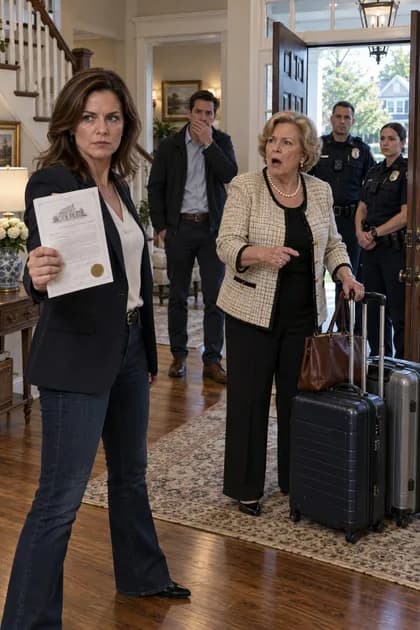
Brett did not become reasonable when he realized I was serious.
Chapter 4
PART 4 - THE DAY I TOOK BACK MY HOUSE AND MY BOUNDARIES
1,450 words
He became theatrical.
He called Mom from the front porch.
He called Dad.
He called two relatives.
He announced loudly enough for the neighbors to hear that his sister was “putting a homeless father on the street.”
Daniel waited until the phone calls ended.
Then he said, calmly, “Mr. Thornton, nobody is asking you to be homeless. You are being required to leave property you do not own after written notice and repeated opportunities to relocate.”
Brett stared at him.
Then he looked at me.
“You really hired a lawyer to talk to your own brother?”
“No,” I said. “I hired a lawyer because my brother stopped listening to me.”
That ended the performance for a moment.
The legal process did not magically remove him that afternoon. Real life is slower than revenge stories.
But something had changed.
Brett now knew every day he remained would create more documentation, more
cost, and less leverage.
He had spent weeks relying on one belief:
That I would be too ashamed to finish what I started.
He was wrong.
Within four days, he accepted one of the jobs he had previously rejected.
Within six, he rented a room from an old coworker.
On the seventh morning, a truck pulled into my driveway.
Not a U-Haul this time.
A small moving van.
Brett carried boxes down the stairs without looking at me.
The master bedroom emptied slowly.
First the diaper boxes.
Then his clothes.
Then Kayla’s abandoned dresser items.
Then the television.
When the mattress was finally visible again, I saw scratches across one side of the hardwood floor.
Old Myra would have said nothing.
New Myra photographed them.
Brett saw me.
“You’re unbelievable.”
“I’m documenting damage.”
He shook his head.
“You really became a landlord.”
I looked at him.
“No. I became the
homeowner.”
He had no answer.
Before he left, he stopped at the doorway.
“You picked a house over your family.”
I almost let that sentence hurt me.
Then I remembered the $63,742 spreadsheet.
The brass lock.
The fake equity agreement.
My closing-day photograph face down in a box.
“No,” I said. “I picked boundaries after my family decided my house was theirs.”
He left.
I changed every exterior lock that afternoon.
Then I called a locksmith for the master bedroom.
When he removed Brett’s shiny brass knob, he held it up.
“You want to keep this?”
I looked at it for a second.
“No.”
He tossed it into his scrap bin.
That tiny sound felt better than it should have.
The next few weeks were quiet.
Painfully quiet.
Mom did not call.
Brett blocked me.
Kayla sent one message thanking me for not involving her in the legal dispute after
she moved out.
Dad checked in twice.
The first conversation lasted three minutes.
The second lasted almost twenty.
He told me Mom was furious because several relatives had learned the condo had been ready for nearly a month while they were still staying with me.
Apparently, the story that I had abruptly thrown recovering parents onto the street stopped working once people knew they had an empty condo waiting.
Dad also told me something else.
After moving out, he went through their finances.
Really went through them.
Not just bills.
Years.
He discovered that they had given Brett far more money than he realized.
The $22,000 I had seen was only one period.
Over roughly seven years, it was closer to $49,000.
Mom had hidden some of it by calling transfers “family expenses.”
Dad sounded exhausted.
“I kept thinking each time was the last time.”
I knew that sentence.
I had lived that sentence.
A week later, Mom asked to meet me.
Not at my house.
At a coffee shop.
That mattered.
She arrived early and looked smaller than I remembered.
For several minutes, we talked about nothing.
Then she said, “I was angry at you because you made me feel like I failed as a mother.”
I did not rescue her from the sentence.
She continued.
“When Brett struggled, I thought helping him was what good mothers do. Every time he fell, I thought if I could just make the landing softer, he’d get back up.”
She stared into her coffee.
“Then eventually I started making everyone else responsible for keeping the ground soft.”
That was the closest thing to accountability I had ever heard from her.
She did not apologize perfectly.
There were still excuses.
Kayla was pregnant.
Brett had been depressed after losing work.
Dad’s surgery had scared her.
But beneath all of it, she finally said the words that mattered.
“I had no right to give away your space.”
My throat tightened.
“No. You didn’t.”
“And I had no right to assume you would keep paying for our choices.”
“No.”
She nodded.
Then she surprised me.
“I’m sorry.”
I did not say it was okay.
Because it wasn’t.
I said, “Thank you.”
That was enough for that day.
Brett took longer.
Three months passed.
Then five.
The baby was born healthy, a little girl named Elise.
Kayla and Brett did not stay separated permanently, but they did not move back in together right away either.
Kayla made one condition clear: Brett needed steady work and their own housing.
For once, no one volunteered my house as the solution.
Brett kept the lower-paying job.
Then he got promoted.
Not dramatically.
Not magically.
He just showed up.
Week after week.
Dad told me Brett hated the rented room.
Good.
Discomfort was finally doing what rescue never had.
It was forcing him to build something.
Seven months after he moved out, Brett texted me.
I almost did not open it.
It said:
“I shouldn’t have taken your room.”
A second message came.
“Or your tools.”
Then:
“I was angry because I thought you had everything and I had nothing. Mom kept telling me you’d be fine, and I wanted to believe that meant I wasn’t taking anything from you.”
I read that line twice.
Finally:
“I’m sorry.”
I waited an hour before replying.
“Thank you for saying it.”
I did not invite him back.
An apology does not erase consequences.
It only creates the possibility of something better afterward.
By spring, my house felt like mine again.
I moved my office back where it belonged.
I refinished the scratched bedroom floor.
I replaced the reading chair because I wanted something new.
Then I rehung the framed closing-day photograph.
Not in the bedroom.
In the front hallway.
Right where everyone entering the house could see it.
Myra on the porch.
Keys in hand.
Smiling like she had no idea how expensive peace could become.
There was one more change.
I stopped being the automatic family emergency fund.
When Dad mentioned a car repair, I sympathized.
I did not reach for my wallet.
When Mom talked about a holiday cabin, I told her to send everyone the cost and let people decide if they wanted to contribute.
When Brett asked whether I knew anyone who could help him find a better apartment, I sent him three listings.
Not money.
Not a deposit.
Information.
Help without surrender.
That became my new rule.
The strangest part was that the world did not collapse.
Dad figured out the car repair.
The family chose a cheaper holiday plan.
Brett found an apartment he could actually afford.
For years, I had believed saying no would make everything fall apart.
Instead, saying no forced everyone else to start carrying their own weight.
On the anniversary of the day I bought the house, I sat alone on the front porch with a cup of coffee.
The house was quiet.
My coffee maker was on the kitchen counter.
My office held my monitors.
My garage held my tools.
My bedroom door did not have a lock.
I thought about Brett asking, “Or what?”
At the time, I had hated myself for not having an answer.
Now I knew the answer had never been a threat.
It was a boundary.
Or I stop paying.
Or I document.
Or I say no.
Or I let consequences happen.
Or I choose myself even when people I love call that selfish.
The house had taught me something I should have learned years earlier.
Generosity without boundaries does not stay generosity forever.
Eventually, someone starts calling it an obligation.
And sometimes the only way to get your life back is to stop proving how much you love everyone else by giving them pieces of it.
I looked through the front window at the photograph hanging in the hallway.
Then I smiled.
The house was still mine.
More importantly, so was I.
THE END.
Chapter complete
You have reached the end of this chapter.
Continue reading
Find your next story
A few more worlds to get lost in after this chapter.