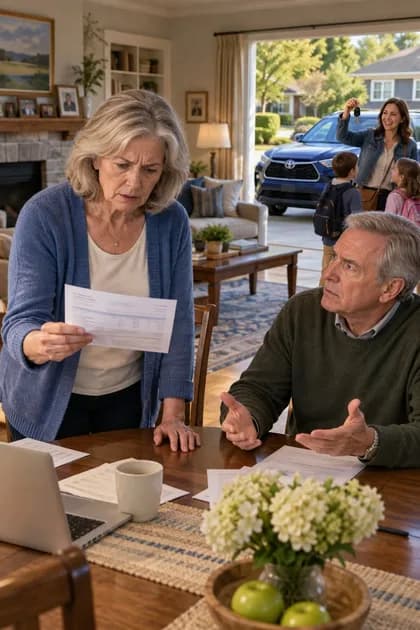
Monday morning, I called a local attorney named Daniel Mercer.
Chapter 2
PART 2 - THE LEGAL NOTICE THAT EXPOSED MY FAMILY’S REAL PLAN
1,462 words
I expected him to tell me this was messy.
Instead, after I explained the U-Haul, the unsigned household plan, the bedroom lock, and my parents’ “family plan,” he said something that made me sit straighter.
“Myra, stop treating this like a family disagreement. This is your property.”
He asked how long everyone had been staying, whether anyone paid rent, whether I had written messages establishing that their stays were temporary, and whether Brett had ever been given permission to take the master bedroom.
I had all of it.
Texts.
The original eight-week agreement with my parents.
My message to Brett saying I had not approved his move.
My six-week deadline.
Photos of my belongings packed in the hallway.
Even a picture of the lock.
Daniel explained that I needed to follow Ohio’s legal process carefully. No dramatic lockout. No tossing their things onto the lawn. No giving Brett a reason
to turn my boundaries into a story about me illegally evicting a pregnant woman.
“That’s exactly what he wants,” Daniel said. “He wants you emotional.”
That landed hard.
Because Brett had always won that way.
He pushed until someone exploded, then pointed at the explosion as proof that he was the reasonable one.
So I did the opposite.
I became boring.
Precise.
Documented.
That afternoon, I installed security cameras in common areas and photographed every box and piece of furniture Brett had moved into my house.
Mom watched from the kitchen.
“What are you doing?”
“Documenting my house.”
Her face changed.
Not much.
Just enough.
Brett laughed when he heard.
“You’re seriously going to kick out your pregnant sister-in-law?”
“No,” I said. “I’m going to handle this properly.”
Two days later, the first official notices were delivered.
Dad opened the front door.
The second he saw the envelope, his face
went pale.
Mom read hers at the kitchen table, then slapped the paper down.
“You served your own parents?”
“I gave you an eight-week stay. You’re already past it.”
“Your father had surgery.”
“And your condo was supposed to be ready three weeks ago.”
Dad looked away.
That tiny movement bothered me.
I turned to him.
“Isn’t it?”
He said nothing.
Mom jumped in immediately.
“There were delays.”
“What kind?”
“Construction delays.”
“Which builder?”
Her mouth tightened.
I knew the name of their builder. I knew the development. I had helped compare HOA fees before they signed.
So I called the sales office from my car.
I didn’t ask for private financial information. I only asked whether the building was still under construction.
The woman sounded confused.
“That phase was completed last month.”
I sat behind the wheel for a long time after the call ended.
That evening, I asked
my parents again.
Mom became offended before I had even finished the question.
“Do you not trust us?”
“Was the condo finished last month?”
Dad closed his eyes.
Mom said, “That’s not the point.”
Which meant yes.
Eventually Dad admitted the truth.
Their condo had been ready for twenty-six days.
They had not moved because Mom wanted to help Brett and Kayla “get settled,” and because Dad found my house more comfortable during physical therapy.
Then came the part they clearly had not planned to tell me.
They had also delayed moving some of their furniture because Mom hoped I would eventually “see sense” and let Brett stay until after the baby was born.
“How long after?” I asked.
Mom folded her arms.
“As long as they need.”
There it was.
No six weeks.
No temporary arrangement.
No real deadline at all.
The next morning, Brett tried a different strategy.
He was waiting in the kitchen before I left for work.
“You embarrassed Mom.”
I poured coffee.
“She lied to me.”
“She was protecting me.”
“From what?”
His jaw flexed.
“From you making everything about money and paperwork.”
That almost made me laugh.
The brother whose credit-card debt I had once paid was accusing me of making things about money.
Then he leaned against the counter and lowered his voice.
“Look, I’m interviewing. Kayla’s due in eleven weeks. You have four bedrooms. You’re one person.”
There it was again.
The math my whole family had apparently done.
Four bedrooms.
One Myra.
Therefore everyone else was entitled to the difference.
“What exactly do you think I owe you?” I asked.
Brett stared at me.
“You’ve always had it easier.”
I actually stopped moving.
“Easier?”
“You went to college. You make six figures. You travel. You bought this place before thirty. I got laid off with a baby coming.”
“I worked co-op semesters to pay for school.”
“You know what I mean.”
“No. I don’t.”
His face flushed.
He finally said the thing underneath all of it.
“Mom and Dad spent years worrying about you, helping you get where you are.”
I stared at him.
That wasn’t true.
Not even close.
Our parents loved us, but they had never paid my tuition. Never paid my rent. Never funded my down payment.
And Brett knew that.
Before I could answer, Kayla appeared at the doorway.
“Brett.”
Her voice was warning him.
He stopped.
That moment stayed with me.
Not because of what he said.
Because Kayla looked scared that he had said too much.
That night, while I was going through old financial records for Daniel, I found a payment I had forgotten about.
Three years earlier, when Brett was drowning in credit-card debt, I had transferred $18,400 to him.
At the time, Mom had told me it was the last major debt.
It wasn’t.
Attached to an old email chain was a spreadsheet Brett had accidentally forwarded.
Cards.
Personal loans.
A past-due truck balance.
And one line I had never noticed before.
“Mom/Dad - $22,000.”
I called Dad.
“What was the twenty-two thousand dollars?”
Silence.
Then: “Where did you see that?”
“Answer me.”
Dad sighed.
Years earlier, after Brett’s first layoff, my parents had taken money from their retirement savings to keep him afloat. When that ran out, they refinanced their old house.
The condo they had purchased was smaller partly because they were still recovering from helping him.
Suddenly Mom’s behavior made horrible sense.
She wasn’t merely favoring Brett.
She had tied years of money, sacrifice, and identity to saving him.
If Brett failed again, she would have to admit all those rescues had not fixed anything.
So she had decided I would be the next rescue.
My house was not a home to her anymore.
It was the family’s remaining safety net.
The next day, I changed my direct deposits, removed Mom as an emergency contact on one old investment account, and canceled the automatic payment I had quietly been making for my parents’ storage unit.
Then I opened a second folder.
Not for the house.
For every dollar I had spent fixing family emergencies over the past five years.
I did not plan to demand repayment.
I needed to see the pattern in black and white.
By Friday night, the total was more than $63,000.
I stared at the number until my stomach hurt.
Then the camera alert on my phone went off.
Brett was in my office.
The room they had already started calling “the nursery.”
He opened one of my file drawers.
Then another.
He removed a folder.
My closing documents.
I watched him flip through the pages, photograph something with his phone, and put the folder back.
I drove home immediately.
He was in the living room when I walked in.
“What were you doing in my office?”
He didn’t even pretend.
“Looking for something.”
“What?”
He smiled.
“Proof.”
“Of what?”
“That this house isn’t as simple as you keep saying.”
Mom came in from the kitchen.
She looked at Brett.
Then at me.
And that was when I realized this had moved beyond entitlement.
They were looking for a way to challenge me.
I called Daniel from the driveway.
He listened quietly, then asked one question.
“Did anyone in your family contribute money to the purchase of the house?”
“No.”
“Any gift toward the down payment?”
“No.”
“Any co-signer?”
“No.”
“Then let them look.”
His voice hardened.
“Because tomorrow, we’re going to make sure they understand exactly what happens when they confuse access with ownership.”
The next morning, Brett came downstairs holding a printed sheet of paper.
He dropped it on the table in front of me.
Across the top, in bold letters, were the words:
FAMILY EQUITY AGREEMENT.
And beneath them was a line claiming my parents were entitled to a financial interest in my house because of “substantial household contributions.”
Mom slid a pen toward me.
“Sign it,” she said.
Click the blue “PART 3” below to read the next part: 👉 PART 3 👈
Chapter complete
You have reached the end of this chapter.
Continue reading
Find your next story
A few more worlds to get lost in after this chapter.