Dad followed me into the hallway before I could reach the front door.
Chapter 2
PART 2 - THE REJECTION LETTER MY FATHER HID FOR FIFTEEN YEARS
1,263 words
“Rachel, wait.”
I stopped.
For once, his voice held no sarcasm.
“You’re seriously buying Harrison Aviation?”
“Yes. The closing documents are signed tomorrow morning.”
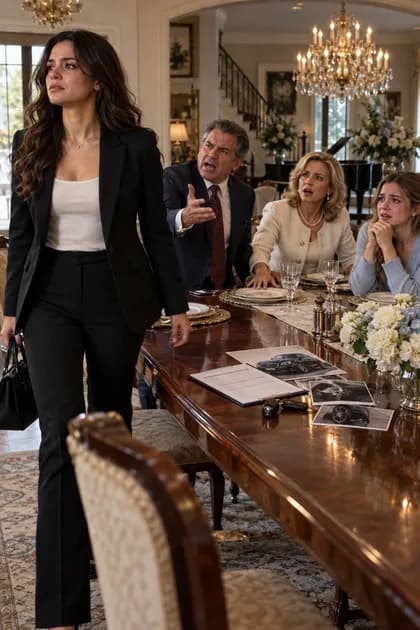
Vanessa stood behind him, still clutching her wineglass.
“How?” she demanded. “You take trains. You live in a tiny apartment.”
“I take trains because I like trains. I live in that apartment because I like my neighborhood. None of that means I’m broke.”
Nobody answered.
Then my phone rang.
Captain Mercer.
“Ms. Bennett, Aircraft One has landed. The board members are already waiting in the executive lounge.”
“I’m on my way.”
I ended the call and opened the front door.
Then Dad said something that stopped me cold.
“Rachel… Harrison Aviation rejected me for a partnership fifteen years ago.”
I turned around.
His face had lost all color.
“What partnership?”
He looked toward the dining room, as though he regretted speaking.
“It doesn’t matter.”
“You just
chased me into the hallway to tell me. It matters.”
Mom appeared behind Vanessa.
“Richard?”
Dad’s jaw tightened.
“In 2011, I proposed an East Coast operating partnership. Harrison had helicopters, maintenance capacity, and corporate clients. I had a plan for a regional response network.”
Something about the phrase regional response network made the back of my neck tighten.
I had heard language like that before.
Not from Dad.
From myself.
When I was nineteen, I had spent an entire summer building a routing model for a university transportation competition. It was primitive compared with the systems my company used now, but it was the first time I had tried to solve the exact problem that later became my career: how to move aircraft, crews, medical teams, and high-priority passengers across multiple cities without wasting hours or equipment.
Dad had looked at the diagrams spread across our dining table and called
them “cute schoolwork.”
I stared at him.
“What was in your proposal?”
His eyes shifted.
That was all the answer I needed.
“Dad.”
“It was fifteen years ago.”
“What was in the proposal?”
He lowered his voice.
“Some scheduling concepts. Some regional mapping.”
Vanessa frowned.
“Why is that a big deal?”
I ignored her.
“Did you use my model?”
Dad looked offended.
“You were nineteen.”
“That wasn’t my question.”
“I was trying to turn an academic idea into something practical.”
The words landed harder than the insult at dinner.
I had spent years believing he had dismissed my early work because he thought it was useless.
Now I was realizing he might have dismissed it because he had already decided it belonged to him.
Mom whispered, “Richard, tell me you didn’t.”
Dad snapped, “I was her father. I paid tuition. I paid for that computer. I gave her the environment
to develop it.”
I almost laughed at the logic.
“You didn’t pay my tuition. Grandma’s education trust did.”
He went silent.
Vanessa looked between us.
I put my hand on the doorknob.
“I have a closing to prepare for. We can discuss this later.”
Dad stepped forward.
“You don’t understand Harrison the way I do.”
I looked at him.
“You were rejected by them fifteen years ago.”
His face hardened.
“I know the people. I know how they think. You walk into that room tomorrow acting like you built all of this alone, and you are going to make enemies you don’t even recognize.”
There it was.
Not concern.
A demand to be necessary.
“I have lawyers, an operations team, a finance team, and six months of due diligence behind me.”
“You need someone local.”
“No. You want me to need you.”
His eyes flashed.
I opened the door.
“Do not call anyone at Harrison on my behalf.”
He did not answer.
That should have worried me more.
Forty minutes later, I walked into the executive lounge at Bradley.
Our three helicopters were already on the ground, lined up under floodlights beyond the glass. My operations director, Maya Chen, was waiting beside a conference table covered with binders and tablets.
She looked at my face once.
“What happened?”
“My family found out what I do.”
Maya winced.
“Happy Thanksgiving.”
“That was the easy part.”
I told her about Dad’s 2011 proposal.
Her expression changed immediately.
“Bennett Strategic Air?”
I stopped.
“You know the file?”
“It came up in legacy due diligence. Old partnership solicitation. I didn’t flag it to you because it was rejected before Harrison ever entered a formal agreement, and Bennett is not exactly an unusual last name.”
“Pull it.”
She opened her laptop.
Within two minutes, Harrison’s digital archive was on the screen.
Bennett Strategic Air Partnership Proposal.
Submitted by Richard Bennett.
March 2011.
My father.
I sat down.
The first pages were ordinary enough—market statistics, regional airport maps, corporate travel projections.
Then Maya scrolled to page eleven.
I stopped breathing.
There it was.
A hub-and-spoke emergency-response diagram I had drawn at nineteen.
Not similar.
Not inspired by.
Mine.
Even the typo in the lower-right corner was still there.
Page fourteen contained a phrase I had invented for the competition: distributed rotorcraft response grid.
Maya looked at me.
“You wrote this?”
“Yes.”
She scrolled farther.
My old assumptions had been dressed up in business language, but the structure was unmistakable.
Dad had taken my work, removed my name, and presented it to Harrison Aviation as his own operating concept.
Then we reached the final page.
A scanned internal review note had been attached to the rejected proposal.
Applicant cannot adequately explain routing assumptions or contingency logic. Technical concepts appear to originate from daughter Rachel Bennett, currently an undergraduate student. Recommend no partnership without direct attribution and participation of original author.
I read it twice.
Then a third time.
Maya leaned back.
“So Harrison knew.”
“Apparently.”
“And your father knew they knew?”
“I don’t know.”
My phone rang.
Dad.
I let it go to voicemail.
Thirty seconds later, Maya’s phone buzzed.
She looked down.
Her face changed.
“What?”
She turned the screen toward me.
An email from Calvin Reece, one of Harrison’s three directors.
Richard Bennett just contacted me. He says he is serving as your informal local advisor and would like access to tomorrow’s transition session.
I closed my eyes for one second.
I had told him not to call anyone.
He had waited less than an hour.
“Reply that he has no role in the transaction.”
Maya typed.
Then another message arrived.
This one came from our counsel.
Subject: Urgent—Pre-Closing Claim.
I opened it.
Dad had sent an email to Harrison’s board and copied both legal teams.
He claimed that my company’s operating model was derived from intellectual property he had developed in 2011.
He demanded that the closing be postponed until “his contribution” could be recognized.
And at the bottom, in a sentence so arrogant I almost admired it, he proposed a solution.
A paid advisory position.
A seat on the post-acquisition strategy committee.
And equity.
Maya read over my shoulder.
“He is trying to leverage the closing.”
“No,” I said quietly.
I looked through the glass at the three helicopters sitting under the runway lights.
“He’s trying to make me buy back something he stole from me when I was nineteen.”
My counsel called.
“We need to address this on the record before the board signs tomorrow.”
I looked at the old Harrison review note again.
Then at the timestamp on Dad’s demand.
For the first time that night, I smiled.
“Good,” I said. “Put it on the agenda.”
Click the blue “PART 3” below to read the next part: 👉 PART 3 👈
Chapter complete
You have reached the end of this chapter.
Continue reading
Find your next story
A few more worlds to get lost in after this chapter.