For six years, Barron had defended his mother against everyone.
Chapter 4
PART 4 - THEIR OWN RECORDINGS ENDED THE LIE AND GAVE ME BACK MY HOME
1,411 words
Against creditors.
Against landlords.
Against former business partners.
Against me.
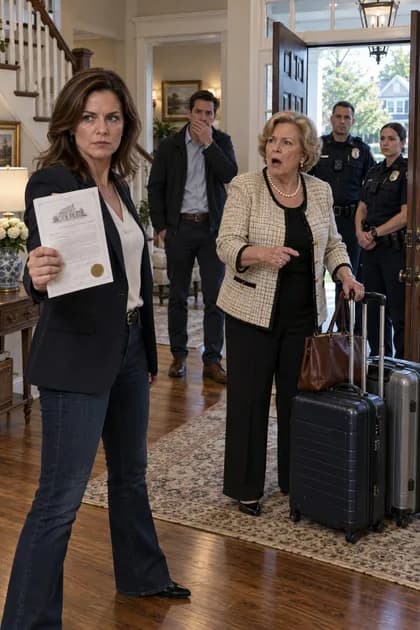
But when Celina stood in a courtroom with Detective Ruiz beside her and told him to take the blame, something finally broke.
Barron stared at her as though he had never seen her before.
“My idea?” he said.
Celina’s face tightened.
“Barron, don’t.”
“You told me the bank would never check the old power of attorney.”
His attorney grabbed his sleeve.
“Do not speak.”
Barron pulled his arm away.
“You said once the deed recorded, Adela would have to fight us in divorce court and we’d have time to move the money.”
Celina went white.
The assistant district attorney looked at Detective Ruiz.
Ruiz said nothing.
She did not need to.
Barron was doing their work for them.
His attorney stepped directly in front of him.
“Stop talking. Now.”
Barron finally seemed to understand where he was.
He closed his
mouth.
But the words were already in the room.
The judge called a brief recess while Celina was escorted out.
As she passed me, she stopped.
The deputy beside her immediately said, “Keep moving.”
Celina ignored him for one second and looked at me.
“You think you won?” she asked.
I did not answer.
Because by then I understood something she did not.
Winning was not watching her get arrested.
Winning was getting my name, my house, my credit, and my future out of the machinery she and Barron had built around me.
When court resumed, the judge granted the emergency relief Naomi had requested.
Barron was removed from temporary possession of the Raleigh property.
The disputed deed was formally placed under challenge pending adjudication.
No further debt could be secured against the house.
Funds traceable to the first loan remained frozen.
And the divorce court ordered a full accounting
of every transaction Barron had made using my identity, my property, or any authority he claimed through the revoked power of attorney.
The judge was careful not to decide the criminal case.
But he said one thing I never forgot.
“Marriage does not convert fraud into permission.”
Outside the courtroom, Barron tried to reach me.
Naomi stepped between us.
“If you have something to communicate, send it through counsel.”
Barron looked past her at me.
“Adela, please.”
I stopped.
Not because he deserved a conversation.
Because I wanted to hear what six years of marriage sounded like once entitlement ran out of excuses.
He looked exhausted.
“I was going to fix it.”
“You were applying for another two hundred twenty-eight thousand dollars.”
“To consolidate everything.”
“With my house.”
“Our house.”
The words came out automatically.
Then he heard himself.
His face changed.
I almost felt sorry for him.
Almost.
“That,”
I said quietly, “is the entire reason we’re here.”
He had spent so long saying our that he had stopped recognizing mine.
My inheritance.
My signature.
My credit.
My consent.
My career.
My right to know what was being done in my name.
“You could have asked me to help your mother,” I said.
“You would have said no.”
“Yes.”
He blinked.
I continued.
“And you knew I had the right to say no. That’s why you forged the path around me.”
He looked down.
That was the closest Barron came to admitting the truth to my face.
The criminal case took months.
Reality was slower than the Army Ball.
There were no dramatic doors swinging open every morning. No instant convictions. No judge delivering a perfect speech and ending everything before lunch.
There were interviews.
Subpoenas.
Forensic reports.
Bank records.
Handwriting comparisons.
Notary records.
Motions.
Continuances.
And a mountain of paperwork that seemed to reproduce whenever Naomi opened her briefcase.
Denise Parker, the notary, became the first person to cooperate fully.
Her records and emails confirmed that she had notarized the deed without me present after Celina assured her it was “just a family transfer” and that I had already agreed.
That did not excuse what Denise had done.
But it explained how Celina had gotten the document through.
Barron’s cloud backup supplied the rest.
Investigators recovered draft versions of my signature.
Photographs of old documents bearing my handwriting.
A scan of the revoked power of attorney.
And a spreadsheet Barron had created listing projected loan proceeds, debt payments, Celina’s condo deposit, his legal retainer, and something labeled POST-DIVORCE RESERVE.
The number beside it was $61,500.
That spreadsheet ended his claim that he had merely panicked while trying to help his mother.
This had been budgeted.
Celina’s defense shifted next.
She claimed Barron had controlled everything and that she believed the money transferred to her was a lawful gift from her son.
Then prosecutors showed her the email to Denise.
Adela won’t know until after the money moves.
After that, the story changed again.
By the time plea negotiations began, mother and son were blaming each other through separate attorneys.
I was not involved in deciding their criminal sentences.
I gave investigators documents, answered questions, and provided a victim-impact statement when asked.
Then I returned to my own case.
That mattered to me.
I did not want my life to become a permanent waiting room for Barron’s consequences.
The civil side resolved first.
The fraudulent deed was voided.
The second loan never closed.
The bank unwound the unauthorized first loan after its investigation and title proceedings, while preserving its recovery claims against the people responsible.
Most of the traceable money was recovered through frozen accounts, the forced sale of Celina’s Cary condominium, and other assets identified during the litigation.
Not every dollar came back immediately.
But the debt was no longer attached to my house.
That was the victory I cared about most.
My grandfather had bought that house after thirty-two years as a machinist.
He used to tell me that a home was not valuable because of the square footage.
It was valuable because it gave you one place in the world where nobody got to decide you did not belong.
Barron had almost turned that gift into leverage against me.
He failed.
The divorce became simple after that.
Not easy.
Simple.
Barron withdrew his claim that the Raleigh house was marital property.
He abandoned his demand for reimbursement for fictional “improvements.”
His lawyer negotiated the remaining division of legitimate marital assets through Naomi.
There was no birthday video apology.
No reconciliation.
No final hug in a courthouse hallway.
Some betrayals do not need one more conversation.
They need paperwork with signatures that are real.
Barron eventually entered a plea to charges arising from the fraudulent loan and property documents. Celina entered her own plea later, after fighting longer and losing more leverage.
The exact legal consequences belonged to the court.
The personal consequences belonged to them.
Barron lost his marriage.
Celina lost the condo she had purchased with money tied to my house.
And both of them lost the version of the story in which I was an ungrateful wife who had selfishly refused to share what “belonged to the family.”
Their own messages ended that story.
So did Barron’s own video.
Six months after the Army Ball, my unit held a smaller formal dinner.
No birthday.
No ballroom ambush.
Just people I trusted, bad coffee, overcooked chicken, and the kind of Army jokes I had originally expected on my thirty-first birthday.
Near the end of the evening, my battalion commander stopped beside my table.
He did not mention Barron.
He did not mention Celina.
He simply lifted his glass and said, “To knowing when silence is discipline—and when it’s time to act.”
A few people around the table smiled.
I did too.
For weeks after the Army Ball, people had told me how calm I had looked while Celina served those papers.
They thought calm meant I had not been hurt.
That was never true.
I had been humiliated.
I had been furious.
I had been devastated by the realization that the man sleeping beside me had studied my routines so he could use them against me.
But discipline is not the absence of emotion.
Sometimes it is choosing what to do with it.
On my thirty-first birthday, Barron raised his phone because he wanted a permanent record of the moment he broke me.
Instead, he recorded his mother announcing their motive in front of eighty-seven witnesses.
He thought the camera was pointed at my humiliation.
He never realized it was pointed at their confession.
THE END.
Chapter complete
You have reached the end of this chapter.
Continue reading
Find your next story
A few more worlds to get lost in after this chapter.