The old man across the hall had barely spoken to anyone in days.
Chapter 1
THE LEATHER FOLDER AND THE MAN WHO KNEW COURTLAND
4,086 words
But the night before my daughter-in-law arrived carrying a brown leather folder filled with papers about my dying son, he suddenly grabbed my arm with surprising strength.
His eyes locked onto mine.
“Drive home tonight if you can,” he whispered.
At the time, I had no idea those six words were about to change everything.
There are some doors in life you only walk through once.
I understood that the morning I helped my thirty-eight-year-old son through the glass entrance of Gracewood Hospice.
My name is Dovy Hail. I’m sixty-two, from Nashville, Tennessee, and I had already buried one man I loved.
I never imagined I would someday sit beside my only child and watch life slowly leave his body one breath at a time.
Casius had always been the strong one.
Disciplined. Kind. Dependable.
He returned every phone call, remembered birthdays, and still asked whether I had eaten even
when he was the one being admitted to hospice.
That first morning, he held my elbow as we walked down the corridor.
As if he were keeping me steady.
The truth was, he was.
His room smelled of clean sheets and quiet endings.
I unpacked his clothes, folded his shirts, placed his water within reach, and positioned his phone charger exactly where he liked it.
Then I sat in the chair beside his bed and began the only job left for a mother in a room like that.
Staying.
That afternoon, while Casius slept, I noticed the patient across the hallway.
His door was halfway open.
An elderly man sat upright in bed, hands folded over his lap, staring through the window.
There were no flowers.
No cards.
No family photographs.
No visitors asking if he needed anything.
He had the stillness of someone who had accepted being forgotten.
That
night, I went home and baked peach muffins.
I told myself I simply needed something to do with my hands.
The next morning, I crossed the hall carrying a small tin wrapped in one of my kitchen towels.
The old man stared at it as though kindness were a language nobody had spoken to him in years.
“My son is across the hall,” I said. “I thought maybe you could use some company.”
He looked at the muffins for several seconds.
Then he quietly said, “I haven’t eaten a peach muffin since my wife died.”
His name was Cornelius.
At first, that was nearly everything he told me.
But over the next several days, we talked.
About Nashville summers.
Old houses.
Marriage.
Loss.
And the strange way time moves differently when someone you love is running out of it.
His wife had been named Ruth.
I told him about Casius.
But I began noticing something strange.
Whenever footsteps passed in the hallway, Cornelius looked toward his door.
Not nervously.
Carefully.
Like a man who understood that people often reveal their true intentions when they believe nobody is watching.
I told myself he was simply lonely.
Then Casius started declining faster than the doctors had prepared me for.
His hands shook when he reached for water.
His words came slower, thinner, as if each sentence cost him energy he could no longer afford.
One morning, he took my hand.
“Mama, I need you to make sure my affairs are in order.”
I smiled because mothers smile when they’re desperately trying not to fall apart.
“Everything is fine, baby.”
But Casius stared toward the window.
“Andine knows what needs to be done,” he said. “But I need you to make sure.”
Andine was his wife.
Warm. Polished. Capable.
She could discuss medication, bank accounts, and funeral flowers without letting her voice crack.
When she called and said she was coming to Nashville, I thought nothing of it.
“There are some things I need to help him organize while he can still answer questions,” she told me.
It sounded responsible.
Devoted.
Like love wearing practical shoes.
So I didn’t question her.
Not then.
That evening, while Casius slept, I reached toward his bedside lamp and noticed a business card near the edge of the table.
I didn’t recognize the name.
The address was local.
Nashville.
On the back, someone had handwritten a phone number.
Beneath it was the name of Casius’s LLC.
I stood there staring at the card while my son breathed softly behind me.
Eventually, I slipped it into my purse.
I told myself it probably meant nothing.
I was wrong.
The evening before Andine was scheduled to arrive, I crossed the hall to tell Cornelius good night.
He wasn’t sitting peacefully like usual.
He was leaning forward, both hands gripping the bed rail.
The moment I entered, his eyes found mine.
“Cornelius? Are you all right?”
He reached out.
And grabbed my forearm.
Hard.
Not painfully, but with the startling strength of someone who had been waiting for exactly the right moment.
He pulled me closer.
“Drive home tonight if you can,” he whispered.
I froze.
His voice dropped even lower.
“They move differently when family leaves overnight.”
Then he released me.
Turned toward the window.
Folded his hands.
As though nothing had happened.
I stayed beside Casius that night.
My coat remained on.
My purse sat beside my feet.
At two in the morning, footsteps moved through the corridor.
Slow.
Measured.
They stopped outside Casius’s room.
Then outside Cornelius’s.
Then continued down the hallway.
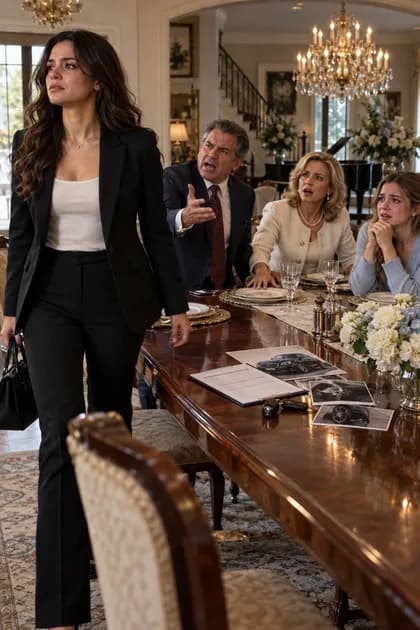
The next morning, Andine arrived carrying a travel bag in one hand and a brown leather folder beneath her arm.
She went directly to Casius, touched his face, and whispered to him.
There was real grief in her eyes.
I will never lie about that.
She loved my son.
That part was real.
But so was the leather folder.
Twenty minutes later, Andine stepped into the hallway to speak with a nurse.
The folder remained on the table.
A document had slipped partially out.
And I saw the name printed across the page.
Casius’s LLC.
The exact same name written on the business card.
That afternoon, I called Lydia Cross, the attorney who had handled my husband’s estate years earlier.
“Dovy,” she said, “what exactly are you looking at?”
“I don’t know yet,” I answered. “That’s why I need you to look.”
Before the end of the day, Lydia called back.
Something in her voice had changed.
“Someone has been preparing transfer paperwork involving Casius’s LLC for several weeks. Recent filings. Active drafts.”
My fingers tightened around the phone.
“Did Casius start any of it?”
“No.”
Behind me, my son slept.
The hallway lights hummed.
And suddenly, it felt as though the floor beneath me had tilted.
Two days later, Lydia found more.
A beneficiary modification.
A private holding company.
And one name buried beneath layers of paperwork.
Foster Gains.
A Nashville estate consultant.
The handwritten phone number on the business card matched his operation.
Then Lydia uncovered the connection that turned my stomach cold.
Courtland Arseno.
Andine’s brother.
For more than a year, Courtland had been feeding Foster information.
Information about Casius’s accounts.
His LLC.
His life insurance.
His entire financial world.
Andine had no idea.
I knew the moment I showed her the records.
Confusion crossed her face first.
Then recognition.
Then betrayal so deep she didn’t even cry.
“My brother called me three weeks ago,” she whispered. “He said he knew someone who could help organize Casius’s affairs. He told me it was what Casius would want.”
She looked at me.
“What do you need me to do?”
I took her hand.
“Call him. Tell him nothing has changed. Tell him the documents are ready.”
Her eyes narrowed.
“You want him to come here.”
“I want him to think he’s already won.”
Andine picked up her phone.
Her hand was perfectly steady.
When Courtland answered, her voice became gentle.
Warm.
Trusting.
The voice of a sister speaking to a brother she had loved her entire life.
She told him the papers were ready.
She told him to come to Nashville.
And when she ended the call, I looked down at that brown leather folder between us and finally understood something even colder than fear.
Whoever had arranged this had planned almost everything perfectly.
My dying son.
The paperwork.
The accounts.
Andine.
Even the timing.
They had accounted for nearly everyone.
Everyone except the lonely old man across the hall...
Courtland arrived at Gracewood the next afternoon wearing a navy suit and the calm smile of a man who believed everything had already gone according to plan.
Andine met him in the hallway.
“You brought the documents?” he asked quietly.
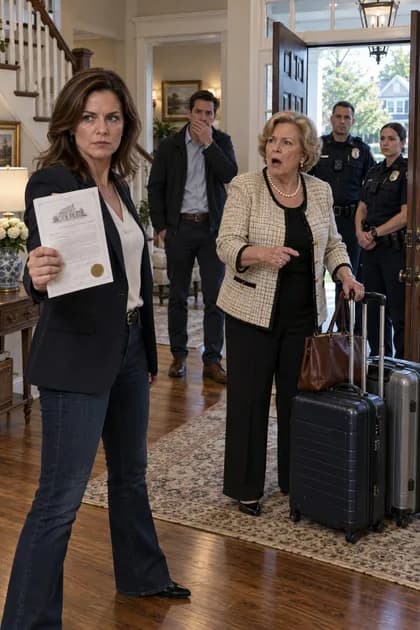
She nodded and held up the brown leather folder.
From inside Casius’s room, I watched through the narrow opening in the door.
Courtland never looked toward his dying brother-in-law.
Not once.
His eyes stayed on the folder.
That was when I knew Lydia had been right.
But before Andine could hand it over, a weak voice came from across the hall.
“Courtland.”
Everyone froze.
Cornelius stood in his doorway, gripping his walker.
For the first time since I had met him, he wasn’t wearing hospital clothes. He wore a button-down shirt, neatly tucked in, and his expression was sharper than I had ever seen.
Courtland’s face drained of color.
“You…” he whispered.
Andine slowly turned toward her brother.
“You know him?”
Courtland stepped backward.
Cornelius looked directly at me.
“I told you they move differently when family leaves,” he said.
Then he reached into his pocket and pulled out a small black device.
A recorder.
Courtland suddenly lunged forward.
And that was when two men at the end of the hallway stepped into view.
Courtland made it two steps.
The first man caught his wrist before he reached Cornelius.
The second moved between them.
“Mr. Arseno,” he said, opening his jacket just enough to show a badge. “Keep your hands where I can see them.”
Courtland stopped.
His face changed so quickly it was almost frightening.
The polished brother disappeared.
So did the calm smile.
What remained was panic.
Andine stared at me.
“Dovy?”
“I called Lydia again after you called your brother.”
I stepped out of Casius’s room.
“I told her I wasn’t asking for advice anymore. I told her I wanted the documents protected and the right people notified before Courtland walked into this building.”
Courtland looked at Andine.
“You set me up?”
Her expression hardened.
“No. You set yourself up when you decided my husband was worth more to you dying than alive.”
His mouth opened.
Nothing came out.
One of the men introduced himself as Detective Bell. The other was an investigator who worked financial crimes.
Then Cornelius lifted the recorder.
“You should let them hear this.”
Courtland’s eyes snapped toward him.
“Don’t.”
It was the first honest word he had spoken since arriving.
Detective Bell took the recorder carefully.
Andine looked at Cornelius.
“How do you know my brother?”
Cornelius rested both hands on his walker.
“Because nine days before your mother-in-law brought me a peach muffin, he came into my room carrying almost the same folder.”
The hallway went silent.
Courtland shook his head.
“That is not what happened.”
Cornelius ignored him.
“He told me a man named Foster Gains had been asked to help straighten out my estate. Said Foster had been referred by my nephew.”
His mouth curved without humor.
“I don’t have a nephew.”
I felt the skin along my arms tighten.
Cornelius continued.
“I told Courtland I was tired. Confused. That numbers were getting hard for me.”
He looked directly at Courtland.
“He believed me.”
Courtland’s jaw tightened.
“What you signed was legitimate estate-planning paperwork.”
“I signed nothing.”
That landed harder than shouting would have.
Cornelius lifted his chin toward the recorder in Detective Bell’s hand.
“I only let you believe I had.”
For the first time, I understood why Cornelius had watched every person walking past his doorway.
Why he had listened to footsteps.
Why he had known what happened when family disappeared at night.
Courtland had already shown him.
Cornelius had simply been waiting to see whether he would do it again.
Detective Bell pressed play.
At first, all we heard was the low hum of a hospital room.
Then Foster’s voice.
I recognized it only because Lydia had played me a voicemail from his office earlier that morning.
“Once the signature is on the assignment, the holding company controls the interest.”
A second voice answered.
Courtland.
“Andine’s husband will be easier. She trusts me. She’ll bring me whatever I tell her he needs.”
Andine closed her eyes.
The recording continued.
Foster asked, “How long does he have?”
Courtland answered, “Not long enough to start asking questions.”
I heard Andine inhale beside me.
Just once.
Sharp.
Broken.
Courtland stepped toward Detective Bell.
“That recording is out of context.”
The investigator raised a hand.
“Stay where you are.”
“I was trying to help my sister.”
Andine opened her eyes.
“Help me?”
Courtland turned to her immediately, desperate now.
“You don’t understand what happens when somebody dies with a company, insurance, property, accounts everywhere. It becomes a mess. Lawyers take everything apart.”
“Lydia is a lawyer.”
“That’s different.”
“How?”
He had no answer.
So Andine opened the brown leather folder.
She pulled out the first document.
Her hands were still steady.
“This transfers Casius’s membership interest into a private holding company.”
Courtland said nothing.
She pulled out another.
“This one changes the beneficiary instructions attached to one of his accounts.”
Still nothing.
Then she held up the page Lydia had marked that morning.
“And this gives the holding company management authority.”
She looked at him.
“Foster controls the holding company.”
Courtland swallowed.
“And you were supposed to receive a percentage.”
His eyes flickered.
That was all.
But it was enough for a sister who had known every expression on his face since childhood.
Andine lowered the papers.
“How much?”
“Andine—”
“How much was my husband worth to you?”
Courtland looked down the hallway.
At the detectives.
At Cornelius.
At me.
Anywhere except his sister.
“I wasn’t stealing from you.”
“That wasn’t my question.”
His voice dropped.
“I had obligations.”
Andine gave a small, disbelieving laugh.
“Debts.”
Courtland said nothing.
“Was it debt?”
He finally looked at her.
“You think I wanted this?”
“I think you wanted something.”
His composure cracked.
“Foster helped me when nobody else would. A commercial deal went bad. I owed money. He gave me time.”
“And the price was Casius?”
“No.”
“Cornelius?”
“No.”
“Then what was the price?”
Courtland’s silence answered for him.
People.
Names.
Accounts.
Families already frightened enough to sign whatever someone they trusted placed in front of them.
Courtland had not walked into Gracewood because he hated my son.
Somehow that made it worse.
Casius had simply become useful.
A dying man with a business.
A grieving wife who trusted her brother.
A deadline nature itself was enforcing.
Courtland had turned all of that into opportunity.
Detective Bell took the folder from Andine.
“We’re going to need you to come with us, Mr. Arseno.”
Courtland stiffened.
“Am I under arrest?”
“You’re being detained while we sort through what we have here.”
“I want an attorney.”
“That is your right.”
They began walking him toward the elevators.
Courtland twisted around.
“Andine.”
She did not move.
“You know me.”
Her face crumpled for one second.
Then she forced it still.
“I thought I did.”
The elevator doors opened.
Courtland looked at her again.
“You’re really choosing them over your own brother?”
Andine’s voice was almost a whisper.
“No.”
She glanced toward Casius’s room.
“I’m choosing my husband over the man who tried to use his death.”
The elevator doors closed.
Andine stood frozen.
Then she walked into Casius’s room.
I followed.
He was awake.
Barely.
His eyes moved from Andine to me.
“What happened?”
Andine sat beside him immediately.
For the first time since she had arrived, her control disappeared.
She bent over his hand and began to cry.
Not loudly.
Not dramatically.
Just the exhausted crying of a woman who had been carrying too many unbearable things at once.
Casius looked at me.
“Mama?”
I sat on his other side.
“Courtland was working with Foster.”
His brow tightened.
“The papers?”
“We stopped them.”
He looked at Andine.
She wiped her face.
“I’m sorry.”
“For what?”
“I brought those documents here.”
“You didn’t know.”
“I should have.”
Casius lifted his hand perhaps two inches from the blanket.
It was all the strength he had.
Andine caught it in both of hers.
“My brother—”
“Your brother,” Casius whispered, “is not you.”
She bowed her head over his fingers.
Then Casius looked at me again.
“Did you make sure?”
The question broke something inside me.
Because suddenly he was not a thirty-eight-year-old man in hospice.
He was six years old again, asking whether I had checked beneath his bed after a thunderstorm.
He was seventeen, asking whether I had mailed his college forms.
He was twenty-nine, calling to make sure I got home safely after my husband’s funeral.
Did you make sure?
I covered his hand with mine.
“Yes, baby.”
He closed his eyes.
And smiled.
“I knew you would.”
Lydia came to Gracewood that evening.
She had already contacted the banks, the LLC’s registered agent, and the institutions connected to the suspicious documents.
Nothing could be transferred without additional review.
No beneficiary change Foster had prepared would be accepted without verification.
Andine gave Lydia every email her brother had sent.
Every text.
Every attachment.
She even turned over old messages that embarrassed her because Courtland had been asking about Casius’s finances for months under the excuse of helping them plan.
That part hurt her most.
The betrayal had not begun when Casius entered hospice.
Hospice had simply created the deadline.
The next morning, investigators searched Foster’s office.
What they found took months to unravel.
Draft assignments.
Client questionnaires.
Copies of account statements that Foster had no legitimate reason to possess.
Unsigned transfer forms for several families.
And the same private holding company appearing again and again.
Courtland had been receiving referral payments.
Sometimes money.
Sometimes credit against what he owed Foster.
According to Lydia, their plan depended less on brilliant fraud than on exhausted families.
People who were sleeping in hospital chairs.
People arranging funerals.
People who trusted someone who said, Sign here, this will make things easier.
That was why Cornelius mattered.
Not because he had some secret power.
Because he had refused to stop paying attention.
And because when he saw the same pattern beginning across the hall, he warned me.
Casius died two nights later.
Andine was on one side of his bed.
I was on the other.
There was no dramatic final speech.
Real death is rarely considerate enough for that.
His breathing slowed.
Then paused.
Then returned.
Then one time it simply did not.
I kept holding his hand long after the nurse gently told us he was gone.
Andine pressed her forehead against his shoulder.
I stared at his face.
I had spent days terrified that someone would steal his business.
His insurance.
His accounts.
His wishes.
But sitting there after his last breath, I understood the cruelest truth of all.
They had been fighting over things.
And the only thing I would have paid anything to keep had just left the room.
At the funeral, Andine stood beside me.
Courtland did not attend.
By then, a judge had ordered him to stay away from several people involved in the investigation, including his sister.
Some relatives whispered about what had happened.
Others asked questions.
Andine answered none of them.
Neither did I.
Casius deserved one day when nobody turned his life into evidence.
After everyone left, Andine remained beside his grave.
“I don’t know what my family looks like anymore,” she said.
I took her hand.
“It looks smaller.”
She looked at me.
“Is that supposed to make me feel better?”
“No.”
For the first time in days, she almost smiled.
I squeezed her fingers.
“But smaller isn’t always the same as empty.”
The criminal case moved slowly.
There were hearings.
Interviews.
Forensic accountants.
Lawyers.
Foster blamed Courtland.
Courtland blamed Foster.
Neither explanation changed the documents or the recordings.
Months later, prosecutors filed fraud and forgery-related charges connected to more than one attempted transfer.
Courtland eventually admitted his role in exchange for a reduced sentence.
Foster fought longer.
He lost his consulting business before he finally lost the case.
I did not attend every hearing.
I discovered there comes a point when justice can proceed without requiring you to sit in the front row and bleed for it.
Andine testified once.
Then she came home with me.
We ate soup at my kitchen table in silence.
That was enough.
But before any of those court dates, before indictments and lawyers and newspaper language turned what happened into something cold and official, I crossed the hall at Gracewood one final time.
Cornelius was weaker.
His button-down shirt was gone.
He was back beneath the white hospice blanket, his face thinner than it had been only days earlier.
I carried a small tin.
He looked at it.
“Peach?”
“Peach.”
I sat beside him.
For a while neither of us spoke.
Then I said, “Why didn’t you tell me everything when you warned me?”
Cornelius looked toward the window.
“Because if I had told you somebody was trying to steal from dying people, you might have panicked.”
“I did panic.”
“Yes.”
A faint smile touched his mouth.
“But you also watched.”
I thought about the business card.
The folder.
Lydia.
Andine’s phone call.
Courtland walking into Gracewood thinking we were still blind.
“You knew I would?”
“No.”
He looked at me.
“I hoped you would.”
I opened the tin and handed him half a muffin.
He took one small bite.
Closed his eyes.
For a moment, the hospital room seemed to disappear.
“Ruth used more cinnamon,” he said.
I laughed before I could stop myself.
“That is an incredibly rude thing to say to the woman feeding you.”
He smiled.
It was the biggest smile I ever saw on his face.
Then his expression softened.
“You came across that hall when you had every reason in the world to stay beside your own grief.”
I looked down.
“It was just a muffin.”
“No.”
His voice was thin now.
“It never is.”
Cornelius died eleven days after Casius.
Gracewood called me because my number was the only personal number he had asked them to add to his chart.
He had no children.
No surviving siblings.
No one close enough to come.
So Andine and I went.
We stood beside his bed for a while.
Then I folded the kitchen towel that had been beneath the muffin tin and left it on the chair.
I thought about the first day I saw him sitting alone across the hall.
I had believed I was bringing comfort to a forgotten old man.
Instead, he had given me the one thing grief almost stole from me.
Attention.
The willingness to look twice.
To question what looked ordinary.
To act before certainty arrived.
A year after Casius died, I still baked peach muffins.
Not often.
Grief changes recipes.
Some days you can make the same thing and it tastes like memory.
Other days it tastes like absence.
Andine came by on Sundays.
She kept Casius’s business running with the professional team he had already trusted, exactly as he had intended.
She never tried to erase what Courtland had done.
But she stopped believing his betrayal belonged to her.
As for me, I kept the brown leather folder in a box with the business card Lydia had returned after the case.
Not because I enjoyed remembering it.
Because sometimes I needed proof of something else.
On the worst week of my life, when I was tired enough to believe anything spoken gently, I had still noticed one small thing that did not belong.
Then another.
Then another.
And I had acted.
People later told me I had saved my son’s estate.
Maybe.
But that was never how I remembered it.
I remembered Casius looking at me from that hospice bed.
Weak.
Trusting.
Asking one final question.
Did you make sure?
I did.
And when I finally closed the box and turned off the kitchen light, that was the answer I carried with me.
Not the money.
Not the case.
Not Courtland.
Just my son’s faith that when something mattered, his mother would look twice.
THE END.
Chapter complete
You have reached the end of this chapter.
Continue reading
Find your next story
A few more worlds to get lost in after this chapter.