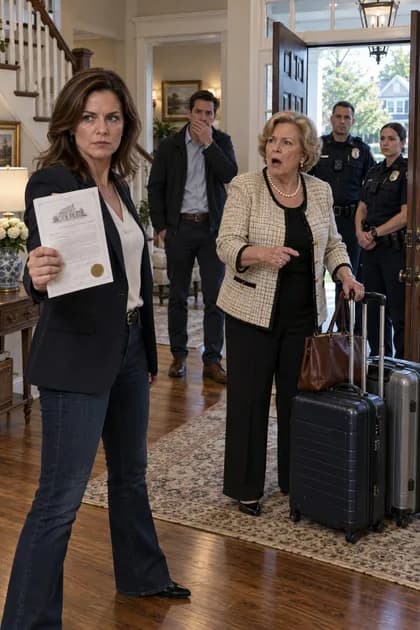
By the time I reached Uncle Steven’s house, both of my parents’ cars were parked outside.
Chapter 4
PART 4 - I STOPPED SAVING THEM AND MADE THEM FACE THE BILL
1,737 words
Kayla was already there.
So was a man in a navy suit with a leather briefcase.
He introduced himself as Mark Ellison, the accountant who had prepared tax returns for Reed Family Holdings.
Dad looked furious that I had come.
Mom looked terrified.
Uncle Steven looked like someone who had finally gotten tired of carrying a secret.
We sat around his dining table.
For once, nobody had decorated the room.
No balloons.
No flower crown.
No applause.
Just paper.
Mark opened his briefcase.
“Before we start,” he said, “I want to be clear that I am here because several statements attributed to this company do not match the records I was given.”
Dad immediately said, “This is a family matter.”
Mark looked at him.
“It became an accounting matter when you filed documents.”
The room went silent.
He placed three folders on the table.
The first contained the refinance records.
The second contained Reed Family Holdings bank statements.
The third contained copies of the “capital contribution” schedules.
My name appeared on page after page.
Not because money had been transferred directly from me into the company.
Because Dad had created a running spreadsheet that assigned dollar values to everything I paid for the family.
Property taxes.
Medical bills.
Mortgage transfers.
Kayla’s rent.
House repairs.
He had added them together and labeled the total NATALIE CAPITAL.
I stared at him.
“Why?”
Dad folded his arms.
“It was bookkeeping.”
“For what?”
Mom began crying.
Dad didn’t look at her.
Finally, Mark answered.
“They were trying to qualify for a business line of credit.”
My stomach dropped.
“Using my money?”
“Using the appearance of family capital support,” Mark said carefully.
He explained that Reed Family Holdings had been formed when Dad and Uncle Steven considered buying a small rental property together.
Steven backed
out before closing.
Dad didn’t.
Instead, he and Mom used the company to move money between the refinanced house, Kayla’s boutique expenses, and a failed short-term rental investment two towns over.
The rental had lost money.
The boutique had lost money.
The house carried the debt.
And my emergency fund had quietly become the cushion keeping every payment current.
“How much?” I asked.
Nobody answered.
Mark turned a page toward me.
Total outstanding debt tied directly or indirectly to the company: $137,840.
Kayla covered her mouth.
I looked at Dad.
“You were going to let me keep paying until this disappeared?”
His face hardened.
“We were going to fix it.”
“With what money?”
“We had a plan.”
I almost laughed.
“The Natalie Contribution Plan?”
Mom flinched.
I turned toward her.
“You wrote that if I bought a house, this stops working.”
She wiped her face.
“I was scared.”
“So you
tried to keep me from buying one?”
“No.”
“Did you create fake emergencies?”
Her silence answered before her mouth did.
Kayla stared at Mom.
“What fake emergencies?”
Mom shook her head.
“Not fake. We needed help.”
“The truck transmission?” I asked.
Dad looked away.
My heart sank.
“The dental procedure?”
Mom whispered, “Insurance covered more than we expected.”
“How much more?”
She didn’t answer.
“The rent emergency when I was buying my condo?” I asked Kayla.
Kayla looked stunned.
“I was behind,” she said. “But only one month. Mom told you two.”
I stood and walked away from the table.
That was the part that hurt most.
Not the Hawaii trip.
Not even the money.
They had learned that my love could be activated by crisis.
So when there wasn’t enough crisis, they enlarged one.
Dad followed me into the living room.
“Natalie, listen to me.”
I turned.
“No. You listen.”
My voice was calm.
“I spent years thinking I was less loved because I wasn’t celebrated like Kayla. Then I spent twenty-four hours thinking maybe you only valued me because I was useful.”
He opened his mouth.
I kept going.
“But this is worse. You built financial decisions around the assumption that I would never choose myself.”
Mom began sobbing behind him.
I looked at her.
“You didn’t just spend my money. You planned my future around keeping me available.”
She whispered, “I thought family meant sacrifice.”
“Whose?”
She had no answer.
Mark cleared his throat.
“There is another issue.”
Dad closed his eyes.
That told me he already knew.
The business line of credit application had not yet been approved.
But it was still open.
And attached to the application was a statement that Reed Family Holdings had “ongoing family capital commitments exceeding $100,000.”
My certified letter had destroyed that claim.
Without my supposed support, the lender would almost certainly deny the application.
Which meant Dad could no longer borrow his way out.
For the first time in ten years, the family had reached a problem I could not solve by writing a check.
Because I had decided not to.
Dad sat down.
“What do you want?”
It was the wrong question.
For years, I had wanted apologies.
Recognition.
A birthday where I didn’t feel like furniture.
Now I wanted boundaries.
“I want my name removed from every document that suggests I’m financially committed to this company.”
Mark nodded.
“That can be done.”
“I want written confirmation that none of my past payments created an ownership obligation, lending obligation, or future contribution requirement.”
Another nod.
“And I want the emergency account to remain closed to everyone except me.”
Mom looked up.
“What about us?”
“You have income. You have a house with equity. You have two cars. You have options.”
Dad’s jaw tightened.
“You expect us to sell our home.”
“I expect you to make the same decisions you expected me to make every time I rescued you.”
Kayla spoke quietly.
“What about my debt?”
I looked at her.
“You signed it.”
Tears filled her eyes, but she nodded.
“I know.”
That mattered.
“I’ll help you understand the documents,” I said. “I won’t pay them.”
She nodded again.
For the first time, she did not ask.
Over the next month, the family story changed faster than I expected.
The Hawaii trip was canceled.
The refund covered most of the next mortgage payment and several overdue bills.
My parents listed the short-term rental property for sale and accepted a loss.
They sold Dad’s newer truck and replaced it with an older used vehicle.
Mom went back to part-time bookkeeping work.
And after weeks of fighting the idea, they listed the family house.
It sold three months later.
There was enough equity to pay off the mortgage, clear a large portion of the business debt, and leave them with enough for a smaller townhouse.
Not the disaster they had described.
Just consequences.
Uncle Steven signed a formal statement confirming that I had never agreed to invest in Reed Family Holdings.
Mark amended the company records.
The credit application disappeared.
And I hired my own CPA to review everything that involved my name.
There was no magical lawsuit.
No police raid.
No billionaire stranger waiting to rescue me.
Just paperwork, boundaries, and a family forced to live inside its actual income for the first time.
Kayla surprised me most.
She got a second job.
Then she sold clothes, equipment, and inventory she had kept from Wild Ivy.
Six months later, she sent me a screenshot.
Her credit card balance had dropped below ten thousand dollars.
Under it she wrote:
I know this doesn’t fix what I did. I just wanted you to know I’m finally paying my own bills.
I stared at the message for a long time.
Then I replied:
Good. Keep going.
We did not become best friends.
But we stopped pretending.
My relationship with my parents changed more.
Mom still called.
At first, every conversation somehow drifted toward money.
A repair.
A medical copay.
A fee.
I learned to say one sentence.
“I’m sorry you’re dealing with that. What are you going to do?”
The first few times, the silence afterward felt unbearable.
Then it became peaceful.
Dad didn’t speak to me for almost two months.
When he finally did, he asked if I wanted to see their new townhouse.
I went.
It was smaller than the old house.
No formal dining room.
No giant yard.
No extra bedroom they never used.
But the mortgage was gone.
They could actually afford it.
Mom made coffee.
Dad stood by the kitchen counter.
For a while, none of us knew what to say.
Then he looked at me.
“I was angry because you forced me to admit I couldn’t afford the life I was pretending we had.”
I waited.
He swallowed.
“That wasn’t your responsibility.”
It wasn’t a perfect apology.
But it was the first honest one he had ever given me.
A year after my twenty-eighth birthday, I bought the condo I had once walked away from.
Not the same unit.
A better one.
Two bedrooms.
A balcony.
Morning light in the kitchen.
At closing, I transferred the down payment from an account nobody in my family could access.
That night, Kayla came over carrying a small cake.
No relatives.
No speeches.
No Hawaii envelope.
Just a cake.
She put it on the counter and smiled awkwardly.
“Happy birthday.”
I laughed.
“My birthday was three weeks ago.”
“I know. I thought maybe we could start over without making it a production.”
So we ate cake on the floor because my dining table had not arrived yet.
At one point, she looked around the condo.
“You know Mom used to say you didn’t need encouragement.”
I smiled.
“I didn’t.”
Kayla frowned.
I added, “I needed respect.”
She nodded.
And that was the difference.
For years, my family believed being dependable meant I had no limit.
They believed strength meant I could absorb every consequence.
They believed love meant access.
They were wrong.
The night they applauded my sister on my birthday and used my money to send her to Hawaii, I thought I was only moving eighty-three thousand dollars out of an account.
I was actually moving myself out of a role.
The emergency fund.
The backup plan.
The daughter who would always fix it.
I still love my family.
But I no longer finance their refusal to change.
And the most valuable thing I bought with the money I saved wasn’t the condo.
It was the right to build a life that did not require everyone else’s permission.
THE END.
Chapter complete
You have reached the end of this chapter.
Continue reading
Find your next story
A few more worlds to get lost in after this chapter.