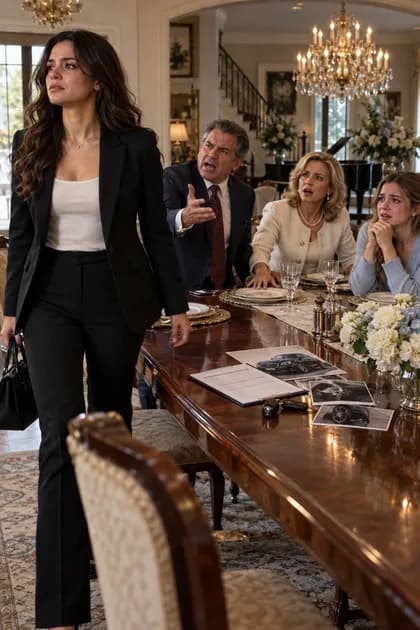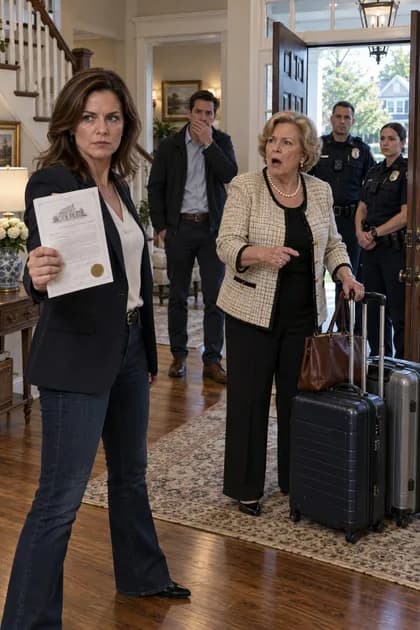
My father called me a disgrace at my sister’s wedding in front of 250 guests, then smiled like he had finally finished erasing me.
Chapter 1
My father called me a disgrace at my sister’s wedding in front of 250 guests, then smiled like he had finally finished erasing me.
Fifteen years earlier, he threw me out for joining the Air Force and told everyone I was the daughter who failed. What he didn’t know was that Clare, the bride, was alive because of me. And when she took the microphone, the whole ballroom learned what my family had spent years hiding.
My father tried to erase me at my sister’s wedding with a place card and a glass of Bordeaux.
“If it wasn’t for pity, no one would have invited you.”
He said it beside table 22, loudly enough that the guests nearby stopped cutting into their salmon. My stepmother kept one jeweled hand on his arm and watched me with the calm little smile of someone waiting for damage.
I looked down at the card in front of my plate.
Not Evelyn.
Not sister of the bride.
Just: guest of the bride.
The table had been pushed near
the swinging kitchen doors, with cheap silk flowers, uneven lighting, and a perfect view of waiters carrying trays of dirty glasses.
Across the ballroom, the family table glowed under white roses and candlelight. My father stood there with a crystal glass of Bordeaux in one hand, looking pleased with the arrangement.
Fifteen years earlier, when I chose the Air Force instead of a desk in his insurance company, he put my suitcase on the front steps and changed the locks before dinner. He had not spoken to me since.
Apparently, tonight he had decided silence wasn’t enough.
He wanted witnesses.
“Dad,” I said, “do you still need a crowd to be cruel?”
His mouth tightened. “You always did have a gift for drama.”
During cocktail hour, my stepmother had already done her part.
“Oh, Evelyn,” Margaret said, her smile soft and poisonous. “What a surprise. I thought someone from the
charity list had been mixed in with the invitations.”
Then she guided me toward a group near the terrace and asked, sweetly, “And what is it you do now? Something with planes? Still no husband? No children?”
I let the questions fall between us without picking them up.
My watch caught the eye of one woman nearby. Olive drab. Plain. Functional. It was probably the cheapest watch in the ballroom, and the only one I would have trusted in an emergency.
Then Clare found me.
She came hurrying toward me in white silk and cathedral lace, breathless and already close to tears.
“I sent the invitation,” she whispered. “Dad doesn’t know. Margaret tried to stop it.”
I should have left right then.
Instead, Clare grabbed both of my hands and squeezed hard enough to hurt.
“Please stay,” she said. “No matter what he says tonight, stay.”
So I stayed.
I
stayed through the whispers. Through the looks. Through the careful little humiliations.
I stayed when one of my father’s business partners sat at my table, glanced at my dress, and asked what the military paid these days, like it was a joke with a salary attached.
“I spend that on my boat,” he said, swirling his scotch.
My father laughed. “At least she stopped asking me for money.”
I had not asked him for a dime since I was twenty-two.
At dinner, he stood for the toast like a king rising before his court. Silver hair. Black tuxedo. Chandelier light flashing along the rim of his glass.
“Clare has always understood loyalty,” he said. “She knew the difference between family and fantasy.”
Three tables turned toward me.
Not subtly.
I kept my spine straight.
People who humiliate you in public want movement. Tears. A flinch. A tremor in the mouth. Something they can point to later and call proof.
I gave him stillness.
That bothered him more.
He stepped down from the head table and came closer.
“If it wasn’t for pity, no one would have invited you.”
A bread basket stopped halfway to table 19. A woman in pearls covered her mouth. Behind me, one of the kitchen doors slapped shut.
I lifted my glass and took one slow sip.
“Funny thing about pity,” I said. “The people handing it out usually need it most.”
For the first time all night, my father had nothing ready.
He stared at me. Margaret’s smile flickered. His business partner looked down at his plate like he suddenly remembered an urgent appointment somewhere else.
Before dessert, I went to the ladies’ room.
I locked the door, put both hands on the marble vanity, and looked at myself under the soft gold sconces.
My eyes were red, but dry. My right knuckles still carried a pale scar from a rescue years ago. I looked at that scar and reminded myself who I was before I had ever been his disappointment.
When I returned to the ballroom, something inside me had gone cold and steady.
An older man at the next table noticed my watch, then the engraving on the back.
“Whoever seated you at table 22 made a serious mistake, ma’am.”
I did not answer.
I did not need to.
Then the maid of honor took the microphone.
She began with harmless stories. College pancakes. Snowstorms. A stray cat Clare once smuggled into a dorm room. The room relaxed. My father leaned back in his chair, confident again.
Then the maid of honor’s voice changed.
“Seven years ago,” she said, “we almost lost Clare.”
The ballroom went quiet in a way I felt in my teeth.
My sister lowered her gaze to her hands.
My father looked into his wine.
The maid of honor spoke about rain. A bridge. A car sinking into black water. An unnamed military pilot who did not wait for the dive team.
My stomach turned hard.
Before I could stand, David appeared beside my chair and crouched low enough to stay mostly out of sight.
“She’s been planning this for six months,” he whispered.
He slid a phone toward me under the tablecloth. On the screen was government letterhead I recognized instantly.
Department of the Air Force.
Freedom of Information Act response.
I looked up at him.
“Clare tracked it all,” he said quietly. “She knows everything now.”
Across the room, my sister rose from the head table.
My father smiled at first. He thought he was about to be thanked. Margaret straightened in her chair and folded her hands as if waiting for tribute.
Clare did not look at either of them.
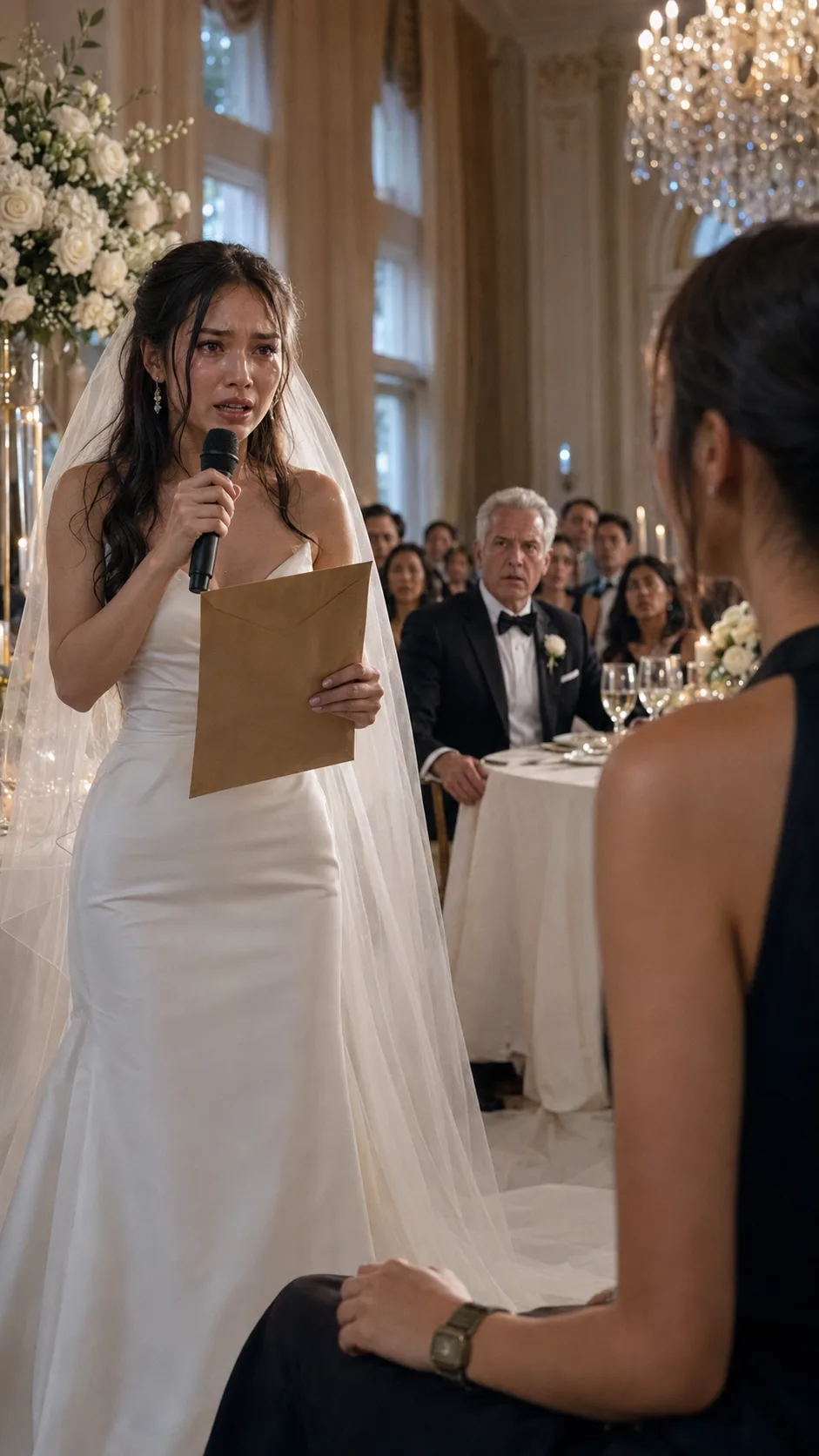
She walked past the cake table, climbed the small stage, and took the microphone with a hand that was visibly shaking.
Then she reached behind the podium and pulled out a brown envelope.
Not ivory.
Not wedding stationery.
Government issue.
My father’s smile slipped.
The room felt it.
Two hundred fifty guests in black tie and diamonds turned toward the single piece of paper in my sister’s hand. Even the servers froze beside the coffee urns.
Clare looked straight at me.
Then she turned toward the family table.
And into that perfect candlelit silence, my sister said, “I want to honor someone my family tried to erase.”
“Seven years ago, my car went off the Route 9 bridge,” Clare began, her voice echoing off the high ceilings. “I was trapped. The water was freezing, and I was drowning. The police report said a good Samaritan pulled me out before the dive team arrived. My father told everyone it was a passing fisherman.”
She looked down at the head table. My father had gone perfectly still, the crystal glass frozen in his hand.
“He lied,” Clare said.
The word dropped into the room like an anvil.
“Clare, sweetheart,” Margaret interrupted, her voice shrill, a desperate attempt to maintain control. “This isn’t the time for tall tales—”
“It is exactly the time,” Clare snapped, turning a fierce, uncompromising glare on her stepmother. She held up the government envelope. “Because for seven years, I believed that lie. Until I filed a Freedom of Information Act request to find the military personnel who actually responded to the highway patrol’s distress call that night.”
She unfolded the paper. The microphone picked up the sharp rustle of the page.
“Incident report. November 12th. Responding officer: Captain Evelyn Hayes, United States Air Force.”
A collective gasp swept through the ballroom. Two hundred and fifty pairs of eyes shifted from the bride on the stage to the woman sitting in the shadows by the kitchen doors.
My father’s face drained of all color, leaving him looking like a wax figure. He stood up, his chair scraping violently against the hardwood floor. “Clare, you’re making a scene. Put that away.”
“No, Dad. You made a scene,” Clare said, her voice gaining a sharp, ringing authority. “You stood here tonight and said Evelyn was invited out of pity. You told your friends she was a failure. You tried to erase her with a place card.”
She stepped down from the stage. The cameraman scrambled to keep her in frame.
“But while you were sitting in your corner office, the daughter you threw out of your house was diving into freezing black water to break my windshield with her bare hands.”
I looked down at the pale scar on my right knuckles. The memory of the shattering glass and the crushing weight of the river flashed behind my eyes.
Clare walked right past the head table. She didn't even look at our father as she moved through the sea of guests. The crowd parted for her in stunned silence. The business partner who had joked about my salary was staring at me, his face pale, his scotch forgotten on the table.
Clare didn't stop until she reached Table 22.
David, her new husband, smiled at me and stepped back to give her room.
Clare held out both of her hands. I stood up and took them. They were warm, and she was gripping me just as fiercely as she had during the cocktail hour.
“I am not alive today because of luck,” Clare said, looking at me, but speaking into the microphone so the entire room could hear. “I am alive because my big sister never stopped watching over me, even after this family turned its back on her. And if anyone in this room has a problem with the bravest person I know sitting at my wedding, you know exactly where the exit is.”
She dropped the microphone. It hit the floor with a heavy thud of feedback.
She threw her arms around my neck, burying her face in my shoulder, and cried. Not delicate, polite tears, but deep, shaking sobs of relief. I held her tight, resting my chin on her veil, ignoring the flash of the photographer’s camera.
When we finally pulled apart, I looked across the room.
My father was standing alone at the head table. The people around him—his friends, his investors, his social circle—were looking at him with undisguised disgust. Margaret was staring at her lap, shrinking into her expensive silk dress. They looked exactly like what they were: small, cruel, and finally exposed.
I picked up my cheap, olive-drab watch from the table and strapped it to my wrist.
“Happy wedding day, Clare,” I said quietly.
“Where are you going?” she whispered.
“I have an early flight back to base,” I smiled, wiping a tear from her cheek. “And you have a party to enjoy.”
I turned and walked out of the ballroom through the main double doors. No one stopped me. No one whispered. As I walked past the family table, my father couldn't even meet my eyes.
The silence I left behind wasn't the silence of humiliation. It was the silence of absolute respect.
Chapter complete
You have reached the end of this chapter.
Continue reading
A few more worlds to get lost in after this chapter.