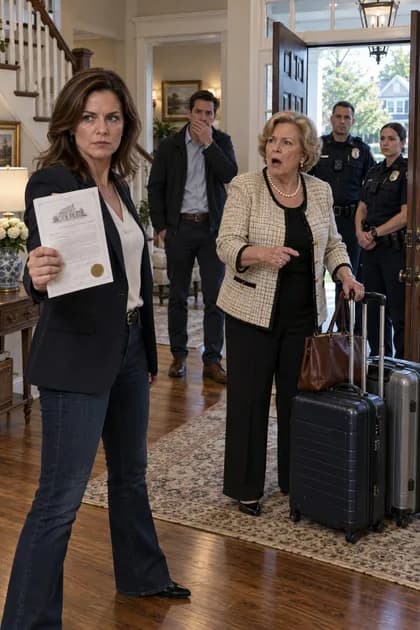
The first warning wasn’t the three men in suits sitting at my parents’ dinner table.
Chapter 1
PART 1 - THE DINNER WHERE MY FAMILY TURNED A WEDDING INTO AN ULTIMATUM
948 words
It wasn’t the thick legal agreement waiting beside my plate, either.
It was the way my mother smiled when I walked in—as if whatever happened that night had already been decided.
Thirty minutes later, my younger sister leaned across the table and hissed, “Sign this or I’ll ruin you.”
My mother didn’t tell her to stop.
My father didn’t even look up.
And my husband Nathan?
He quietly reached for the briefcase beside his chair.
That was when everyone at the table should have started worrying.
My name is Franchesca Sinclair. I’m thirty-six, and I work as a senior risk analyst in Manhattan. I spend my days examining numbers, contracts, and worst-case scenarios before they become expensive disasters.
Yet that Friday night, I was sitting in the dining room of the house where I grew up, wondering how my own family had turned dinner into an ambush.
Around the table
sat my mother, my father, my younger sister Tiana, her fiancé Chase, my husband Nathan—and three strangers in suits.
Directly in front of my plate was a thick document covered in yellow tabs.
Sign here.
Sign here.
Sign here.
Alden Pierce, the man who introduced himself as the family’s attorney, clicked his pen while I read.
The agreement required me to provide $45,000 toward Tiana’s wedding.
But that wasn’t all.
It also required me to co-sign a business line of credit for Chase’s company. Buried farther down was a clause promising that I would make no “harmful statements” about any member of the family or affiliated business.
My money.
My credit.
My silence.
All bundled into one convenient packet.
My mother folded her hands. “This just makes official what family already means.”
I knew exactly what she meant.
For most of my adult life, whenever something went wrong, I was
the person everyone called. When my parents’ roof failed, I sent $9,000. When Tiana needed help finishing college, I paid for her final two years. When my parents couldn’t handle their property taxes one Christmas, I handled them.
And when Grandma Ruth died, she named me executor of her estate. I spent months documenting every transaction and accounting for every dollar.
For years, everyone called me responsible.
Eventually, I learned that in my family, responsible meant available.
The wedding fight had started months earlier at Tiana’s bridal brunch.
I had found a cream-colored envelope beside my water glass. Inside was an itemized list for the venue, dress, flowers, band, photographer, and rehearsal dinner.
At the bottom was my assigned total.
$45,000.
Nobody asked whether I wanted to contribute.
Instead, eleven people raised their glasses and toasted to “family stepping up.”
I offered to pay for Tiana’s entire wedding dress, including
the alterations and veil.
My mother looked insulted.
“You seem confused,” she said. “Nobody’s asking.”
Then came the sentence I had heard in different forms my whole life.
“Family is a debt you’re born into.”
I refused.
After that, the group chat went quiet. Then aunts I barely spoke to began calling me selfish. Tiana posted vague messages about people revealing their “true colors.”
Then Chase came to my office.
He suggested that instead of giving the $45,000 directly to the wedding, I invest it in his company. He called it a friends-and-family opportunity.
Then he smiled and casually mentioned the exact amount of my annual bonus.
I had never told him that number.
“How do you know what my bonus is?”
“Family talks.”
That was the moment I stopped treating this as wedding drama.
I started paying attention.
Now, months later, I was staring at a legal agreement containing information about my income.
So I asked questions.
“What’s the limit on the line of credit?”
Pierce gave me a vague answer.
“What are the repayment terms on the $45,000?”
Another vague answer.
Then I looked at Chase.
“Why does a family reconciliation agreement require me to promise I won’t say anything negative about your company?”
Nobody answered.
Chase finally shrugged. “Standard stuff, Franny. Protects everybody.”
Nobody calls me Franny.
I placed the pen on the table.
“No.”
One word.
That was all it took.
Tiana shoved her chair backward and came halfway out of her seat.
“Sign this or I’ll ruin you.”
Silence swallowed the room.
She told me exactly what she planned to do. Monday morning, she would call my employer and accuse me of mishandling Grandma Ruth’s estate.
She knew every dollar had passed through my hands because I had been executor. And she knew I worked in an industry where even a false allegation of financial misconduct could trigger a review.
I looked at my mother.
She said nothing.
I looked at my father.
He stared at his plate.
There was my little sister—the woman whose education I had helped pay for—looking at me as if years of support meant nothing compared with the check she wanted now.
I didn’t yell.
I didn’t defend myself.
I calmly folded my napkin and placed it beside the unsigned agreement.
Then I looked at Nathan.
For four years, my family had barely bothered asking what my husband actually did. They knew he worked with contracts, wore ordinary suits, drove a Honda, and rarely talked about himself.
Nathan had been unusually quiet throughout dinner.
Almost too quiet.
He met my eyes, reached beside his chair, and wrapped his fingers around the handle of the briefcase he had carried into the house.
Across the table, Pierce finally stopped clicking his pen.
Chase glanced toward Nathan.
Tiana was still standing.
My mother’s smile disappeared.
Nathan looked at me once.
And then he opened the briefcase.
Chapter complete
You have reached the end of this chapter.
Continue reading
Find your next story
A few more worlds to get lost in after this chapter.