PART 2 — Chloe’s Plan for My Home
I had left it on the kitchen table by mistake, tucked half under a stack of grocery coupons.
Chapter 2
PART 2 — Chloe’s Plan for My Home
I had left it on the kitchen table by mistake, tucked half under a stack of grocery coupons.
It was from the townhouse community, a glossy little pamphlet with a photo of the front row of homes and a map on the back.
Chloe found it on a Tuesday afternoon.
I knew the second I walked into the kitchen that something had shifted.
She was standing by the table with the brochure pinched between two fingers, holding it the way someone might hold a piece of evidence. Her eyes were narrowed. Her mouth was tight. Austin stood behind her near the doorway, staring at the floor like the tiles had suddenly become fascinating.
“What is this?” she asked.
I set my purse on the counter. “It looks like a brochure.”
“Don’t be cute with me.”
I looked at Austin.
He did not look back.
Chloe slapped the brochure onto the table.
“You bought a house?”
Her voice rose on the last word, sharp enough to slice the room
open.
“Yes,” I said.
The stillness afterward was almost peaceful.
Then Chloe laughed once, but there was no humor in it.
“You bought a house,” she repeated, slower this time. “With family money?”
I took off my coat and hung it on the back of the chair.
“My money,” I said.
Her face hardened.
“Money that could have helped this family.”
Austin shifted his weight. His hands stayed buried in his pockets.
Chloe stepped closer, her cheeks already flushing.
“Do you have any idea how selfish this is? We have plans. We have responsibilities. You know how expensive everything is right now, and you just went off and made a huge financial decision without even talking to us?”
I poured myself a cup of coffee from the pot I had made that morning. It was lukewarm, bitter, and exactly what I needed to keep my hands steady.
“I’m sixty-one years
old,” I said. “I don’t need permission to use the money I earned.”
That was when I saw what really bothered her.
It was not the house.
It was not even the money.
It was the fact that I had made a decision without leaving room for her to control it.
Chloe wanted a fight. I could see it in the way her chin lifted, in the way her fingers flexed against the edge of the table. She wanted tears, apologies, maybe even a trembling explanation she could pick apart line by line.
I gave her none of it.
I took a sip of coffee and said, “The house is mine. The decision is final.”
She slammed the kitchen door so hard the frame rattled.
Austin gave me one of those wounded, apologetic looks I had seen too many times to count, the kind that asked me to forgive him
without requiring him to do anything worth forgiving.
Then he followed her out.
I stood alone in the kitchen, listening to their footsteps fade upstairs, and felt something settle inside me.
Not sadness.
Not anger.
Decision.
That little townhouse was not an indulgence. It was a lifeboat.
And I was done drowning quietly so other people could pretend the water was fine.
By the next evening, Chloe had moved from outrage into strategy.
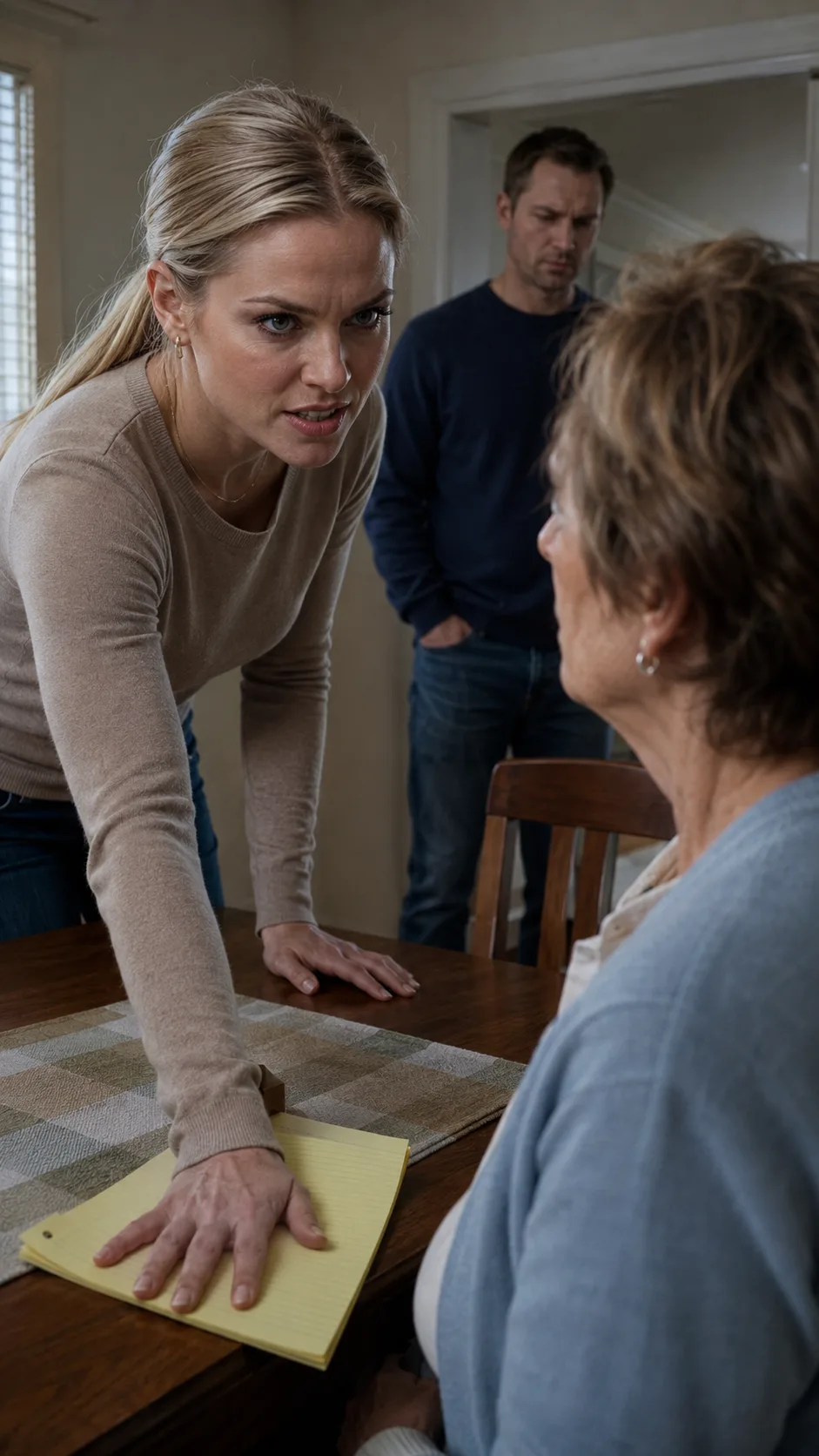
She arrived at my dining table with a yellow legal pad, a pen, and the calm expression of a woman who had convinced herself that theft sounded better when organized into bullet points.
Austin came with her, of course.
He sat down slowly, avoiding my eyes.
Chloe smiled as if the previous day had never happened.
“I think we all got a little emotional yesterday,” she began.
I said nothing.
She opened the legal pad.
“I’ve been thinking about the townhouse, and honestly, it makes more sense for Austin and me.”
The room went so quiet I could hear the refrigerator hum.
She continued, encouraged by my silence.
“It’s newer, it’s in a better location, and it has more usable space. You’re one person. You don’t need all that. You could stay here in the downstairs unit, or even move upstairs if that’s easier after we rearrange things.”
Austin swallowed.
I looked at him. “Is that what you think?”
His mouth opened, then closed.
Chloe answered for him.
“We’re just being practical.”
Then she slid the legal pad toward me.
She had written out a list.
Transfer townhouse use to Austin and Chloe.
Add Chloe to deed for financial security.
Discuss garage conversion if necessary.
I looked at the words, then at her.
“If necessary?” I asked.
Her smile became thinner.
“Well, if you insist on being difficult and living there too, the garage could probably be converted into a nice little mother-in-law suite for you.”
For a second, I could not even be hurt.
The audacity was too clean, too bright, too complete.
She had taken my private escape, the first thing I had done purely for my own peace in years, and turned it into a floor plan where I was shoved into the garage of my own house.
Austin gave a weak nod, like a man agreeing with bad weather.
That hurt more than I wanted it to.
Not because he wanted the house. I do not think he had even thought that far. It hurt because he was willing to let her ask.
I reached into the pocket of my cardigan and pulled out the new keys.
They were heavy in my palm. Solid. Real.
I placed them on the table, covered them with my hand, and looked Chloe straight in the eye.
“This house is mine and mine alone, Chloe. No one else’s name is going on that deed.”
My voice did not shake.
That seemed to offend her more than anything.
Her face turned red.
“You are unbelievable,” she snapped. “Cold, selfish, cheap. Family is supposed to look out for each other.”
“Family is not supposed to circle someone’s savings like vultures,” I said.
Austin flinched.
Chloe pushed back her chair.
“So that’s what you think of us?”
I stood and picked up my plate from the table.
“I think you heard me clearly.”
She followed me with her voice as I walked to the dishwasher.
“You’re going to regret this. You’re going to end up alone in that little house with nobody caring what happens to you.”
I loaded my plate, closed the dishwasher, and walked out of the room.
Behind me, Chloe kept talking.
For the first time in a long time, I let her speak to an empty space.
Later that night, Austin came downstairs alone.
He knocked softly on my door, the way he had as a child when he had broken something and hoped I already knew.
“Mom?”
I opened it.
He stood in the hallway, shoulders rounded, hair still damp from a shower. He looked tired, but tiredness had become his excuse for everything.
“I’m sorry,” he said.
“For what?”
He blinked.
“For earlier. For how Chloe got.”
“How Chloe got,” I repeated.
His eyes dropped.
“I don’t want things to be like this.”
“Then stop helping them become like this.”
He looked at me then, wounded.
“I’m trying.”
“No, Austin,” I said quietly. “You’re hoping everyone else will change so you don’t have to.”
The words landed hard. I saw it in his face.
Part of me wanted to soften. He was still my son. I still remembered his small hand in mine walking into kindergarten, the gap between his front teeth, the way he used to bring me dandelions from the yard and call them flowers.
But mothers can love their children and still refuse to be used by the adults they become.
“Words without backbone are worthless,” I told him.
He stood there for another moment, then nodded once and went upstairs.
That was when the real campaign began.
Chloe did not yell every day. That would have been too obvious. Instead, she became petty with the precision of a surgeon.
She moved my things out of shared spaces and stacked them in the basement without asking. She filled the kitchen with expensive groceries bought with money she expected me to keep contributing. She blocked the stove when I tried to cook. She left my laundry basket in the hallway. She looked through me when I spoke, as if I had become a ghost haunting property she had already claimed in her mind.
Austin disappeared into work, errands, and garage projects. His absence became its own kind of answer.
So I stopped asking questions.
I bought a mini fridge for my bedroom. I put my coffee creamer, lunch meat, fruit, and leftovers inside it. I started cooking at odd hours and washing my dishes immediately. I paid only the bills I was legally responsible for and stopped handing over extra money for “household expenses” that somehow always turned into Chloe’s specialty groceries and decorative storage bins.
It took her less than a week to notice.
She cornered me in the kitchen one evening with a receipt in her hand.
“Did you forget to transfer the grocery money?”
“No.”
She stared. “No?”
“I didn’t forget.”
Her mouth opened slightly.
“What is that supposed to mean?”
“It means every dollar I have is going toward my new house now. You and Austin are on your own.”
She looked genuinely stunned, as if she had never considered that an ATM could become a person.
“You can’t just cut us off.”
“I can. I did.”
Her eyes flashed.
“This is punishment.”
“No,” I said. “This is correction.”
After that, dinner became a quiet battlefield.
Chloe made sharp little comments to the walls about ungrateful parents, selfish older women, and people who cared more about houses than family. Austin sat between us like a man trapped on thin ice, afraid every breath would crack the surface.
I stopped reacting.
I read my Kindle. I drank my tea. I let her words fall into the room and die there.
Inside, though, something important was happening.
With every insult I refused to answer, I felt a little less owned.
Behind the scenes, my move continued with a precision that surprised even me.
I scheduled the movers. I transferred utilities. I updated my address. I bought shelf liners, curtain rods, and a new doormat that said simply, Welcome.
Then, before a single box entered that townhouse, I called a locksmith.
The man who came out was middle-aged, polite, and efficient. He replaced every lock with high-security deadbolts, checked the strike plates, and handed me a new set of keys in a small paper envelope.
When those keys landed in my hand, I felt a wave of relief so strong I had to sit down on the front step.
It was not just metal.
It was proof.
No one could walk in unless I allowed it.
No one could “drop by” and decide a room would work better for them.
No one could take the spare and make themselves permanent.
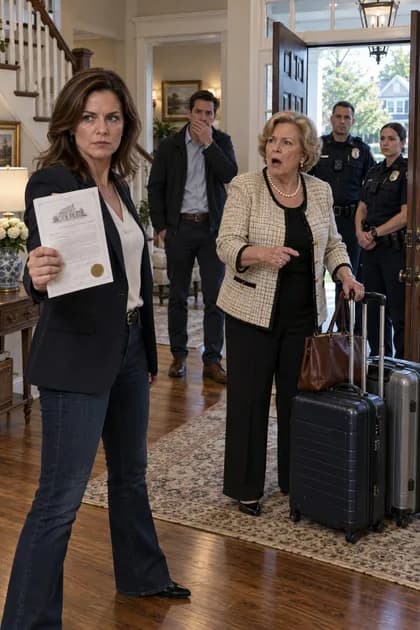
That weekend, Chloe announced that she and Austin were going to drive over to the townhouse to measure rooms for furniture.
Click the blue “PART 3” below to read the next part: 👉 PART 3 👈
Chapter complete
You have reached the end of this chapter.
Continue reading
A few more worlds to get lost in after this chapter.