My parents announced over Sunday dinner that they were moving into my house the next morning.
Chapter 1
THE NIGHT MY FAMILY DECIDED MY HOME BELONGED TO THEM
4,281 words
Not asked.
Not hinted.
Announced.
My spoiled younger sister and her boyfriend were coming too.
Dad actually smirked when he said it, as if the decision had already been made and my opinion was just an annoying technicality.
I looked around the dinner table, took one slow bite of roast chicken, and smiled.
“Fine,” I said.
Everyone relaxed.
Then I added, “Just make sure you bring $860,000 if you want the keys.”
The smiles vanished.
But I’m getting ahead of myself.
The roast chicken should have warned me the moment I walked into my parents’ house.
Garlic.
Butter.
Rosemary.
And trouble.
My mother only made that particular meal when she wanted something from me.
Actually, “wanted” wasn’t the right word.
Mom didn’t cook roast chicken when she planned to ask me for something.
She cooked it when she had already decided I was going to give it to her.
My
name is Sophia Miller. I’m thirty-one years old, and that Sunday evening became the last family dinner I ever attended.
Dad sat at the head of the table like an exhausted king presiding over a kingdom he had personally run into the ground.
Mom sat across from him, giving me that soft, satisfied smile she always wore when she believed she already knew how the conversation would end.
My younger sister, Natalie, barely looked up from her phone.
Beside her, Kevin—her boyfriend—leaned back with one arm draped casually over her chair.
He looked remarkably comfortable for a man who had apparently already moved into my home inside his own imagination.
They thought I hadn’t noticed the hints.
I had noticed every single one.
For weeks, Natalie had been asking strange questions about my apartment.
“Does your second bedroom get much sunlight?”
“Could you fit a large easel near the window?”
Mom kept mentioning how city apartments were “too lonely for single women.”
Dad complained constantly about how difficult their house was becoming to maintain.
And Kevin once laughed and said, “Man, I could definitely work from that balcony of yours.”
I smiled through all of it.
Passed the potatoes.
Asked Natalie about her artwork.
Pretended not to understand.
Because they still believed I was the Sophia they had trained me to be.
The strong daughter.
The accommodating daughter.
The daughter who always understood.
In our family, Natalie was the treasure.
I was the tool.
When Natalie struggled in school, my parents sent her to private school because she “needed individual attention.”
I attended public school because I was “smart enough to handle myself.”
For Natalie’s sixteenth birthday, they bought her a red Toyota.
Around the same time, they emptied my savings to cover overdue property taxes.
Later, Natalie spent six
weeks in Europe for an art program.
I gave up a full scholarship to the University of Chicago.
That scholarship had been everything to me.
Architecture.
Chicago.
Glass towers and unfamiliar streets.
A future where nobody knew me as the daughter who existed to fix everyone else’s mistakes.
One week before I was supposed to leave, Dad called me into the dining room.
This same dining room.
This same table.
“Just stay one year, Sophia,” he told me. “Help us catch up.”
Mom stood behind him and delivered the sentence that had controlled most of my life.
“Family comes first.”
Natalie was in Paris.
Her future was protected.
Mine was negotiable.
So I stayed.
One year became two.
Two became five.
Eventually, five became ten.
I worked call centers.
I cleaned office buildings at night.
I answered phones in a medical office during the day.
And every month, part of my paycheck went home.
Somehow, the “temporary family emergency” never ended.
It simply became another responsibility assigned to me.
But there was something my family didn’t know.
While they were using one version of my life, I was quietly building another.
Some nights, after work, I sat in my car outside closed office buildings because I could pick up the free Wi-Fi.
That was where I studied IT.
I earned certifications one by one.
Systems.
Cybersecurity.
Databases.
Programming.
Eventually, I started doing freelance technology consulting.
Then I met Mark.
Together, we co-founded a health-tech startup.
Mark became the first person in my professional life who treated me like a partner instead of a resource.
We built software for small medical clinics.
The beginning was brutal.
Twice, we came dangerously close to losing everything.
Then a venture capital firm invested in us.
The company grew.
And slowly, quietly, without my family noticing, the daughter they considered their financial backup plan became worth more money than any of them could have imagined.
Then Aunt Linda called.
Her voice was trembling.
“Sophia, your parents are talking about moving into your apartment.”
I stared through my office window at the rain running down the glass.
“They’re talking about what?”
“They’ve been telling people you’ll be happy to have them,” she whispered. “Natalie has already chosen your second bedroom.”
My stomach turned cold.
That apartment wasn’t just property to me.
It was my refuge.
The first home I had ever chosen entirely for myself.
Two bedrooms.
Large windows.
A small balcony where I drank coffee alone before morning meetings.
Peace.
Silence.
Freedom.
And somehow, my family had already divided it up without asking.
Mom and Dad planned to take the master bedroom.
Natalie and Kevin would take the second.
Apparently, where I was supposed to sleep wasn’t important enough to discuss.
That evening, I drove to my parents’ house.
I didn’t tell them I was coming.
I never even went inside.
Standing near the den, I heard Dad talking on the phone.
“She won’t refuse,” he said.
I froze.
“She always complains at first, then she does the right thing. That apartment is family property anyway.”
He paused.
Then came the words I would never forget.
“She owes us.”
Family property.
She owes us.
I got back into my car and drove away before he ever knew I had been there.
The next morning, I called an attorney named Evelyn Reed.
I told her everything.
The money.
The sacrifices.
The apartment.
My parents’ plan.
Evelyn didn’t give me sympathy.
She didn’t tell me to forgive them.
She didn’t lecture me about family.
When I finished, she simply said, “This isn’t a family disagreement, Sophia. It’s an asset-protection problem.”
And then we got to work.
Within weeks, Evelyn helped me build a legal wall around everything I had spent years creating.
My startup equity.
My savings.
My apartment.
Trust documents.
Holding companies.
Deed transfers.
Lease agreements.
By the time Mom called and invited me to what she cheerfully described as “a special family dinner,” I already knew what they planned to announce.
I also knew they were too late.
So I went.
Simple black dress.
Calm expression.
No visible emotion.
Dinner was a performance from beginning to end.
Mom fussed over the chicken.
Natalie talked endlessly about needing more space for her art.
Kevin asked casual questions about the view from my balcony.
Dad waited until dessert was finished.
Then he placed his fork down.
Leaned back.
And smiled.
“Sophia,” he said, “your mother and I have made a decision.”
There it was.
Mom folded her hands in front of her.
“Things have been difficult,” she said. “And your sister really needs somewhere peaceful where she can focus.”
Natalie smiled into her wine.
Kevin’s expression told me he was probably already deciding where his gaming setup would go.
Then Dad leaned forward.
“Tomorrow,” he said, “we’re moving into your house. No excuses.”
Silence.
Four faces turned toward me.
Waiting.
They expected the old Sophia.
The daughter who would panic.
The daughter who would feel guilty.
The daughter who would eventually surrender because saying no had always been more frightening than sacrificing herself.
Instead, I picked up my fork.
Cut a small piece of chicken.
Took one bite.
Chewed slowly.
Then smiled.
“Fine.”
Natalie gasped.
“Oh my God, seriously?”
Mom’s shoulders visibly relaxed.
Kevin grinned.
Dad looked triumphant.
For several seconds, I let them enjoy it.
Then I gently placed my fork beside my plate.
“But make sure you bring $860,000 tomorrow morning.”
The room went dead silent.
Kevin’s grin disappeared first.
Natalie stared at me with her mouth open.
Mom blinked.
Dad’s face hardened.
“What did you just say?”
I reached into my handbag.
Pulled out the folder Evelyn had prepared.
And slid it slowly across the table.
Dad looked down at it but didn’t touch it.
“That’s the current purchase price,” I said.
Mom frowned. “Purchase price for what?”
“The apartment.”
Dad’s face began turning red.
“What are you talking about? You own that apartment.”
I held his gaze.
For the first time in thirty-one years, nobody at that table could tell me what I owed them.
Nobody could decide what happened next.
And nobody knew what was inside the folder sitting between us.
I leaned back in my chair.
“No,” I said quietly.
“Not anymore.”
Dad finally grabbed the folder.
He opened it.
His eyes moved across the first page.
Then the second.
And suddenly, every trace of anger disappeared from his face.
Because he had just realized what I had done...
Dad’s hands tightened around the papers.
“What is this?” he demanded.
I stayed perfectly calm.
“It means the apartment is owned by a holding company controlled through my trust,” I said. “You can’t move in, claim it, pressure me into transferring it, or call it ‘family property.’”
Mom’s face went pale.
Natalie suddenly pushed her chair back. “You seriously did all this just to keep us out?”
“No,” I replied. “I did it to protect what I built.”
Kevin stared at the documents, clearly realizing this was no longer the easy free-living arrangement he had imagined.
Then Dad slammed the folder onto the table.
“After everything we did for you?”
That sentence almost made me laugh.
Everything they had done for me?
I thought about Chicago.
My scholarship.
My savings.
The years I spent working two jobs while Natalie traveled through Europe.
For the first time, I didn’t feel guilty.
I felt free.
But then Evelyn’s second warning came back to me.
My parents might not stop at demanding the apartment.
And judging by the look on Dad’s face, he already had another plan.
He leaned closer and said something that made even Mom turn toward him in shock.
That was when I realized this fight was far from over.
“What I’m saying,” Dad said, his voice low, “is that if you shut us out, I’ll call your investors. I’ll tell them exactly where the money for your little company came from.”
Mom turned toward him so fast her chair creaked.
“Richard.”
He didn’t even look at her.
“I’ll tell them you built that business while your family paid your bills,” he continued. “I’ll tell them you took from us, got rich, and then abandoned us.”
For one second, the room was completely still.
Then I asked, “Which money?”
Dad blinked.
“What?”
“Which money did you give me?”
His jaw tightened.
“You lived under our roof.”
“Until I was eighteen.”
“We fed you.”
“So did every parent who chose to have a child.”
Natalie made an impatient sound. “Oh my God, Sophia, stop making everything transactional.”
I looked at her.
“You’re sitting at a table where Dad just threatened to invent a financial history and send it to my investors because I won’t give four adults a free apartment. We passed transactional ten minutes ago.”
Kevin suddenly became very interested in his water glass.
Dad pointed at the folder.
“You think paperwork makes you clever?”
“No,” I said. “Records do.”
I opened the folder to a tab he hadn’t reached yet and slid a page toward him.
Evelyn had insisted we reconstruct ten years of my financial history.
Not because I wanted revenge.
Because she had asked one simple question during our second meeting.
“If they claim you owe them, can you prove what actually flowed in each direction?”
So I had downloaded old bank statements.
Found canceled checks.
Recovered tax records.
Pulled payment histories from accounts I hadn’t opened in years.
The number at the bottom of the page was $183,720.
Dad stared at it.
Mom leaned closer.
“What is that?” she asked.
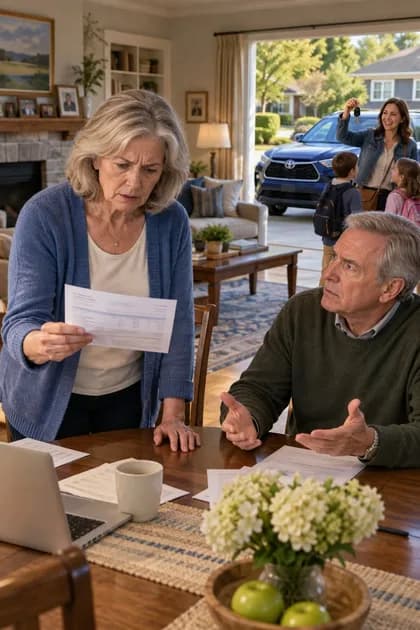
“What I transferred to this household from the time I was twenty-one until last month,” I said. “That includes the property-tax emergency, utility bills, insurance, repairs, groceries, and the money Dad called temporary help.”
Mom’s lips parted.
Natalie looked from the page to me.
I continued.
“It does not include the scholarship I gave up. It does not include lost earnings. It does not include the years I spent working two jobs. It is just money I can document.”
Dad pushed the page away.
“That doesn’t mean anything.”
“It means if you contact my investors and claim you financed my company, you’ll be lying in writing.”
His face changed.
Not much.
Just enough.
I knew then that Evelyn had been right.
People who feel entitled to your property rarely stop because you say no.
They stop when no stops being negotiable.
Dad leaned back and folded his arms.
“You still don’t understand.”
“Then explain it.”
He looked at Mom.
She looked confused now, not angry.
And something in his expression made my stomach tighten.
Finally he said, “The bank is taking the house.”
Nobody moved.
Mom whispered, “What?”
Dad rubbed a hand across his mouth.
“We’re behind.”
“How far behind?” she asked.
He didn’t answer.
“Richard. How far?”
“Far enough.”
Natalie’s phone was face down on the table now.
Dad exhaled sharply.
“The refinance bought time.”
Mom went pale.
“You told me it fixed things.”
“It did.”
“For how long?”
Dad looked away.
Mom’s voice dropped.
“For how long?”
“Six months.”
She stared at him.
“That was six months ago.”
There it was.
The real reason for the sudden invasion of my apartment.
Not loneliness.
Not family togetherness.
Not concern about a single woman living alone.
They needed somewhere to land, and Dad had decided my home would absorb the consequences.
He started talking faster.
“The mortgage went up. The repairs kept coming. Natalie needed help getting established. We had expenses.”
Natalie flinched.
“What do you mean I needed help?”
Dad ignored her.
“I thought we could catch up. Then I thought we could sell. But after the second lien—”
Mom stood so abruptly her napkin fell to the floor.
“The second what?”
Dad closed his eyes.
That was the first moment all evening when I stopped feeling like the only person at the table who had been kept in the dark.
Mom hadn’t known.
Natalie hadn’t known.
Maybe Dad had convinced himself he was protecting them by hiding it.
Maybe he had simply been protecting his pride.
Either way, he had run out of road.
He looked at me.
“We need the apartment for a year. Maybe two. You can afford somewhere else.”
There it was again.
Not: Can you help?
Not: We made a mess.
Not: I’m sorry.
You can afford it.
As if my success had turned everything I owned into emergency inventory for the family.
I closed the folder.
“No.”
Mom looked at me, shaken. “Sophia, we could lose this house.”
“I understand.”
“And you’re still saying no?”
“Yes.”
Her face crumpled.
For a second, the old guilt hit exactly where it always had.
Then I remembered myself at eighteen, standing in this same room with a scholarship letter in my hand.
Just stay one year.
Help us catch up.
Family comes first.
I had already given them that year.
And nine more after it.
I looked at Dad.
“You still have choices. Sell before the bank forces the issue. Talk to a financial counselor. Downsize. Rent. But you are not moving into my apartment, and I am not paying off debt I didn’t create.”
Dad’s chair scraped backward.
“You’d let your own parents become homeless?”
“No,” I said. “I’m refusing to become the next asset you burn through.”
His face went red.
Natalie whispered, “Dad, is the house really that bad?”
He snapped, “This is not the time.”
“It became the time when you volunteered my bedroom in Sophia’s apartment without telling me we were broke.”
Kevin quietly removed his arm from the back of her chair.
I noticed.
So did Natalie.
Dad looked at me again.
“We’ll be there at eight tomorrow.”
I stood.
“Then bring $860,000.”
He laughed once, harshly.
“You won’t lock your mother out.”
I picked up my handbag.
“No. The building will.”
The next morning, my phone rang at 7:48.
It was the front desk.
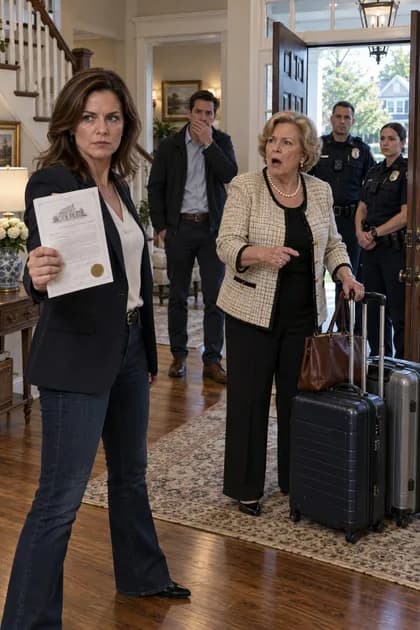
“Ms. Miller, there are four people here with a moving company. A man says he’s your father.”
I looked out at the city from my balcony.
Coffee in my hand.
Heart steady.
“I know,” I said. “I’ll be down.”
Evelyn had helped with legal documents.
I had handled the practical part myself.
The building manager had copies of the ownership records.
The old guest access code had been canceled.
My parents’ names were removed from every authorization list.
The front desk had written instructions that nobody entered my unit without my approval.
When the elevator opened into the lobby, I saw them immediately.
Dad stood beside a tower of boxes.
Mom looked as if she hadn’t slept.
Natalie had two suitcases and an easel.
Kevin was holding a computer monitor.
Behind them, two movers waited with the exhausted expressions of men who had already realized they had been hired into a family disaster.
Dad marched toward me.
“Tell them to let us up.”
“No.”
“You said fine.”
“I said you could have the keys for $860,000.”
His voice rose.
“You knew exactly what I meant.”
“Yes,” I said. “That’s why I prepared.”
The building manager stepped closer.
“Sir, Ms. Miller is the authorized resident. You do not have access to the unit.”
Dad pulled an old key card from his wallet.
“I’ve been in that apartment before.”
The manager didn’t take it.
“That card is inactive.”
Dad turned to me.
“You changed it?”
“I changed everything.”
Natalie stared at me.
“Where are we supposed to go?”
I looked at the suitcases.
Then at the easel she had apparently packed for the second bedroom she had claimed before asking me.
“You still have your parents’ house today.”
Dad cut in. “Not for long.”
“Then use today to make a real plan.”
Mom’s eyes filled.
“Sophia…”
I hated that her voice still had the power to make me feel twelve years old.
I also knew that if I surrendered now, every document in Evelyn’s office would be meaningless.
So I kept my voice gentle.
“I love you. But loving you does not require me to give you my home.”
Dad took out his phone.
“You think you’ve won?”
He tapped the screen.
“I emailed your partner this morning. And the investment firm. Let’s see how proud you are when they hear what you’ve done to your family.”
Mom closed her eyes.
Natalie whispered, “Dad, what did you do?”
My phone buzzed.
I looked down.
A forwarded email from Mark.
No panic.
No questions.
Just one line above Dad’s message.
Thought you’d want this for your records.
I turned my screen toward Dad.
“I already have it.”
His expression faltered.
“You think Mark is the only person I told?”
“No,” I said. “But he isn’t the person you needed to worry about.”
Another message arrived.
This one from Evelyn.
Dad’s phone rang seconds later.
He glanced at the screen.
His face went blank.
“Answer it,” I said.
He did.
I couldn’t hear Evelyn’s side, but I didn’t need to.
I watched Dad’s posture change.
First anger.
Then interruption.
Then silence.
Then the slow realization that sending false financial accusations to my business contacts had created a record.
When he hung up, I said, “Evelyn has the transfer history, my company formation records, my tax returns, and the email you just sent. If you want to tell people the truth, tell them. If you knowingly tell them something false to pressure me into giving you property, she’ll deal with it.”
Dad stared at me.
For once, he had nothing.
The movers looked at him.
One of them finally asked, “So… are we unloading?”
“No,” I said.
Dad’s head snapped toward me.
I wasn’t speaking to him.
I was speaking to the men whose time he had also decided belonged to him.
“There is no move-in. Please bill whoever hired you for the trip.”
Kevin slowly lowered the monitor onto one of the boxes.
Then he looked at Natalie.
“I’m going back to my place.”
Her face changed.
“What?”
“I didn’t sign up for this.”
She gave a short, disbelieving laugh.
“You were literally moving into my sister’s apartment.”
“Yeah, because you said it was handled.”
And there, in the middle of my lobby, the future Natalie thought she had began coming apart.
Not because I destroyed it.
Because it had been built on something that was never hers.
Kevin left with his monitor.
Natalie watched him go.
Dad muttered something under his breath.
Mom sat down on a lobby chair.
I could have enjoyed that moment.
A younger version of me might have.
Instead, I just felt tired.
I looked at Mom.
“Evelyn gave me the name of a realtor who handles distressed sales and a financial counselor who can help you understand your options. I’ll text you both names.”
Dad scoffed.
“So you’ll give us phone numbers. How generous.”
I met his eyes.
“Yes. Advice. Information. Contacts. Those are things I can choose to give.”
I pointed toward the elevator.
“My home is not.”
That was the last time Dad tried to enter my apartment.
It wasn’t the last time he tried to punish me.
For the next week, he sent messages.
Some angry.
Some wounded.
Some written as if nothing had happened.
He told relatives I had abandoned them.
He told Aunt Linda I had become arrogant.
He sent one more email to a business address.
Evelyn responded.
After that, the messages stopped.
The house went on the market twelve days later.
There was enough equity left to avoid the worst outcome, but not enough to preserve the life my parents had been pretending they could still afford.
They moved into a two-bedroom rental across town.
Mom found part-time work at a dental office.
Dad hated the apartment.
He hated the smaller kitchen.
He hated the shared parking lot.
Mostly, I think he hated that nobody else could be ordered to fix it.
Natalie did not move in with them.
For the first time in her life, my parents told her they couldn’t cover her rent.
Kevin was gone by then.
She took a job at a framing shop and rented a room from a friend.
We didn’t suddenly become close.
Real life rarely repairs thirty-one years of resentment with one dramatic conversation.
But three months later, Natalie called me.
“I didn’t know,” she said.
I was quiet.
“About the house?”
“About any of it. The money you sent. Chicago. Dad made it sound like you just didn’t want to go.”
That hurt in a place I thought had scarred over.
“He was wrong.”
“I know.”
She started crying.
I didn’t tell her it was okay.
It wasn’t.
But I also didn’t hang up.
That was the beginning of something more honest than what we had before.
Mom apologized eventually.
Not perfectly.
At first, she apologized for “how things got out of hand.”
I told her that wasn’t enough.
A month later, she tried again.
This time she said, “I kept asking you to be the strong one because it was easier than admitting we were failing you.”
That was the first apology from her I believed.
Dad never apologized.
For a long time, I thought I needed him to.
Then one Saturday morning, I realized I didn’t.
The second bedroom in my apartment was still empty.
The room Natalie had chosen.
The room my parents had allocated like a square on a floor plan they owned.
I stood in the doorway with a cup of coffee and looked at the sunlight spreading across the floor.
Then I drove to an art supply store.
I bought a drafting table.
Not an easel.
A drafting table.
That fall, I enrolled in an evening architectural design course.
I wasn’t trying to become eighteen again.
I wasn’t abandoning the company Mark and I had built.
I simply wanted to reclaim one piece of a future I had once surrendered because someone told me family came first.
The first night I came home from class, I set my drawings on the table by the window.
The apartment was quiet.
No boxes in the hallway.
No voices claiming bedrooms.
No one telling me what I owed.
I stepped onto the balcony and looked over the city.
For most of my life, “family comes first” had meant Sophia comes last.
I don’t live by that sentence anymore.
I still love my family.
But love is not a deed.
It is not a key.
It is not a blank check.
And it is not permission to take whatever someone else worked to build.
The apartment was never really the point.
The point was that for the first time in my life, when they told me what I had to give up, I said no.
And nothing terrible happened.
The world did not end.
I did not become selfish.
I simply remained standing in the life I had built.
This time, nobody took it from me.
THE END.
Chapter complete
You have reached the end of this chapter.
Continue reading
Find your next story
A few more worlds to get lost in after this chapter.