His Pregnant Wife Hit the Floor While His Mistress Laughed and the Sirens Brought a Secret He Never Saw Coming
For a moment, silence.
Chapter 1
For a moment, silence.
Then the waiter who had called 911 raised his hand.
“He pushed her.”
Daniel whipped around. “I did not.”
“I saw it,” the waiter said, voice shaking. “He grabbed her and shoved her away.”
A woman near the window stood. “I saw it too.”
“So did I,” said the nurse on the floor.
More voices followed.
“I recorded part of it.”
“He was yelling at her.”
“She was pregnant and he grabbed her.”
Vanessa stepped backward, as if distance could erase association.
Daniel’s chest tightened. “This is ridiculous. She slipped.”
The officer looked at him with no expression. “Sir, you need to remain here.”
“They’re taking my wife.”
“And we need to ask you questions.”
The paramedics lifted Harper onto the stretcher. For one brief second, her eyes opened.
She saw Daniel.
He would remember that look longer than he would remember courtrooms, headlines, or prison walls.
There was no
hatred in it.
Only pain.
The kind of pain that comes when love finally understands it was wasted on the wrong person.
Then her eyes closed again, and the paramedics rushed her out into the storm.
Daniel tried to follow.
The officer caught his arm.
“Not tonight.”
The ambulance doors slammed.
The sirens screamed again, pulling away into the Chicago rain.
And Daniel Pierce, who had once believed every room belonged to him, stood trapped in the middle of a restaurant full of witnesses while his mistress stared at the floor and his wife fought for two lives in the back of an ambulance.
At Northwestern Memorial, the emergency doors flew open before the ambulance even stopped moving.
“Thirty-two-year-old female, thirty-four weeks pregnant, blunt trauma from fall, heavy bleeding, unstable pressure,” the paramedic called out.
Doctors and nurses surrounded Harper’s stretcher and moved as one.
Her wedding ring flashed beneath
the fluorescent lights.
A nurse cut away the sleeve of her dress. Another adjusted an IV. A doctor placed an ultrasound probe against her abdomen, his face tightening when the image appeared.
“OR now,” he said.
“Baby?”
“Fetal distress.”
The words traveled down the hallway faster than the stretcher.
By the time Harper disappeared behind double doors, her mother, Elaine Whitaker, was running through the lobby in a cardigan thrown over pajamas, her gray hair loose around her face.
“Where is my daughter?” she cried. “Where is Harper Pierce?”
No one answered quickly enough.
Elaine grabbed the edge of the admissions desk. “She’s pregnant. Please. Somebody tell me.”
A young nurse came around the desk and took her hand. “Mrs. Whitaker, she’s in surgery.”
Elaine swayed. “And the baby?”
The nurse’s face softened in a way that was worse than any answer.
“The doctors are doing everything they can.”
Elaine
covered her mouth.
For a moment, she was back at Harper’s wedding four years earlier, watching Daniel Pierce cry as he said vows under a canopy of white roses. He had promised to protect her daughter. He had promised to honor her. He had promised, in front of everyone they loved, that no storm would ever find Harper alone.
Now a real storm beat against the hospital windows, and Harper was alone beneath surgical lights because Daniel had been holding another woman’s hand.
At the police station, Daniel sat in an interview room with rainwater drying on his cuffs and blood he had not noticed on his sleeve.
Detective Maya Brooks entered with a folder and a tablet.
She was in her late thirties, sharp-eyed, calm in the way people become after years of watching liars talk themselves into cages.
“Mr. Pierce,” she said, sitting across from him. “Do you understand why you’re here?”
“My wife fell.”
“That isn’t what witnesses say.”
“My wife was emotional. She’s pregnant. She’s been under stress.”
Detective Brooks looked at him for a long second. “Is that your explanation?”
“It’s the truth.”
“Interesting.”
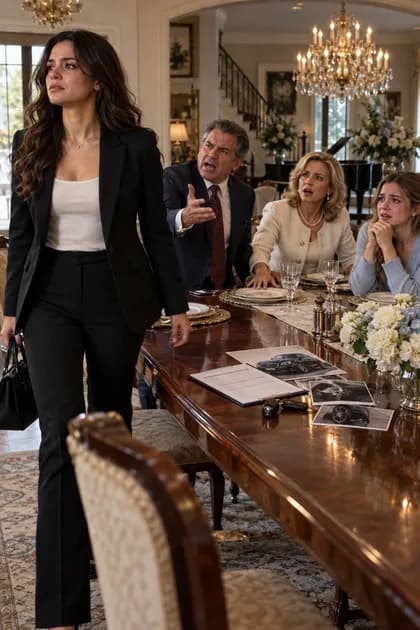
She tapped the tablet. The restaurant video began to play.
No sound. Grainy angle. But clear enough.
Harper approaching.
Daniel standing.
Harper holding up the paper.
Daniel stepping close.
His hand catching her arm.
The violent motion.
The fall.
Daniel looked away.
Detective Brooks paused the video. “You grabbed her.”
“I was trying to stop a scene.”
“You stopped it.”
He looked at her sharply.
She did not blink.
In the next room, Vanessa was giving her third version of the story.
At first, she said she had not seen anything. Then she said Harper lost her balance. Then she admitted Daniel touched Harper but insisted he was only trying to steady her.
The problem was Vanessa kept adjusting the truth to fit whatever she thought the detective already knew.
Finally, Brooks entered her room.
Vanessa sat straighter. “Am I free to go?”
“That depends.”
“On what?”
“On why your name appears in transfers connected to Daniel Pierce’s company.”
Vanessa’s lips parted.
Detective Brooks noticed.
She always noticed the moment fear arrived.
Part 2
By sunrise, Daniel Pierce’s life had become public property.
The video from Bellamont appeared online before dawn. By seven in the morning, every local news station had a blurred clip of Harper falling beneath headlines that made Daniel’s publicist stop answering calls.
Millionaire developer questioned after pregnant wife collapses during confrontation.
Witnesses say prominent Chicago businessman pushed wife before emergency surgery.
Mistress present during shocking restaurant incident.
Daniel sat in the back office of his attorney’s building and watched strangers destroy him in comment sections.
They called him a monster.
A coward.
A man who had mistaken money for immunity.
His attorney, Martin Lowell, stood near the window with a phone pressed to his ear, speaking in low, urgent bursts. He had represented CEOs, aldermen, athletes, and men who cried in private after acting untouchable in public. But even Martin looked unsettled.
“There are too many witnesses,” he said after hanging up. “And the video is bad.”
“It was an accident.”
Martin turned. “Stop saying that like repetition turns it into evidence.”
Daniel’s face hardened. “You’re my lawyer.”
“And I’m telling you the truth before a prosecutor does. Your wife may have nearly died. Your child may have nearly died. You were filmed putting hands on her in front of forty people.”
Daniel looked down.
“Is she alive?” he asked.
Martin hesitated.
Daniel looked up. “Tell me.”
“She made it through surgery. The baby did too.”
Something collapsed in Daniel’s chest. Relief came so suddenly it hurt.
But Martin was not finished.
“Both are critical. And there is another issue.”
Daniel’s fingers tightened around his phone. “What issue?”
“The hospital found inconsistencies in Harper’s medical records.”
Daniel did not move.
Martin watched him carefully. “Do you know anything about that?”
“No.”
“Daniel.”
“I said no.”
But his voice had changed.
Across town, Detective Maya Brooks stood in a hospital conference room while Dr. Samuel Reed, the obstetric surgeon, laid out copies of Harper’s records across a table.
Elaine Whitaker sat in the corner, gripping a paper cup of coffee she had not touched.
Dr. Reed looked exhausted. His surgical cap had left a red line across his forehead.
“Harper and the baby survived,” he said. “But I need you to understand something. What happened at the restaurant triggered a crisis. It did not create the entire medical problem.”
Detective Brooks leaned in. “Explain.”
“Mrs. Pierce had risk factors that should have been monitored aggressively. Her early labs showed warning signs. But the later records in her chart showed those signs disappearing.”
“Is that possible?”
“Medically? Yes, sometimes. But not like this.” He tapped one page, then another. “The numbers change too neatly. And the medication list is worse. She was prescribed drugs that would have been questionable given her condition. Not always obviously dangerous to a casual reader, but dangerous in context.”
Elaine’s face drained. “Her doctor said everything was fine.”
Dr. Reed looked at her gently. “I’m sorry.”
Detective Brooks picked up the top page. “Who signed these?”
“A private maternal-fetal medicine consultant. Dr. Glenn Marlow.”
Brooks’s eyes lifted.
She knew the name.
Two years earlier, Dr. Marlow had been questioned in connection with a medical billing fraud investigation tied to a private clinic. Charges had never stuck. The clinic had been owned by an investment group connected to Aldridge Foundation Holdings.
That name mattered.
Warren Aldridge was one of Chicago’s untouchables.
A billionaire philanthropist. A hospital donor. A man whose face appeared beside governors, senators, and children holding oversized charity checks. He built clinics in poor neighborhoods, funded scholarship programs, and sat on the boards of half the city’s cultural institutions.
He was the kind of man police departments thanked at annual banquets.
Detective Brooks had never trusted him.
She just had never had a reason that would stand in court.
“Can I see Harper?” Elaine whispered.
Dr. Reed nodded. “Only for a few minutes.”
When Elaine entered the intensive care room, Harper lay beneath white blankets, her face almost transparent against the pillow. Tubes ran from her arms. Machines whispered and beeped around her. Beside the wall, behind glass, nurses moved around a tiny incubator.
Elaine’s knees nearly failed.
The baby was so small.
Her grandson.
A boy with a cap no bigger than Elaine’s palm and fingers that opened and closed as if searching for something to hold.
“His name,” Harper had told her months earlier, smiling through tears at the kitchen table, “is going to be Noah. I don’t care if Daniel says it’s too simple. I want something peaceful.”
Elaine touched the glass.
“Hello, Noah,” she whispered.
Behind her, Harper stirred.
Elaine rushed to her bedside. “Honey?”
Harper’s eyes opened halfway.
For a moment, she looked lost between worlds.
Then fear came back.
“The baby,” she breathed.
“He’s alive,” Elaine said quickly. “He’s alive, sweetheart. He’s beautiful.”
Tears slid from the corners of Harper’s eyes.
She tried to speak again.
Elaine bent close.
“Phone,” Harper whispered.
“What?”
“My phone.”
“You need to rest.”
“No.” Harper’s fingers twitched weakly against the sheet. “Need it.”
“Why?”
Harper’s lips moved.
Elaine could barely hear her.
“Archive.”
The monitor began to beep faster.
A nurse hurried in. “Mrs. Whitaker, you need to step out.”
Elaine did not want to leave, but Harper’s eyes held hers with desperate force.
“Phone,” Harper whispered again.
Then she slipped back into unconsciousness.
Detective Brooks was outside the room and heard enough.
Phone.
Archive.
Two words that did not belong in a medical crisis unless the crisis was part of something bigger.
By noon, Brooks had a warrant for Harper’s phone.
By one, she had a tech pulling deleted messages.
By two, she had a financial crimes agent named Colin Hayes standing beside her desk, looking at bank records that made his face go cold.
“This is bigger than Pierce,” Hayes said.
Brooks looked at the screen. “How much bigger?”
He scrolled. “Shell companies. Real estate holdings. Charity disbursements. Offshore transfers. Medical nonprofit grants. Some of this money leaves through Pierce Development, but it comes back through entities connected to Aldridge Foundation Holdings.”
“Warren Aldridge.”
Hayes nodded. “Indirectly. Carefully. But yes.”
Brooks pointed to another line. “And this?”
“That’s the weird part.”
The recipient name appeared again and again.
Andrew Walker.
Brooks frowned. “Who is Andrew Walker?”
“Officially?” Hayes clicked open another file. “Dead.”
A driver’s license photo appeared on the screen.
Dark-haired man. Mid-forties. Serious eyes. An ordinary face until you knew he was supposed to be buried in a cemetery outside Milwaukee.
“Died four years ago,” Hayes said. “Car accident. Body identified by dental records. Insurance paid out. Case closed.”
Brooks stared at the transfer history. “Dead men don’t receive seven figures in consulting fees.”
“No, they don’t.”
“When did the transfers begin?”
Hayes highlighted a date.
Brooks’s jaw tightened.
Two weeks after Harper told Daniel she was pregnant.
That night, in an abandoned industrial district near the Chicago River, Andrew Walker stood in a storage office surrounded by banker’s boxes, hard drives, old contracts, photographs, and printouts that could destroy men who had spent years buying respectability.
His phone vibrated on the metal desk.
He looked at the screen.
Unknown number.
He answered without speaking.
A distorted voice said, “Pierce has become a problem.”
Andrew closed his eyes. “I warned you this would happen.”
“The wife survived.”
Andrew opened his eyes.
For a second, something like relief moved through his face.
“And the baby?”
“Also alive.”
“Good.”
“Do not pretend you care.”
Andrew looked at the boxes. “I care more than you think.”
“Then understand this. If the archive surfaces, everyone burns.”
“That was always the point.”
The line went silent.
Then the voice said, “You were allowed to live because you were useful.”
Andrew smiled bitterly. “No. I was allowed to live because I knew where the bodies were buried.”
“You should leave town.”
“I should have left four years ago.”
He hung up.
For a moment, he stood in the dim light listening to rain drip through the warehouse roof.
Andrew Walker had spent four years as a ghost.
Once, he had been the best financial analyst at Aldridge Capital. Young, ambitious, brilliant with numbers and dangerously slow to question why so many numbers had to be hidden. By the time he understood what Warren Aldridge was building, he was already inside the machine.
A machine that moved money through charities, clinics, development deals, disaster relief funds, and political action committees. A machine that made criminals look like benefactors and benefactors behave like kings.
Andrew tried to leave.
A week later, his car exploded on a rural highway.
The world believed he died.
In truth, he survived because one person inside Aldridge’s circle had decided a living witness might be more useful than a dead one.
So Andrew disappeared.
But he kept copies.
Every transfer. Every name. Every bribe. Every signature.
The archive.
He had planned to release it when he could protect himself.
Then Daniel Pierce married Harper Whitaker.
Harper, who had once been Andrew’s intern years before and had been kind to him when everyone else treated him like office furniture. Harper, who had no idea the man she married was tied to the same network that had destroyed Andrew’s life.
When Andrew learned she was pregnant, he knew Aldridge would tighten control around Daniel. A pregnant wife meant inheritance, attention, vulnerability. It meant a woman asking questions.
And Harper had started asking too many.
Andrew had tried to warn Daniel anonymously.
Daniel chose fear.
Then greed.
Then Vanessa.
Now Harper was in intensive care, and Andrew knew hiding was no longer survival.
It was complicity.
He opened the metal cabinet and removed a passport under the name Andrew Walker, even though that name was supposed to belong to a dead man. Then he picked up a hard drive sealed in plastic.
A noise sounded outside.
Andrew froze.
Footsteps.
He killed the light.
Through a crack in the blinds, he saw headlights sweep across the yard.
Not police.
A black SUV.
Daniel Pierce stepped out into the rain.
Andrew swore softly.
The fool had come for the archive.
At the hospital, Harper woke again just after sunset.
This time, her mind returned in pieces sharp enough to cut.
Bellamont.
Vanessa laughing.
Daniel’s hand.
The fall.
Blood.
Sirens.
Then before that, the phone call she had overheard two months earlier from the hallway outside Daniel’s study.
If the archive gets out, we all go down.
Andrew is getting nervous.
Aldridge won’t protect you twice.
At the time, Harper thought she had misheard.
Then she found transfers.
Then her doctor changed her test results.
Then Daniel stopped coming home.
Now she understood that her marriage had not simply been dying.
It had been hiding something.
Detective Brooks entered softly. “Mrs. Pierce?”
Harper turned her head.
“I know you’re tired,” Brooks said. “But you asked for the police.”
Harper’s throat burned. “My phone?”
“We have it.”
“There’s a recording,” Harper whispered. “Deleted folder. Voice memo.”
Brooks leaned closer.
“I recorded Daniel talking,” Harper said. “I was scared he’d say I imagined it.”
“What did he say?”
Harper swallowed. Her hand moved weakly toward the glass where Noah slept beyond the room.
“He said the archive could ruin Aldridge.”
Detective Brooks went still.
Harper saw the reaction.
“You know that name,” she whispered.
“Yes.”
“Then you know my husband isn’t the worst man in this.”
Brooks looked at her. “Who is?”
Harper closed her eyes, exhausted.
But before sleep took her again, she answered.
“Warren Aldridge.”
Part 3
The warehouse district was almost empty when Daniel forced open the side door of Building 19.
Rain hammered the roof. Wind pushed trash across the cracked pavement. Somewhere in the distance, a train horn moaned.
Daniel moved through the dark with his phone flashlight raised, his breath coming fast.
“Andrew,” he called.
No answer.
He pushed deeper into the building, past rusted shelves and stacks of abandoned pallets, until he reached the office at the back.
The door was open.
The boxes were still there.
For one wild moment, relief flooded him.
Then a voice said, “You always arrive too late.”
Daniel spun.
Andrew Walker stepped from the shadows.
He looked older than the photo Daniel had seen years before. Harder. Thinner. But alive.
Very alive.
Daniel’s mouth went dry. “Where is it?”
Andrew tilted his head. “Not hello? Not how are you alive? Not sorry my choices helped ruin your life?”
“I don’t have time for your drama.”
“No,” Andrew said. “You never had time for anyone else’s pain.”
Daniel took a step toward the boxes. “Move.”
Andrew did not.
Outside, another vehicle entered the yard.
Daniel turned toward the window.
Blue and red lights flashed across the broken glass.
Police.
His face emptied.
“No,” he breathed.
Andrew looked almost sad. “Yes.”
Daniel rushed to the cabinet, yanking drawers open, throwing folders to the floor.
“Where is the drive?”
“Gone.”
Daniel grabbed Andrew by the jacket. “Where?”
Andrew did not resist. “With someone braver than you.”
Daniel’s hand tightened.
For a second, it looked like Bellamont again. Daniel’s rage, another body in his grip, another moment where he believed force could fix consequences.
Then the door burst open.
“Police!” Detective Brooks shouted. “Hands where I can see them!”
Daniel released Andrew.
Officers flooded the office, weapons drawn.
Daniel lifted his hands, shaking. “This is not what it looks like.”
Brooks stepped inside, rain gleaming on her coat. “Somehow men like you always say that in rooms full of evidence.”
Andrew slowly raised his hands too.
Brooks looked at him. “Andrew Walker?”
“That used to be my name.”
“You’re supposed to be dead.”
“I’ve heard.”
Before Brooks could respond, headlights filled the warehouse entrance again.
A black sedan rolled into the yard.
Colin Hayes cursed under his breath. “Who the hell is that?”
The rear door opened.
Warren Aldridge stepped out beneath a large black umbrella held by a driver.
Even in a storm, even outside a rotting warehouse, Aldridge looked composed. Silver hair. Charcoal overcoat. Calm blue eyes. The face of a man who had convinced Chicago he was its conscience.
He walked into the warehouse as if arriving at a board meeting.
Detective Brooks turned toward him. “Mr. Aldridge.”
Aldridge smiled faintly. “Detective. I heard there was confusion involving some old corporate documents. I thought I might be helpful.”
Daniel stared at him. “You came here?”
Aldridge’s eyes moved to him with quiet contempt. “You made yourself visible, Daniel. That was never the arrangement.”
The words were soft.
Everyone heard them.
Brooks took one step forward. “Warren Aldridge, you’re under arrest.”
For the first time, Aldridge’s smile weakened.
“On what charge?”
“Money laundering. Fraud. Conspiracy. Witness intimidation. Obstruction. And depending on what we find in Dr. Marlow’s communications, attempted harm against Harper Pierce.”
Aldridge looked past her at Andrew.
“You gave it to them.”
Andrew’s face was pale, but steady. “No. Harper did.”
Daniel flinched.
Detective Brooks held up Harper’s phone in an evidence bag.
“Mrs. Pierce recorded a conversation between her husband and one of your people,” Brooks said. “That led us to Mr. Walker. Mr. Walker led us to the archive. And the archive led us to you.”
Aldridge’s driver shifted near the door.
Officers moved immediately.
“Don’t,” Brooks warned.
The driver stopped.
Aldridge looked around the warehouse, at the officers, at Andrew, at Daniel, at the boxes of paper that had outlived every lie.
Then he did something no one expected.
He extended his wrists.
“Make sure the cameras don’t see my face,” he said quietly.
Brooks snapped the cuffs on him. “You don’t own every camera in Chicago.”
The next morning, Vanessa Cole was arrested in the lobby of a boutique hotel where she had tried to check out under an alias.
She was not laughing then.
Her hair was hidden beneath a scarf. Her designer suitcase contained cash, a second phone, and a passport with another woman’s name.
Detective Brooks watched as officers led her to the car.
Vanessa saw the detective and stopped.
“I didn’t hurt Harper,” she said.
Brooks looked at her. “You helped them isolate her. You reported what she knew. You moved money through your accounts. You lied to police while a pregnant woman was in surgery.”
Vanessa’s eyes filled with tears.
For once, they looked real.
“I thought Daniel would leave her. That’s all.”
“No,” Brooks said. “You thought you could step over her life and keep your shoes clean.”
Vanessa had no answer.
The archive became the biggest financial scandal Illinois had seen in decades.
Aldridge Foundation Holdings, once praised for building clinics and funding housing projects, had been used to move illegal money through layers of fake vendors and inflated contracts. Public funds meant for community health centers had been siphoned into private accounts. Charity donations had been used to buy silence. Medical professionals connected to Aldridge’s network had manipulated records when inconvenient people became threats.
Dr. Glenn Marlow was arrested after investigators found messages about Harper’s care.
One message was enough to turn even hardened prosecutors silent.
Keep her calm, keep her doubtful, and keep the numbers clean until after delivery.
Harper read that line two weeks later from her hospital bed.
For several minutes, she said nothing.
Elaine sat beside her, holding Noah, who had grown stronger by the day. He still looked tiny in his grandmother’s arms, but his cry had become fierce, offended, alive.
Harper touched his blanket with trembling fingers.
“They wanted me to think I was crazy,” she whispered.
Elaine’s eyes filled. “But you weren’t.”
“I kept apologizing to Daniel for being scared.”
“I know.”
“I kept telling myself he was under stress.”
Elaine leaned forward. “Listen to me. Loving someone does not make you responsible for the harm they choose.”
Harper looked at her mother.
That sentence stayed with her.
Daniel was charged with assault, financial crimes, and conspiracy. His lawyers worked hard to separate him from Aldridge, to paint him as pressured, manipulated, trapped by powerful men. There was some truth in it. Aldridge had controlled him. Vanessa had watched him. Andrew’s fake death had terrified him.
But none of that explained Harper on the floor.
None of that explained his hand on her arm.
None of that explained the way he had let another woman laugh while his pregnant wife begged for answers.
Three weeks after Noah’s birth, Daniel was granted a supervised visit at the hospital.
Harper almost refused.
Then she looked at her sleeping son and realized she was not afraid of Daniel anymore.
That was the only reason she agreed.
Daniel entered the room without his expensive suit. He wore a plain gray sweater and jeans, his face unshaven, his eyes hollow. He looked smaller than Harper remembered. Not physically, but in spirit, as if the air had gone out of the version of him that once filled every room.
A guard stood outside the door.
Elaine sat by the window.
Noah slept in the bassinet beside Harper’s bed.
Daniel stopped when he saw the baby.
His face crumpled.
For a moment, he was not a developer, defendant, husband, or headline.
He was only a man staring at the son he had almost lost before holding him once.
“Is that him?” Daniel whispered.
Harper looked at Noah. “Yes.”
“What’s his name?”
“Noah Samuel Whitaker Pierce.”
Daniel swallowed. “Whitaker.”
“My family name,” Harper said.
He nodded as if he had no right to object, because he did not.
Silence stretched between them.
Finally, Daniel looked at Harper.
“I’m sorry.”
The words were small.
Harper had imagined this moment many times during sleepless nights. Sometimes she imagined screaming. Sometimes she imagined throwing him out. Sometimes she imagined forgiving him so beautifully that everyone would think she was noble.
But real life was quieter than imagination.
She looked at the man she had loved.
She remembered dancing barefoot with him in their first apartment because they could not afford a speaker and he played music from his phone. She remembered the night he proposed beside Lake Michigan with nervous hands and tears in his eyes. She remembered believing him.
Then she remembered Bellamont.
Vanessa’s laugh.
The floor rising toward her.
The blood.
Their son fighting for breath behind glass.
“Some things can’t be repaired by being sorry,” Harper said.
Daniel closed his eyes.
“I know.”
“I don’t hate you,” she continued.
His eyes opened.
That seemed to hurt him more than hatred would have.
“I wish I did sometimes,” she said. “It would be easier. But I don’t. I just don’t trust you. And I will never let my son grow up thinking love means enduring humiliation until someone else decides you’ve suffered enough.”
Tears ran down Daniel’s face.
“I was scared,” he whispered. “Aldridge had everything. He said if I didn’t cooperate, he’d destroy the company. Then he said he’d destroy me. Then Vanessa—”
“Don’t,” Harper said.
He stopped.
“Do not make another person responsible for the moment you put your hands on me.”
Daniel lowered his head.
“You’re right.”
Harper looked toward Noah.
“You can answer to the court,” she said. “You can answer to the investigators. Someday, when he is old enough, you can answer to him if he asks. But you and I are done.”
Daniel nodded, crying openly now.
Not for cameras. Not for sympathy. Not because a lawyer had told him to look remorseful.
Because he finally understood that the greatest thing he had lost was not his company, his reputation, or his freedom.
It was the woman who had once believed there was good in him when even he had stopped looking for it.
As the guard led him out, Daniel paused at the door.
“Harper.”
She looked at him.
“Thank you for saving him.”
Harper’s voice was steady.
“I didn’t save him for you.”
The door closed.
A year later, the park near Lake Michigan was bright with spring sunlight.
Noah toddled across the grass in a little blue jacket, laughing every time he fell and clapping when he managed to stand again. Harper followed close behind, her hair shorter now, her body stronger, her face softer in ways pain had carved and healing had filled.
Elaine sat on a bench with coffee, watching them with the exhausted joy of a woman who had seen disaster arrive at the door and leave without taking everyone.
The trials were over.
Warren Aldridge had been convicted on enough charges to spend the rest of his life trying to purchase dignity from a prison cell. Vanessa Cole had taken a plea deal and testified against half the network. Dr. Marlow had lost his license and his freedom. Andrew Walker, no longer dead, entered witness protection after testifying for three days.
Daniel received prison time too.
Not as much as Aldridge.
More than his lawyers promised.
Less than some people wanted.
Harper had stopped measuring justice by the number of years assigned to other people’s cages. Justice, for her, had become quieter.
It was waking up without fear.
It was signing divorce papers with a calm hand.
It was watching her son breathe.
It was learning that peace did not always arrive dramatically. Sometimes it came in tiny moments, like a toddler placing a dandelion in your hand as if it were the most valuable thing in the world.
Her phone buzzed.
She glanced at the screen.
A message from Daniel.
Thank you for saving me from the man I became.
Harper stared at the words for a long moment.
Once, a message like that would have pulled her backward. She would have wondered if he meant it. She would have imagined his loneliness. She would have felt guilty for surviving without him.
But that morning, she felt only a soft, distant sadness.
She typed nothing.
She deleted the message.
Not out of revenge.
Not out of hatred.
Out of freedom.
Noah stumbled toward her, laughing, his cheeks pink from the wind.
“Mama!”
Harper crouched and opened her arms.
He crashed into her with all the trust in the world.
She held him tightly, breathing in the scent of baby shampoo, grass, and sunshine.
Across the lake, clouds moved slowly over the water, but the storm was gone.
Harper kissed the top of her son’s head and stood.
For the first time in a long time, she did not feel like a woman who had been pushed down.
She felt like a woman who had risen.
And as she walked forward into the bright Chicago morning, carrying the child she had fought for and the life she had chosen, Harper finally understood something many people learn too late.
Sometimes the miracle is not that someone comes to save you before you fall.
Sometimes the miracle is that after the worst fall of your life, you find the strength to stand up, walk away, and never again hand your future to the person who pushed you.
THE END
Chapter complete
You have reached the end of this chapter.
Continue reading
A few more worlds to get lost in after this chapter.