"Wait in the car."
My father didn't raise his voice.
Chapter 1
THE DINNER WHERE MY FAMILY FINALLY LEARNED WHO I WAS
5,093 words
He didn't have to.
Grant Whitmore's fingers closed around my arm, and before I could fully process what was happening, he was steering me away from one of the most important business dinners our family had attended in years.
"We need these investors, Nora," he hissed. "Tonight is not the night for you to make things complicated."
Then he shoved the car door open.
Twenty minutes later, the man my father had spent weeks trying to impress would walk through those same restaurant doors.
He would see me.
He would stop dead.
And then, in front of everyone, he would bow.
But at that moment, my family had absolutely no idea what was coming.
The door of my father's black sedan clicked shut behind me with a sound that somehow felt louder than the traffic outside.
For several seconds, I didn't move.
I simply sat in the rear seat, staring
through the rain-streaked tinted window at the glowing entrance of Valère.
Valère wasn't the kind of San Francisco restaurant where you casually grabbed dinner.
It was the kind of place where reservations carried social weight, the host remembered billionaires by name, and the enormous flower arrangements in the lobby probably cost more than the monthly rent on my first apartment.
Light rain had begun falling over Nob Hill, turning the pavement into polished black glass beneath the restaurant's white entrance lights.
Inside, my family was preparing for dinner.
A dinner I had been invited to.
A dinner from which I'd just been expelled before we even reached the private dining room.
Less than three minutes earlier, my father had taken me firmly by the elbow.
"Wait in the car, Nora."
At first, I'd thought he was joking.
That should have been my first mistake.
My father almost never joked.
"What?"
His expression didn't change.
"We cannot have another scene tonight."
I stared at him.
"What scene?"
His jaw tightened immediately.
Behind him, my younger sister, Paige, adjusted the delicate silver bracelet around her wrist and suddenly became extremely interested in studying the restaurant décor.
My older brother, Owen, didn't even bother pretending he wasn't listening.
Dad leaned closer and lowered his voice.
"The Hargroves are considering putting substantial capital into Whitmore Capital. This evening matters. I need everyone focused."
I blinked once.
"And my sitting at a table somehow prevents that?"
That was when my mother stepped in.
Celeste Whitmore had perfected one particular expression over the course of thirty years.
Soft eyes.
Slightly furrowed brows.
A faint, almost painful smile.
It was the face she used whenever she wanted to say something cruel while making herself look compassionate.
"Sweetheart," she said gently, "you've been away from the family business
for years. You don't understand how delicate these negotiations are."
There it was.
The family business.
Their favorite weapon.
The phrase they could use to dismiss anything I said without actually listening to me.
Five years earlier, I'd worked at Whitmore Capital.
I'd been twenty-eight, ambitious, and naive enough to believe that being good at my job would eventually matter more to my father than being obedient.
Then, during a meeting with six senior partners, I'd presented an idea I believed could transform the firm's investment strategy.
Dad hadn't even let me finish.
He'd leaned back in his chair and told me my ideas belonged in "some college incubator, not a serious investment firm."
In front of everyone.
Nobody had defended me.
Nobody had even looked surprised.
So I left.
And I never went back.
According to my family, however, leaving Whitmore Capital apparently meant I'd spent the last five years wandering aimlessly through life.
"Consulting," Mom would tell relatives whenever they asked what I did.
She always said the word with the same tone someone might use for "unemployed."
"Playing with startups," Paige liked to say at parties, usually followed by a little laugh.
And Owen's favorite explanation was even simpler.
"Burning through her inheritance."
Everyone found that one hilarious.
The funniest part?
Nobody had ever actually asked me what I did.
Not once.
Not my mother.
Not my father.
Not Paige.
Not Owen.
At first, that had hurt.
Then it became irritating.
Eventually, it became almost funny.
Almost.
I looked directly at Dad.
"So why invite me tonight?"
For the first time, his confidence flickered.
His eyes shifted briefly toward Mom.
She answered for him.
"It's a family dinner."
I stared at her.
"A family dinner I'm not allowed to attend."
Paige let out an exaggerated sigh.
"God, Nora. Why does everything have to become a confrontation with you?"
A laugh escaped me before I could stop it.
It came out sharper than I'd intended.
Paige rolled her eyes.
Owen stepped forward, adopting the calm, reasonable tone he always used when he wanted everyone to know he was Dad's natural successor.
"The Hargroves are traditional," he explained. "They respect continuity, stability, family leadership. Dad is trying to reassure them that Whitmore Capital is solid."
Solid.
Something about the way he said that word caught my attention.
Not strong.
Not growing.
Not successful.
Solid.
I looked from Owen to Dad.
For half a second, my father's face betrayed something.
Concern.
Maybe even fear.
Then the mask returned.
"Enough," he said.
He opened the sedan door.
"Wait here."
"You seriously expect me to sit in the car while the rest of you have dinner?"
"It's one evening, Nora."
Mom touched my shoulder.
"Please don't make this harder than it needs to be."
I looked down at her hand until she removed it.
Then I climbed into the car.
Not because Dad had won.
Not because I was embarrassed.
And certainly not because I believed I didn't belong at that table.
I simply didn't see any point in telling them the truth.
Not yet.
So now I sat alone in the back seat while rain traced thin streams down the windows.
Through the glass, I could occasionally see silhouettes moving past the restaurant entrance.
Men in tailored jackets.
Women beneath black umbrellas.
Drivers opening doors.
Valets rushing through the drizzle.
My phone rested beside me.
It vibrated twice.
I ignored it.
Inside Valère, my father was probably shaking hands with the Hargroves.
Owen was probably talking about leadership and continuity.
Paige was probably smiling at exactly the right moments.
And Mom was probably explaining my absence with some carefully polished version of the truth.
Nora wasn't feeling well.
Nora had another commitment.
Nora decided not to join us.
Anything except:
We made our daughter sit in the car because we were afraid she might embarrass us.
I leaned back against the leather seat.
Five years.
Five years since I'd walked away from Whitmore Capital.
Five years of being treated like the family disappointment.
Five years of listening to them make jokes about a life they'd never bothered to understand.
And still, somehow, I was the problem.
Another black car pulled beneath Valère's awning.
The valet immediately hurried forward.
The rear door opened.
A man stepped out.
Even through the rain, I recognized him.
My posture changed instantly.
No.
Of all people...
He buttoned his jacket and headed toward the entrance, accompanied by two others.
Then, halfway to the doors, he glanced toward my father's sedan.
He slowed.
Stopped.
For one long second, he simply stared through the rain-covered glass.
Then his expression changed.
Recognition.
He turned away from the restaurant entrance and walked directly toward the car.
A valet rushed after him with an umbrella.
The man barely seemed to notice.
My pulse remained strangely calm as he approached.
The rear door opened.
Cold rain-scented air rushed inside.
His eyes met mine.
"Nora?"
I gave him a small smile.
"Good evening."
He looked from me to the restaurant, then back again.
Confusion flashed across his face.
"What are you doing out here?"
Before I could answer, the doors behind him opened.
My father had appeared beneath the awning.
Owen stood beside him.
Then Mom.
Then Paige.
Dad's face lit up the moment he recognized the man beside my car.
He hurried forward, his entire posture changing into the polished confidence he reserved for people whose money mattered.
"Mr. Hargrove!"
The man beside me slowly turned.
My father's smile widened.
"We've been expecting you."
Mr. Hargrove looked at Dad.
Then at Owen.
Then at Paige and Mom standing under the awning.
Finally, he looked back at me.
Something in his expression made my father's smile begin to disappear.
Mr. Hargrove straightened.
And then, right there in the rain, in front of my entire family, one of the most powerful CEOs in the room lowered his head respectfully.
"Madam President," he said.
My father's face went completely white.
Mr. Hargrove looked genuinely stunned.
"I didn't know this was your family."
For several seconds, nobody spoke.
Rain tapped softly against the roof of the sedan while my father stared at Mr. Hargrove as if he'd just heard the impossible.
"Madam... President?" Dad repeated.
Owen's face had gone completely rigid.
Paige looked at me, then at Mr. Hargrove, searching desperately for some sign that this was a joke.
There wasn't one.
Mr. Hargrove straightened and smiled at me.
"I've been trying to get fifteen minutes on your calendar for three months."
My mother actually took a step backward.
Dad looked from him to me.
"Nora... president of what?"
I slowly stood from the car, smoothing my cream jacket.
"The company your investors keep asking you about."
His expression changed instantly.
I could almost see the pieces connecting in his mind.
The startup he'd dismissed.
The firm that had quietly acquired stakes in dozens of companies.
The investment group whose valuation had recently crossed into the billions.
Owen finally whispered the name.
"No way..."
Mr. Hargrove turned toward him.
"Yes. Way."
Then he looked at my father.
"And if I had known Whitmore Capital was connected to President Nora Whitmore, tonight's conversation would have been very different."
Dad swallowed.
"What exactly does that mean?"
Mr. Hargrove's smile disappeared.
"It means, Grant, your company isn't the reason I'm here tonight."
He turned toward me.
"She is."
The rain seemed louder after that.
Dad's mouth opened, but nothing came out.
For once, Grant Whitmore had no prepared response.
Mr. Hargrove glanced toward the restaurant.
"Perhaps we should continue this inside."
Dad recovered quickly.
Too quickly.
"Of course."
His smile snapped back into place.
"Absolutely. We have the private room prepared."
He turned toward me as though the last ten minutes had never happened.
"Nora, come on."
I didn't move.
That stopped him.
Dad looked back.
I reached into the sedan, picked up my phone, and closed the door.
Two notifications still waited on the screen.
Both were from my chief investment officer.
The first read:
HARGROVE TERM SHEET CLEARED. FINAL AUTHORITY IS YOURS.
The second:
WHITMORE MATERIALS REVIEWED. CALL BEFORE YOU MAKE ANY RECOMMENDATION.
I locked the screen.
Interesting.
Very interesting.
Mr. Hargrove noticed my expression.
"Problem?"
"Possibly."
Dad's face tightened.
"What does that mean?"
I looked at him.
"It means I'd like to know what exactly you've told Mr. Hargrove about Whitmore Capital."
Owen stepped in before Dad could answer.
"That is confidential."
Mr. Hargrove's eyebrows rose.
I almost smiled.
Five minutes earlier, Owen had been explaining investment etiquette to me in a restaurant lobby.
Now he was telling the woman Hargrove had come to negotiate with that information was confidential.
Mr. Hargrove looked at Owen.
"Not from her."
Owen's jaw flexed.
"What?"
"I asked Nora's firm to review the strategic side of our proposed allocation."
Dad turned sharply toward him.
"You did what?"
Hargrove remained calm.
"We're considering a significant commitment. I don't move that kind of capital because someone pours good Bordeaux and gives me a presentation."
Dad's expression darkened.
"We provided your team with everything requested."
"Yes."
Hargrove paused.
"That's why I asked for a second set of eyes."
A silence settled between us.
There it was again.
That fear I'd seen in Dad's face outside.
This time it didn't disappear quickly enough.
I looked at him.
"What aren't you telling him?"
"Nothing."
Too fast.
Owen folded his arms.
"This is ridiculous. You're turning a routine diligence process into some family drama because Dad asked you to sit in a car for twenty minutes."
I stared at him.
"No, Owen. Dad asking me to sit in the car is family drama."
I lifted my phone.
"This is business."
Mr. Hargrove gave a tiny nod.
Dad glanced toward the restaurant doors where two members of Hargrove's team were waiting discreetly.
"Can we please get out of the rain?"
We went inside.
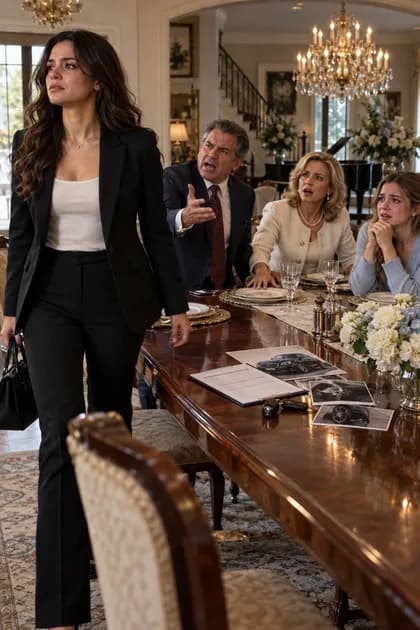
The host led us through Valère's main dining room, past white tablecloths and flickering candles, into a private room paneled in dark walnut.
Seven place settings waited around an oval table.
One chair had been removed to the side.
Mine, apparently.
A strange little detail.
My family had not merely planned for the possibility that I wouldn't attend.
They had already rearranged the room for it.
Mr. Hargrove noticed too.
His eyes moved from the extra chair to me.
He didn't say anything.
He didn't need to.
A waiter stepped forward.
"Would you like me to add another setting?"
Before Dad could answer, I pulled the unused chair back to the table myself.
"Yes, please."
Then I sat down.
Across from my father.
Not beside him.
Not near the end.
Across.
Hargrove took the seat to my right.
His general counsel and finance director settled beside him.
My family filled the remaining chairs.
No one touched the wine.
Dad cleared his throat.
"Before we get into anything else, I think there has been a misunderstanding."
I almost laughed.
"Which part?"
His eyes hardened.
"Nora."
There was the warning.
The same one he'd used when I was sixteen.
The same one he'd used in partner meetings when I challenged him.
The same one he'd used outside thirty minutes earlier.
Except it didn't work anymore.
Mr. Hargrove leaned back.
"I'm interested in hearing the answer."
Dad looked at him.
"My daughter and I have had professional disagreements in the past."
"Professional?"
I repeated the word quietly.
Mom finally spoke.
"Perhaps tonight isn't the place to reopen old wounds."
I looked at her.
"You told me I didn't understand the negotiations."
Her face flushed.
"I didn't know—"
"No."
My voice wasn't loud.
That made her stop.
"You didn't know because you never asked."
Nobody moved.
I looked around the table.
"None of you did."
Paige shifted in her chair.
Owen looked irritated rather than embarrassed.
Dad looked trapped.
And I realized something.
For years, I had imagined this moment differently.
I thought if they ever discovered what I'd built, I'd want to watch them regret every joke.
Every dismissive comment.
Every eye roll.
Every time Mom called my work "consulting" because learning the truth required more interest than she was willing to give.
But sitting there, I didn't feel triumphant.
I felt tired.
Mr. Hargrove broke the silence.
"Nora, I assume your team sent you its review."
"Only the alert. I haven't opened the report."
Dad's shoulders loosened almost imperceptibly.
I noticed.
"So let's do this differently," I said.
I placed my phone facedown on the table.
"Tell me yourselves."
Owen scoffed.
"Tell you what?"
"Why you need Hargrove's capital."
Dad answered.
"Expansion."
I held his gaze.
"No."
His fingers tightened around the stem of his water glass.
"We have several opportunities—"
"Then fund them through operating cash flow or your existing credit facilities."
Owen leaned forward.
"You've been out of the firm for five years."
"And yet somehow I still know the difference between growth capital and rescue capital."
That landed.
Paige looked at Dad.
Mom went very still.
Hargrove said nothing.
Dad's eyes dropped for half a second.
There was my answer.
I leaned back.
"How bad?"
Owen's chair scraped.
"This is not your concern."
Mr. Hargrove turned toward him.
"If you're asking me to put money into it, it's very much her concern."
Owen's face reddened.
Dad finally exhaled.
"We've had redemptions."
"How many?"
"Enough."
"That's not a number."
"Nora."
"No."
I shook my head.
"You wanted me gone because you were afraid I'd complicate this dinner. Fine. I'm here now. Don't ask me to endorse something you're unwilling to explain."
Dad stared at me.
Then, slowly, he looked at Hargrove.
"Several larger clients requested withdrawals after two portfolios underperformed."
Owen immediately cut in.
"Temporarily underperformed."
Dad ignored him.
"Those withdrawals created pressure."
"Liquidity pressure?"
"Yes."
"How much?"
Dad hesitated.
Hargrove's finance director opened a folder.
"We can answer that."
Dad's face changed.
The director slid three pages toward Hargrove.
"We calculated a substantial twelve-month funding gap under the current redemption schedule."
Mom whispered, "Grant?"
Dad didn't look at her.
I looked at Owen.
His confidence was gone.
Now I understood why he'd used the word solid outside.
He hadn't been reassuring me.
He'd been rehearsing the story.
"What caused the underperformance?" I asked.
Owen's eyes flashed.
"Market conditions."
I turned to Hargrove's finance director.
"Concentration?"
He nodded once.
Dad closed his eyes.
Owen stared at him.
"What?"
I didn't need the report anymore.
Five years earlier, my argument at Whitmore Capital had been simple.
The firm was too dependent on a narrow group of large, correlated positions.
I had proposed building a strategy around smaller, diversified investments with controlled downside and patient capital.
Dad had called it a college incubator.
Apparently Owen had spent the years since then doing exactly what Dad preferred.
Bigger positions.
Bigger conviction.
Bigger exposure.
Until clients started asking for their money back.
The irony wasn't satisfying.
It was expensive.
For employees.
For clients.
For people who had nothing to do with my family's pride.
I looked at Dad.
"Did the board know the full extent of the redemption pressure?"
His silence answered me.
Owen snapped, "Careful."
I turned toward him.
"With what?"
"You don't know what you're implying."
"I asked a question."
"And I'm telling you you're outside the firm."
"Then answer as though I'm an outside investor."
He couldn't.
Mr. Hargrove folded his hands.
"Grant, this is the issue my team was concerned about."
Dad looked furious.
"You came here knowing this?"
"I came here knowing there were weaknesses."
Hargrove looked at me.
"I came here hoping to determine whether they were manageable."
Dad followed his gaze.
And I saw the next calculation happen in real time.
Suddenly, I wasn't the daughter he'd put in the car.
I was a solution.
His face softened.
"Nora."
I hated that tone more than the angry one.
"We've had our differences."
I said nothing.
"But we're still family."
There it was.
Family.
The word they'd used to invite me.
The word they'd suspended when I became inconvenient.
And now the word Dad wanted back because it might be worth hundreds of millions of dollars.
He leaned closer.
"You understand this business. You understand what we've built. Whatever happened between us, you don't want to see Whitmore Capital fail."
Owen stared at him in disbelief.
Mom looked relieved.
Paige watched me.
Dad continued.
"If Hargrove needs your confidence, give it to him."
Not ask.
Not apologize.
Not explain.
Give it to him.
As though my judgment still belonged to my father.
I looked at Hargrove.
"Would my recommendation affect your decision?"
"Significantly."
"Then I won't give one tonight."
Dad's face fell.
"Nora—"
"I haven't read the final diligence."
"We can discuss that."
"We are discussing it."
"You know the firm."
"I knew the firm five years ago."
His voice sharpened.
"Don't punish hundreds of people because you're angry with me."
That sentence changed something in me.
Because it was clever.
Almost persuasive.
Exactly the kind of argument he'd used my entire life.
If I resisted him, someone else would suffer.
If I embarrassed him, I was selfish.
If I left the company, I was disloyal.
If I refused to rescue it now, I was vindictive.
I looked at him for a long moment.
Then I reached for my phone.
Dad's eyes fixed on it.
I opened the review.
I read silently for almost three minutes.
No one interrupted.
The room became so quiet I could hear silverware being set at another table through the wall.
The report confirmed what the conversation had already exposed.
Concentrated risk.
Incomplete communication with the board.
Aggressive assumptions about client retention.
And, buried halfway down, a familiar name.
Owen.
He had personally championed both portfolios responsible for most of the pressure.
I set the phone down.
Owen spoke first.
"Well?"
I looked at him.
"If Hargrove puts unrestricted capital into Whitmore under the current structure, I recommend against it."
Dad went pale.
Owen pushed his chair back.
"This is revenge."
"No."
"It absolutely is."
"If I wanted revenge, I would let you take the money."
He stopped.
Even Hargrove looked at me.
I continued.
"Because then you would use new capital to protect the same structure that created the problem. You'd buy time without fixing anything."
Dad's eyes narrowed.
"What are you proposing?"
That was the first useful question he'd asked me all night.
I turned my phone around.
"Independent restructuring review. Full board disclosure. No new concentrated positions until risk limits are rewritten. Capital released in stages, not all at once."
Owen laughed bitterly.
"And I suppose you want my resignation."
I met his eyes.
"I want the board to decide whether the person who created the largest exposures should still have unilateral authority over them."
His face hardened.
"Same thing."
"No. It isn't."
I looked at Dad.
"And you cannot control the review."
His expression chilled.
"This is my company."
"Then you can refuse."
I pushed the phone away.
"Hargrove can walk. I can walk. You can keep full control."
Silence.
That was the choice.
Not revenge.
Not humiliation.
Control.
My father had spent his whole life treating control as proof of strength.
Now holding onto it might cost him the company.
Mr. Hargrove leaned forward.
"If Nora's conditions are incorporated, I'm willing to continue discussions."
Dad stared at him.
"Continue?"
"Yes."
"Not commit?"
"No."
Dad looked offended.
Hargrove didn't blink.
"I'm not writing a rescue check because I enjoyed dinner."
Paige suddenly made a tiny choking sound that might have been a laugh.
Mom shot her a look.
For some reason, that nearly broke the tension.
Dad sat back.
His face had aged ten years in twenty minutes.
Then Owen stood.
"This is insane."
Dad looked up.
"Sit down."
"No."
"Owen."
"You brought her here, pushed her outside, and now you're letting her dictate our company because some billionaire bows to her?"
Hargrove's expression cooled.
I stayed quiet.
Owen pointed at me.
"She wanted this."
I looked at his hand.
Then his face.
"I wanted you to ask me what I did for a living."
His finger lowered.
"That's all."
For the first time that night, Owen had no answer.
He left.
The door slammed behind him.
Mom flinched.
Dad didn't move.
I expected him to follow.
He didn't.
Instead, he looked at the closed door for several seconds.
Then he turned back to me.
"What happens if I agree?"
"Your board gets the truth."
He winced slightly.
"Your clients get a firm that stops pretending short-term appearances matter more than long-term stability."
He said nothing.
"And you may have to stop being CEO."
Mom inhaled sharply.
Dad's eyes locked on mine.
There it was.
The real cost.
Not money.
Identity.
He had built Whitmore Capital until he could no longer tell where the company ended and Grant Whitmore began.
"What would you do?" he asked quietly.
It was the first time in my life my father had asked me that question and actually wanted the answer.
I didn't rush it.
"I would protect the firm before I protected my title."
His jaw tightened.
I expected anger.
Instead, he looked down.
Mr. Hargrove said nothing.
Neither did I.
Eventually Dad nodded once.
"Send me the conditions."
"I will."
"And the board?"
"You tell them."
He looked up.
"Tonight?"
"Tomorrow morning."
His mouth twisted.
"You don't make anything easy."
I almost smiled.
"Neither did you."
The smallest hint of something passed across his face.
Not amusement exactly.
Recognition.
Dinner was over before the first course arrived.
Hargrove and I moved to a smaller room down the hall with his team and spent another hour discussing the transaction he had actually come to negotiate.
My transaction.
Not Dad's.
Before he left, he shook my hand.
"Nine tomorrow?"
"My office."
"I'll be there."
Then he glanced toward the private room where my parents and Paige remained.
"For what it's worth, I hope they understand what happened tonight."
I looked through the doorway.
"So do I."
But I wasn't sure they would.
The next morning, at 8:07, my father called.
I let it ring twice before answering.
"The board knows," he said.
No greeting.
Typical Dad.
"All of it?"
A pause.
"All of it."
"And Owen?"
"Suspended from investment authority pending review."
That surprised me.
Not because Owen didn't deserve scrutiny.
Because Dad had actually done it.
"How did he take that?"
"How do you think?"
I leaned against my office window.
San Francisco spread below me beneath a pale gray morning sky.
My office occupied the thirty-sixth floor of a building my family had passed dozens of times.
None of them had ever known I worked there.
"They want to meet you," Dad said.
"The board?"
"Yes."
"I'm not joining Whitmore."
"I didn't say you were."
"You were going to."
Silence.
Then, unexpectedly, he exhaled a quiet laugh.
"Probably."
I smiled despite myself.
"I'll advise Hargrove. Nothing more."
"I understand."
Another silence.
Then Dad said something I had waited five years to hear.
"I should have let you finish that presentation."
I looked out at the city.
Five years earlier, that sentence would have meant everything.
Now it meant something different.
Not validation.
Closure.
"Yes," I said.
"You should have."
He didn't defend himself.
That mattered more than an apology dressed in explanations.
Whitmore Capital's restructuring took four months.
It wasn't clean.
It wasn't painless.
Two board members resigned.
Several positions were unwound at losses nobody enjoyed discussing.
Owen fought his suspension, blamed me privately, blamed market conditions publicly, and eventually left the firm after the board voted to eliminate the authority Dad had allowed him to accumulate.
Hargrove invested less than Dad originally wanted and attached more safeguards than Dad originally imagined he would tolerate.
But the capital stabilized the firm.
Clients received honest updates.
The redemption pressure slowed.
And Whitmore Capital survived.
Smaller.
Less glamorous.
Much harder to brag about at dinner parties.
Stronger.
Dad stepped down as CEO at the end of the restructuring and stayed on as chairman for a transition period.
He told the press it was part of a long-planned succession process.
I let him have that sentence.
Some people need one last piece of dignity when they finally loosen their grip.
My mother took longer.
At first, she tried to rewrite our history.
"We always knew you were capable."
I stared at her across a coffee shop table.
"No, Mom."
Her smile faded.
"We did."
"You told people I was playing with startups."
"I didn't understand what you were doing."
"Exactly."
She looked down at her coffee.
That was the first conversation we'd ever had where I didn't rescue her from her own discomfort.
Eventually she whispered, "I should have asked."
"Yes."
She nodded.
"I should have."
Paige surprised me most.
Two weeks after the dinner, she appeared at my office with no appointment and no dramatic speech.
She sat across from me and placed her silver bracelet on my desk.
The same bracelet she'd been adjusting outside Valère when Dad ordered me into the car.
"I do that when I'm uncomfortable," she said.
I looked at it.
"I noticed."
She grimaced.
"I was embarrassed that night."
"Of me?"
"No."
She swallowed.
"Of myself."
I waited.
"I laughed at things because Owen laughed. I repeated what Mom said because it was easier than admitting I had no idea what your life looked like."
She looked around my office.
"I thought you were failing."
"Why?"
Her answer came quietly.
"Because everyone kept saying you were."
That one hurt in a different way.
Not because she believed them.
Because for years, none of them had considered me worth verifying.
Paige looked at me.
"I'm sorry."
I believed she meant it.
That didn't erase anything.
But it gave us somewhere to start.
Owen and I didn't reconcile.
At least not then.
Sometimes consequences aren't followed by hugs.
Sometimes a person has to live without access to you until they decide whether losing power taught them anything.
I stopped trying to force endings that made other people comfortable.
Six months after Valère, an envelope arrived at my office.
No company letterhead.
No assistant's note.
Just my name in Dad's handwriting.
Inside was a photocopy of the presentation I'd made five years earlier.
The one he'd interrupted.
The margins were filled with handwritten notes.
Not dismissive ones.
Questions.
Calculations.
Underlined passages.
On the last page he'd written:
You were seeing the risk before I was willing to see it.
Below that:
I spent years assuming leaving meant you had failed.
I never considered that you had simply stopped asking my permission to succeed.
And finally:
Dinner next Thursday?
No investors.
No business.
No one waits in the car.
I read the last line twice.
Then I folded the pages and put them back in the envelope.
For years, I had wanted my family to finally understand who I was.
But the strangest thing was that by the time they did, I no longer needed their understanding to prove anything.
I picked up my phone.
I texted Dad.
Thursday works.
Just you and me.
His reply came less than a minute later.
Deal.
That Thursday, I arrived at a small neighborhood restaurant fifteen minutes before him.
No private room.
No billionaires.
No negotiations.
No one trying to impress anyone.
Dad walked through the door, spotted me, and stopped.
For a second I remembered Valère.
The rain.
The sedan.
The humiliation of being treated like a liability by people who had never bothered to learn my value.
Then Dad crossed the room.
He didn't bow.
He didn't need to.
He simply pulled out the chair across from me and sat down.
"What are you working on now?" he asked.
It was such a simple question.
Five years late.
But finally asked.
I looked at him.
And smiled.
THE END.
Chapter complete
You have reached the end of this chapter.
Continue reading
Find your next story
A few more worlds to get lost in after this chapter.