At seventy-one years old, I became an $89 million lottery winner.
Chapter 1
THE MORNING MY FAMILY LEARNED I HAD OPTIONS THEY COULDN'T CONTROL
4,848 words
And for weeks, nobody knew.
Not my son.
Not my daughter-in-law.
Not even the grandchildren I drove to soccer practice and piano lessons.
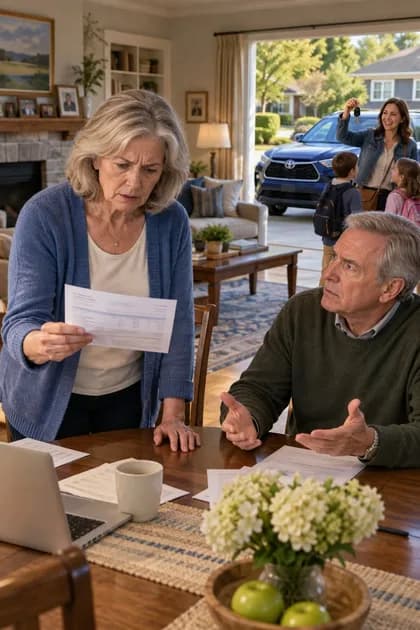
Then, one Sunday night, while I was passing dinner rolls across the table, my son looked at me as if I were an overdue bill and asked the question that changed everything.
“Mom, when are you finally going to move out?”
I didn’t argue.
I didn’t cry.
I didn’t tell him I was worth more money than he could imagine.
I simply left.
And by 7:30 the next morning, I was quietly making arrangements that would eventually put their dream house in my hands—under a name they had never bothered to remember.
My name is Margaret Briggs.
I’m seventy-one years old, and until that night, my family thought I had nowhere else to go.
Daniel pushed his chair back after asking the question.
It was 6:18 p.m.
The farmhouse table beneath my fingertips was long, polished, and strangely cold. Roast chicken sat cooling beside a bowl of mashed potatoes. Garlic still clung to the smell of the green beans.
Then the ice in Renee’s water glass cracked.
Just once.
Sharp and tiny.
It sounded like the whole room splitting open.
Two years earlier, my husband, Harold, had died in Tucson.
Afterward, Daniel insisted I shouldn’t live alone.
“Just for a little while, Mom,” he told me.
So I sold the house Harold and I had shared.
I sold the yellow kitchen where he used to sneak bites while I cooked.
The creaking hallway.
The rosebushes.
The porch where Harold drank tea every morning as the sun came up.
Then I moved into Daniel’s Scottsdale home.
His house looked like something from a magazine no one was actually allowed to touch.
White cabinets.
Black fixtures.
A covered pool.
Three garage doors.
And a refrigerator filled with almond milk, string cheese, and routines that never belonged to me.
Renee called my bedroom “the guest room.”
But when I once suggested moving the chair closer to the window, she quickly stopped me.
“The room photographs well the way it is.”
So I learned to take up less space.
For two years, I folded towels.
Packed lunches.
Signed permission slips.
Drove my grandchildren to soccer and piano.
I knew exactly which pan Renee liked for eggs and which coffee mug Daniel wanted left clean beside the machine every morning.
That was the trust signal I gave them.
Access.
Help.
Silence.
The softest parts of my grief.
And slowly, almost politely, their gratitude disappeared.
One Sunday morning, instead of asking me to brunch, they left a note beside the coffee maker.
Another afternoon, I passed Daniel and Renee’s bedroom and heard her
speaking behind the closed door.
“She eats our food, uses our utilities, and contributes what exactly?”
I stopped walking.
Daniel was in that room.
He heard her.
And he never corrected her.
Not once.
So when he finally asked me at dinner when I planned to move out, I wasn’t completely surprised.
My grandson stopped scrolling on his phone.
My granddaughter froze with her fork hovering over her potatoes.
Renee stared at her plate, but the tightness around her mouth told me everything.
She had known.
Maybe she had even helped him rehearse the question.
The room went still in that clean, terrible way families go still when cruelty has finally been spoken aloud.
Forks stopped moving.
Napkins stayed folded.
The candle on the sideboard kept burning.
A bead of condensation slid slowly down Renee’s glass while both children stared at the table runner as if it might explain what kind of people they were supposed to become.
Nobody defended me.
Nobody moved.
And for one ugly second, I nearly told them everything.
I imagined watching Daniel’s expression change when he learned what had happened in February.
That day, after a Medicare appointment, I’d stopped at a gas station.
For no particular reason, I bought a lottery ticket.
The clerk smelled like cigarette smoke and cinnamon gum.
Harold used to say that luck sometimes wore dirty shoes.
The following Monday morning, at exactly 9:42, I sat alone in Daniel’s empty house with a cup of coffee growing cold beside me and checked the numbers.
Once.
Twice.
Then again.
$89 million.
I didn’t scream.
I didn’t cry.
I simply folded the ticket and slipped it into my Bible, between Psalms and the church bulletin Harold had saved.
Because money doesn’t always make you louder.
Sometimes it makes you careful.
Sometimes it gives you the one thing nobody can take back.
Options.
So at dinner, I set the basket of rolls down.
I folded my napkin once.
Then again.
“Excuse me,” I said.
That was all.
Outside, the Phoenix evening smelled of chlorine, dry dirt, and somebody’s expensive candle burning through an open sliding door.
I sat on the patio.
The chair scraped against the stone.
Behind me, nobody followed.
At 2:13 that morning, I opened the notepad in my nightstand and wrote five lines.
Keep silent.
Hire attorney.
Claim privately.
Separate assets.
Find a home.
Then beneath those words, I added two more.
Not a room.
A home.
Before sunrise, I showered and put on my gray church blazer.
Then I sat at the same kitchen table where my son had made me feel disposable.
By 7:30 a.m., I had appointments booked with three estate attorneys.
All under my maiden name.
Renee came downstairs wearing heels.
Her perfume reached the kitchen before her voice did.
She noticed my blazer.
My laptop.
My hands moving calmly over the keyboard.
She had expected tears.
Instead, she got typing.
The attorney I chose was Patricia Holloway.
Sharp eyes.
Calm voice.
The kind of woman who could make panic feel unnecessary.
Her first question was simple.
“Have you told anyone?”
“No.”
“Good. Keep it that way.”
Within days, the trust existed.
The private claim was filed.
Account authorizations were separated.
Every document Daniel might someday assume he could touch now had a legal wall around it.
And then I found the house.
Four bedrooms.
An east-facing sunroom.
A real yard.
A quiet street.
Shade trees.
And a porch wide enough for morning tea.
I stared at the listing longer than I meant to.
Because it wasn’t merely beautiful.
It was exactly the sort of house Daniel and Renee had spent years describing as their dream.
Their “next chapter.”
More charm.
A better neighborhood.
More space for entertaining.
More status.
I toured it alone at 10:05 one morning.
The front hallway smelled faintly of cedar and lemon oil.
Sunlight warmed the old floorboards.
On the counter sat a brass house key for the showing.
I reached out and touched it with two fingers.
And suddenly I remembered the woman I had been before grief taught me to ask permission.
The next morning, through the trust, I submitted a full-price cash offer.
Clean close.
No Daniel.
No Renee.
No explanation.
By the end of the week, something inside their house had changed.
Breakfast appeared before I asked.
Renee smiled too warmly.
Daniel suddenly wanted to know whether I needed anything from Target.
My grandchildren were encouraged to “spend more time with Grandma.”
I had to keep myself from laughing.
Because kindness that arrives too suddenly usually has paperwork behind it.
Then Saturday morning came.
At exactly 8:11, Renee walked straight into my room without knocking.
She closed the door behind her.
Her eyes immediately landed on the envelope sitting on my dresser.
And beneath my Bible, half-hidden from view, was the brass key.
Her face changed.
“You bought a house?” she asked.
I walked over calmly and placed one hand across the key.
Before I could answer—
the doorbell rang.
Renee turned toward the hallway.
Daniel came downstairs barefoot.
I followed them toward the front door.
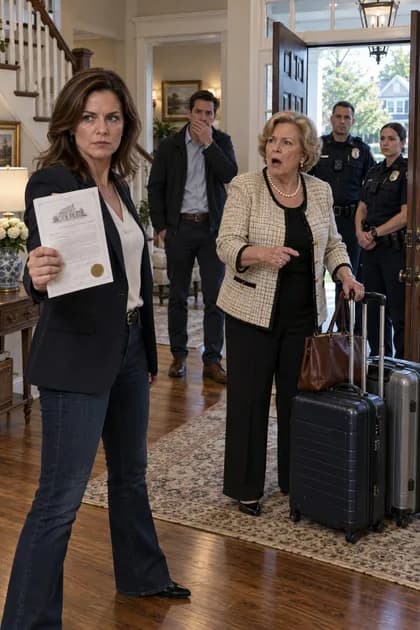
Standing on the porch was a man in a suit.
In his hands was a folder.
And written clearly across the front of it was Renee’s name.
Daniel stared at the man.
Renee went completely still.
She stopped breathing through her nose.
Then the man looked directly at her…
and slowly lifted the folder.
Renee’s face drained of color.
The man in the suit glanced at the folder, then back at her.
“Mrs. Renee Briggs?”
“Yes,” she whispered.
Daniel stepped forward. “What is this about?”
The man didn’t answer him.
Instead, he handed Renee the envelope.
She tore it open with shaking fingers.
I stood behind them, silent.
Her eyes moved across the first page.
Then stopped.
“What?” Daniel demanded. “Renee, what does it say?”
She looked at me.
For the first time in two years, there was no irritation in her expression.
Only fear.
“This house…” she said slowly. “It’s been sold.”
Daniel frowned. “That’s impossible.”
Renee swallowed hard.
“The owner accepted an all-cash offer.”
Daniel grabbed the paperwork and scanned it.
Then his eyes widened.
Because attached to the notice was the name of the trust that had purchased the property.
Margaret Evelyn Briggs Trust.
My full legal name.
My maiden name included.
The name neither of them had bothered to learn.
Daniel looked at me as if he were seeing a stranger.
“Mom… what did you do?”
I reached beneath my Bible, picked up the brass key, and slipped it into my purse.
“No, Daniel,” I said calmly.
“The better question is what you did.”
Then Patricia’s car pulled into the driveway.
And she wasn’t alone.
A woman stepped out of the passenger side carrying a leather portfolio.
I recognized her immediately.
Claire Benton, the real estate broker who had handled my offer.
Renee recognized her too.
That was when I understood the fear.
Not confusion.
Not surprise.
Recognition.
Claire walked toward us and gave me a small professional nod.
“Good morning, Margaret.”
Daniel looked from her to me.
Then back to the papers in his hand.
“What is happening?”
Patricia reached the porch first.
She didn’t enter the house.
She simply stood beside me.
Claire glanced at Renee.
“The paperwork you received is the written notice regarding the Arcadia property.”
Daniel’s head snapped toward his wife.
“Arcadia?”
Renee said nothing.
Claire continued.
“Mrs. Briggs submitted an offer through another agent yesterday afternoon. It was contingent on financing and several additional conditions. The seller had already accepted an earlier full-price cash offer from Margaret’s trust.”
Daniel looked at Renee.
“You made an offer?”
“We talked about it.”
“No. We talked about looking at it.”
Renee’s jaw tightened.
“You loved that house.”
“That doesn’t mean we could buy it.”
“We could have.”
Her eyes flicked toward me.
Just once.
That tiny movement explained the breakfast.
The Target offer.
The grandchildren suddenly being encouraged to sit beside Grandma.
I almost admired the efficiency of it.
Daniel saw the look too.
His voice dropped.
“Renee.”
She folded her arms.
“We were going to ask your mother for help with the down payment.”
I laughed then.
Not loudly.
Just one breath that escaped before I could stop it.
Renee turned toward me.
“It isn’t funny.”
“No,” I said. “It really isn’t.”
Daniel rubbed both hands over his face.
“How much?”
Renee didn’t answer.
“How much were you planning to ask her for?”
“Three hundred thousand.”
The porch became very quiet.
My granddaughter had appeared halfway down the staircase behind us.
My grandson stood two steps above her.
Neither child spoke.
Renee noticed them and lowered her voice.
“It wasn’t some outrageous thing. Margaret sold her Tucson house. She has savings. We’ve housed her for two years.”
There it was.
Not helped.
Not welcomed.
Housed.
Like I was a box they had stored in the garage.
Patricia shifted beside me, but I lifted one hand.
I wanted to answer this myself.
“For two years,” I said, “I packed your children’s lunches five mornings a week.”
Renee opened her mouth.
I kept going.
“I drove them to practices. I picked them up when you worked late. I cooked. I did laundry. I waited for repairmen. I stayed home when one of them was sick. I rearranged my days around yours because I thought I was part of a family.”
“You were,” Daniel said.
I looked at him.
“Then why did your wife ask what I contributed?”
His face changed.
He knew exactly what I meant.
Renee stared at him.
Daniel stared at the floor.
I continued.
“And why, when she said it, did you stay quiet?”
“Mom—”
“No. You asked me when I was finally going to move out. I listened.”
Claire held the portfolio closer to her chest.
Patricia remained silent.
Neither woman needed to rescue me.
That mattered.
For the first time in a long time, I didn’t need anyone else to speak because I was afraid of what my own voice might cost me.
Renee pointed at the paperwork.
“So you bought that house because we wanted it?”
“No.”
“You expect me to believe that?”
“I bought it because it has an east-facing sunroom, a yard, mature trees, and a porch where I can drink tea in the morning.”
Her face hardened.
“You knew we loved it.”
“Yes.”
“And that didn’t bother you?”
I thought about the question.
“No,” I said. “But it also didn’t stop me.”
Daniel looked at the trust name again.
His confusion had replaced his anger.
“Mom, where did you get enough cash to buy a house like that?”
Patricia turned slightly toward me.
The choice was mine.
That was another thing money had changed.
Not whether I had secrets.
Whether I was allowed to decide when they ended.
I looked at my grandchildren.
Then at my son.
“In February, I bought a lottery ticket.”
Daniel blinked.
Renee stopped moving.
“I won.”
My granddaughter whispered, “Like… how much?”
I smiled at her.
“A lot.”
Renee stepped closer.
“How much is a lot?”
Her voice came too quickly.
Too sharply.
Daniel noticed.
So did I.
I could have refused to answer.
Instead, I decided there was value in watching the truth arrive all at once.
“Eighty-nine million dollars.”
Nobody spoke.
The pool pump hummed somewhere behind the house.
A delivery truck passed at the end of the street.
My grandson sat down on the staircase.
Daniel’s mouth opened, but nothing came out.
Renee actually gripped the edge of the door.
Then her entire face changed.
It happened in seconds.
Fear disappeared.
Anger softened.
Her eyes widened with something dangerously close to tenderness.
“Margaret…”
I almost laughed again.
There are smiles you receive because someone loves you.
And there are smiles that begin calculating before they reach the eyes.
Hers was the second kind.
“Oh my God,” she whispered. “Why didn’t you tell us?”
I looked at her.
“Why didn’t you knock before walking into my room this morning?”
Her smile vanished.
Daniel stepped toward me.
“Mom, this is serious. Eighty-nine million? You can’t handle something like that alone.”
Patricia finally spoke.
“She isn’t.”
Daniel looked at her.
Patricia’s voice stayed level.
“Your mother has independent legal counsel, tax professionals, financial management, and a trust structure already in place.”
Renee frowned.
“You arranged all that without your own son?”
I answered before Patricia could.
“Yes.”
“But we’re family.”
“That wasn’t the question Sunday night.”
Daniel flinched.
My granddaughter came down the remaining stairs.
“Grandma, are you leaving today?”
I looked at her.
“Yes.”
Her eyes filled.
“Because of us?”
That question hurt more than anything the adults had said.
I walked to her and held both her hands.
“Never because of you.”
My grandson came closer too.
“I should’ve said something at dinner,” he muttered.
“You were put in a situation no child should have been asked to fix.”
“I’m not a child.”
“You’re sixteen.”
“Exactly.”
Despite everything, I smiled.
Then I touched his cheek.
“You don’t have to fight every battle you witness. But remember how that dinner felt. Someday you’ll have a chance to make someone else feel small or make them feel safe. Choose carefully.”
He nodded.
Behind us, Renee cleared her throat.
“So what now?”
I turned.
“Now I move.”
“You can’t be serious,” Daniel said.
“You asked me to.”
“I was upset.”
“You were prepared.”
His eyes dropped.
That landed.
Because we both knew the difference.
An angry sentence is thrown.
A prepared sentence has been discussed before it reaches the table.
Patricia handed me a slim folder.
Inside were the temporary housing arrangements I had made until the Arcadia closing was complete.
I had also scheduled movers for Monday.
I looked around the hallway.
The white walls.
The family photographs.
The expensive vase Renee had once moved two inches after I dusted beneath it.
For two years, I had mistaken familiarity for belonging.
They were not the same thing.
Daniel followed me upstairs.
“Mom.”
I stopped at my bedroom door.
He stood behind me with both hands at his sides.
For the first time that morning, he didn’t look angry.
He looked scared.
“Are you cutting me out?”
I knew what he meant.
Not out of my life.
Out of the money.
And that realization hurt because some part of me had still hoped he meant me.
“I haven’t decided what my estate will look like.”
His face tightened.
“I’m your only son.”
“Yes.”
“Dad would’ve wanted you to take care of us.”
I stared at him.
“Your father would have wanted you to take care of me when I was grieving.”
He looked away.
I picked up my suitcase.
It was already packed.
Daniel stared at it.
“You knew?”
“After dinner Sunday, yes.”
“You were really going to leave without telling us?”
“You told me to go.”
“That’s not the same thing.”
“It becomes the same thing when the person hearing it believes you.”
He had no answer.
I spent the next four nights in a quiet suite near Paradise Valley.
Nobody asked me to move a chair.
Nobody commented on how much electricity I used.
Nobody needed me to pick up dry cleaning.
The silence felt strange for the first twenty-four hours.
Then it began to feel expensive.
Not because of the room rate.
Because peace is costly when you’ve spent years giving it away.
Daniel called eleven times.
I answered three.
Renee texted twice.
The first message said she was sorry if her words had ever made me feel unwelcome.
The word if did most of the work.
The second message included a photograph of the grandchildren.
I didn’t respond to that one.
Children should never be attached to negotiations.
Three days later, I closed on the house.
When Claire placed the keys in my palm, the brass was warm from her hand.
I stood in the empty foyer.
No furniture.
No photographs.
No routines.
Just sunlight stretching across the floorboards.
I walked into the sunroom and cried for the first time since Daniel had told me to leave.
Not because I had won.
Not because the house was beautiful.
Because there was nobody standing behind me telling me where the chair belonged.
I moved it beside the window.
Exactly where I wanted it.
The following Saturday, Daniel asked if he and Renee could come over.
I almost said no.
Then Patricia had reminded me of something during our last meeting.
“A boundary isn’t avoiding a conversation,” she said. “Sometimes it’s deciding the terms under which the conversation happens.”
So I agreed.
Two o’clock.
No children.
No surprises.
They arrived at 1:58.
Renee carried a leather binder.
Of course she did.
I noticed it before I noticed her shoes.
We sat at my new dining table.
Daniel looked tired.
Renee looked prepared.
She opened the binder.
“We’ve been thinking about everything.”
“I’m sure.”
“Eighty-nine million dollars creates responsibilities, Margaret.”
I waited.
She slid a page across the table.
“We’re not asking you to give us control.”
The first paragraph contained the words family financial advisory authority.
I pushed it back without reading further.
“No.”
Renee blinked.
“You haven’t even looked at it.”
“I looked at the title.”
“It would allow Daniel to help coordinate things.”
“I have people coordinating things.”
“Strangers.”
“Professionals.”
Daniel leaned forward.
“Mom, I’m not trying to take your money.”
“Good.”
“I’m trying to protect you.”
“From whom?”
He hesitated.
Renee answered.
“People who will come out of nowhere.”
I looked directly at her.
“Some of them already have.”
Her cheeks flushed.
Daniel closed his eyes.
“Mom.”
I opened a drawer beside me and removed two envelopes.
I placed them on the table.
“One is for my grandson. One is for my granddaughter.”
Renee looked at them immediately.
“What are those?”
“I’ve established education trusts for them.”
Daniel stared at me.
I continued.
“Tuition, books, reasonable living expenses, graduate school if they choose it. Payments will be made directly by the trust.”
Renee’s expression shifted.
“Directly?”
“Yes.”
“So we can’t access it.”
“No.”
Her face told me everything before her voice did.
“That’s insulting.”
Daniel turned toward her.
“Renee.”
“No, it is. She’s treating us like thieves.”
“I’m treating the children’s education as the purpose of the money.”
“We’re their parents.”
“Exactly. You should be happy they’re protected.”
Renee shoved her chair back.
The sound reminded me of Daniel at Sunday dinner.
Different table.
Same instinct.
Control disappearing makes certain people very loud.
“You are punishing us.”
“No.”
“You bought the house we wanted.”
“I bought the house I wanted.”
“You put millions behind lawyers and trusts so your own family can’t touch it.”
“Yes.”
“And you expect us to smile?”
“No.”
She stared at me.
That answer stopped her.
I folded my hands.
“You keep confusing access with love.”
Neither of them spoke.
“I loved you before I had eighty-nine million dollars. I drove your children places. I cooked for you. I sat in your guest room trying not to disturb the photographs. I was useful every day, and somehow you decided I was a burden.”
Daniel’s eyes lowered.
“Then the second you learned I had money, I became important again.”
“That isn’t fair,” he said quietly.
“Which part?”
He opened his mouth.
Nothing came.
Renee crossed her arms.
“We gave you somewhere to live.”
“And I was grateful.”
“Apparently not.”
“I was so grateful I spent two years trying to earn a room you told me was temporary charity.”
Renee stood.
“I’m done with this.”
Daniel didn’t move.
She looked at him.
“Are you coming?”
He stared at the table.
“No.”
Her face changed.
“What?”
“I said no.”
“Daniel.”
He finally looked at her.
“You were the one who kept saying Mom was costing us money.”
Renee stared at him as if he had slapped the table.
“You agreed.”
“I know.”
“You were the one who asked her to leave.”
“I know.”
“You don’t get to put this on me now.”
“I’m not.”
His voice cracked slightly.
“I’m finally putting my part on me.”
That silenced all three of us.
Renee picked up her binder.
At the doorway, she turned toward me.
“So that’s it? We get nothing?”
Daniel looked at her.
I looked at her too.
There are moments when a person says the quiet part aloud and can never put it back.
Renee knew it immediately.
Her lips parted.
But there was nothing useful left to say.
I answered calmly.
“You were invited here to talk about our family.”
She tightened her grip on the binder.
“You answered a question about money.”
Then she left.
The front door closed.
Daniel stayed at the table.
For nearly a minute, neither of us spoke.
Finally he said, “I’m ashamed.”
I studied him.
He looked older than he had a week earlier.
Not because he had suffered some great punishment.
Because excuses make people look younger than they are, and losing them adds years quickly.
“I let her resentment become mine,” he said.
I didn’t rescue him from the silence.
“I liked having you there,” he continued. “I liked that the kids were taken care of. I liked coming home and having things handled. Then Renee started talking about privacy and expenses and needing our life back, and instead of telling her what you actually did for us…”
He swallowed.
“I started thinking of you like a cost.”
My eyes burned.
Daniel looked at me.
“The worst part is that I didn’t even notice when I started doing it.”
“That doesn’t make it better.”
“I know.”
He nodded.
“I know.”
He didn’t ask me for money.
That mattered.
He didn’t ask whether I was changing my will.
That mattered too.
When he left, I didn’t hug him.
Not yet.
Forgiveness and trust are different things.
I could begin one before restoring the other.
Over the next several months, life became quieter.
Daniel and Renee did not buy the Arcadia house.
Obviously.
They stayed in Scottsdale.
Without me handling school pickups, laundry overflow, weeknight dinners, sick days, and last-minute errands, they hired an after-school sitter three days a week and a cleaning service every Friday.
The first time Daniel told me what it cost, he stopped halfway through the sentence.
Then he laughed without humor.
“I get it now.”
“No,” I said. “You understand the invoice now.”
He looked at me.
“What do you mean?”
“What I gave you wasn’t expensive because a sitter and cleaner cost money. It was valuable because it was my time.”
He nodded slowly.
“I get that now too.”
Renee took longer.
For several weeks, she didn’t come to my house.
I didn’t chase her.
Then one afternoon she arrived alone.
No binder.
No perfume cloud before the door opened.
No polished speech.
She stood on my porch holding the same kind of grocery-store flowers people buy when they don’t know whether they’re welcome.
“I was cruel to you,” she said.
There was no if.
I listened.
“I resented having another adult in the house. Instead of saying that honestly and setting boundaries, I turned everything you did into something I thought we were owed.”
I still said nothing.
She looked down at the flowers.
“And when I learned about the money, I proved every ugly thing you already thought about me.”
“That part is true.”
She almost smiled.
Almost.
“I don’t expect you to trust me.”
“Good.”
She nodded.
“I’d like the chance to behave differently.”
That was the first apology from her I believed.
Not because it was emotional.
Because it asked for no reward.
I let her in for coffee.
Nothing more.
That was enough.
My grandchildren began spending some weekends with me.
My grandson claimed the bedroom overlooking the yard.
My granddaughter chose the room closest to the sunroom because, according to her, “Grandma makes breakfast too early and somebody needs to supervise.”
I stopped making breakfast every morning just to prove I could.
Sometimes we ordered pancakes.
Sometimes nobody folded the towels.
Nothing terrible happened.
On the first cool morning of October, I woke before sunrise.
I made tea.
Then I carried my cup through the sunroom and onto the porch.
The neighborhood was quiet.
A few leaves moved across the sidewalk.
Inside, on a shelf beside the window, sat my Bible.
The lottery ticket was no longer inside it.
Patricia had made sure of that.
But Harold’s old church bulletin still rested between Psalms.
I opened it once in a while.
Not because I believed Harold had somehow sent me eighty-nine million dollars.
He would have laughed at that.
I opened it because it reminded me of the life I had before I began disappearing inside somebody else’s house.
Daniel came by that morning.
Alone.
He brought bagels.
He stood at the porch railing while I poured him coffee.
For a few minutes, we talked about the children.
Then he looked across the yard.
“Dad would’ve loved this porch.”
“Yes.”
“He’d have put his chair right there.”
He pointed to the far corner.
I shook my head.
“No. Too much afternoon sun.”
Daniel smiled.
“You’re right.”
We sat quietly.
Then he said, “I’m glad you bought this place.”
I looked at him.
Six months earlier, I would have searched his face for an angle.
That morning, I didn’t find one.
Maybe because there wasn’t one.
Maybe because rebuilding trust had taught both of us to stop rushing.
“Thank you,” I said.
He took another sip of coffee.
Then he looked toward the sunroom window.
“You moved the chair.”
I followed his gaze.
The chair sat exactly where I had placed it on closing day.
Beside the glass.
Facing east.
“Yes.”
“Looks good there.”
I smiled.
“It does.”
At seventy-one, I thought winning $89 million would be the event that changed my life.
It wasn’t.
Money changed my options.
The real change happened at 6:18 on a Sunday evening, when my own son asked when I was finally going to move out.
For two years, I had been waiting for someone else to make me feel welcome.
That question taught me something better.
A home is not the place where people permit you to stay.
It is the place where you no longer need permission to belong.
The money bought the house.
But the boundary—
the boundary gave me my life back.
THE END.
Chapter complete
You have reached the end of this chapter.
Continue reading
Find your next story
A few more worlds to get lost in after this chapter.