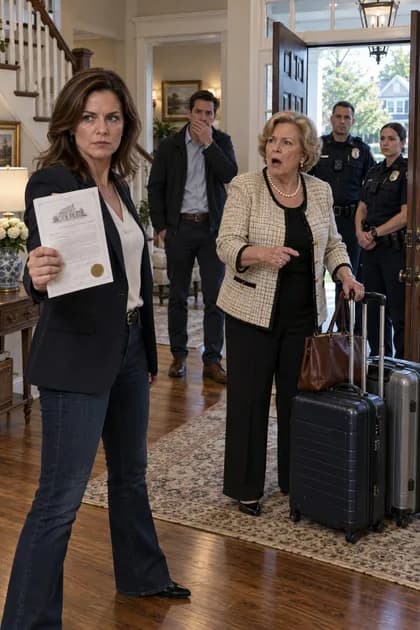
Twelve minutes before my mother grabbed my four-year-old daughter and sent her crashing onto the polished floor, she looked me straight in the eye and demanded $180,000.
Chapter 1
THE EASTER DEMAND THAT EXPOSED ASHBOURNE'S NINE-YEAR SECRET
4,890 words
By Wednesday, Judith Mercer would discover something that would shake the foundation of everything she believed about our family.
For nine years, the daughter she dismissed, criticized, and treated like an outsider had been quietly keeping Ashbourne from falling apart.
But even that wasn’t the secret that would eventually make my mother look at me with fear.
My name is Claire Hale.
And the day Judith Mercer underestimated me was the day she began destroying herself.
It happened on Easter Sunday.
Ashbourne looked beautiful that afternoon.
Of course it did.
My mother would have considered anything less a personal humiliation.
White tulips stood perfectly arranged down the center of the long dining table. Sunlight spilled through the tall windows and reflected off polished silver, crystal glasses, and plates that had belonged to the Mercer family for generations.
Everything was elegant.
Everything was controlled.
Everything was exactly the way Judith Mercer
wanted it.
Until she calmly lowered her wineglass and looked at me.
“I need one hundred and eighty thousand dollars by Wednesday.”
For a moment, I thought I had misheard her.
I stared across the table.
“For what?”
Mother didn’t blink.
“The west roof. Masonry. Drainage work near the terrace.”
I waited for more.
Nothing came.
“All by Wednesday?”
“The contractor requires a deposit.”
I looked at her.
“One hundred and eighty thousand dollars is the deposit?”
Her mouth tightened.
“Claire, don’t be vulgar.”
There it was.
Classic Judith Mercer.
She could demand six figures from me over Easter lunch and somehow make me the embarrassing one for asking what the money was for.
Cassandra sat farther down the table, quietly watching.
My sister had perfected the same expression Mother wore whenever I questioned anything—a faint look of irritation mixed with pity, as though I were an inconvenient person who
had somehow failed to understand the rules everyone else had been born knowing.
Mother folded her hands neatly in front of her.
“Consider it a small return on everything this family has given you.”
That sentence hit harder than I wanted it to.
Because for one humiliating second, at thirty-eight years old, I actually searched my memory for the debt she seemed so certain I owed.
College?
Dad had paid for it.
And I had scholarships.
My wedding?
Graham and I had covered most of it ourselves.
My business?
I had built it from nothing.
Our house?
Ours.
No Mercer money.
No family trust.
No secret gift.
And Ashbourne?
That was almost funny.
Because Ashbourne was the one thing nobody sitting at that table understood.
Especially Mother.
For nine years, while Judith dismissed my preservation firm as my “charming little occupation,” my company had quietly paid Ashbourne’s delinquent property taxes.
We had also covered emergency conservation expenses when the estate desperately needed them.
Whenever something had gone wrong—something serious enough to threaten the property—money had appeared.
Mother believed it came from an anonymous preservation foundation.
Cassandra believed the same thing.
Neither of them had ever bothered looking very closely.
And neither of them knew the truth.
The foundation money had been coming from me.
For nine years.
Quietly.
Without thanks.
Without recognition.
Without my mother even realizing that the daughter she considered least useful was one of the only reasons she could still sit beneath those high ceilings and pretend Ashbourne was untouchable.
And inside my purse, resting only a few feet from Judith’s chair, was a cream-colored envelope.
Inside it were the documents that would end all of that.
I had brought them with me that afternoon.
Until that moment, I hadn’t been certain what I was going to do.
Then a small voice beside me interrupted my thoughts.
“Mommy, look.”
I turned.
Elsie.
My four-year-old daughter.
She was sitting quietly beside me, her little legs barely reaching the edge of the chair.
Near her bread plate was a decorative green wooden egg painted with delicate gold vines and tiny glass stones.
It was exactly the kind of object my mother filled Ashbourne with—beautiful, expensive-looking, and apparently more important than the people standing near it.
Elsie leaned forward.
She reached toward the egg with one finger.
Mother moved instantly.
“Don’t.”
Her hand shot across the space between them.
She grabbed Elsie by the forearm.
Hard.
Everything happened so quickly that for a fraction of a second, nobody reacted.
Then Mother pulled her backward from the chair.
The wooden legs scraped violently across the polished floor.
Elsie lost her footing.
Her hip struck first.
Then her hand.
The sound of her tiny body hitting that hard floor stopped my heart.
And then she cried.
“Mother!”
I was out of my chair before I even realized I had moved.
I dropped beside Elsie and gathered her into my arms.
Behind me, another hand grabbed my sleeve.
Cassandra.
“Don’t turn this into another performance,” she snapped. “Mother told you to control her.”
I looked at the hand gripping me.
Then at my sister.
“Get your hand off me.”
She hesitated.
I tore my arm free.
Elsie wrapped both arms tightly around my neck.
Her whole body was trembling.
“I didn’t break it,” she gasped through her tears.
I held her closer.
“I know.”
“I only touched it.”
“I know, baby.”
Her face pressed against my shoulder.
Then she whispered something so softly I almost didn’t hear it.
“Did I ruin Easter?”
That was it.
Not the money.
Not the insults.
Not thirty-eight years of being told I was too emotional, too difficult, too independent, too sensitive, too much whenever I refused to become exactly what Judith Mercer wanted.
That question broke something in me.
Or maybe it finally freed something.
I slowly looked up at my mother.
She hadn’t moved from her chair.
She didn’t kneel beside her granddaughter.
She didn’t apologize.
She didn’t ask whether Elsie was hurt.
She didn’t even look ashamed.
Instead, Judith Mercer straightened her shoulders and said coldly,
“Take her home. Neither of you knows how to behave in this house.”
For thirty-eight years, words like that had worked on me.
They had made me explain myself.
Apologize.
Try harder.
Stay quieter.
Prove that I deserved a place at the table.
But this time?
Something inside me went completely still.
I reached for Elsie’s stuffed rabbit lying beside her chair.
My fingers closed around the soft fabric.
Hidden underneath it was a small emergency button.
Graham had insisted on putting it there months earlier.
At the time, I had thought he was being overly cautious.
Now my thumb found it.
And pressed.
Once.
No one at the table noticed.
I lifted Elsie into my arms.
Then I reached for my purse.
That was when Mother’s expression changed.
Her eyes immediately dropped toward the opening of the bag.
Toward the cream envelope inside.
“The renewal documents?” she asked.
I followed her gaze.
“Yes.”
A subtle wave of relief passed over her face.
Of course.
She thought I had come to Easter lunch prepared to sign everything.
To continue everything.
To quietly protect Ashbourne for another term while she treated my husband as an afterthought, my daughter as an inconvenience, and me as an endless source of money she didn’t have to respect.
I reached into my purse.
My fingers closed around the cream envelope.
I pulled it out.
Mother watched me carefully.
Cassandra did too.
For one second, I considered placing it beside Judith’s plate.
Just setting it there.
Letting her open it while the Easter flowers were still fresh and the wine was still cold.
Then I looked down at Elsie.
Her cheek was wet against my shoulder.
I slid the envelope back into my purse.
Mother frowned.
“What are you doing?”
I closed the bag.
“You’re right.”
Her eyes narrowed.
“About what?”
I shifted Elsie higher against me and picked up her stuffed rabbit.
Then I looked straight at Judith Mercer.
“We don’t belong at this table.”
Across the room, Cassandra smiled.
Small.
Satisfied.
Triumphant.
She thought Mother had finally put me in my place.
She thought I was leaving Ashbourne humiliated.
She thought they had won.
Neither of them understood what was inside the cream envelope I was carrying out of that house.
Neither of them knew what pressing that hidden button had just set into motion.
And neither of them had any idea that by Wednesday, the most expensive secret in Ashbourne would no longer be mine.
By the time Graham’s car pulled away from Ashbourne, Elsie had stopped crying.
I hadn’t.
Not where she could see me.
My phone buzzed before we reached the main road.
MOTHER.
I ignored it.
Then Cassandra called.
I ignored that too.
A third notification appeared.
This one was from Daniel Reeves, the attorney who handled the preservation trust.
Emergency signal received. Are you safe?
I typed back one word.
Yes.
Then another message arrived.
Do you want me to proceed?
I looked at Elsie sleeping against Graham’s shoulder, still clutching her stuffed rabbit.
For nine years, I had protected Ashbourne because it had belonged to my father before it became my mother’s throne.
I had paid the taxes.
Covered emergency repairs.
Negotiated with creditors.
And quietly prevented the estate from being seized twice.
Judith thought my signature in that cream envelope would renew the arrangement.
She was wrong.
The documents were termination papers.
At 9:03 Monday morning, Daniel filed them.
At 9:17, the bank contacted my mother.
At 9:42, Cassandra called me eleven times.
And at 10:06, Mother finally left a voicemail.
Her voice no longer sounded angry.
It sounded frightened.
“Claire… what have you done?”
I listened to it twice.
Then Daniel called.
“Claire, there’s something else you need to know about Ashbourne.”
I sat upright.
“What?”
He paused.
And when he finally answered, I understood why my mother had demanded exactly $180,000.
“The contractor never asked her for that amount.”
I said nothing.
Daniel continued.
“I pulled the notices that came in after we filed the termination. Judith took out a short-term bridge loan ten weeks ago.”
My grip tightened around the phone.
“How much?”
“One hundred and eighty thousand dollars.”
For a few seconds, all I could hear was the low hum of the air conditioner in my office.
“The exact amount?”
“Almost to the dollar. The note matures Wednesday.”
I closed my eyes.
So there had never been a $180,000 roof deposit.
There had been a debt.
And Mother had expected me to erase it before anyone noticed.
“What was the money used for?”
“That part is messy.”
“Daniel.”
“Operating expenses. Staff. Insurance. Landscaping. Two overdue vendor accounts. A private event invoice. She’s been using short-term money to keep the estate functioning.”
I leaned back in my chair.
Ashbourne had always been Mother's masterpiece.
She didn't merely live there.
She performed there.
The flowers had to be fresh.
The silver polished.
The hedges cut.
The west lawn perfect.
Guests had to believe that the Mercer family still possessed the effortless wealth of three generations ago.
But effortless wealth had never existed.
Not anymore.
Daniel lowered his voice.
“There’s something worse.”
I waited.
“When she applied for the loan, she listed the preservation funding as recurring guaranteed support.”
My stomach turned.
“She couldn’t do that.”
“No.”
“She knew those payments were discretionary.”
“She apparently assumed the renewal was automatic.”
Of course she did.
For nine years, I had never allowed Ashbourne to suffer the consequences of Judith’s decisions.
Why would she imagine the tenth year would be different?
“She used my money to qualify for a loan?”
“Not your name. She still doesn’t know who the funder is. She described it as established preservation income and provided the previous payment history.”
“And now that I terminated it?”
“The lender wants proof of renewal or full payment.”
“By Wednesday.”
“Exactly.”
I stared through my office window.
Across the room, framed photographs from projects my firm had completed covered one wall—an old courthouse, a railroad station, two Victorian homes, a church that had nearly been demolished before we found financing.
Buildings worth saving.
That was what I did.
I saved structures.
Somewhere along the way, I had confused saving Ashbourne with saving my mother from every consequence Ashbourne created.
“Do not pay them anything,” I said.
“I wasn’t planning to.”
“And don't extend the foundation agreement.”
“I already filed the nonrenewal.”
“Good.”
Daniel was silent for a moment.
Then he said, “Claire, you understand what happens next?”
“Yes.”
Ashbourne would finally have to survive on Judith Mercer’s money.
And Judith Mercer did not have enough.
That afternoon, I took Elsie to her pediatrician.
Her wrist wasn’t broken.
Her hip was badly bruised.
When the doctor asked how it happened, I told the truth.
I didn’t soften it.
I didn’t say Elsie had slipped.
I didn’t say there had been an accident at Grandma’s house.
I said, “My mother grabbed her and pulled her out of a chair.”
The doctor documented everything.
For years, I had translated Judith's behavior into gentler language so other people wouldn't think badly of her.
That stopped too.
At 4:18 that afternoon, Mother arrived at my office.
My receptionist called upstairs.
“Claire? There’s a Judith Mercer here.”
I almost laughed.
“A Judith Mercer?”
“She says she’s your mother.”
“She is.”
“She says this is urgent.”
“I’m sure she does.”
I walked into the conference room five minutes later.
Mother was standing beside the windows.
No coat.
No handbag on the table.
No polite smile.
That alone told me how frightened she was.
She turned the moment I entered.
“You embarrassed me.”
No hello.
No question about Elsie.
Of course.
I closed the door.
“The bank called me as if I were some delinquent borrower.”
“You are a delinquent borrower.”
Her face hardened.
“You had Daniel file something this morning.”
“Yes.”
“You terminated the preservation arrangement.”
“Yes.”
“You had no authority to do that without discussing it with me.”
“It was my arrangement.”
Her eyebrows drew together.
“What do you mean, yours?”
I watched her carefully.
For nine years, I had imagined this moment hundreds of times.
Sometimes I thought I would enjoy it.
I didn’t.
Mostly, I felt tired.
“The foundation money came from Hale Preservation.”
She stared at me.
I waited.
Nothing.
So I said it more plainly.
“My company.”
Her lips parted.
“No.”
“Yes.”
“No, the funding came from the Ashbourne Preservation Initiative.”
“A fund administered through my company.”
Her face changed.
Not all at once.
First confusion.
Then disbelief.
Then calculation.
I watched her mentally replay nine years.
The tax notices that disappeared.
The emergency stonework.
The boiler replacement.
The drainage stabilization.
The insurance shortfall.
The winter the western chimney nearly collapsed.
Every time Ashbourne had reached the edge, someone had caught it.
Me.
“How much?” she asked.
I almost smiled at the question.
Not who knew.
Not why I had done it.
Not even how long.
How much?
“Over nine years?”
She nodded.
“One million, two hundred and forty thousand dollars.”
Mother sat down.
Actually sat.
For the first time in my life, Judith Mercer looked small in a room with me.
“That’s impossible.”
“Daniel has the records.”
“Why would you do that?”
“Because Dad loved Ashbourne.”
Her eyes lifted.
“And because I thought preserving something he loved meant preserving something for all of us.”
I paused.
“I was wrong.”
Her expression sharpened again.
“If you had that kind of money available, then this entire spectacle is ridiculous. Pay the bank.”
“No.”
“Claire.”
“No.”
“It is one hundred and eighty thousand dollars.”
“I know.”
“You just told me you’ve spent more than a million.”
“Yes.”
“Then what difference does another hundred and eighty make?”
There it was.
The sentence that ended any remaining doubt.
I leaned both hands against the conference table.
“It makes the difference between generosity and obligation.”
She stared at me.
“You grabbed my daughter hard enough to bruise her because she touched a wooden egg.”
Mother exhaled impatiently.
“Oh, for God's sake. I did not hurt that child.”
“I have a medical report that says otherwise.”
“She fell.”
“Because you pulled her out of a chair.”
“She was misbehaving.”
“She is four.”
“And you have always been far too indulgent with her.”
I straightened.
“This conversation is over.”
Mother stood.
“You think because you’ve made some money restoring houses you can threaten me?”
“No.”
I picked up the folder Daniel had sent to my office.
“I think because I finally stopped spending that money on you, you can no longer pretend you don’t need me.”
She looked at the folder.
For the first time, I saw it.
Fear.
Not because I had become powerful overnight.
Because I had always possessed the one thing Judith depended on most.
And she had never bothered to find out where it came from.
I slid the bank summary across the table.
“The roof deposit is $37,800.”
Mother’s gaze froze.
I tapped the next page.
“The bridge note is $180,000.”
Silence.
“You lied to me.”
Her chin lifted.
“I simplified a private financial matter.”
“You asked me for $180,000 under false pretenses.”
“I was protecting Ashbourne.”
“So was I.”
“That house is your family legacy.”
“No. It became your excuse.”
Her eyes flashed.
“You have no idea what it costs to maintain that property.”
I stared at her.
“I paid the bills.”
That finally silenced her.
For several seconds, neither of us spoke.
Then she said quietly, “What am I supposed to do?”
It might have moved me once.
That frightened note in her voice.
For decades I had been trained to hear fear from my mother as a command.
Fix it.
Pay it.
Apologize.
Make the uncomfortable thing disappear.
This time, I answered the question.
“Meet with Daniel and the lender on Wednesday.”
“And then?”
“You decide what you can actually afford.”
She stared at me as if I had started speaking another language.
Tuesday was worse.
Cassandra sent me twenty-three messages.
The first six were angry.
YOU’RE PUNISHING MOM OVER AN ACCIDENT.
Then accusatory.
YOU ALWAYS RESENTED ASHBOURNE.
Then frightened.
THE BANK IS TALKING ABOUT DEFAULT.
Finally:
PLEASE CALL ME.
I called.
She answered on the first ring.
“Fix this.”
Not hello.
I almost laughed.
“You and Mother really do practice together.”
“This isn't funny, Claire.”
“I agree.”
“Do you know what happens if the bank forces a sale?”
“Yes.”
“Then how can you be so calm?”
“Because I am not the borrower.”
Cassandra inhaled sharply.
“You're enjoying this.”
“No.”
“You've wanted to humiliate us for years.”
“Cassandra, I spent $1.24 million making sure neither of you was humiliated.”
Silence.
Then, very softly:
“What?”
So Mother hadn't told her.
I explained.
Not everything.
Just enough.
When I finished, Cassandra didn't speak for several seconds.
Then she said, “That money was you?”
“Yes.”
“All of it?”
“Yes.”
“But Mother said—”
“I know what Mother said.”
Cassandra went quiet again.
I could almost hear the architecture of our family shifting in her head.
Then she asked the question I had been waiting for.
“Why didn't you tell us?”
“Because I didn't want gratitude.”
“That doesn't make sense.”
“It made sense to me at the time.”
“What did you want?”
I looked toward the family photograph on my desk.
Graham.
Elsie.
Me.
All three of us laughing because the photographer had sneezed during the picture.
“Peace.”
Cassandra didn't have an answer for that.
Wednesday morning, we met at Ashbourne.
I had asked Graham to stay with Elsie.
Not because I was afraid of Mother.
Because Elsie had already spent enough time inside that house learning that adults could behave badly and still demand a child's apology.
Daniel sat beside me at the long dining table.
The Easter tulips were still there.
They had started to bend at the stems.
Mother sat opposite us.
Cassandra beside her.
Two days earlier, that arrangement would have made me feel outnumbered.
It didn't anymore.
Daniel opened the meeting.
“The lender has agreed to a thirty-day cure period rather than accelerating immediately.”
Mother visibly relaxed.
“Then there is no emergency.”
Daniel didn't react.
“There is still a default.”
She waved one hand.
“Which Claire can cure.”
“No,” I said.
Mother looked at me.
Daniel continued.
“The preservation support has ended. The lender will not treat it as recurring income going forward.”
Mother turned to him.
“You people have accepted those funds for nine years.”
“The lender accepted your representation of those funds. Claire never guaranteed them.”
Cassandra looked at Mother.
“You told them the foundation money was guaranteed?”
Mother didn't answer.
“Mom?”
“I had every reason to believe it would continue.”
“Because Claire always paid?” Cassandra asked.
Mother's gaze snapped toward her.
“Don't be naïve. Everyone in this family has benefited from that house.”
I almost responded.
Then I stopped myself.
Cassandra did it for me.
“I didn't know Claire was paying for it.”
Mother's mouth tightened.
“You knew it required support.”
“That isn't the same thing.”
For the first time I could remember, Cassandra wasn't standing beside Mother automatically.
It wasn't reconciliation.
It was simply the first crack.
Daniel placed three documents on the table.
“Judith has options. She can obtain replacement financing independently. She can sell sufficient liquid assets to cure the note. Or she can market Ashbourne.”
“Absolutely not.”
Mother's answer came instantly.
Daniel remained calm.
“There is one additional possibility.”
Mother looked at him.
“Hale Preservation is prepared to make a formal offer for the property at independent appraised value.”
Her face went white.
Then she looked at me.
“You.”
“Yes.”
“You intend to take my home.”
“No.”
I kept my voice level.
“I intend to make an offer. You can reject it.”
“And let the bank take it?”
“You can refinance.”
“You know I can't.”
There was the truth.
Finally.
Not dressed in silver.
Not hidden behind tulips.
Not called a roof repair.
Just the truth.
Mother could not afford Ashbourne.
I could.
“You planned this,” she whispered.
“No.”
I looked around the dining room.
“I planned to keep paying for another year.”
That hurt more.
I saw it.
“I brought the renewal documents on Sunday.”
Mother's eyes dropped toward my purse as if the cream envelope were still inside it.
“I was going to sign them.”
“Then why didn't you?”
I stared at her.
“Elsie.”
Mother looked away.
One word.
That was all it took.
She knew.
Maybe she had known from the moment Elsie hit the floor.
Maybe that was why she had watched my purse so closely.
Cassandra spoke quietly.
“Mom, did you ever even apologize?”
Mother's jaw tightened.
“This is not about a child's tantrum.”
“No,” I said. “It stopped being about the egg the second she asked me if she ruined Easter.”
Mother's expression flickered.
I continued.
“You know what the worst part was?”
She said nothing.
“She wasn't afraid because she was hurt. She was afraid she had disappointed you.”
My voice nearly broke then.
I let it.
“I spent thirty-eight years feeling exactly the same way.”
No one moved.
Daniel lowered his eyes to give me the dignity of pretending he wasn't listening.
I looked directly at my mother.
“You taught me that love meant staying useful enough not to be rejected.”
Her eyes glistened.
“But I'm not teaching that to my daughter.”
For once, Judith Mercer had no answer ready.
The meeting ended forty minutes later.
She did not accept my offer.
Not that day.
For the next three weeks, Mother fought reality with the same determination she had once used to fight me.
She contacted lenders.
She tried to restructure the bridge note.
She considered selling several pieces of furniture.
She reduced staff.
She canceled events.
None of it solved the underlying problem.
Ashbourne consumed more money every month than she had available.
The house had been surviving because I had been subsidizing the difference.
Once that ended, mathematics did what I had never managed to do.
It made Judith listen.
Five weeks after Easter, Daniel called me.
“She's ready.”
The sale took another two months.
I did not buy Ashbourne for one dollar.
I did not trick Mother out of her inheritance.
I did not use a hidden clause to steal the property.
Hale Preservation purchased it at the value established by two independent appraisers.
The bank was paid.
The bridge note disappeared.
The remaining valid debts were settled.
Mother received what was left.
Enough to buy a comfortable townhouse and live well if she stopped pretending she was still supporting an estate built for another century.
Ashbourne entered a permanent preservation program.
Part of the property became our firm's headquarters.
Several ground-floor rooms opened for historical tours and preservation workshops.
The gardens remained gardens.
The stonework remained intact.
Dad's library stayed exactly where it had always been.
The house survived.
But the performance ended.
Cassandra and I didn't suddenly become best friends.
Real families don't repair thirty years in a montage.
She did, however, call me one evening about a month after the sale.
“I owe you an apology.”
I sat quietly.
“For Easter?”
“For longer than Easter.”
That surprised me.
She inhaled.
“I spent years agreeing with Mom because it was easier than becoming the person she was angry at.”
I understood that more than I wanted to.
“That doesn't excuse it,” she added.
“No.”
“I know.”
It wasn't forgiveness.
But it was honest.
And honesty was a better beginning than anything we had shared in years.
Mother was different.
For nearly four months, we barely spoke.
I required one boundary.
She would not be alone with Elsie.
Not until I decided otherwise.
Mother called it cruel.
I called it parenting.
She threatened not to see us at all.
I told her that was her decision.
For the first time, I didn't chase her when she withdrew.
Three months later, a letter arrived.
Handwritten.
No expensive stationery.
No family crest.
Just my name on an ordinary envelope.
Claire,
I have spent most of my life believing that keeping Ashbourne meant keeping this family together.
I can see now that I sometimes protected the house when I should have protected the people inside it.
What happened with Elsie was wrong.
I am sorry.
I read those five words several times.
What happened with Elsie was wrong.
Judith Mercer had probably never written a harder sentence.
I didn't rush to forgive her.
I didn't pretend one letter erased everything.
But I kept it.
The following spring, nearly a year after the Easter when everything changed, we hosted a small preservation open house at Ashbourne.
Elsie came with Graham.
She was five now.
Louder.
Braver.
Still carrying a stuffed rabbit sometimes, although the emergency button was gone.
We walked through the old dining room together.
The long table remained, but the formal place settings were gone.
No crystal.
No silver arranged with military precision.
A group of children had spent the morning making paper flowers for a restoration workshop.
Glue sticks and crayons covered one end of the table.
Elsie stopped near the cabinet where the green wooden egg had once been displayed.
During the estate inventory, an appraiser had examined it.
Mother had nearly injured her granddaughter protecting an object she treated like a priceless antique.
It turned out to be a modern decorative reproduction.
Worth less than eighty dollars.
I hadn't told Elsie that.
There was no reason to.
Instead, I placed a plain unfinished wooden egg in front of her beside a tray of paints.
She looked up at me.
“Can I paint it?”
“You can.”
“Any color?”
“Any color.”
She chose purple.
Then blue.
Then yellow.
Within ten minutes, paint covered the egg, the paper beneath it, three of her fingers, and a small spot on the table.
She froze.
Her eyes jumped to mine.
For one terrible second, I saw the old question trying to form.
Did I ruin it?
I smiled.
“Looks like we need a wet cloth.”
Her shoulders relaxed.
“That’s it?”
“That’s it.”
She grinned.
Then she went back to painting.
I stood there watching her.
All those years I thought I had been saving Ashbourne because buildings mattered.
They do.
History matters.
Craftsmanship matters.
The things people build and leave behind matter.
But buildings are supposed to shelter people.
Not rule them.
Not frighten them.
Not become more precious than the child sitting at the table.
Later that afternoon, I stepped outside onto the terrace.
The drainage had finally been repaired.
The west roof had been repaired too.
The actual deposit had been nowhere near $180,000.
Graham joined me and slipped his hand into mine.
Through the open doors, I could hear Elsie laughing.
Not whispering.
Not asking whether she belonged.
Laughing.
For nine years, I had believed the secret I was keeping was that I had saved Ashbourne.
It wasn't.
The real secret was how much of myself I had been spending to stay accepted by people who treated my love like an automatic payment.
The day I stopped paying wasn't the day I destroyed my family.
It was the day I finally gave us a chance to become something better than what we had been.
Ashbourne was still standing.
So was I.
But only one of us had finally learned that being preserved and being trapped were not the same thing.
THE END.
Chapter complete
You have reached the end of this chapter.
Continue reading
Find your next story
A few more worlds to get lost in after this chapter.