“You Have No Idea Who You Just Messed With, Piccola” Whispered The Mafia Boss
The Night It All Began
This wasn’t supposed to be happening.
Chapter 1
“You Have No Idea Who You Just Messed With, Piccola” Whispered The Mafia Boss
The Night It All Began
This wasn’t supposed to be happening.
There is a sentence I should have taken seriously the first time I heard it. He whispered it in my ear the way someone shares a private secret, but it was no secret at all.
It was a warning.
“You have no idea who you just messed with, piccola.”
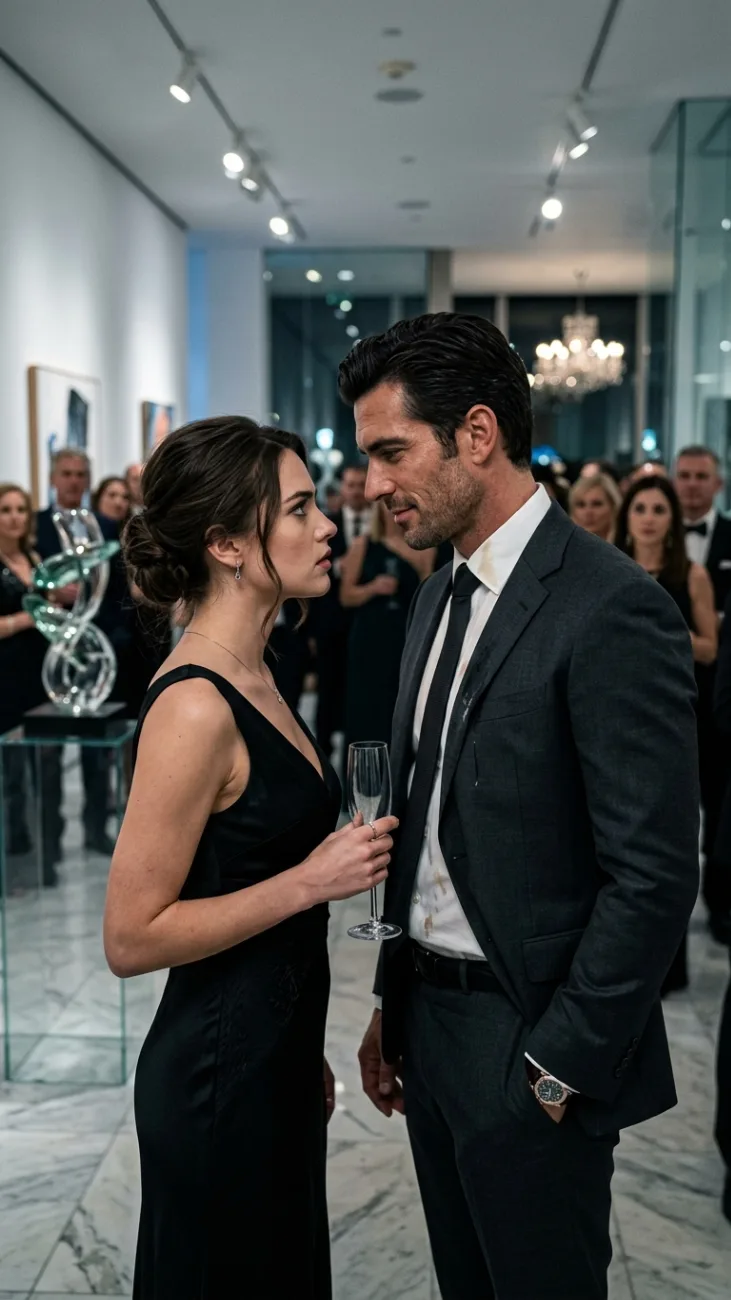
I had just spilled champagne on the most expensive suit I had ever seen in my life. And the man wearing that suit was looking at me as though I were the most fascinating and most inconvenient thing to cross his path in years.
I should have apologized.
I should have disappeared.
Instead, I lifted my chin and said, “You should watch where you stand.”
Then I walked away.
He let me go that one night.
After that, Lorenzo Varrick never let anything go again.
My name is Sloan Whitmore, and I did not come to New York City for champagne,
art, or dangerous men with quiet voices.
I came for my father.
Two years earlier, Thomas Whitmore had vanished from a hotel in Boston while consulting for a private legal firm tied to a name I kept seeing in his documents: Meridian Consortium.
The police had called it voluntary disappearance. My mother had called it grief. I called it impossible.
My father was the kind of man who labeled power cords, kept grocery receipts in dated folders, and once drove forty minutes back to a gas station because the cashier had accidentally given him five dollars too much change. He did not vanish without leaving a trace.
Unless someone made him.
That was why I was standing inside the Alden Gallery in Manhattan on a Thursday night, wearing a borrowed black dress from my best friend Tatum Reed and shoes that were actively trying to murder me.
The gallery was
all white walls, polished concrete, champagne flutes, and people who looked like they had never checked a price tag in their lives. A glass sculpture hung above the center of the room like frozen rain. Somewhere behind me, a woman laughed with the brittle sound of expensive boredom.
Tatum stood beside me, holding a glass of champagne and pretending we belonged.
“To the left,” she murmured. “Woman in emerald silk. Necklace worth more than my student loans. Do not stare directly at her or you’ll turn into a decorative statue.”
“Tatum.”
“To the right,” she continued, “man in gray suit, emotionally absent, physically present, probably here because his wife threatened divorce if he skipped one more cultural event.”
“You’re doing sports commentary at an art opening.”
“I’m doing observational journalism.”
I needed her because Tatum knew New York better than I did. She had the confidence of someone who could
walk into a private fundraiser with seventeen dollars in her checking account and make everyone assume she owned the building.
I had no such talent.
I moved carefully past the sponsor table, phone hidden in my hand. There were thick cream programs arranged beneath a vase of white roses. Names printed in silver. Foundations. Private collections. Corporate donors.
Then I saw it.
Meridian Consortium.
Beside the name was a simple logo: three parallel black lines.
My pulse changed.
I lifted my phone and took a picture. One silent click. One more piece of the puzzle.
I had just slipped the phone into my clutch when I turned too fast.
The collision was immediate and catastrophic.
Champagne flew from my glass in a bright arc and struck the chest of the man standing behind me.
For one suspended second, the room went still.
Not dramatically. Rich people do not freeze dramatically. They pause with surgical discretion, conversations thinning, eyes cutting sideways, glasses held halfway to mouths.
I looked up.
He was tall, dark-haired, and still in a way that made every movement around him seem unnecessary. His suit was charcoal, perfectly cut, now ruined across the front by a spreading stain of champagne.
He did not curse.
He did not raise his voice.
That somehow made it worse.
His eyes moved over my face, not with anger exactly, but with a kind of controlled curiosity that felt more dangerous.
“I—” I began.
Apologize, Sloan.
Say sorry.
Leave.
Instead, panic chose arrogance.
“You should watch where you stand.”
Something shifted in his expression.
Not a smile. Not yet.
He leaned closer, just enough that his voice belonged only to me.
“You have no idea who you just messed with, piccola.”
The word was soft.
The warning was not.
I turned my back on him and walked away before my knees could prove I was terrified.
Outside, Tatum grabbed my arm.
“Sloan,” she said, breathless. “No.”
“I know.”
“You spilled champagne on him.”
“I was there.”
“And then you blamed him.”
“I remember.”
“Do you know who that was?”
I looked back through the glass doors.
The man was still inside, surrounded now by people pretending not to hover. He was not looking at his ruined suit.
He was looking at me.
“No,” I said.
Tatum swallowed.
“I don’t either,” she whispered. “But everyone in that room did.”
Part 2: The Man Who Didn’t Disappear
Three days later, I found the three-line symbol again.
It was in the New York City Municipal Archives, stamped faintly in the corner of a property transfer from 1991. The file had been miscataloged under a legal services subsidiary that no longer existed, the kind of clerical accident that only mattered to someone desperate enough to look.
I sat there with cotton gloves, a cracked notebook, and a heartbeat too loud for a public research room.
Meridian Consortium had not appeared from nowhere.
Before Meridian, there had been Halcyon Legal Holdings.
Before Halcyon, a shell company called Eastbridge Civic Development.
Before that, only the three lines.
Always three lines.
And next to one of those old contracts was my father’s signature.
Not as a witness.
Not as an employee.
As a protected consultant.
I photographed every page with trembling hands.
That night, in my temporary Brooklyn apartment, I pinned the copies to the wall beside everything else: my father’s last hotel receipt, an email with two deleted attachments, a blurry security image from Boston, the Alden Gallery program, and now the old contract.
At the center, I wrote one question in red ink.
What did Dad find?
The answer came closer the next afternoon.
I was at a coffee shop near Columbia, laptop open, documents spread around me in controlled chaos, when every instinct I had sharpened at once.
I looked up.
He was sitting at the back table.
The man from the gallery.
Different suit. Same stillness.
He had a coffee in front of him he had not touched. His gaze rested on me as if he had been waiting for the exact second I would notice.
I closed my laptop.
He did not move.
I packed my papers.
He still did not move.
I left my half-finished coffee behind and walked out into the cold brightness of Broadway.
Through the window, I looked back.
He was still sitting there.
Still watching.
That night, Tatum listened with a fork suspended over takeout noodles.
“Let me understand,” she said. “The man you humiliated at the gallery appeared at your coffee shop and just sat there?”
“Yes.”
“Did he speak to you?”
Chapter complete
You have reached the end of this chapter.
Continue reading
A few more worlds to get lost in after this chapter.