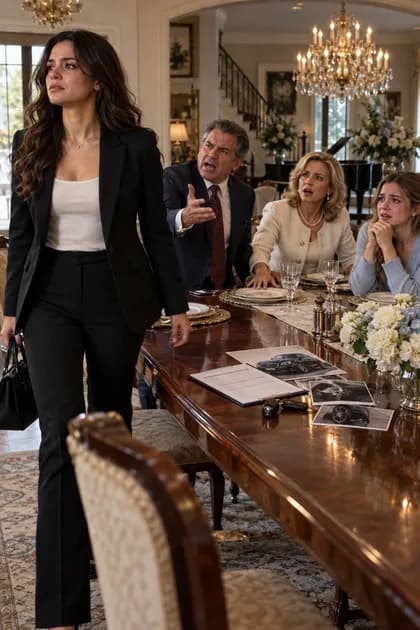
He Rear-Ended Her, Threw Cash on Her Hood, and Said, “I’m Not Interested” — Three Hours Later, She Walked Into His Family’s Penthouse as the Bride They’d Already Chosen for Him

Part 1
The first time Adrian Cole met the woman his parents had chosen for him, he rear-ended her black Mercedes in Midtown Manhattan, dropped a stack of cash on her hood, and assumed the matter was finished.
When she asked for something simpler and infinitely more difficult, an apology, he looked at her like he looked at every problem money had ever solved and said the worst possible thing.
“I’m not interested.”
Three hours later, she walked into his parents’ Park Avenue penthouse in a black coat, knee-high boots, a tattoo of dark wings rising from the side of her neck, and eyes cool enough to freeze a room.
That was how Adrian learned that the woman he had just insulted on Lexington Avenue was Sloane Mercer, the daughter of the family his father had selected for a merger disguised as a marriage.
And that was how Sloane learned the arrogant man who thought cash could replace decency was the one she was expected to stand beside at an altar in three weeks.
At 8:20 that morning, Adrian had still believed his life was predictable.
He was
late, which irritated him more than it should have. Adrian Cole did not like lateness, surprises, inefficiency, or anything that suggested the world might move without first asking his permission. At thirty-two, he ran Cole Holdings like a man trying to outpace gravity itself. Investors trusted him, his board feared disappointing him, and strangers mistook his control for confidence.
The honk behind him came sharp and impatient. Adrian barely registered it. He was already reviewing the rest of his day in his mind: one merger call, two legal revisions, a dinner at his parents’ place that he had no real interest in attending, and then a red-eye to California he was considering canceling.
Then the car in front of him slowed at the light.
He braked hard, but not hard enough.
Metal met metal with a sickening crunch.
Adrian’s jaw clenched. Not panic. Irritation.
He stepped out onto the street,
straightened his charcoal coat, and walked toward the car he had hit. The damage wasn’t catastrophic. A cracked taillight. A dented bumper. Nothing that couldn’t be handled in a day.
The driver’s door opened.
He stopped.
She emerged like she had all the time in the world.
Black wool coat. Short dark dress beneath it. Long legs in fitted boots. Pale blonde hair tucked behind one ear. Oversized sunglasses hid half her face, but nothing about her looked uncertain. And above the collar of her coat, just visible against her skin, was a tattoo of black wings—sharp, elegant, spreading toward her jaw.
She glanced at the bumper, then at him.
Adrian, already reaching for his wallet, misread the silence the way powerful men often do.
He pulled out several bills, laid them on the hood of her car, and said, “That should cover it.”
Then he turned away.
“Excuse me.”
Her voice stopped him before he took two steps.
He turned back.
She had removed the sunglasses.
Her eyes were a clear gray, beautiful in a way that wasn’t soft. They were direct, unreadable, and unamused.
He sighed. A mistake. A reflex.
“I’m not interested,” he said.
For one stunned beat, the city seemed to pause around them.
Then she picked up the cash and threw it at his chest.
The bills slid down his coat and fluttered onto the pavement.
“I don’t want your money,” she said, and her voice had changed—lower now, colder, edged. “I wanted an apology.”
Adrian stared at her.
She stepped closer.
“I know men like you. Men who move through the world like everyone else is either a delay or a decoration. You hit my car, looked at me, decided what kind of woman I was, and figured cash would be enough.” Her chin lifted. “You didn’t even think to say you were sorry.”
He opened his mouth, but there was nothing in it.
“That,” she said, “is what irritates me.”
Then she put her sunglasses back on, got into her car, and drove away.
Adrian stood in the exhaust and noise of Lexington Avenue with the cash at his feet and the strange, deeply unfamiliar sensation of having been seen too clearly by a stranger.
He bent, picked up the money, and returned to his car.
For the next twenty minutes, he could not stop thinking about her.
Not because she was beautiful, though she was.
Not because she was rude, though she had been.
But because she was right.
By the time he arrived at his parents’ building on Park Avenue, he had already spent too much mental energy on a woman he would never see again.
At least, that was what he thought.
His father, Victor Cole, was waiting in the formal sitting room in a navy suit and the expression of a man to whom punctuality was not merely a preference but a moral position.
“You’re fifty-three minutes late,” Victor said.
“There was an accident.”
Victor’s gaze sharpened. “Are you hurt?”
“No.”
A beat.
“Then sit down.”
His mother, Eleanor, gave him a softer look from the cream-colored sofa near the windows. Across from her sat Richard and Dana Mercer, both polished, wealthy, and visibly tense in the particular way of people trying to look relaxed at an event they are deeply invested in controlling.
Adrian knew the basics. Mercer Biotech had been circling a strategic alliance with Cole Holdings for eight months. The financial upside was real. The social one, according to both families, was elegant. Two old American dynasties. Two heirs. One union that would make the papers in all the right sections.
Adrian had not agreed because he was romantic.
He had agreed because he had been raised by people who believed feelings were best handled privately, after the deal was closed.
“She’s running late,” Dana Mercer said with a brittle smile, glancing toward the foyer for the fifth time in three minutes.
Adrian sat, folded his hands, and wondered what kind of woman arrived late to her own arranged engagement dinner.
The front door opened.
He looked up.
And for the first time in years, Adrian Cole completely lost command of his expression.
Black coat. Black boots. Pale hair. Gray eyes. Wings at the neck.
The woman from Lexington Avenue.
Dana stood quickly. “Sloane, sweetheart—”
Sloane.
The name landed in Adrian’s mind and stayed there.
Sloane Mercer took in the room in one sweep. Her gaze moved over his parents, over her own, and then finally found him.
Something darkened in her eyes.
Not surprise.
Recognition.
Then contempt.
She greeted the room politely. Not warmly, not coldly, but with the kind of trained restraint that suggested she had learned very young how to survive emotionally expensive rooms.
“Adrian,” Eleanor said carefully, “this is Sloane.”
“We’ve met,” Sloane said.
No one spoke.
Victor’s eyes moved from Adrian to Sloane and back again. “Apparently.”
Dinner began under a level of strain no amount of crystal stemware could disguise.
Conversation floated where it had to—business, travel, philanthropy, market conditions, weather in the Hudson Valley where the ceremony was supposed to happen. Dana Mercer filled silences with nervous elegance. Richard Mercer contributed only when required. Victor led. Eleanor smoothed.
Adrian answered when spoken to. So did Sloane.
But Adrian kept watching her.
She barely touched her food. Her posture was perfect. Her face gave away almost nothing. Yet every now and then he caught tiny signs of fracture: the flex of her fingers around her glass, the tight set of her jaw when Dana mentioned the wedding planner, the way her gaze went remote whenever someone referred to the ceremony as “a beautiful solution.”
She was angry. Not theatrically. Not loudly.
She was angry in the way a blade is sharp—quietly, absolutely.
Dessert arrived. So did the confirmation.
Three weeks.
The wedding would be held at the Cole family estate in the Hudson Valley, private and heavily secured, away from photographers and industry gossip. The official press release would focus on the strategic partnership between the two companies and mention the engagement as “a joyful joining of families.”
Adrian found the phrase unbearable.
After dinner, as coats were being collected and farewells arranged, he followed Sloane into the hall.
“Sloane.”
She turned.
He had planned the apology during the elevator ride to his parents’ floor, reshaped it twice during appetizers, and ruined it by waiting too long.
“I owe you—”
“If you’re apologizing because you found out who I am,” she said, “don’t.”
“That’s not why.”
She gave him a look that suggested she did not care to separate his motives into finer categories.
“I don’t need your apology,” she continued. “And I don’t care about this marriage.”
There was something almost frightening in the calmness of her voice.
“I’ll do what’s expected. You’ll do what’s expected. Afterward, we can return to being exactly what we are.”
“And what’s that?”