The hall became so quiet that I could hear my father struggling to breathe.
Chapter 2
The hall became so quiet that I could hear my father struggling to breathe.
General Adrian Cole slowly lowered his hand, but his eyes never left him.
“My name is Adrian Cole,” he said. “Thirty-one years ago, I was a twenty-two-year-old lieutenant who believed bravery meant not being afraid.”
He paused.
“Captain Evans taught me that bravery means being terrified and going back anyway.”
A murmur swept through the guests.
I stared at my father.
Captain Evans.
The title sounded impossible attached to the man who spent Tuesday mornings pruning Mrs. Keller’s roses and Wednesday afternoons mowing the lawns at Oakridge Elementary.
My father had never mentioned the Army.
Not once.
General Cole turned so the entire room could hear him.
“Captain Evans commanded a transport unit during a classified border operation. Our convoy was hit. One vehicle caught fire with seven wounded men trapped inside. Captain Evans had already reached cover when he realized we were missing.”
Cole swallowed hard.
“He went back.”
The general explained that my father entered the burning transport three separate times while ammunition was exploding inside it. He dragged out six soldiers and carried Cole nearly four hundred yards after Cole lost consciousness.
Then my father returned one final time to destroy a case of classified intelligence before enemy forces could capture it.
He suffered burns across his back, shrapnel wounds in his left hip, permanent nerve damage in one hand, and injuries serious enough to end his military career.
Suddenly, a thousand details from my childhood made sense.
The way Dad sometimes gripped the kitchen counter when standing up.
The scars I had glimpsed across his shoulder when I was young.
The nights when thunderstorms woke him and he sat silently in the living room until morning.
I had always believed those scars came from gardening equipment.
General Cole continued.
“The mission remained classified for decades. Captain
Evans was recommended for one of the nation’s highest military honors, but before the process was completed, he disappeared from the veterans system.”
My father finally spoke.
“I didn’t disappear.”
His voice was barely audible.
Everyone leaned closer.
“I came home.”
The general nodded slowly.
“To Elena.”
My father closed his eyes.
At the sound of my mother’s name, his entire body changed.
Cole opened a velvet case containing a silver medal beside a folded presidential citation.
“You refused the ceremony then,” he said. “You refused interviews. You refused compensation beyond your basic disability payment. When the records were finally declassified, several of us tried to find you.”
My father shook his head.
“I didn’t want Maisie growing up around war stories.”
“Why?” I whispered.
He looked at me.
The pain in his eyes told me the answer was bigger than anything the general had said.
“Because your mother asked
me not to.”
Before I could respond, General Cole signaled toward the entrance.
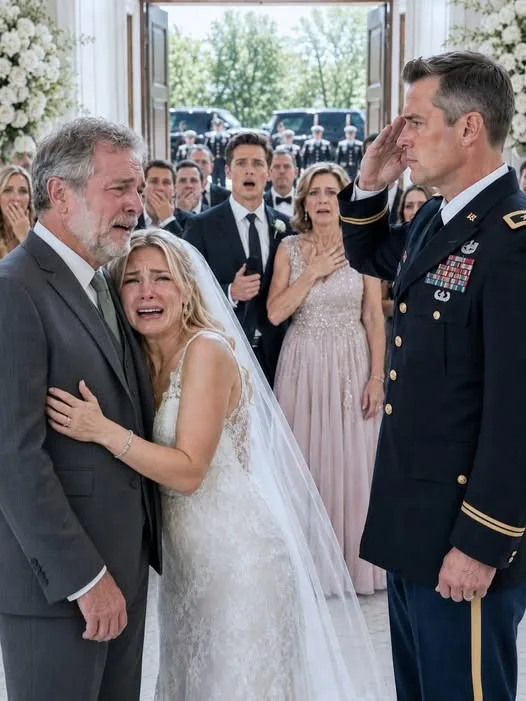
Twelve soldiers walked into the hall and formed two perfect lines.
Every one of them saluted my father.
The gardener.
The man Tristan said cut grass for spare change.
My father covered his mouth and began to cry.
I wrapped both arms around him.
One by one, the guests rose to their feet.
My aunt began clapping first.
Then the neighborhood women.
Then almost everyone in the room.
Everyone except Tristan, Mara, and Victor Vale.
Mara recovered first.
She stepped forward wearing a smile so sudden and artificial that it made my stomach turn.
“Well,” she said, “this certainly changes things.”
I looked at her.
“What things?”
She laughed nervously.
“James is practically family. Obviously, Tristan had no idea about any of this.”
“Not anymore,” I said.
Tristan moved toward me.
“Maisie, emotions are high. I admit I handled this badly.”
“Badly?”
“I was under pressure from my family. We can still discuss the wedding privately.”
He reached for my hand.
I looked down at the engagement ring he had placed on my finger eleven months earlier.
Then I slipped it off.
I put it into his open palm.
“You made your decision publicly,” I said. “I’m accepting it publicly.”
For the first time that afternoon, the applause was for me.
But General Cole did not clap.
He was watching Victor Vale.
And Victor was staring at the exit.
The general reached beneath his arm and removed a sealed gray folder.
“Mr. Tristan Vale,” he said.
Tristan turned slowly.
“Your company recently received the primary subcontract on Phase Two of the Fort Barrington military housing redevelopment.”
Tristan’s face lost color.
“It is an eighty-million-dollar contract,” Cole continued. “My office reviewed procurement records while our investigators were locating Captain Evans.”
Victor interrupted.
“This is completely inappropriate. Whatever business concerns you have should be discussed with our attorneys.”
Cole looked at him.
“They will be.”
Two investigators entered the room.
The general opened the folder.
“Preliminary findings indicate falsified structural certifications, inspectors receiving undisclosed payments, concrete strength reports altered after testing, and substitution of materials below contractual safety requirements.”
Guests who had been whispering about my father twenty minutes earlier were now staring at Tristan.
“That is ridiculous,” Tristan said. “I don’t handle field testing.”
“Your electronic signature approved three of the substitutions.”
“My staff uses my authorization.”
“Then you should explain that to federal investigators.”
Victor suddenly headed toward the side door.
Two officers quietly stepped into his path.
No one touched him.
They did not need to.
He stopped.
Then General Cole reached into the folder again.
This time, he removed an old cream-colored envelope.
My mother’s name was written across the front.
ELENA EVANS.
My father made a sound I had never heard from him before.
Not a gasp.
Not a word.
Something between the two.
“Where did you get that?” he asked.
Cole’s expression changed.
“From evidence recovered during the Vale contract investigation.”
My father stared at Victor.
Victor looked away.
My heart began pounding.
My mother had died when I was nine. Dad had always told me that a mechanical failure caused her car to leave the road during a storm.
General Cole held the envelope carefully.
“Elena contacted an Army oversight office approximately six weeks before her death.”
“Why?” I asked.
The general looked at my father first, as though asking permission to destroy the last ordinary version of my childhood.
Dad’s face had become gray.
Then Cole answered.
“Because your mother discovered that a private supplier was selling defective materials into government construction projects while bribing inspectors to certify them.”
My eyes moved toward Victor Vale.
“No,” Tristan whispered.
Cole continued.
“The supplier was a predecessor company controlled by Victor Vale and his older brother.”
Victor finally spoke.
“That was thirty years ago. None of this proves anything.”
General Cole nodded.
“You are correct.”
For one second, Victor looked relieved.
Then the general added, “Which is why what we found yesterday matters.”
He handed the envelope to my father.
Inside was a copy of an old handwritten statement from my mother and a photograph of a damaged steel support beam.
My father’s knees almost buckled.
He recognized the handwriting immediately.
At the bottom of the statement, my mother had written one sentence in red ink.
If anything happens to me, James must know I was right about Vale.
I looked across the room at the family I had almost married into.
And suddenly our wedding humiliation seemed very small.
General Cole lowered his voice.
“James, your wife’s death was classified as an accident.”
He glanced toward Victor.
“We now have reason to reopen that conclusion.”
Click the blue “PART 3” below to read the next part: 👉 PART 3 👈
Chapter complete
You have reached the end of this chapter.
Continue reading
A few more worlds to get lost in after this chapter.